Qwant vs MetaGer
Qwant vs MetaGer: compare free search with prepaid tokens, result controls, phone apps and data handling. Choose the search setup for your daily queries.
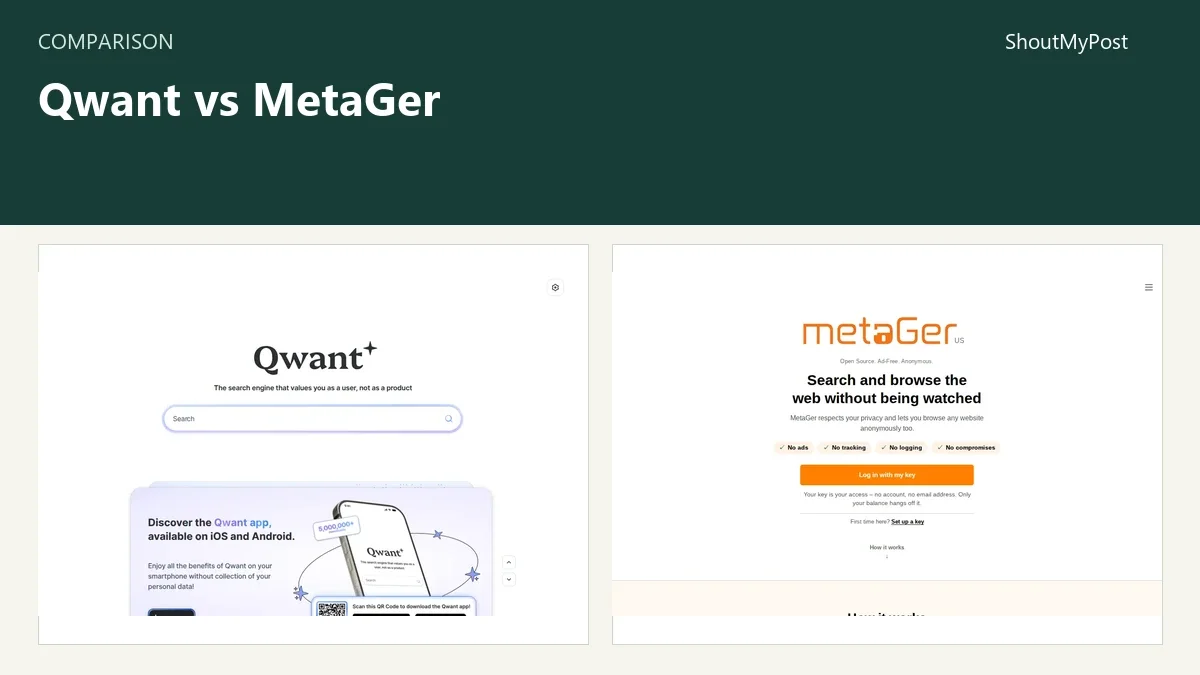
On this page
Qwant wins for most readers who want free everyday search. Pick MetaGer if you're willing to buy search tokens for an ad-free service run by the nonprofit SUMA-EV. The Qwant vs MetaGer decision is mainly about how you fund search and how much control you want over its sources.
The surprising cost detail is that MetaGer can charge for search suggestions too. Its help says suggestions are off by default and different suggestion providers have different costs. Someone who turns autocomplete on should look at that setting before treating a token balance as a simple count of finished searches.
Qwant vs MetaGer at a glance
The source names in this table refer to official pages checked on October 9, 2026. Both services are available through their Qwant listing and MetaGer listing.
| Factor | Qwant | MetaGer | Official source and date checked |
|---|---|---|---|
| Free search | Free, supported by advertising | Paid token key for the current web search offer | Qwant Search terms; MetaGer Prices; Oct 9, 2026 |
| Paid price | No paid plan needed for ordinary Qwant Search | Prepaid packages displayed in euros; no US-dollar figure shown | Qwant Search terms; MetaGer Prices; Oct 9, 2026 |
| Search allowance | No prepaid token meter described for ordinary search | One token per web search at default settings; selected engines affect cost | Qwant Search terms; MetaGer Prices; Oct 9, 2026 |
| Platforms | Browser; iOS and Android apps | Browser; Android app | Qwant Search page; MetaGer Apps; Oct 9, 2026 |
| Main controls | Region, interface language, adult-content filter, Flash Answer | Engine selection, personal blacklist, search within results, anonymous opening | Qwant Search help; MetaGer Main Pages and About Us; Oct 9, 2026 |
| Browser integration | Default-search extension linked from its website | Browser plugin and search-suggestion settings | Qwant settings page; MetaGer Help; Oct 9, 2026 |
| Open source | Full production search-engine source isn't offered on the product page | Published source code; official About Us calls it free and open source | Qwant Search page; MetaGer About Us and GitLab; Oct 9, 2026 |
| Dated documentation | Search help articles updated July 21, 2026 | Privacy statement dated September 28, 2026 | Qwant Search help; MetaGer Privacy; Oct 9, 2026 |
| Operator and hosting | French service; product page says hosted in Europe | SUMA-EV; services run on rented Hetzner hardware | Qwant product page; MetaGer Privacy; Oct 9, 2026 |
| Search-data handling | Policy describes Microsoft result and ad partners, with technical data transfers | Search query goes to partner engines; search results and query held for a few hours | Qwant Privacy Policy; MetaGer Privacy; Oct 9, 2026 |
Price: Qwant starts without a purchase
You can open Qwant and search without buying an allowance. Its advertising help says sponsored results fund the service and are labeled. That's the main reason I recommend it as the first stop for someone who wants to replace a browser default without adding a bill.
MetaGer's Prices page describes a key topped up with tokens. At the default settings, a web search uses one token. Selecting other search services can alter the cost, so a package is a balance to spend, with your settings shaping how quickly you spend it.
MetaGer's prepaid packages are priced in euros. Your payment provider handles the conversion if you pay from a US-dollar account; MetaGer doesn't quote a US-dollar package price.
Unused MetaGer credit can be returned within 30 days of purchase, according to the same page. This is a return of the unspent balance, so someone who has already used tokens shouldn't read it as a promise to refund every search. The key is set up automatically in the purchasing browser, and the service supplies instructions for additional devices.
For a light user, paying by search can be appealing. For someone who keeps a search tab open throughout the workday, a balance needs more attention than a free service does. I wouldn't choose MetaGer solely because a small package looks inexpensive; the better reason is wanting its operator and controls.
Winner for cost and the easiest start: Qwant.
Result controls: MetaGer lets you change the mix
Qwant gives you a familiar list of web results plus search settings for your region and display. Its ranking statement says its own indexing is supplemented by third-party indexing services, including Microsoft Bing. A French operator and an independent component don't mean every returned page came from one wholly separate index.
MetaGer builds a metasearch page from selected services. Its help describes controls for engines, a personal blacklist and searching within results. Those features appeal to readers who want to change the input to the search page, not just its appearance.
Say you're researching a subject that keeps returning the same large sites. A blacklist offers a direct way to stop a particular domain appearing in your results. Changing source engines is another kind of adjustment. My pick for that habit is MetaGer, because these are documented controls tied to the search itself.
Qwant's simpler setup has value too. If you mostly search for a company, a recipe or a known article, fewer settings can make a new default easier to live with. You can set a results region and leave the rest alone. The matching guide explains the exact choices once the interface is open.
Neither service's feature list tells you which will find an obscure local website first. For that decision, use a few actual queries from your own reading, including a site whose address you already know. If your new engine misses that site, you've found a concrete reason to keep a second option available.
Winner for adjusting source engines and unwanted domains: MetaGer.
Data handling: read the policy behind the slogan
Qwant's Privacy Policy describes more detail than the short privacy claims on its homepage. The result-and-ad partnership can receive search keywords and browser information, along with location and IP-derived data. The policy also allows transfer of a full IP address for the partner's security and reliability checks.
A Qwant account with advertising consent has additional processing described in the same policy. That is a reason to make a conscious choice about the cookie manager before signing in, especially if your reason for switching is reducing advertising data. Don't treat an account and a signed-out visit as identical setups.
MetaGer's Privacy statement says search IP addresses and user-agent strings aren't saved or shared. The search query is still sent to partners so they can return matches; MetaGer keeps the received results and query for a few hours to display the results page.
Optional address-bar suggestions have their own setup: MetaGer describes storing suggestion settings under a hashed combination of IP address, user agent and browser language. Someone who leaves the default disabled avoids adding that particular feature. Its payment pages also have payment records, so the search policy doesn't mean a card purchase creates no financial record.
I favor MetaGer when the search request's data handling is the deciding factor. Its documented ad-free model avoids the advertising choices involved in Qwant. That recommendation applies to the search service; the websites you open afterward handle your visit under their own policies.
Winner for the documented search-data model: MetaGer with default suggestions disabled.
Phones: Qwant has apps for both major platforms
Qwant's product page links to iOS and Android apps. MetaGer's app page says its search app is available for Android. An iPhone reader can still use MetaGer in a browser, but the two services aren't offering the same app selection.
That difference matters when you want a search service and browser together. Qwant describes its mobile app as a browser as well as a search app. If you already have a preferred browser, you may get more value from changing its search engine than from moving every tab into another app.
MetaGer supports using a key on additional devices after topping it up. Set it up where you actually search before deciding that the phone experience is ready. A balance in a laptop browser doesn't tell you that the phone's address bar has been configured correctly.
For Android, either route is possible. For iOS, Qwant offers the named app while MetaGer offers the web route. I give Qwant the advantage for readers who want the vendor's mobile app, although the browser option keeps MetaGer practical on an iPhone.
Winner for app availability: Qwant.
What users say
An April 2026 Qwant discussion includes praise for everyday results and reports of difficulty finding smaller sites. The original poster liked the service but described niche searches as weaker. Another reader missed visible publication dates on Reddit results. Those are concrete frustrations for research, even when a general search works well.
In a June 2026 European search thread, one commenter recommended MetaGer for its nonprofit operator and privacy. A January 2025 MetaGer app review objected to buying tokens after previously liking the search engine. The current official price page confirms the token model; the complaint is about whether the reader wants to pay for it.
Choose Qwant if…
- You want to search without buying a balance.
- You want the official iPhone app.
- You prefer a small set of display and region controls.
- You accept sponsored results as the way to fund the service.
Choose MetaGer if…
- You want SUMA-EV's ad-free search model.
- You want to choose result sources and block domains.
- A browser-based iPhone setup works for you.
- You prefer topping up a search balance to using an ad-funded engine.
Other options
Marginalia Search is a second bookmark for noncommercial pages. Browse the search engines category for the wider directory.
Kagi Search offers paid search with another set of customization features. The Kagi alternatives page helps compare the paid route with free and nonprofit options.
Searx Party is a public SearXNG instance for metasearch. Use the MetaGer alternatives page for the broader choice if engine selection is what brought you here. Both pages are scheduled earlier than this comparison.
FAQ
Is MetaGer free?
MetaGer's current web search uses prepaid tokens. Its price page says a search with default settings costs one token, and choosing other engines can affect that charge. The packages on the US-English page are displayed in euros. You can also search from its Android app, but installing the app doesn't change the token-based search offer.
Does Qwant use Bing results?
Yes, Qwant's ranking statement says it supplements its own indexing with third-party services, including Microsoft Bing. Its privacy policy describes the result partnership and related technical data transfers. Pick Qwant for the whole service it currently provides, including its free access and regional settings, rather than expecting every result to come from a separate French index.
Can I use MetaGer on an iPhone?
Yes, you can use MetaGer through an iPhone browser. Its official search-app page lists Android, so the web route is the option to plan around on iOS. After buying a key, follow MetaGer's instructions for adding it on another device and make a normal browser search to confirm that the phone uses the intended service.
Sources
Qwant's Search help center, product page, Search terms and ranking statement; MetaGer's Prices, Privacy, Apps, About Us and Main Pages help. Official pages checked October 9, 2026. The most helpful policy, pricing and user-feedback links appear beside the points they support.
Related articles
Current evidence
Verified facts
Each value shows its source and when it was checked.
No shared facts have current source and check-date evidence yet. Facts without that evidence are left out.