MetaGer Alternatives
Compare six MetaGer alternatives for free metasearch, paid daily search and independent indexes. Find the right replacement without converting prices.
On this page
Searx Party is my first pick among MetaGer alternatives if you want to keep metasearch and stop managing a paid balance. Choose Kagi if you're happy to pay for personal daily-search tools instead. These six options draw on official documentation, current pricing and public feedback. They replace different parts of the MetaGer routine, from search access to small-web discovery.
Why people look for MetaGer alternatives
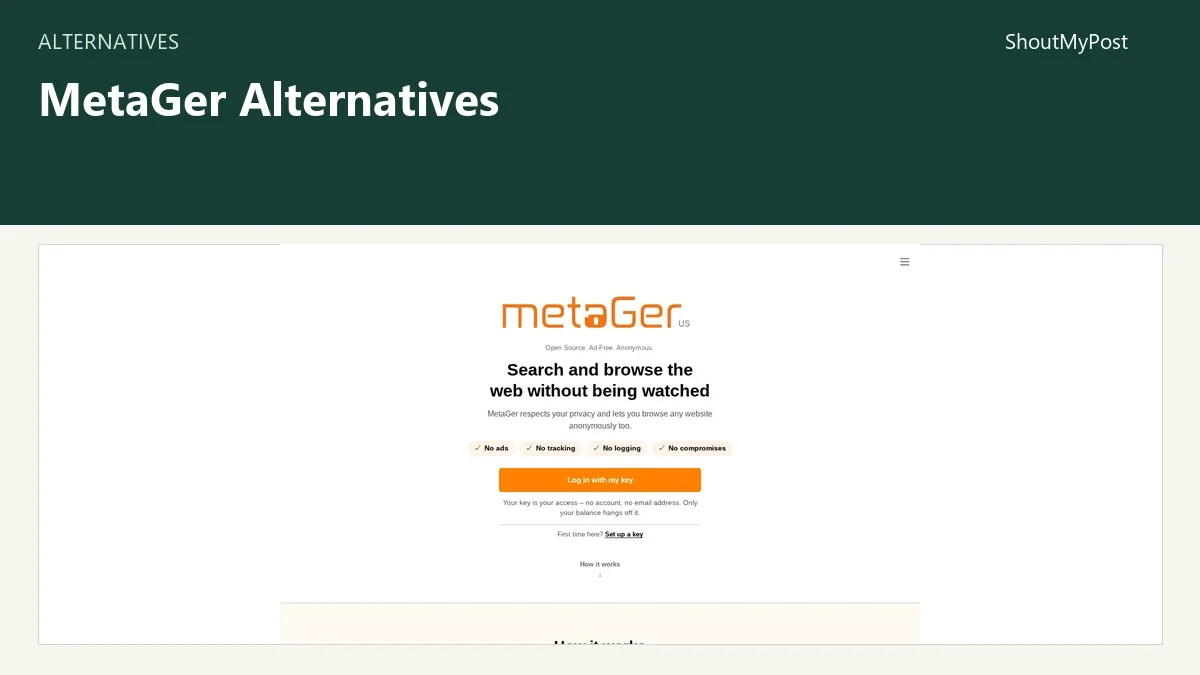
MetaGer uses a randomly generated search key and paid tokens. For many readers that is the attraction. For others, the extra access step makes a free search page more appealing.
- You want ongoing free searching. MetaGer's US Prices page charges one token for a default web query. Searx Party, Marginalia, Mwmbl and Wiby let you begin public searching without funding a balance.
- You prefer a fixed subscription. Kagi's official pricing page offers monthly and annual individual plans. If you search throughout the day, a monthly plan may be easier to fit into a budget than query-based spending.
- You want personal ranking controls. Kagi's domain ranking and lenses or Marginalia's custom filters change the pages you favor. That is a different reason to switch from simply seeking another service that combines providers.
- You want an independent index. MetaGer's homepage explains its metasearch approach. Marginalia and Wiby instead offer their own focused discovery projects. The search engines category separates those choices from the metasearch category.
Start with the reason that actually stopped you searching. A free replacement fixes billing friction; a specialist index changes the material you find. Neither needs to be presented as a universal upgrade.
Quick picks
- Best free metasearch: Searx Party.
- Best paid daily default: Kagi.
- Best for noncommercial writing: Marginalia Search.
- Best for shared result contributions: Mwmbl.
- Best for classic-web browsing: Wiby.
- Best for community-node search: Presearch.
For team research, keep citations and selected source URLs in shared notes. The search engine is how each person discovers material, not the shared record of what the group has read.
Compare the six alternatives
Checked October 9, 2026. No euro amount has been converted into a supposed US price.
| Tool | Best for | Platforms | Free plan | Paid price | Open source | Advantage over MetaGer |
|---|---|---|---|---|---|---|
| Searx Party | Free hosted metasearch | Web | Public search | No paid tier displayed | SearXNG: yes | No token balance to fund |
| Kagi | Personal daily search | Web; integrations | 100-search trial | Professional: $10 monthly or $9/month billed annually, $108/year, plus sales tax | Search service: no | Account-based ranking controls and lenses |
| Marginalia Search | Noncommercial discovery | Web | Public search | Separate paid API options; browsing free | Yes, AGPL | Focused independent discovery index |
| Mwmbl | Shared search contributions | Web | Basic search | No paid basic-search tier listed | Yes, AGPL-3.0 | Approve and add shared results |
| Wiby | Simple personal pages | Web | Public search | No paid search tier listed | Yes, GPLv2 | Classic-web discovery |
| Presearch | Community-node model | Web | Basic search with or without an account | Ad-Free Standard: $2.49/month | Open-source components | Optional participation in its node ecosystem |
Searx Party: the closest free metasearch move
Searx Party preserves the familiar job: type a query and get links from multiple outside sources. Its About page explains that it runs SearXNG. You don't need a server or a paid key to use this public instance.
My pick is Searx Party when the only thing you want to leave behind is billing. You can keep ordinary searches and browser integration while deciding whether the instance's configured sources answer your questions. That is a smaller change than adopting a specialist collection of personal websites.
The weakness is relying on the operator's setup. SearXNG's public-instance documentation describes upstream blocks and CAPTCHAs. A successful page load doesn't mean every provider returned results. The enabled engine mix can also differ between instances.
A July 2026 discussion about search backends contains praise for SearXNG and frustration with fresh-news retrieval. Replies emphasize configuration. For a normal reader, that translates to a practical question: does this hosted instance return the material you need?
Switch if free metasearch is enough. Stay with MetaGer if its search-key tools and operated service are the features you want to fund.
Kagi: trade tokens for a personal search subscription
Kagi Search fits a different daily rhythm. Its personal domain ranking, blocks, lenses and bangs let you shape routine searches. If your work repeatedly sends you to the same documentation and reference sites, those controls can be more attractive than another source mix alone.
The pricing page lists a 100-search trial. Professional costs $10 billed monthly, or $9/month billed annually as $108/year, plus sales tax. Kagi's billing FAQ separately describes no charge for an unused monthly billing month; annual billing isn't that same arrangement.
My recommendation is Professional for a person who searches continually and wants a known monthly plan. The weakness is paying for account-based search when free alternatives remain available. A yearly commitment also changes the decision for someone who might only use the service during one project.
A July 2025 Kagi-alternatives discussion includes free-service suggestions and readers who prefer staying with Kagi. It is a choice about the search experience you want to keep paying for, rather than a rule that every privacy-minded reader needs a subscription.
Switch if personal daily-search controls justify a subscription. Stay with MetaGer if key-based access without email signup is more important to you.
Marginalia Search: move toward unfamiliar personal writing
Marginalia Search is my discovery pick. Its homepage favors noncommercial, text-heavy content and describes its own index and crawler. It also offers search and exploration as separate ways into the web.
This is the stronger recommendation for someone who wants to read about a hobby or follow a person's ideas. A result can be valuable because it introduces an unfamiliar author. It needn't be the official page everyone already knows to expect.
The weakness is destination lookup. In a December 2023 Hacker News discussion, readers criticized expected pages that didn't appear prominently, while the developer described uneven results across queries. Use the discovery goal to decide whether that behavior is a benefit or a frustration.
Public search is free. The official API guide separates free noncommercial keys by email from paid API use, so there isn't a paid browser plan to confuse with an integration fee. Its personal filters add controls over terms and domains if you want to refine the collection.
Switch if noncommercial reading is the goal. Stay with MetaGer if broad metasearch and known-destination queries matter more than discovery.
Mwmbl: improve the result set instead of buying queries
Mwmbl lets contributors approve results and manually add URLs. Its curation guide makes the shared nature of that work explicit. You can help another person reach a page that answered your question.
That is the interesting difference from a search-key service. A useful contribution remains a contribution even if you don't make Mwmbl your only engine. The project aims at shared search improvement rather than selling an individual balance of queries.
The weakness is coverage in a growing index. The September 2023 launch discussion includes enthusiasm for the nonprofit idea and speed alongside complaints about missing results. Developer Daoud Clarke encouraged contributions and named Marginalia as an inspiration.
Basic searching is free without an account; accounts are available for contribution. The Terms describe AGPL-3.0 code and a separately licensed dataset. Optional Seed Search follows another provider route, so choose the mode that matches your reason for visiting instead of assuming every query uses only the project's index.
Switch if improving shared results is part of the appeal. Stay with MetaGer if you want an operated paid service and have no interest in curation.
Wiby: browse a deliberately smaller kind of web
Wiby is the specialist option for simple personal and hobby pages. Its About page also describes helping vintage computers browse suitable pages. That is a concrete purpose, with a narrower target than general private search.
My pick is Wiby when you want the next page to introduce a subject instead of closing a task. Its homepage's surprise me… link makes that browsing style explicit. You can read one author's project and follow their links without inventing another query immediately.
The weakness is page selection. The submission guide prefers simple HTML and noncommercial sites, so a modern page can miss the index even when its content would help you. A small collection needs to be chosen for what it includes, not judged solely against a general engine's reach.
The October 2022 Hacker News discussion about Wiby contains praise for hobby projects and objections to using presentation as a quality measure. Public browsing is free, and the source is GPLv2. There isn't a subscription upgrade that turns Wiby into broad metasearch.
Switch if classic-web discovery is the reason you're searching. Stay with MetaGer if you mostly need current destinations from outside providers.
Presearch: consider a different search community
Presearch uses a community-node search model described in its official docs. Its PRE-token ecosystem is a separate reason people follow the project, beyond the search result list itself.
Basic search is free with or without an account. The Ad-Free Search guide lists Ad-Free Standard at $2.49 a month, payable with PRE or a credit card. You can begin by judging search without purchasing a token or opting into rewards.
The weakness is added complexity around a job that might only need a text box. If your reason for leaving MetaGer was keeping track of paid access, replacing that with an ecosystem you don't care about may add little. Open-source components also don't make the entire hosted service open source.
A June 2026 Presearch community thread includes support for decentralization alongside result-quality and mobile-interface complaints. My recommendation is to put actual page discovery first. Support for a network's design doesn't answer a query that needs a better source.
Switch if community nodes are part of what you want to explore. Stay with MetaGer if its funded key and search tools already fit your routine.
Other common picks
DuckDuckGo is a free general-search starting point when you want to change a daily default.
Brave Search is another general-search service, usable separately from the Brave browser.
Startpage is another private-search choice for a broader shortlist.
Mojeek is a choice for readers interested in an independent index.
Moving from MetaGer
A search-key balance doesn't transfer into the six services here. Keep your destination bookmarks and research notes, then change the browser's search setting to the replacement you choose. Existing source URLs remain the pages you found regardless of which engine becomes the default.
There isn't a documented one-click conversion of a MetaGer key into Kagi account settings or a Searx Party configuration. Recreate personal search preferences in the new service where it supports them. A key is access to one service, not a portable archive of all its behavior.
If you want to seek a refund for unused purchased credit, MetaGer's Prices page describes a 30-day window and its key help explains the payment-ID process. Don't assume changing your browser default cancels or refunds a balance automatically.
FAQ
What is the closest free MetaGer alternative?
Searx Party is the closest free starting point here because it also provides metasearch through outside engines. It runs SearXNG as a public instance, with no paid tier displayed. The operator's configuration and upstream availability affect results, so choose the instance for the searches you actually need to make.
Which paid alternative uses a monthly plan?
Kagi's Professional plan costs $10 billed monthly, or $9/month billed annually as $108/year, plus sales tax. Its 100-search trial lets you decide whether the personal ranking tools fit your work. That monthly account model differs from MetaGer's funded search key and per-query token spending.
Can I use a replacement without an email account?
Searx Party, Marginalia and Wiby provide public search without an email-account setup. Mwmbl also offers basic search without an account, while contribution uses one. Kagi uses an account-based paid model. Choose based on whether you need ordinary searching or saved account features; those are different access needs.
Will changing engines refund my MetaGer tokens?
No, changing a browser search setting doesn't request a refund. MetaGer's pricing page describes returning unused credit within 30 days after purchase, with the separate key-help process using your payment ID. Follow that process if it applies to the purchase. The replacement search engine doesn't manage the MetaGer balance.
Sources
Official pages for the featured services and the linked community discussions, checked October 9, 2026.
Related articles
Directory listings
Other options
Open a listing to review its directory details and current site link.
-
Alternative
searx.party
searx.party, branded as Searx Party, is an instance of SearXNG, a privacy-respecting, open source metasearch engine. Powered by SearXNG version 2026.9.25+12f8b6515, the site provides links to the SearXNG source code, issue tracker, engine statistics, a list of public instances, a privacy policy and contact information for the instance maintainer. It is associated with the Rock Eaters Network.
-
Alternative
Mwmbl
Mwmbl is a completely independent, open source, non-profit search engine. It provides a Seed Search feature that allows logged-in users to help build its index using high-quality results from EUSP and ranking from Typesafe AI.
-
Alternative
Wiby
Wiby is a search engine focused on older-style, classic web pages. It is lightweight and centered on user-specified subjects of interest, with the goal of creating a web experience reminiscent of the early internet. Users can submit pages to the index, adjust their settings, and use the 'surprise me' feature.
-
Alternative
Presearchofficial
Presearchofficial is the official GitHub repository for Presearch, an open source decentralized search engine powered by its community. The repository hosts the project's source code and associated resources for the search engine platform.