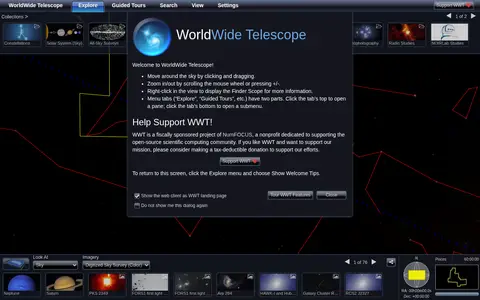

worldwidetelescope.org
WorldwideTelescope is an educational resource for documentaries, courses, books, reference material, or self-learning.
Directory
Explore Space & Astronomy resources in Education & Research.
WorldwideTelescope is an educational resource for documentaries, courses, books, reference material, or self-learning.
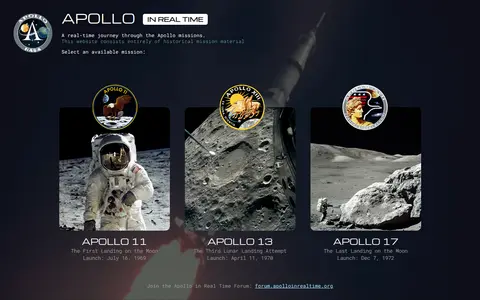
Apollo in Real Time is a website presenting a real-time interactive journey through the Apollo missions, reliving each moment as it occurred. It consists entirely of historical mission material and offers missions Apollo 11, Apollo 13 and Apollo 17, with launch dates given.
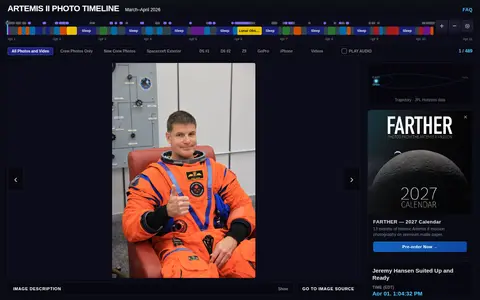
Artemis II Photo Timeline is an educational resource for documentaries, courses, books, reference material, or self-learning.
Ask an Astronaut is an educational resource for documentaries, courses, books, reference material, or self-learning.

Celestia is a free space simulator that provides real-time 3D visualization of space. It displays objects and orbits based on scientific data and runs on Windows, Linux, macOS, iOS and Android. Users can travel through the solar system, to over 100,000 stars, or beyond the galaxy. Its catalogues are expandable with add-ons, and users can create their own objects and planetary systems.

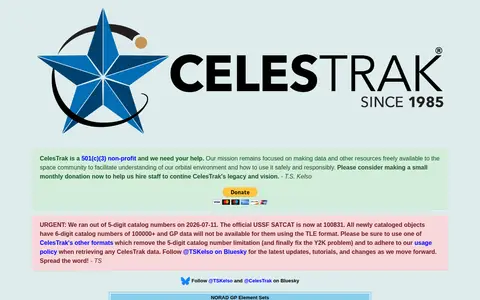
CelesTrak is a 501(c)(3) non-profit that provides orbital data and related resources to the space community. Its site offers NORAD GP element sets, a satellite catalog, conjunction reports, GPS data and space weather data. It notes that 5-digit catalog numbers ran out on 2026-07-11, so newly cataloged objects with 6-digit numbers lack GP data in TLE format.

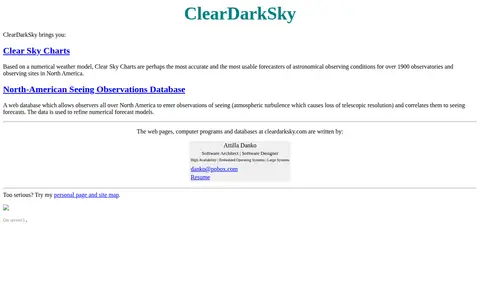
Clear Dark Sky is an educational resource for documentaries, courses, books, reference material, or self-learning.

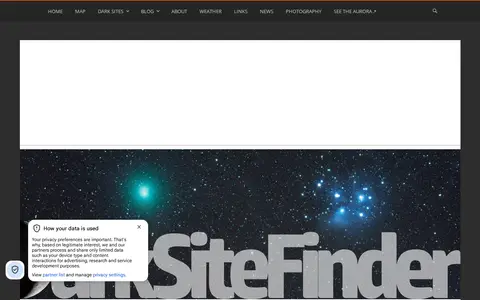
Dark Site Finder is a website with a light pollution map, updated with 2022 data, intended to help users find dark skies. It also includes a listing of dark sites and blog posts about stargazing, photography and astronomical events.

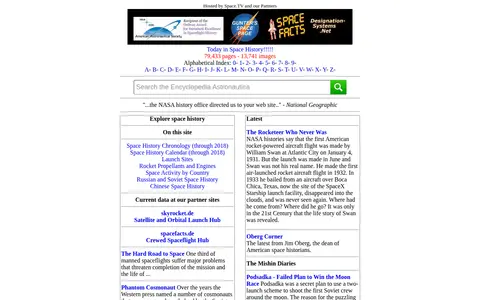
Encyclopedia Astronautica is a space history resource covering rockets, spacecraft, launch vehicles, astronauts, cosmonauts, spaceflights, engines and space exploration. The site provides an alphabetical index and space history chronology and calendar pages.

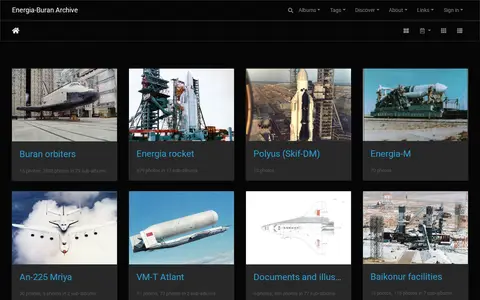
The Energia-Buran Archive is an archive and directory of images from the Buran program, created for educational purposes. It organizes photographs of Buran orbiters, the Energia rocket, Polyus, Energia-M, the An-225 Mriya, the VM-T Atlant, Baikonur facilities, testing and research, and other spaceplanes, along with documents and illustrations.

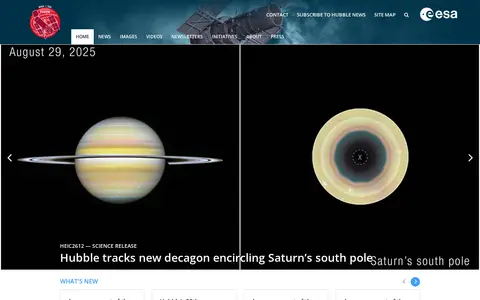
ESA Hubble is an educational resource for documentaries, courses, books, reference material, or self-learning.

Find Starlink is a fan-made site, not affiliated with SpaceX or Starlink, that calculates when the Starlink satellites are expected to be visible at a user's location. It also offers a Live Map and a Results page, and tracks only the first satellite in every chain of satellites.

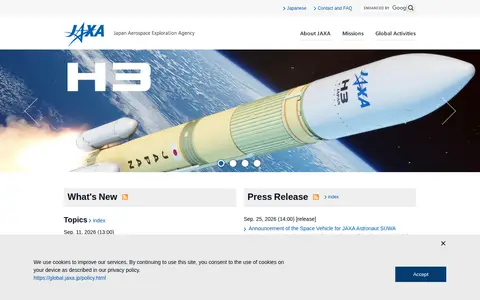
The Japan Aerospace Exploration Agency (JAXA) is an organization that performs various activities related to aerospace, from basic research in the aerospace field to development and utilization. Its site covers missions including XRISM, SLIM, LUPEX, GOSAT-2, BepiColombo, and the H3 and Epsilon launch vehicles, along with press releases and international activities.

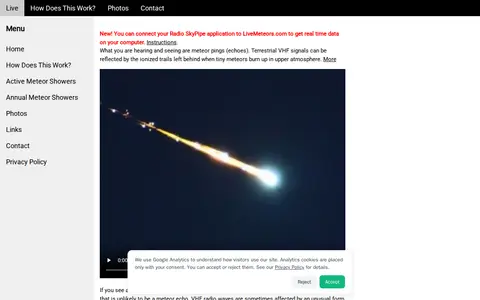
LiveMeteors.com lets listeners hear live meteor radio echoes, described as meteor pings while meteors strike Earth's atmosphere. Terrestrial VHF signals can be reflected by ionized trails left when tiny meteors burn up in the upper atmosphere. The site notes that strong continuous signals lasting more than a minute are unlikely to be meteor echoes, and that Sporadic E propagation can prevent detection.
An interactive map showing about 200,000 galaxies with their actual position and color, from the Milky Way to the edge of the observable Universe. It was created from 15 years of Sloan Digital Sky Survey data by B. Ménard and N. Shtarkman at Johns Hopkins University. The visualization shows a thin slice of the Universe about 10 degrees thick.
Mental Landscape is an educational resource for documentaries, courses, books, reference material, or self-learning.
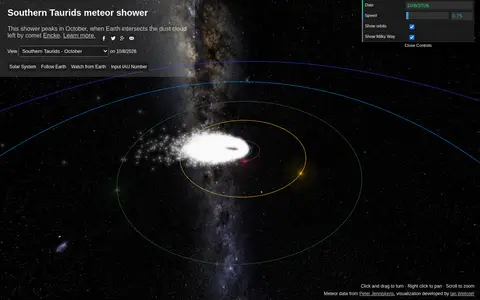
An interactive 3D visualization of NASA meteor shower data that shows meteoroid streams orbiting the Sun and Earth passing through them. The page also includes notes on seeing showers, an iframe embed option and mention of the SpaceKit.js engine.

A beta interactive astronomy calendar that lists meteor showers, conjunctions and eclipses and gives moon and sun rise and set times for each day of the year, adjusted to the user's location. The site also describes a printed wall calendar with astronomical times customized to each user's location.
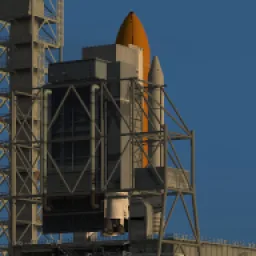
Orbiter Forum is a discussion board for Orbiter, a space flight simulator, and for spaceflight topics. Sections cover Orbiter development, addon development and requests, general questions and help, and spaceflight news. A help section addresses installing and running Orbiter and common troubleshooting issues.

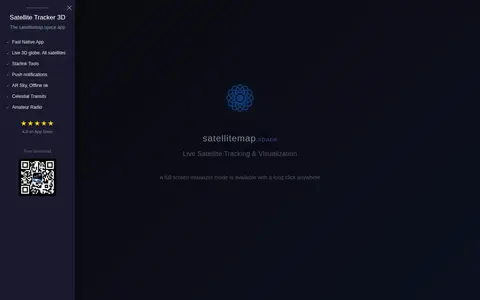
Satellite Map is an educational resource for documentaries, courses, books, reference material, or self-learning.

Scale of the Universe is an educational resource for documentaries, courses, books, reference material, or self-learning.

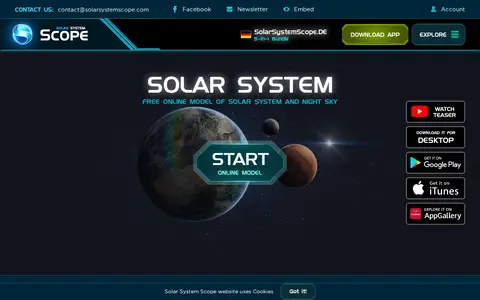
Solar System Scope is an online 3D simulation of the Solar System and night sky in real time, showing the Sun, planets, dwarf planets, comets, stars and constellations. It also offers a free model of the Solar System and night sky with accurate positions of objects. A desktop version and an Android app are available.

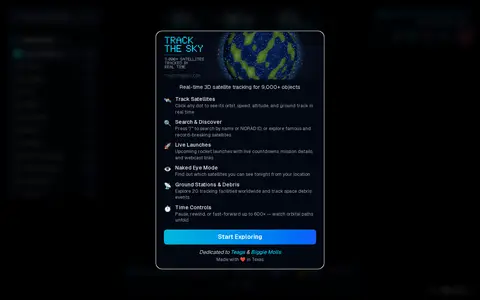
Track The Sky is a real-time 3D satellite tracker that follows over 9,000 satellites on an interactive 3D globe using live orbital data. It covers categories including space stations, Starlink, GPS and weather satellites. Features include clickable orbit paths, ground tracks, altitude and velocity, and overhead pass predictions.
Universe Atlas is an educational resource for documentaries, courses, books, reference material, or self-learning.