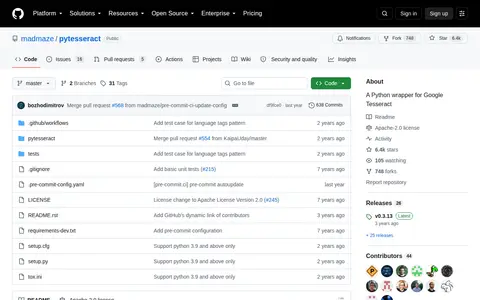

pytessarct is a Python wrapper for the Google Tesseract optical character recognition tool, hosted as a public repository on GitHub. It enables developers to incorporate Tesseract's text recognition capabilities into Python projects.
Directory
Search results
Published directory entries matching your search.
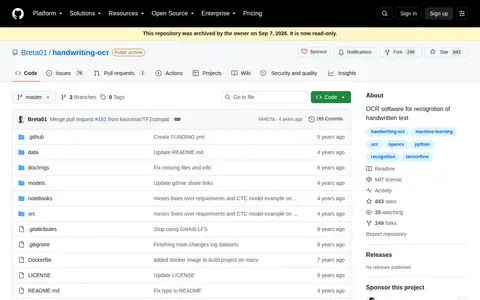
Handwriting-OCR is a project that tries to create software for recognizing handwritten text from photos, including Czech language, using computer vision and machine learning. Recognition is divided into four steps, from page detection through word separation and normalization to character recognition. It is written in Python 3.6 with Jupyter Notebook, and the repository was archived by its owner.
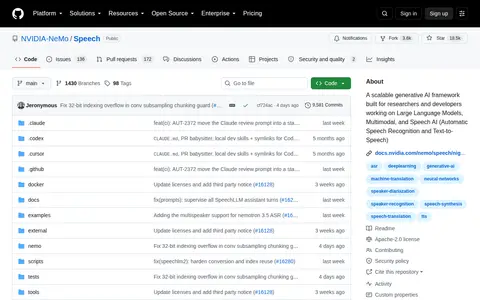
NVIDIA NeMo Speech is a framework built for researchers and developers working on speech AI, including automatic speech recognition and text-to-speech. The repository provides open weight checkpoints and demos through a Hugging Face collection. It is licensed under Apache-2.0 and has pivoted to focus on audio, speech, and multimodal LLMs.
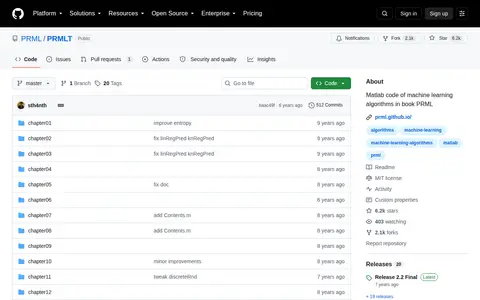
A Matlab package implementing machine learning algorithms described in the textbook Pattern Recognition and Machine Learning by C. Bishop. It is written purely in Matlab and is self-contained with no external dependency.
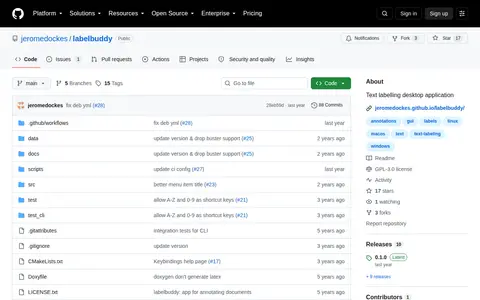
Labelbuddy is an open-source desktop GUI application for annotating documents, developed on GitHub. According to its documentation, it can be used for tasks such as Named Entity Recognition, sentiment analysis and document classification. The documentation states that it works completely offline and that its database is an ordinary file. Import and export use JSON, JSON Lines or plain text formats.
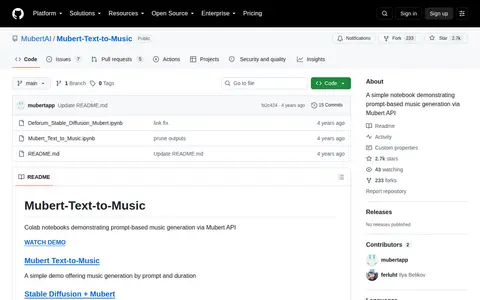
MubertAI/Mubert-Text-to-Music is a GitHub repository maintained by MubertAI. It hosts a simple notebook that demonstrates prompt-based music generation via the Mubert API, providing a reference implementation for users looking to generate music from text prompts using the service.
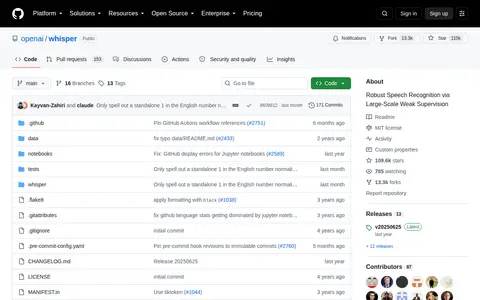
Whisper is a robust speech recognition system developed by OpenAI, hosted on GitHub. It uses large-scale weak supervision for training, and the repository includes documentation on its approach, setup, available models and supported languages, plus command-line usage instructions.

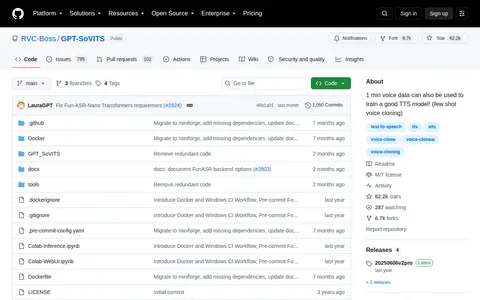
GPT-SoVITS is a few-shot voice conversion and text-to-speech WebUI. It supports zero-shot TTS from a five-second vocal sample and fine-tuning with one minute of training data. Cross-lingual inference covers English, Japanese, Korean, Cantonese and Chinese. Integrated WebUI tools include voice accompaniment separation, training set segmentation, Chinese ASR and text labeling.
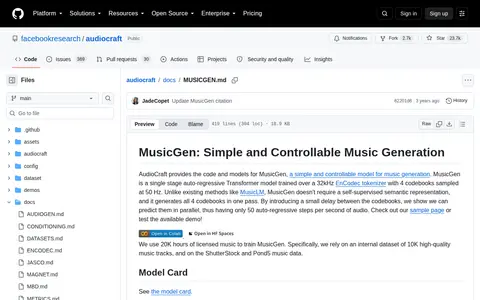
MusicGen is a single-stage auto-regressive Transformer model for music generation trained over a 32kHz EnCodec tokenizer with four codebooks, part of the AudioCraft library. It supports text-to-music and text-plus-melody-to-music models ranging from 300M to 3.3B parameters. Running it locally requires a GPU, with at least 16 GB of memory recommended for medium-sized models.
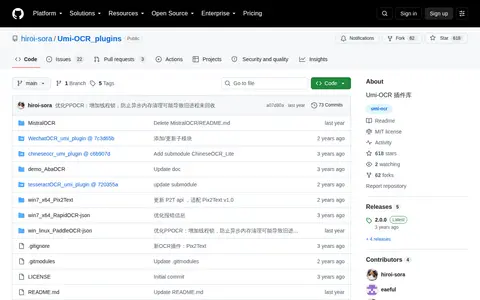
The Umi-OCR plugin repository contains OCR engines and related components for Umi-OCR, with installation instructions and links to plugin releases.
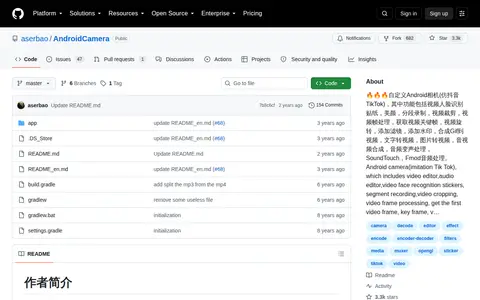
🔥🔥🔥自定义Android相机(仿抖音 TikTok),其中功能包括视频人脸识别贴纸,美颜,分段录制,视频裁剪,视频帧处理,获取视频关键帧,视频旋转,添加滤镜,添加水印,合成Gif到视频,文字转视频,图片转视频,音视频合成,音频变声处理,SoundTouch,Fmod音频处理。 Android camera(imitation Tik Tok), which includes video editor,audio editor,video face recognition stickers, segment recording,video cropping, video frame processing, get the first video frame, key frame, video rotation, add filter Mirror ,add watermark ,add gif to video, add text to video, picture to video, audio and video synthesis, audio change processing
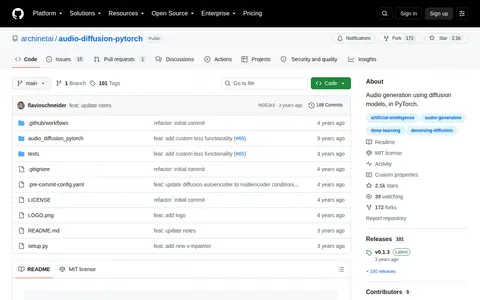
Audio diffusion library for PyTorch that includes models for unconditional audio generation, text-conditional audio generation, diffusion autoencoding, upsampling, and vocoding. The models are waveform-based, and the U-Net, DiffusionModel, diffusion method, and samplers are customizable for other formats. No pre-trained models are provided.
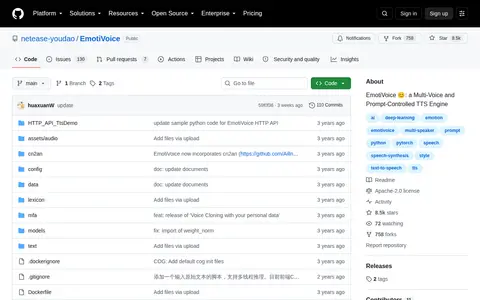
EmotiVoice is an open-source text-to-speech engine that speaks English and Chinese with over 2000 voices. Its main feature is emotional synthesis across emotions such as happy, excited, sad and angry. It provides a web interface and a scripting interface for batch generation.
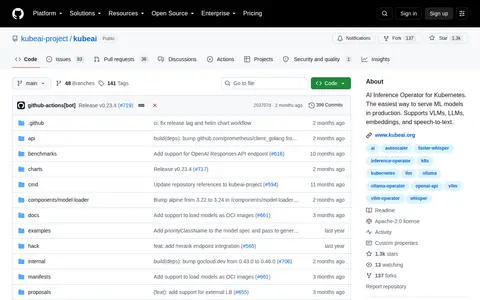
Deploy and scale machine learning models on Kubernetes. Built for LLMs, embeddings, and speech-to-text.
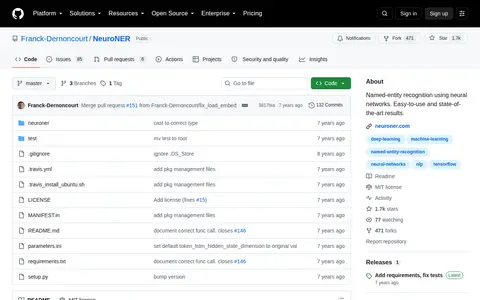
NeuroNER is a program that performs named-entity recognition using neural networks. It relies on Python 3 and TensorFlow 1.0+, optionally uses the BRAT annotation tool, and provides installation instructions, sample datasets and pretrained models.
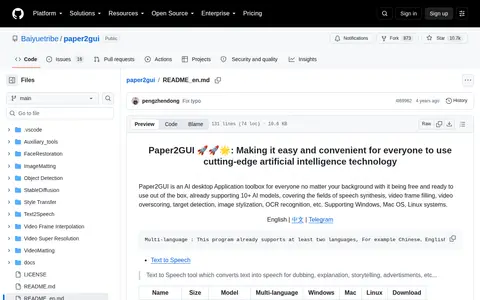
Paper2GUI is an AI desktop application toolbox that is free and ready to use out of the box. It supports more than 10 AI models covering speech synthesis, video frame filling, video overscoring, target detection, image stylization and OCR recognition, on Windows, Mac OS and Linux.
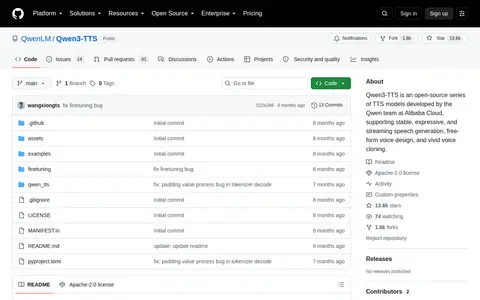
Qwen3-TTS is an open-source series of text-to-speech models developed by the Qwen team at Alibaba Cloud. It supports speech generation, streaming output, free-form voice design and voice cloning, and covers ten major languages with dialectal voice profiles. The release includes models of 0.6B and 1.7B parameters.
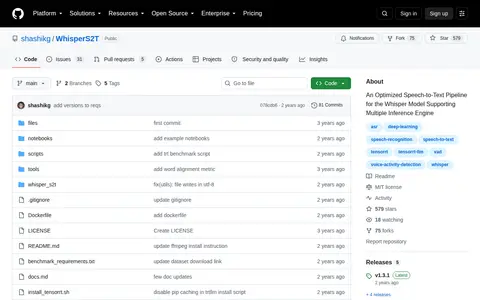
WhisperS2T is an optimized speech-to-text pipeline for the Whisper model that supports multiple inference engines. The repository provides release notes, quickstart guides, future roadmaps, and a benchmark and technical report.
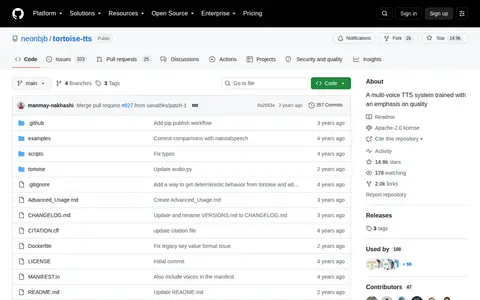
Tortoise TTS is an open-source multi-voice text-to-speech system hosted on the GitHub repository neonbjb/tortoise-tts, trained with an emphasis on output quality. An associated Hugging Face space for the project is available for demonstration.
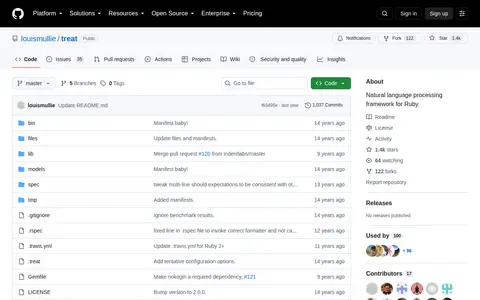
Treat is a natural language processing and computational linguistics toolkit for Ruby. It covers document retrieval, text chunking, segmentation, tokenization, parsing, part-of-speech tagging, keyword extraction and named entity recognition. The README states the gem is unmaintained.
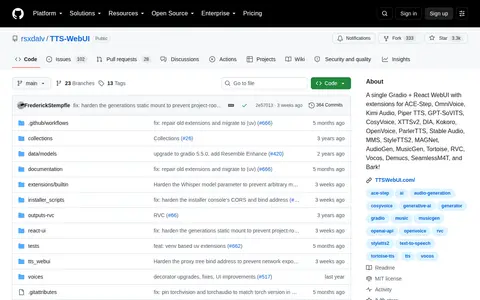
Tts Web UI is a single web interface built with Gradio and React that supports extensions for a wide range of audio and text-to-speech related models and tools, including ACE-Step, OmniVoice, Piper TTS, GPT-SoVITS, and others.