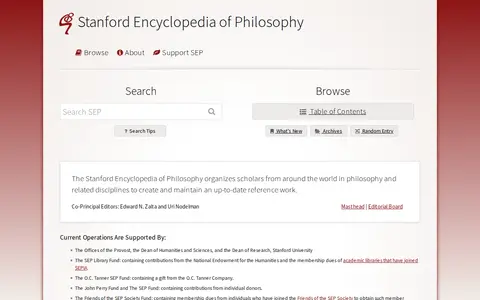

The Stanford Encyclopedia of Philosophy organizes scholars from around the world in philosophy and related disciplines to create and maintain an up-to-date reference work. It offers a table of contents, archives and random entry browsing, with editorial information and citation guidance.

Directory
Search results
Published directory entries matching your search.
Stanford University is a leading global research and teaching institution. Its core mission centers on discovery and learning, fostering intellectual expansiveness, openness to new lines of thinking, and pursuit of excellence across disciplines. The university conducts cross-disciplinary research to address societal challenges, including work on human-centered artificial intelligence, and supports innovation pathways for new applications while shaping related public policies.
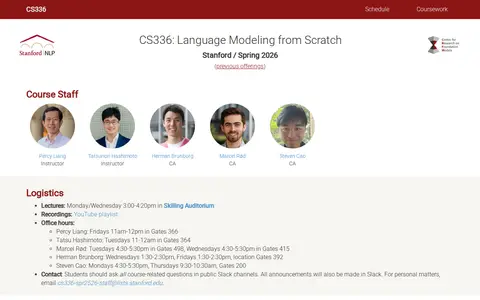
Stanford CS336: Language Modeling from Scratch is the official course website for a Stanford class offered in Spring 2026. The course walks students through the process of developing a language model, including data collection and cleaning for pre-training, transformer model construction, model training, and evaluation before deployment. The site provides logistics, schedule, assignments, and course materials.
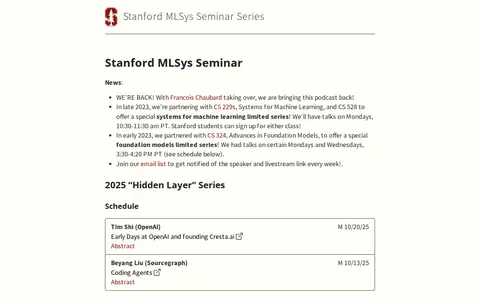
Stanford MLSys Seminar Series is a seminar series on the frontier of machine learning and systems. Its 2025 "Hidden Layer" series schedule lists talks, and earlier limited series covered systems for machine learning and foundation models. Stanford students could sign up for associated classes, and an email list provides speaker and livestream notifications.
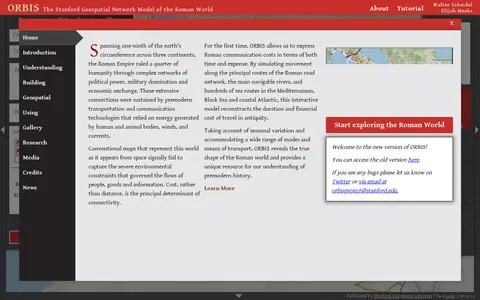
ORBIS is the Stanford Geospatial Network Model of the Roman World, published by Stanford University Libraries, with authors Walter Scheidel and Elijah Meeks. It presents a route and network interface with options for origin and destination, departure month or season, and priority such as fastest, cheapest or shortest, across road, river and sea modes.
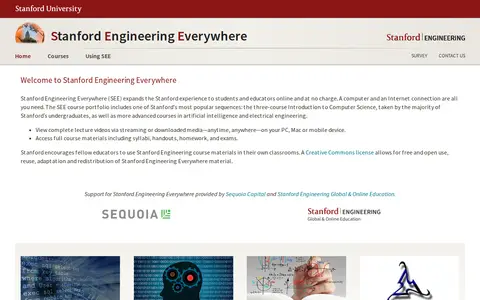
Stanford Engineering Everywhere is an online offering of Stanford engineering courses available to students and educators at no charge. Its course portfolio includes a three-course Introduction to Computer Science sequence and more advanced courses in artificial intelligence and electrical engineering. Lecture videos can be streamed or downloaded, and full course materials include syllabi, handouts, homework and exams.
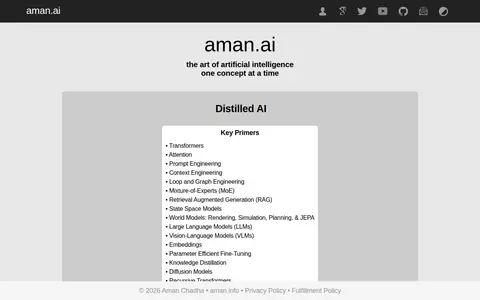
A site offering course notes and learning material for Stanford artificial intelligence and deep learning classes. It lists primers on topics such as transformers, attention and retrieval augmented generation, alongside links to Stanford CS229, CS230, CS231n and CS224n.
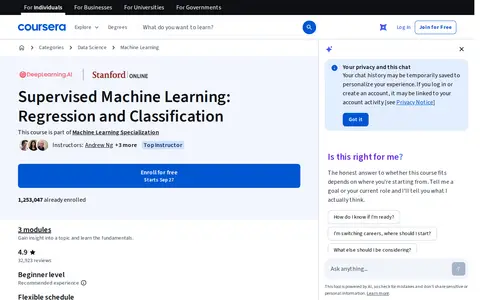
Andrew Ng’s Machine Learning at Stanford University is a Coursera course titled 'Supervised Machine Learning: Regression and Classification'. It is the first course of the Machine Learning Specialization. The course teaches how to build machine learning models in Python using NumPy and scikit-learn, covering regression and classification. It is aimed at beginners, requires flexible scheduling over three weeks at ten hours per week, and offers a shareable certificate.
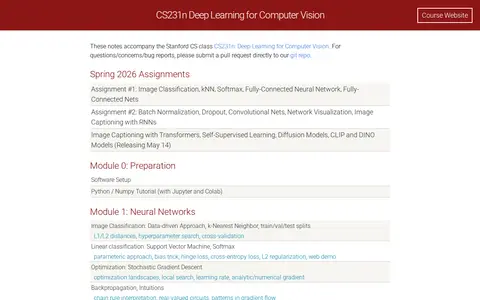
Course materials and notes for the Stanford class CS231n: Deep Learning for Computer Vision. The notes accompany the Stanford CS class and cover topics organized in modules. Spring 2026 assignments are listed.
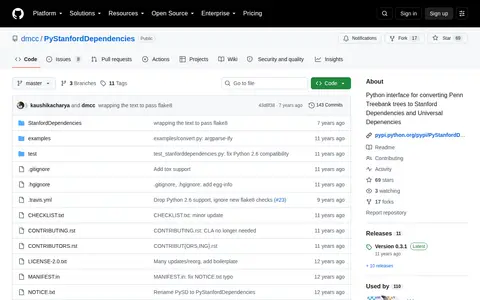
PyStanfordDependencies is a Python interface for converting Penn Treebank trees to Stanford Dependencies and Universal Dependencies. It offers a get_instance() function with subprocess or jpype backends, and convert_tree() or convert_trees() methods returning Token objects. Visualization options include asciitree, Graphviz dotgraphs, and interactive xdot windows. A Stanford CoreNLP or Parser jar file can be supplied, or downloaded automatically.
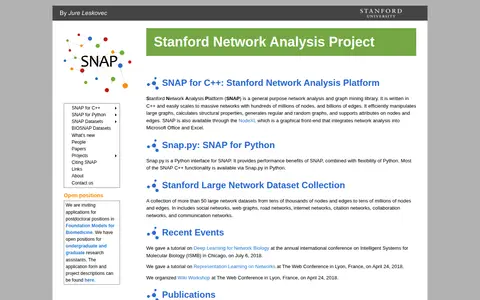
SNAP is a general purpose network analysis and graph mining library written in C++ that scales to large graphs and supports node and edge attributes. Snap.py provides a Python interface with most of the SNAP C++ functionality. The project also offers the Stanford Large Network Dataset Collection, a set of network datasets.
Database management system developed by Stanford University.
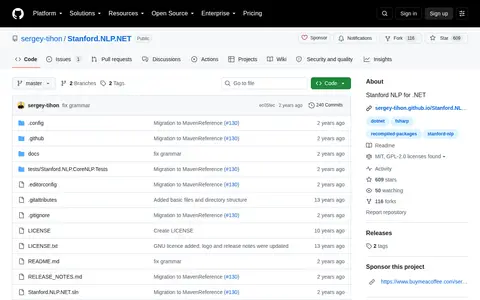
A full port of Stanford NLP packages to.NET and also available precompiled as a NuGet package.
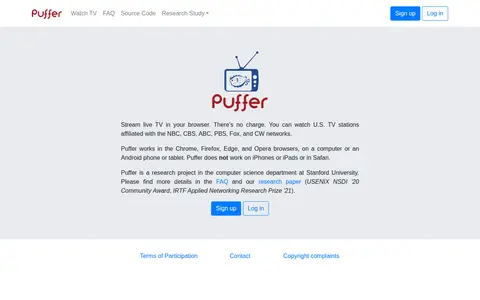
Puffer is a Stanford University computer science research project that streams live TV in a browser at no charge. It offers U.S. TV stations affiliated with NBC, CBS, ABC, PBS, Fox and CW. It works in Chrome, Firefox, Edge and Opera on a computer or Android device, but not on iPhones, iPads or Safari.
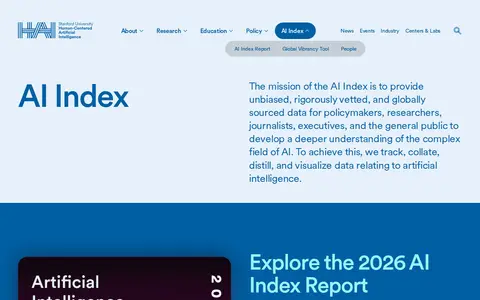
The AI Index Report 2023 is published by Stanford HAI’s Artificial Intelligence Index project, which collects, distills, and visualizes unbiased, globally sourced data about artificial intelligence. The 2023 report highlights a widening gap between advancing AI capabilities and insufficient governance frameworks.

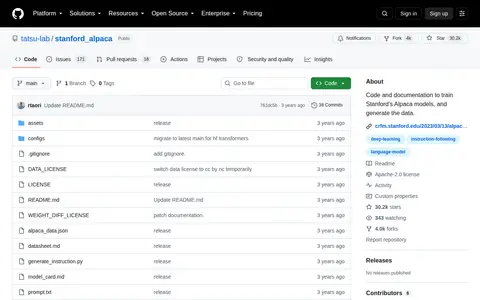
Alpaca is a project that provides code and documentation to train Stanford's Alpaca instruction-following LLaMA models and generate associated training data. It includes details on the data release, data generation process, and fine-tuning procedures.
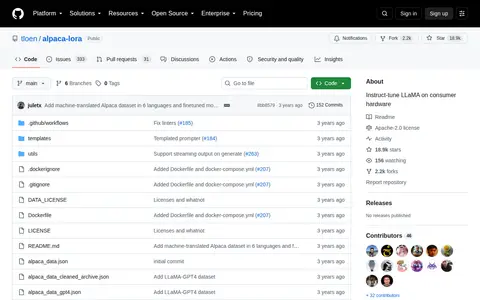
alpaca-lora is a repository with code for reproducing the Stanford Alpaca results using low-rank adaptation (LoRA). It provides an Instruct model and training code that can be easily extended to the 13b, 30b and 65b models, along with a script for downloading and inference.
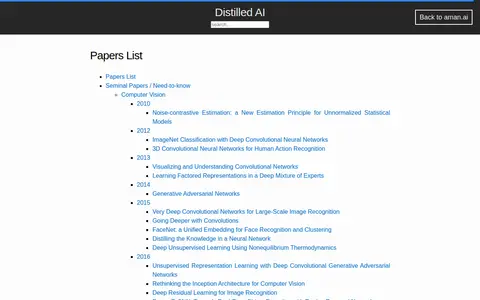
Aman's AI Journal papers list compiles seminal and need-to-know computer vision papers, organized by publication year from 2010 onward. Entries include titles such as ImageNet Classification with Deep Convolutional Neural Networks, Generative Adversarial Networks, and Deep Residual Learning for Image Recognition. The site also offers course notes and learning material for Artificial Intelligence and Deep Learning Stanford classes.
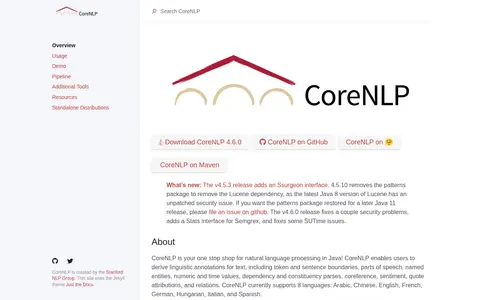
Stanford CoreNLP is a set of natural language analysis tools that take raw text and produce base word forms, parts of speech, named entities, normalized dates and numeric quantities, sentence structure and sentiment. It is an integrated Java framework licensed under the GNU General Public License v3 or later, with a 260 MB download requiring Java 1.8+.
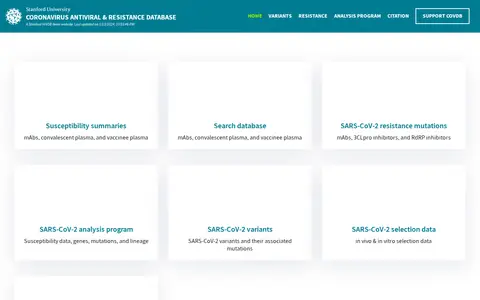
The Stanford Coronavirus Antiviral & Resistance Database (CoVDB) is a curated collection of published data on SARS-CoV-2 variant susceptibility to monoclonal antibodies and plasma from previously infected and vaccinated persons. It also records spike mutations selected by monoclonal antibodies and those emerging in prolonged infections.
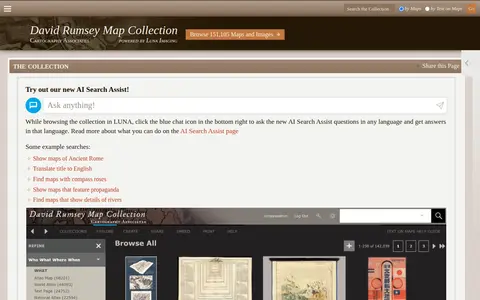
Online historical map collection with over 151,000 maps and related images, including rare 16th through 21st century maps of continents and regions. The searchable database includes the LUNA Viewer and an AI Search Assist. A physical collection is hosted at the David Rumsey Map Center at Stanford University Library.
An article presenting initial impressions of DSPy, a framework developed by the Stanford NLP group for algorithmically optimizing language model prompts. The author describes DSPy as closing the loop of prompt engineering by turning a manual process into a structured machine learning workflow. The piece notes it is not a substitute for the official documentation and covers topics such as teleprompter, optimization, compile, bootstrapping and metric functions.
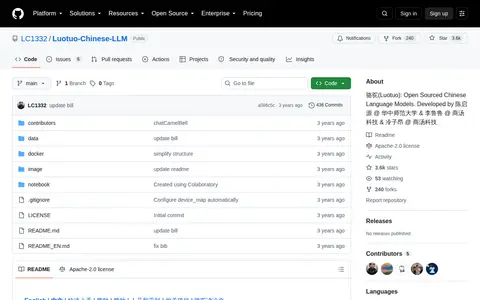
Chinese LLM, Based on LLaMA and fine tune by Stanford Alpaca, Alpaca LoRA, Japanese-Alpaca-LoRA.
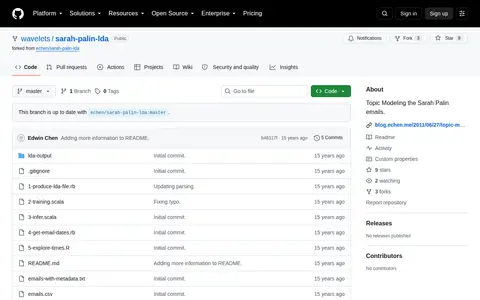
A GitHub repository for topic modeling the released Sarah Palin emails using latent Dirichlet allocation. It includes scripts to prepare the emails, train an LDA model with Stanford's TMT, infer topics, extract email dates, and explore topics over time. The repository also describes a demo email browser for viewing the organized documents.