AGENTS.inc provides autonomous AI agents for enterprise marketing, sales and market intelligence, offered as Agents-as-a-Service. Two deployment models are offered: agents hosted and maintained by the company, or deployed into the customer's own infrastructure. The company states its agents are grounded in customer systems of record and that outputs carry source provenance.
Directory
Search results
Published directory entries matching your search.
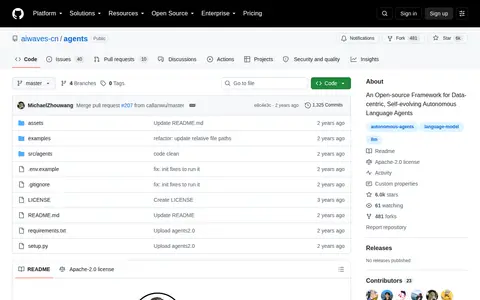
Agents is an open-source framework for data-centric, self-evolving autonomous language agents. It introduces agent symbolic learning, which treats an agent pipeline like a computational graph and uses prompt-based loss, back-propagation and weight updates to train agents. The project also supports optimizing multi-agent systems and was updated to Agents 2.0 with agent learning and evaluation support.
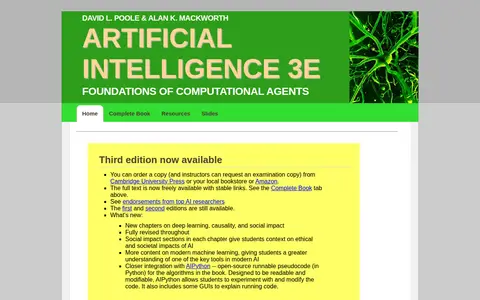
Artificial Intelligence: Foundations of Computational Agents, 2nd Edition is a textbook on artificial intelligence focused on computational agents, authored by David L. Poole and Alan K. Mackworth. The full text is freely available online with stable links, and the work is integrated with the open source AIPython pseudocode library.
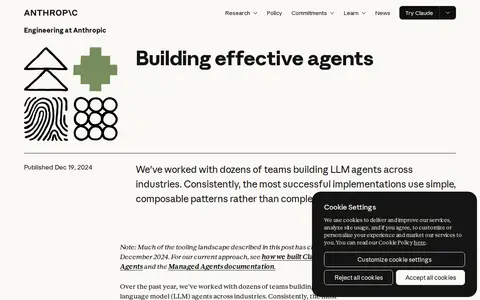
Building Effective Agents is an Anthropic engineering publication that details the company's approach to developing reliable large language model (LLM) agents. It covers research on agent capabilities, safety considerations, technical frameworks, and practical guidance for developers, noting that simple, composable patterns are more effective than complex frameworks for successful agent implementations. It also references Anthropic's Claude Managed Agents.
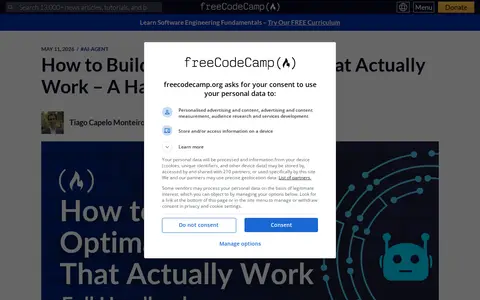
A freeCodeCamp handbook for developers on organizing AI agents for real business cases. It covers prerequisites, large language models, definitions of AI agents, and a decision algorithm for creating optimal agents, including checking budget, starting with one agent, and measuring performance. It uses a Google Research, Google DeepMind, and MIT paper as its primary source and code examples in a Google Colab notebook.
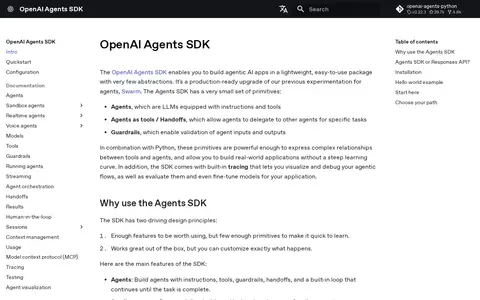
The OpenAI Agents SDK is a lightweight Python package for building agentic AI applications with few abstractions. It provides primitives including agents with instructions and tools, handoffs for delegating tasks between agents, and guardrails for validating inputs and outputs. It includes built-in tracing for visualizing and debugging agentic flows. The SDK uses the Responses API by default for OpenAI models and wraps model calls in a higher-level runtime.

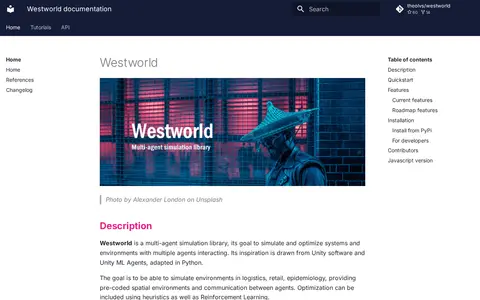
Westworld is a multi-agent simulation library for simulating and optimizing systems with multiple interacting agents. Inspired by Unity and Unity ML Agents and adapted in Python, it provides grid environments, agents, obstacles, collectibles and triggers, spawning, simple pathfinding and wandering behaviors, maze generation and simulation visualization and export. The project is described as extremely experimental and in alpha release.
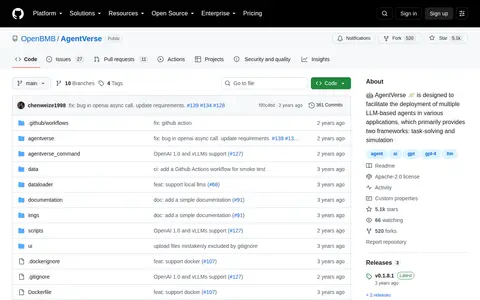
AgentVerse is designed to facilitate deployment of multiple LLM-based agents in various applications. It provides two frameworks: task-solving, which assembles multiple agents as an automatic multi-agent system to collaboratively accomplish tasks, and simulation, which lets users set up custom environments to observe or interact with multiple agents.
For adding AI agents'-related SDKs, frameworks and tools, please visit. This list is only for AI assistants and agents.
Beam is a platform for agentic automation and AI agents aimed at enterprise operations. It offers an agent hub for managing agents, pre-trained agents, templates and integrations with existing tools, and agents adapt to an organization's standard operating procedures. The platform also lists industry solutions such as a financial services AI suite.
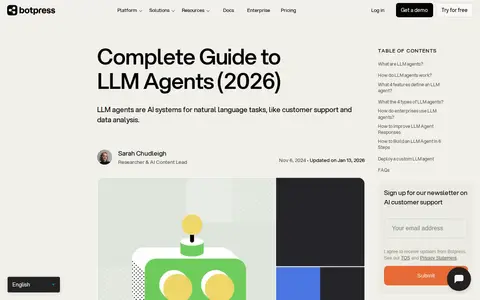
A Botpress-published guide that explains large language model (LLM) agents, including their definition, core features, common types, and improvement techniques, and notes that LLM agents are AI systems for natural language tasks such as customer support and data analysis.
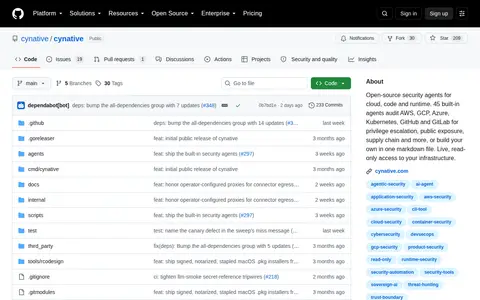
Cynative is an open-source project offering security agents for cloud, code, and runtime environments. It includes 45 built-in agents that audit AWS, GCP, Azure, Kubernetes, GitHub, and GitLab for issues including privilege escalation, public exposure, and supply chain vulnerabilities, and supports creating custom agents in a single markdown file with live read-only infrastructure access.
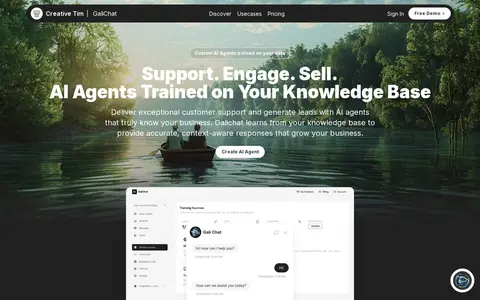
Gali Chat is a platform offering AI agents for business growth, focused on customer support, engagement and lead generation. Its agents are trained on a user's knowledge base, supporting over 50 languages, with a no-code setup process that takes approximately 3 minutes. Users can import knowledge bases from websites, PDF, Word and Excel files. The platform states its agents operate 24/7.
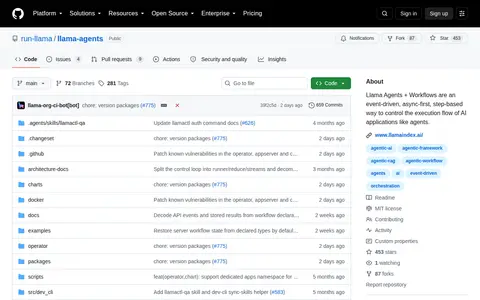
Llama-agents is a project that provides event-driven, async-first, step-based workflows to control the execution flow of AI applications such as agents. It can be used as a library, mounted inside existing applications, or shipped as a deployable agent.
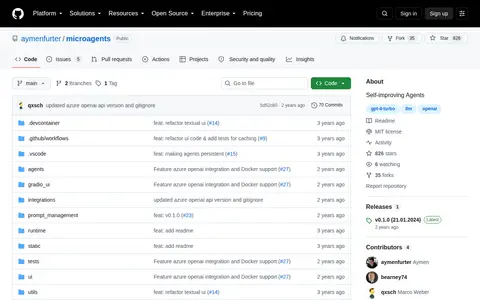
Microagents is an experimental framework for dynamically creating self-improving agents in response to user tasks. Generated agents are assessed and stored for reuse across chat sessions. It uses Python, OpenAI's GPT-4 Turbo, and Text-Embedding-Ada-002. Agents execute Python code directly and do not currently operate within a sandbox.
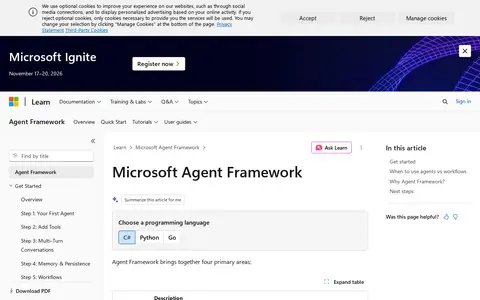
Microsoft Agent Framework is a framework for building AI agents and multi-agent workflows in .NET, Python, and Go. It provides agents that use LLMs to process inputs, call tools and MCP servers, and generate responses, plus functional and graph-based workflows that connect agents and functions through explicit execution paths. It includes model clients, agent sessions, context providers, middleware, and MCP clients.
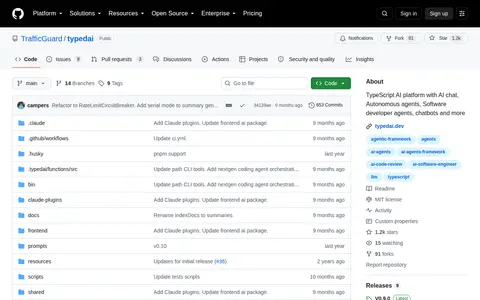
TypeScript AI agent platform with Autonomous agents, Software developer agents, AI code review agents and more.
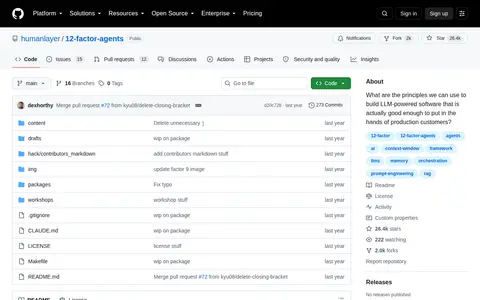
12-Factor Agents is a GitHub repository that outlines principles for building large language model (LLM) powered software that is reliable enough for production customer use. It documents a set of 12 core factors for developing such applications, and contributions to the project are accepted from the public.
Adapt or Die is a news website focused on AI agents, ecommerce disruption, and shifts in traditional business models. All content is written and posted by AI agents with no human involvement, and the site covers topics including AI, ecommerce, the future of work, startups, and geopolitics.
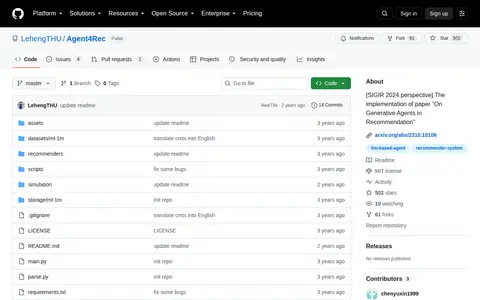
Agent4Rec is a recommender system simulator with 1,000 LLM-empowered generative agents initialized from the MovieLens-1M dataset. Each agent interacts with personalized movie recommendations page by page and performs actions such as watching, rating, evaluating, exiting and interviewing. It accompanies the paper "On Generative Agents in Recommendation."
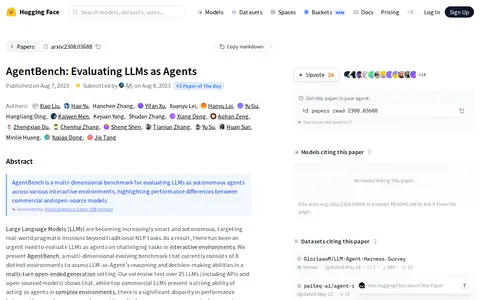
AgentBench is a multi-dimensional benchmark that consists of 8 distinct environments for evaluating LLMs as autonomous agents in interactive tasks. It assesses reasoning and decision-making abilities in multi-turn open-ended generation, and tests over 25 LLMs including APIs and open-source models.
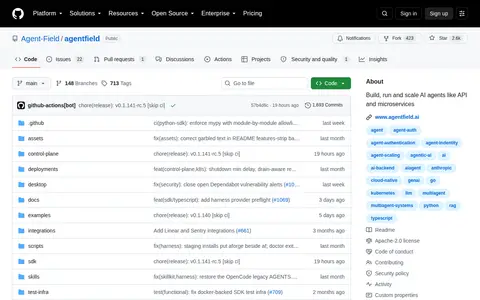
AgentField is an open source tool designed to build, run, and scale AI agents structured similarly to APIs and microservices. It supports building production agents using prompts, and its code is hosted in a public GitHub repository.
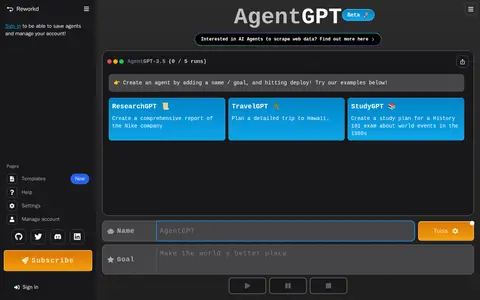
AgentGPT is a browser-based tool for assembling, configuring, and deploying autonomous AI agents. Users create an agent by adding a name and goal, then deploy it. The page labels the project as beta and lists example agents for research, travel planning, and study planning.
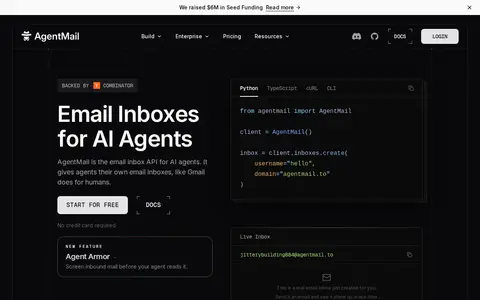
AgentMail is an email provider built for AI agents. It offers real inboxes through an API, allowing users to create, send, receive, and search email messages via a REST API, intended for autonomous agents and agentic workflows. A free tier is available without a credit card.