censys.io
Censys certificate search for exploring TLS certificates, domains, issuers, and transparency logs.
Directory
Published directory entries matching your search.
Censys certificate search for exploring TLS certificates, domains, issuers, and transparency logs.
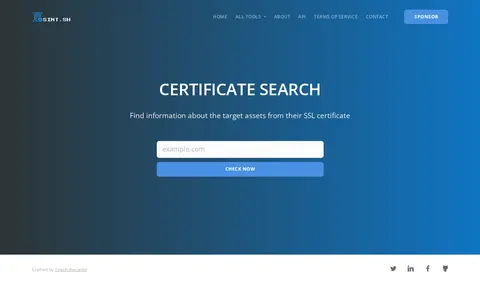
OSINT.sh certificate search for finding TLS certificates, domains, and certificate history.

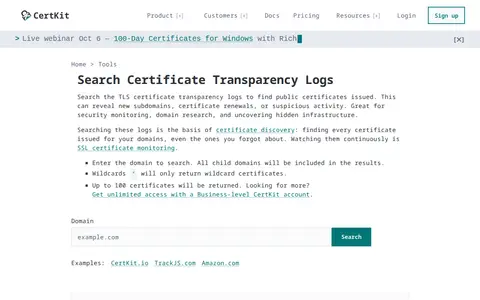
CertKit Certificate Search is a tool that searches TLS certificate transparency logs to locate publicly issued certificates. It can identify new subdomains, certificate renewals, and suspicious activity, supporting security monitoring, domain research, and uncovering hidden infrastructure.

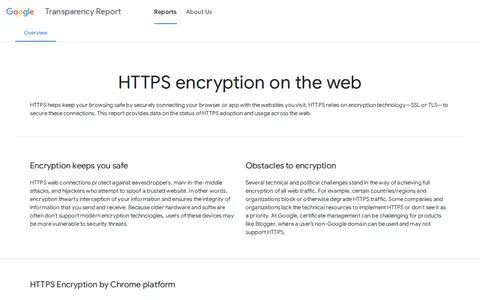
Google certificate transparency search for checking certificates and HTTPS records.
Internet asset search engine for domains, hosts, certificates, and exposed services.
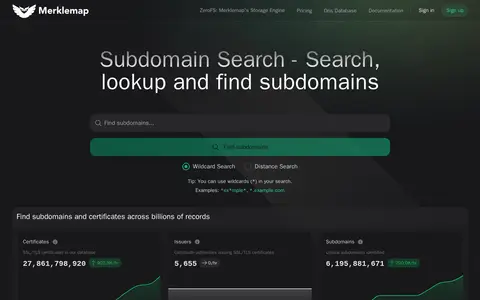
Merklemap is a subdomain and certificate transparency search engine. It collects Certificate Transparency data by live tailing CT logs and indexing certificates, and offers a web interface, an API, and a CLI for searching subdomains and SSL/TLS certificates.
Internet asset search engine for domains, IPs, ports, certificates, and exposed services.

OSINT search engine for exposed assets, IPs, domains, certificates, and network data.
Internet asset intelligence platform for domains, IPs, certificates, and exposed infrastructure.
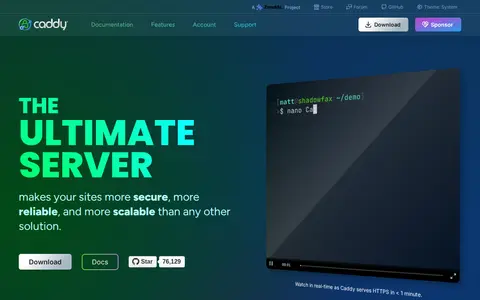
Caddy is an open source web server written in Go that automatically obtains and renews TLS certificates for sites. It includes a JSON configuration with an on-line config API, a static file server, and an HTTP reverse proxy, and can coordinate certificate management across multiple instances sharing storage.

CRT Certificate Search, known as crt.sh, is a free certificate transparency log search tool from Sectigo, formerly Comodo CA. It accepts an identity such as a domain name or organization name, a certificate fingerprint in SHA-1 or SHA-256 form, or a crt.sh ID as search input. The tool is provided by Sectigo Limited.

Let's Encrypt is a free, automated, and open Certificate Authority operated by the nonprofit Internet Security Research Group. It provides free TLS certificates so websites can enable HTTPS encryption; obtaining a certificate requires demonstrating control over the domain, and issuance uses the ACME protocol with client software.

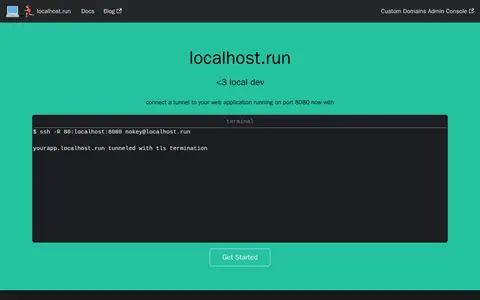
localhost.run connects web applications running on a computer to the internet using the SSH client already installed on major operating systems, with no download or signup required for free domains. It supports custom domains, automatic TLS certificates for HTTPS, and sharing URLs to show clients work or access a local application from another device.
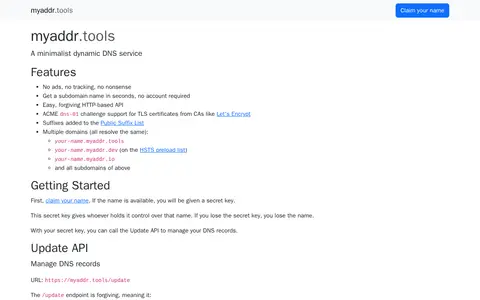
myaddr.tools is a minimalist dynamic DNS service. Users claim a subdomain name, receive a secret key, and manage DNS records through an HTTP-based update API, with support for ACME dns-01 challenges for TLS certificates. IP addresses must be updated at least once every 90 days to remain active, and registrations are deleted after 120 days without updates.