
bootsnipp.com
Snippets is a developer resource for coding, documentation, communities, security research, or software tools.
Directory
Published directory entries matching your search.
Snippets is a developer resource for coding, documentation, communities, security research, or software tools.

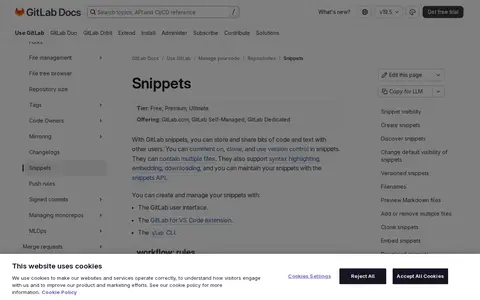
GitLab snippets lets users store and share bits of code and text with other users. Snippets can contain multiple files and support version control, commenting, cloning, embedding, downloading, and syntax highlighting. Users can create personal snippets independent of any project or project snippets tied to a specific project, and manage them through the GitLab user interface, the GitLab for VS Code extension, or the glab CLI.

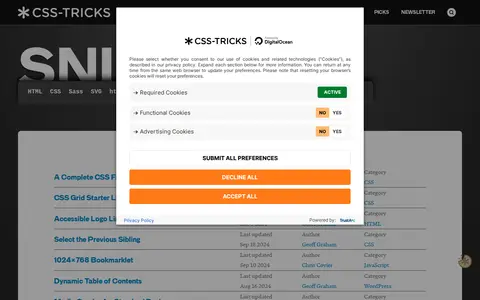
CSS-Tricks Code Snippets is a collection of code snippets for web developers covering HTML, CSS, JavaScript, PHP, WordPress, jQuery and HTAccess. Entries are organized by category and list an author and last updated date.
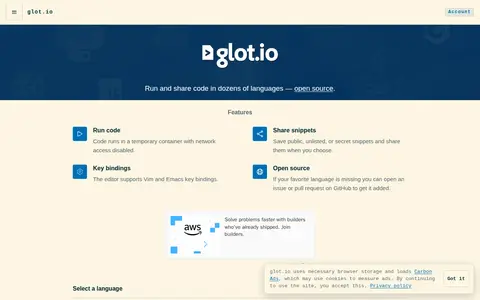
An open-source online code playground for running code in dozens of programming languages. Users can create, execute, save and share snippets, and the editor supports Vim and Emacs key bindings. Code runs in a temporary container with network access disabled. Snippets can be saved as public, unlisted or secret.

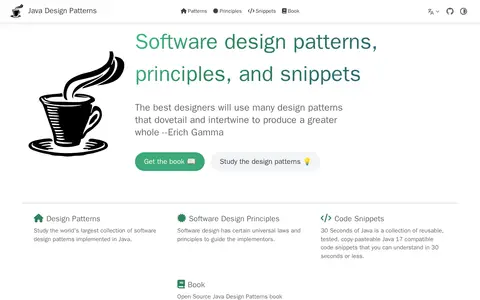
Java Design Patterns is a site showcasing Java-based design patterns, principles and code snippets. It presents a collection of software design patterns implemented in Java, software design principles, and the 30 Seconds of Java collection of reusable, tested, copy-pasteable Java 17 compatible code snippets. It also offers an open source Java Design Patterns book.
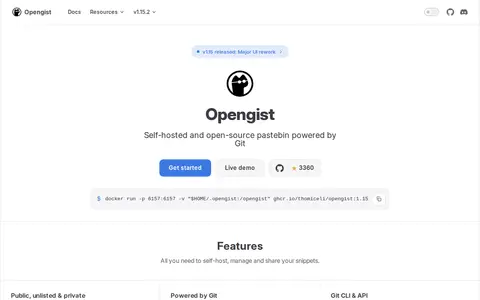
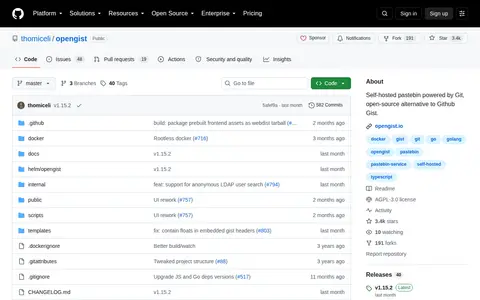
Opengist is an open-source, self-hosted pastebin powered by Git. Snippets are stored in Git repositories and can be managed with standard Git commands or a web interface. It supports public, unlisted, and private snippets, multiple files per snippet, revisions and diffs, syntax highlighting, and login through OAuth2 providers, LDAP, and passkeys. It is written in Go and can run as a single binary, Docker image, or Kubernetes deployment, backed by SQLite, PostgreSQL, or MySQL.

Opengist is a self-hosted pastebin powered by Git, described as an open-source alternative to GitHub Gist. Snippets are stored in a Git repository and can be read or modified with standard Git commands or through a web interface. It supports public, unlisted and private snippets, Git operations over HTTP or SSH, and Docker deployment.
Paste search tool for finding public pastebin-style snippets, text dumps, and shared code.

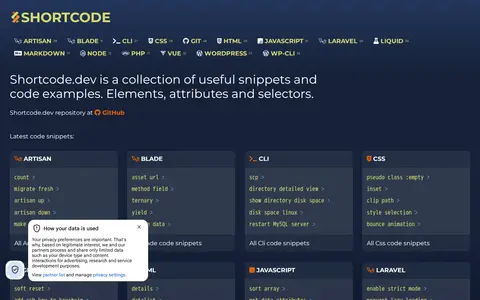
Shortcode.dev is a collection of useful snippets and code examples covering elements, attributes and selectors. Topics include Artisan, Blade, CLI, CSS, Git, HTML, JavaScript, Laravel, Liquid, Markdown, Node, PHP, Vue, WordPress and WP-CLI. The site lists code snippets and links to its repository on GitHub.

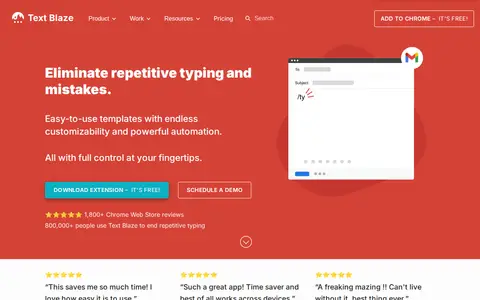
Text Blaze is a text expansion application and Chrome extension for saving reusable snippets and dynamic templates with shortcuts. Snippets can be inserted in apps such as Gmail, Google Docs, LinkedIn and Salesforce, and support forms, formulas and sharing with colleagues. It is also available as a macOS and Windows app.

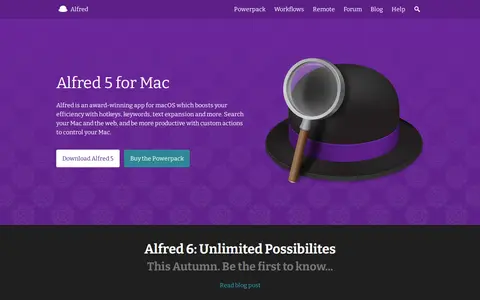
Alfred is a productivity application for macOS that uses hotkeys, keywords and text expansion to search the Mac and the web and to control the Mac through custom actions. It includes clipboard history, snippets, a calculator and 1Password bookmark access. Additional automation workflows are available with the Powerpack.

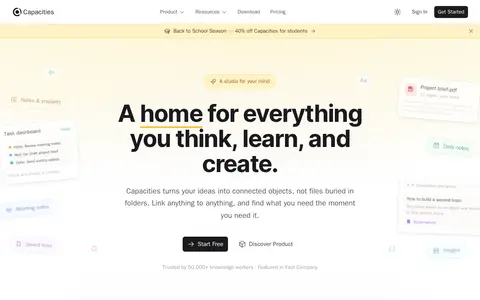
Capacities is a note-taking and knowledge management application that organizes ideas as connected objects rather than traditional files and folders. It is available for free on macOS, Windows, Linux, iOS, and Android. The app aims to provide a studio-like environment for the mind, helping users keep notes, snippets, meeting notes, daily notes, saved links, and images in a connected format.

Code generation with 🤗 is a Hugging Face Space developed by codeparrot. It allows users to generate code snippets by providing a prompt, with options to select from multiple code generation models and adjust settings such as temperature and token length.

Online code playground for testing HTML, CSS, and JavaScript snippets in the browser.

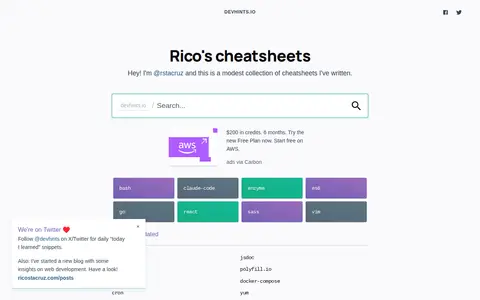
Devhints is a collection of web development cheatsheets covering topics such as JavaScript, CSS, Git, Docker, and various command line tools. Each sheet is a one-page quick reference with usage examples, links, and snippets. The site also includes guidance on writing cheatsheets and on writing Vim help files.

Online disassembly tool for reviewing binaries, shellcode, and low-level code snippets.

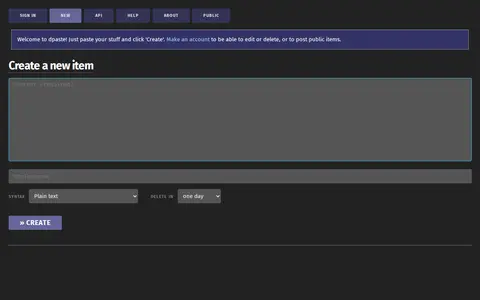
dpaste.com is a pastebin service for sharing and storing code snippets. It offers syntax highlighting, a clean interface, markup preview, and quick sharing options. Users can create public items without an account, or sign up to edit and delete their own pastes. The site supports a wide range of programming languages for syntax highlighting.

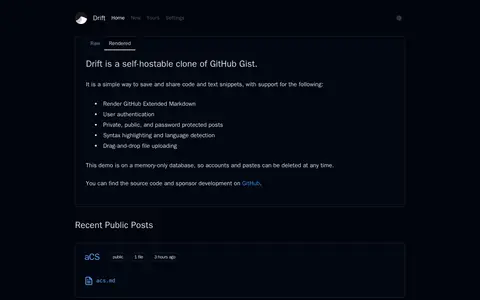
Drift is a self-hostable clone of GitHub Gist that provides a simple way to save and share code and text snippets. It supports rendering GitHub Extended Markdown, user authentication, private, public and password protected posts, syntax highlighting and language detection, and drag-and-drop file uploading.

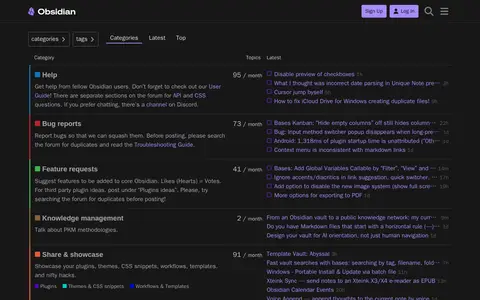
The Obsidian Forum is a place for Obsidian users to discuss Obsidian and knowledge management. Its categories cover help, bug reports, feature requests, knowledge management, and sharing plugins, themes and CSS snippets, along with developer sections for plugins, API and theme design.

A curated collection of front-end snippets intended to save time, described as practical code without fluff. The site presents examples such as buttons and checkboxes, including a frosted glass parallax button built with HTML, CSS, and JavaScript.
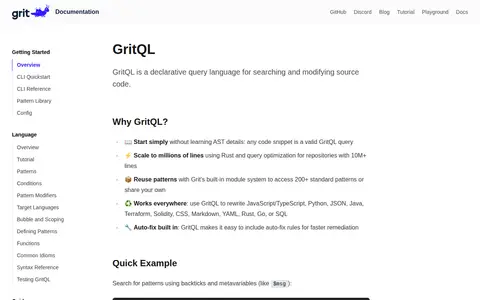
GritQL is a declarative query language from Grit for searching and modifying source code. It lets users search with code snippets and metavariables, define custom lints, and apply auto-fix rules, and it supports rewriting JavaScript/TypeScript, Python, JSON, Java, Terraform, Solidity, CSS, Markdown, YAML, Rust, Go and SQL.
Juicebox is a temporary file hosting site that accepts uploads and supports pasting text or URLs for text snippets or media. Per its documentation, it runs as two separate services, juiceback (API gateway) and juicehost (file storage), both of which are needed to handle uploads and file serving. QUIC/HTTP/3 is optional and requires compiling with the quic feature.

Maige is open-source infrastructure for running natural language workflows on a codebase. After connecting a repository, users write rules describing what should happen when issues and pull requests are opened, and the tool can label, assign, comment, review code, and run simple code snippets. It works with the GitHub API. A standard plan is offered after free use, with usage-based payment.

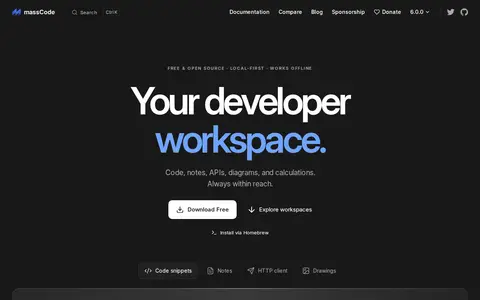
massCode is a free and open-source developer workspace for code snippets, Markdown notes, HTTP requests, calculations, and quick developer utilities. It is a local-first desktop app organized into Spaces, with a built-in AI assistant that connects to a user's own AI provider or a local model.