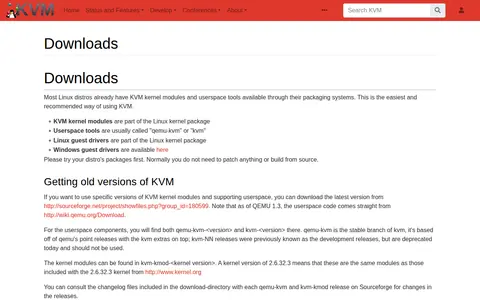
The KVM downloads page explains how to obtain KVM kernel modules and userspace tools, noting that most Linux distributions already provide them through their packaging systems, which the page calls the easiest and recommended way to use KVM. It also describes downloading older versions from Sourceforge, including qemu-kvm and kvm-kmod releases.
Directory
Search results
Published directory entries matching your search.
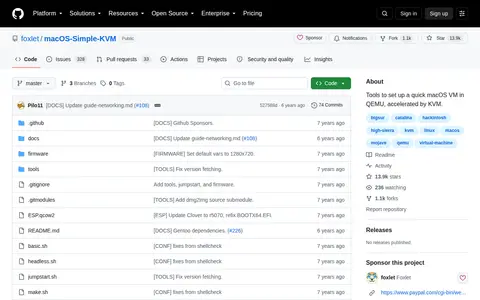
macOS-Simple-KVM provides tools to set up a quick macOS virtual machine in QEMU, accelerated by KVM. It requires a Linux system with qemu 3.1 or later, python3, pip and the KVM modules enabled; a Mac is not required. Installation media is downloaded by running jumpstart.sh, with Catalina as the default version and options for High Sierra, Mojave or Catalina, and basic.sh starts the machine.
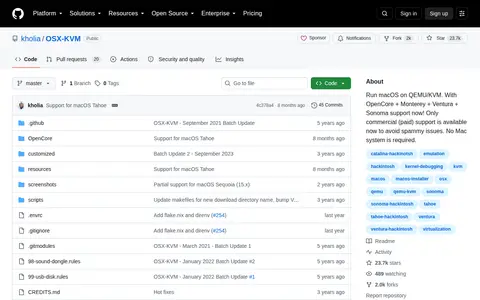
OSX-KVM is a tool that enables running macOS on QEMU/KVM. It supports OpenCore and macOS Monterey, Ventura, and Sonoma, requires no Mac system, and currently offers only commercial paid support.
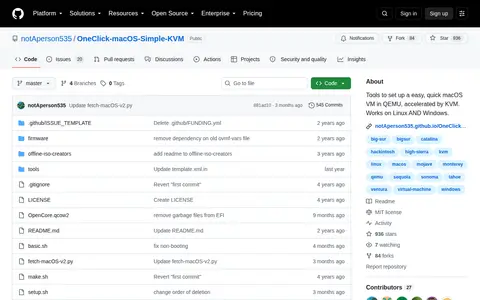
OneClick-macOS-Simple-KVM helps learn, search, or use command-line tools, shell commands, and terminal workflows.
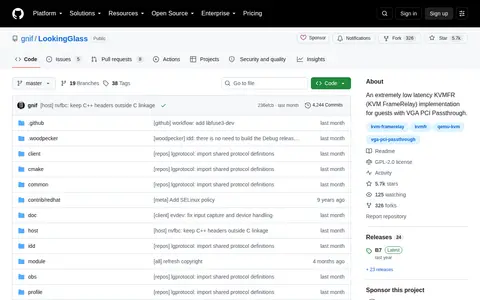
Looking Glass is an extremely low latency KVMFR (KVM FrameRelay) implementation for guests with VGA PCI Passthrough. It lets users use a Windows virtual machine from Linux with very low display and input latency. The recommended setup uses the Looking Glass Indirect Display Driver in the Windows guest and the Looking Glass Client on the Linux host. The Linux client is distributed as source code and must be built before installation.
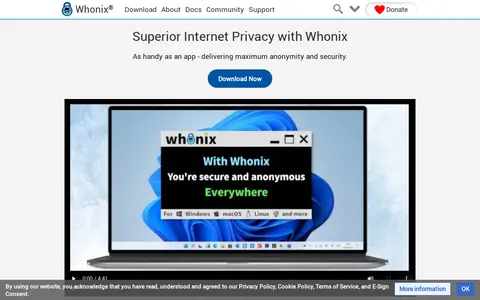
Whonix is a free, open source and Kicksecure hardened Linux distribution that runs like an app and aims to anonymize online activity. It is available for Windows, Linux, macOS, Qubes, KVM and on USB ISO. The project documentation describes itself as a crash course in anonymity and security on the Internet.
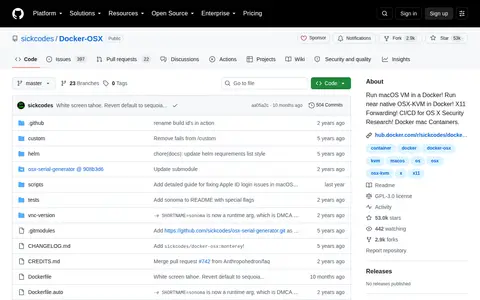
Docker OSX is a GitHub-hosted project that enables running a macOS virtual machine inside a Docker container. It uses near-native OSX-KVM, supports X11 Forwarding, and is intended for CI/CD and OS X security research use cases.
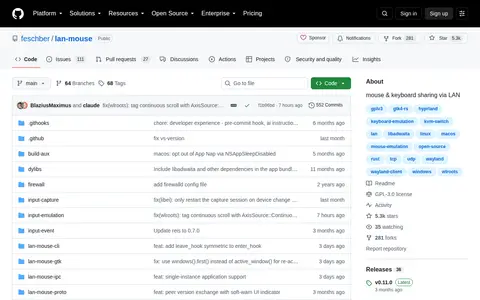
Lan Mouse is cross-platform mouse and keyboard sharing software that lets multiple PCs be used with a single mouse and keyboard, described as a software KVM switch. It is written in Rust and aims to be an open-source alternative to proprietary tools. It supports GNOME, KDE Plasma, wlroots compositors, Windows and macOS.
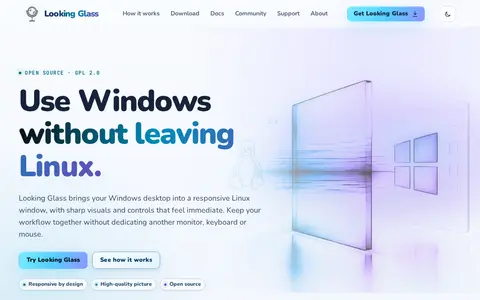
Looking Glass is open-source software for responsive, low-latency display and input, released under the GPL 2.0 licence. It brings a Windows desktop into a Linux window and is used with a KVM VGA PCI pass-through configuration without an attached physical monitor, keyboard or mouse.
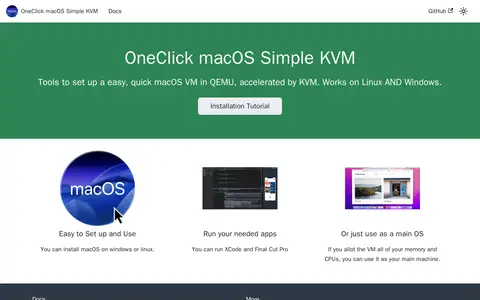
OneClick-macOS is an open-source toolset hosted on GitHub for setting up a streamlined, KVM-accelerated macOS virtual machine via QEMU. The tools are compatible with both Linux and Windows operating systems, and development is open to GitHub contributors.
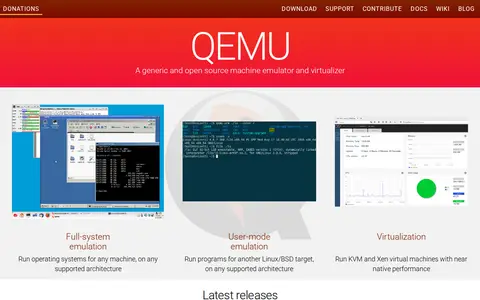
QEMU is a generic and open source machine emulator and virtualizer. It provides full-system emulation, running operating systems for any machine on any supported architecture, and user-mode emulation for running programs for another Linux/BSD target. It also runs KVM and Xen virtual machines with near native performance.