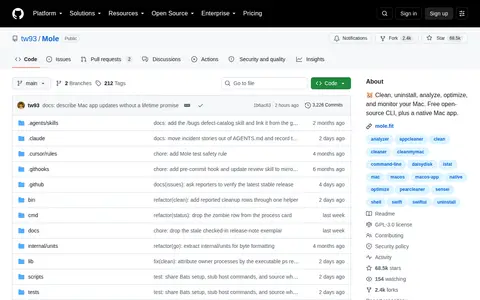

Mole is a free open-source CLI toolkit for macOS and Windows that cleans caches, logs, leftovers and orphaned app data, uninstalls apps with their leftovers, analyzes disk usage, performs system maintenance and shows live system monitoring. The repository is the CLI, called mo, installed via Homebrew or a script; Mole requires macOS 12 or newer and supports Intel and Apple Silicon Macs.
Directory
Search results
Published directory entries matching your search.
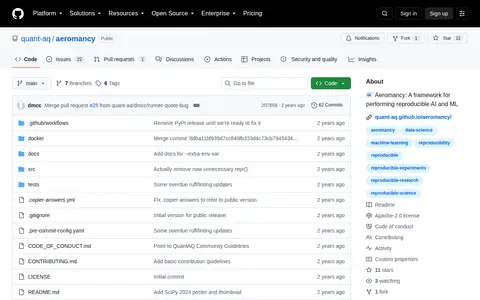
Aeromancy is an open-source GitHub repository hosted by quant-aq. It is a framework designed to support reproducible artificial intelligence and machine learning workflows. The project includes documentation, resources for common development commands, and was featured at the SciPy 2024 conference.

Open-source project that provides machine-learning models, research, training resources, or evaluation tools.
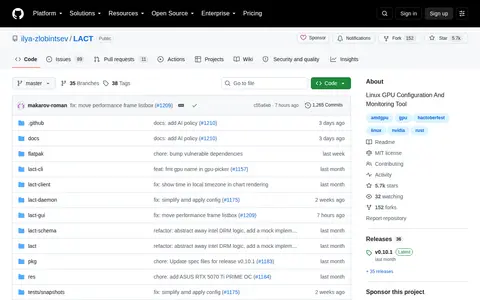
LACT is a Linux GPU configuration and monitoring tool for AMD, Nvidia and Intel GPUs. It reports detailed GPU information and provides historical charts for power, thermals and frequency with CSV export. It supports overclocking, fan control and settings profiles, and its configuration is handled by a system service that does not depend on a graphical session.
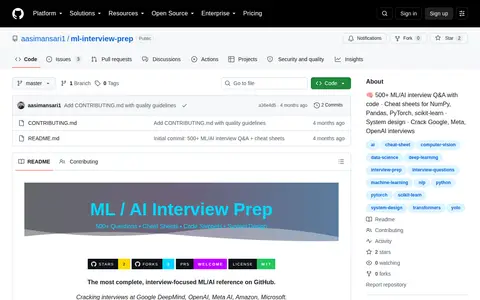
ML/AI Interview Prep is a GitHub-hosted resource collection for machine learning and artificial intelligence technical interview preparation. It includes over 500 interview questions and answers with accompanying code, cheat sheets for NumPy, Pandas, PyTorch, and scikit-learn, and system design content targeted at candidates for roles at companies including Google, Meta, and OpenAI.
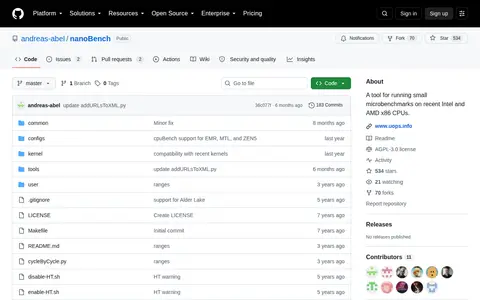
nanoBench is a Linux-based tool for running small microbenchmarks on recent Intel and AMD x86 CPUs, evaluated with hardware performance counters. It offers a user-space variant and a kernel module; the kernel module permits benchmarking privileged instructions and using uncore counters, but should not be used on a production system.
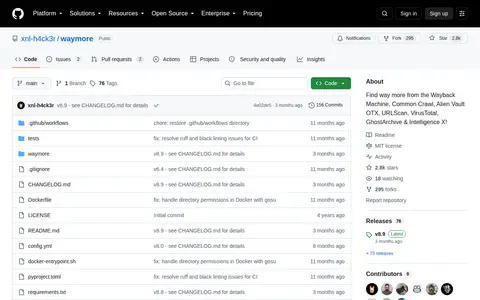
Waymore gathers links from the Wayback Machine, Common Crawl, Alien Vault OTX, URLScan, VirusTotal, GhostArchive and Intelligence X. It can also download archived responses for URLs on the Wayback Machine so those can be searched for more links, developer comments and extra parameters. The tool is intended for coverage rather than speed.
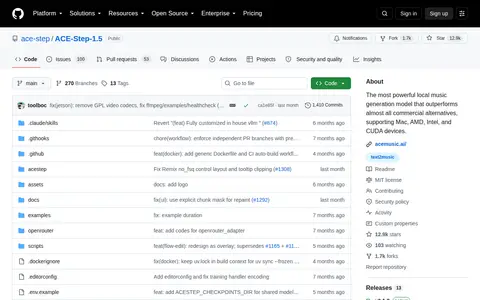
ACE-Step 1.5 is an open-source local music generation model released by the ace-step project under an MIT license. The repository states it supports Mac, AMD, Intel and CUDA devices, and describes a hybrid architecture combining a language model planner with a diffusion transformer on consumer hardware.
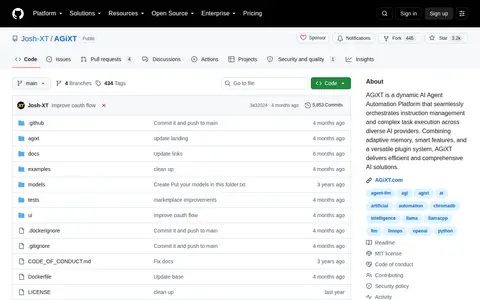
An Artificial Intelligence Automation Platform.
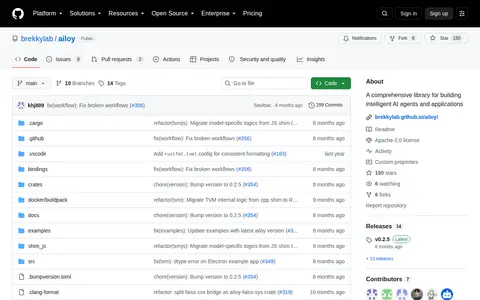
Ailoy is an open-source AI agent builder hosted on GitHub by brekkylab. It is built around a virtual machine core, provides a comprehensive library for constructing intelligent AI agents, supports easy integration of large language model APIs, and offers browser-native functionality via WebAssembly.
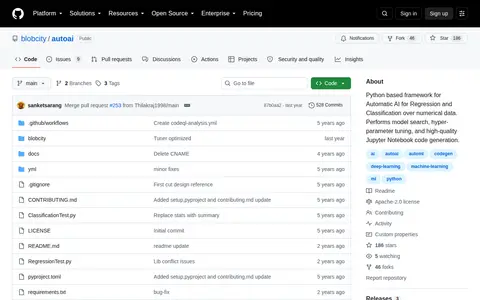
autoai is an open-source Python framework for automatic artificial intelligence focused on regression and classification tasks over numerical data. It automates model search, hyper-parameter tuning, and generates high-quality Jupyter Notebook code for resulting models.
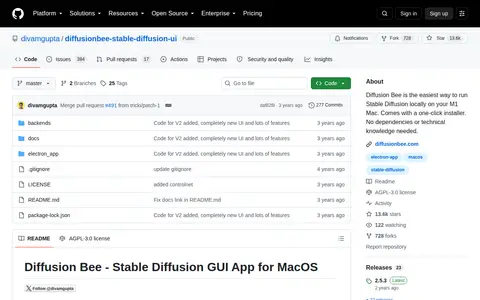
Diffusionbee Stable Diffusion UI is a GitHub-hosted project that provides a graphical user interface for running Stable Diffusion locally on macOS. It supports Intel and M1 Mac computers, includes a one-click installer, and requires no additional dependencies or technical knowledge to operate. It is listed under the AI & Machine Learning category focused on AI image generation.
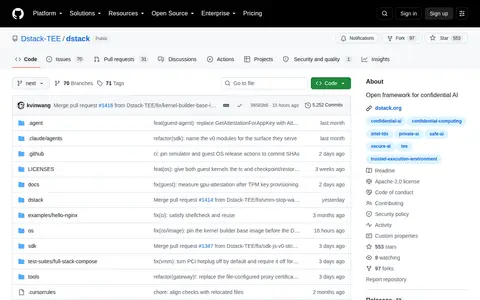
dstack is an open framework for confidential AI that runs containers inside confidential VMs with Intel TDX, using existing Docker Compose files. It supports attested workload identities and native NVIDIA Confidential Computing on H100 and Blackwell GPUs, with options for self-hosted TDX machines or Phala Cloud.
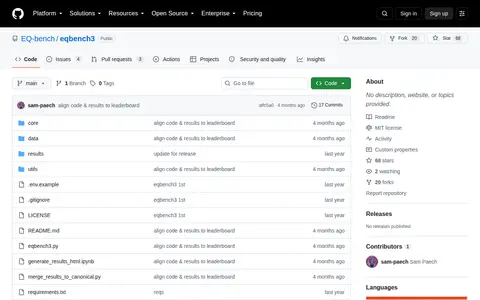
EQ-Bench 3 is a multi-turn emotional intelligence benchmark for language models. It presents role-play scenarios and analysis tasks requiring empathy, insight and social skill, and an auxiliary judge model scores or pairwise-compares the outputs. An MIT-licensed repository with a readme, results and data folders, it includes rubric scoring and pairwise ELO analysis options.
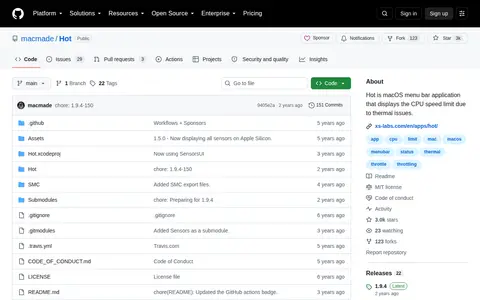
Hot is a macOS menu bar application that displays the CPU speed limit due to thermal issues. On Intel machines it shows the CPU temperature, speed limit, scheduler limit and available CPUs; on Apple Silicon it shows CPU temperature and thermal pressure, with an optional graph view for sensors. It is released under the MIT License.
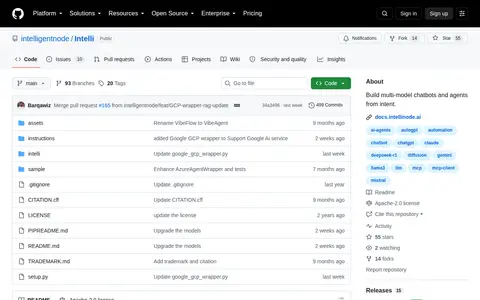
Framework to connect a flow of ML models by applying graph theory.
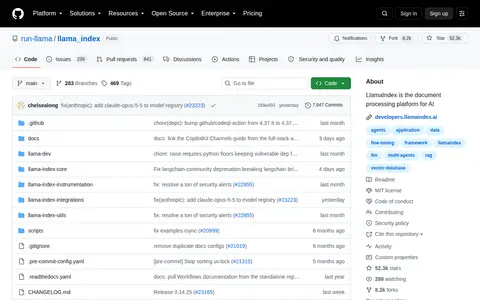
LlamaIndex is an open-source document processing platform built for artificial intelligence applications. It is maintained in a GitHub repository by run-llama, offering tools to handle documents as part of AI workflows.
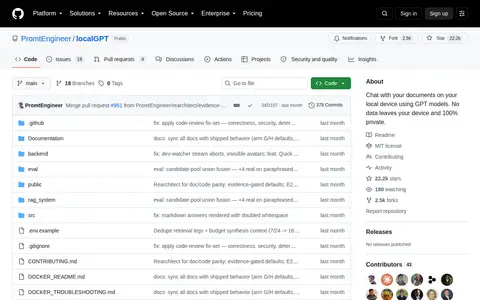
LocalGPT is an on-premise document intelligence platform that lets users chat with their documents on their local device using GPT models. It supports PDF, DOCX, HTML, Markdown, and TXT files and combines dense vector search with LanceDB full-text search and a cross-encoder reranker. It runs with a plain Python RAG core and offers generation models via Ollama.
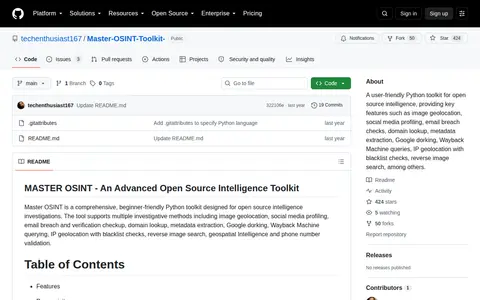
A user-friendly Python toolkit for open source intelligence, providing key features such as image geolocation, social media profiling, email breach checks, domain lookup, metadata extraction, Google dorking, Wayback Machine queries, IP geolocation with blacklist checks, reverse image search, among others.
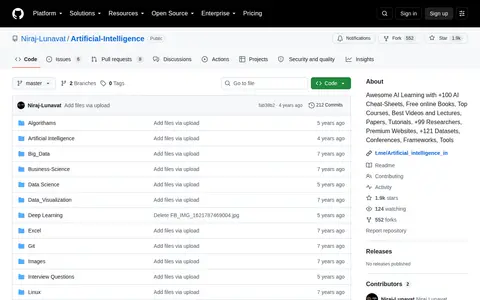
A GitHub repository collecting AI learning resources, including over 100 cheat-sheets, free online books, courses, videos and lectures, papers, tutorials, researchers, websites, datasets, conferences, frameworks and tools. Topics include machine learning, deep learning, big data, data science and Python.
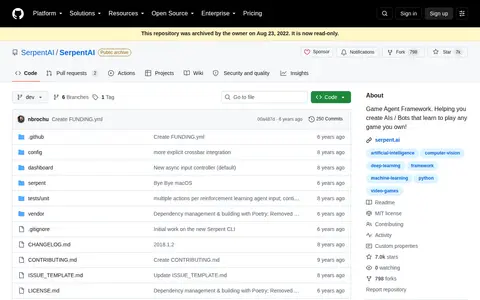
Serpent.AI is a Python-based Game Agent Framework intended to help users create artificial intelligences and bots that learn to play video games. The project was marked as end of life in November 2018, with a revival update released in May 2020.