
github.com
HDR is a GitHub repository or organization with source code, releases, documentation, or project resources.
Directory
Published directory entries matching your search.
HDR is a GitHub repository or organization with source code, releases, documentation, or project resources.
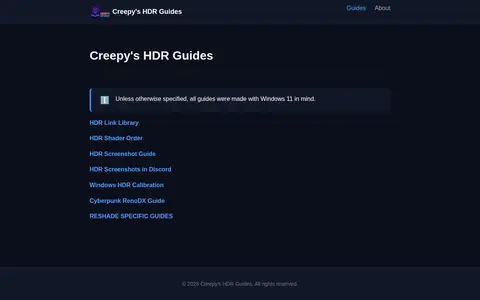
Creepy's HDR Guides is a how-to guide site focused on using ReShade with HDR. It links to guides covering HDR shader order, HDR screenshots, Windows HDR calibration and a Cyberpunk RenoDX guide. Unless otherwise specified, the guides were made with Windows 11 in mind.
Browse regional movies and television through HDrezka's title and episode pages.

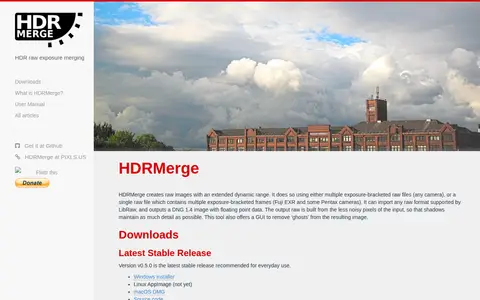
HDRMerge is a free tool that creates raw images with extended dynamic range from exposure-bracketed raw files or a single raw file containing multiple frames. It imports formats supported by LibRaw and outputs DNG 1.4 images with floating point data. It offers a GUI for removing ghosts and a command line interface for batch processing.

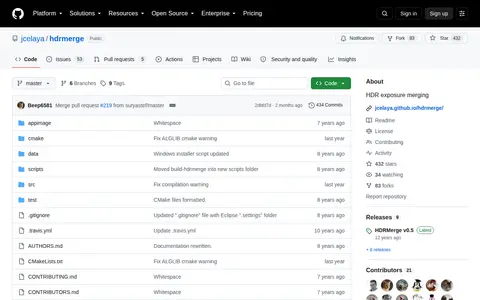
Hdrmerge is a code repository or project page with source code, releases, documentation, or setup notes.

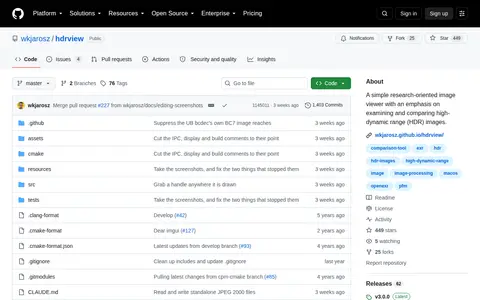
HDRView is a research-oriented image viewer for examining and comparing high-dynamic-range images. It runs on macOS, Linux and Windows, with a slightly limited version in the browser, and offers live exposure, black-point and gamma tonemapping, false-color modes over 17 built-in colormaps, and clip warnings via zebra striping.

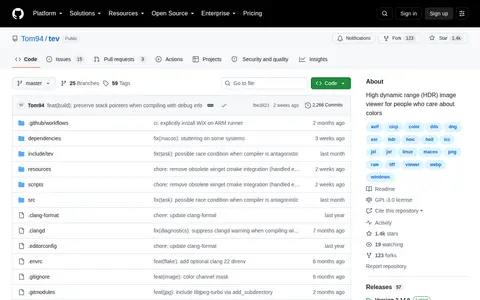
tev is a high dynamic range (HDR) image viewer for people who care about colors. It understands HDR and color profiles and displays HDR on all operating systems, and supports many file formats including gain maps, aux channels and animation.

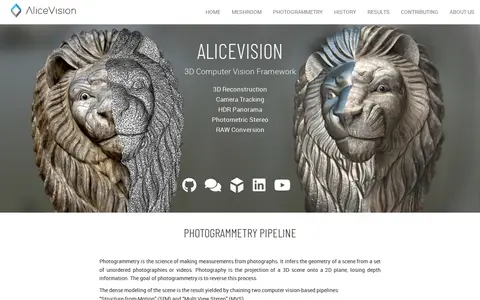
AliceVision is an open-source 3D Computer Vision framework for 3D reconstruction, camera tracking and HDR panoramas. Meshroom is its node-based desktop app, available for Windows and Linux under the MPL-2.0 license. It offers templates for photogrammetry, camera tracking, HDR and panorama, photometric stereo, and calibration and utilities.

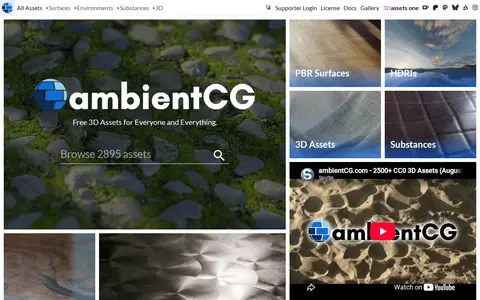
ambientCG offers free 3D assets, including over 2000 PBR materials, HDRIs and other items, released under the CC0 Public Domain license. The site lists categories such as PBR surfaces, HDRIs, substances, 3D assets, paving stones, rocks, ice and snow, and tiles.
The UWA Profiles and Research Repository is an open platform that facilitates the discovery of UWA publications and people. It is intended for finding information on the research, teaching, funding and engagement of UWA staff and HDR students, and for accessing UWA research outputs. UWA staff and HDR students can log in to update their profile.

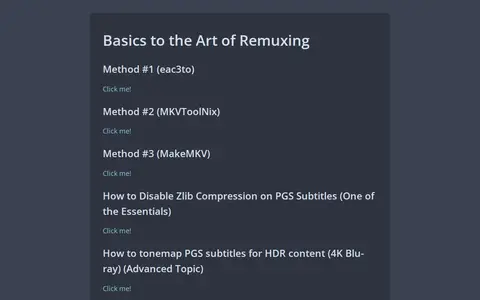
A guide on remuxing that presents three methods, using eac3to, MKVToolNix and MakeMKV, along with sections on disabling zlib compression on PGS subtitles and tonemapping PGS subtitles for HDR content.
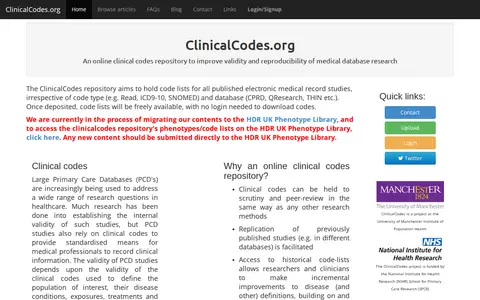
ClinicalCodes.org is an online repository for clinical code lists from published electronic medical record studies, intended to support validity and reproducibility of medical database research. It aims to hold code lists for all code types and databases, with deposited lists freely downloadable without login. Contents are being migrated to the HDR UK Phenotype Library, and new content should be submitted there.

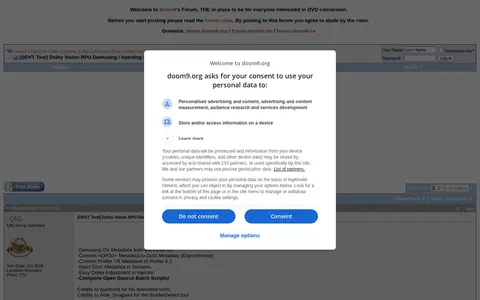
DDVT Tool is a set of open source batch scripts for working with Dolby Vision metadata. It demuxes DV metadata from MKVs and MP4s, converts HDR10+ metadata to DoVi metadata, converts Profile 7/5 metadata to Profile 8.1, and injects DoVi metadata into streams. The injector includes delay adjustment. It is based on quietvoid's tools.

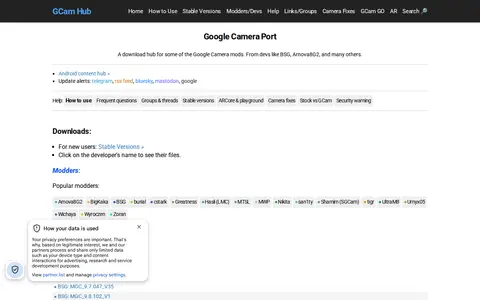
This site is a download hub for modified Google Camera ports, also known as Pixel Camera, by modders including BSG, Arnova8G2, BigKaka and Shamim. It mirrors files and lists recent updates by developer; it is not the official app. Google Camera has features such as HDR+, portrait mode, motion photos, panorama, lens blur, 60fps video and slow motion.
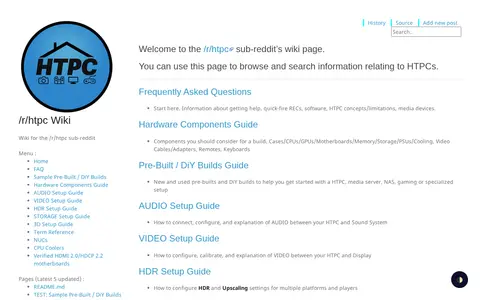
A wiki page for the /r/htpc sub-reddit that offers browsable and searchable information relating to HTPCs. It includes a FAQ, hardware components guide, pre-built and DIY builds guide, audio, video, HDR, storage and 3D setup guides, a term reference, NUC and CPU cooler lists, and verified HDMI 2.0/HDCP 2.2 motherboards.

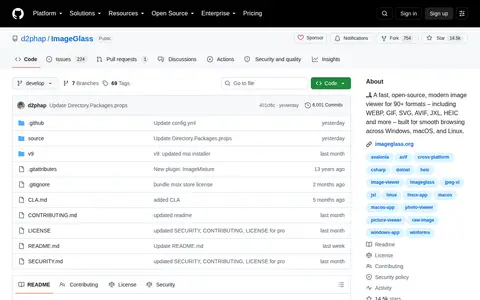
ImageGlass is a fast, modern, open-source image viewer built for Windows, macOS, and Linux. It provides navigation across 90+ image formats, including WEBP, JXL, SVG, HEIC, AVIF, HDR, and raw images. It is primarily a photo viewer with some focused editing capabilities.

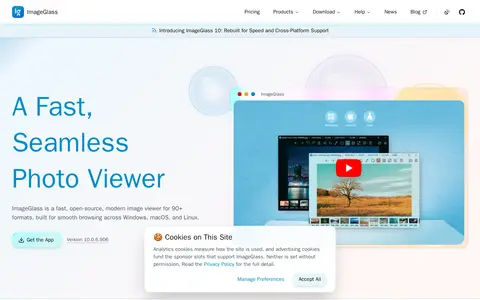
ImageGlass is a free, open-source image viewer for more than 90 formats, including WEBP, GIF, SVG, HEIC and RAW. Version 10 is rebuilt on .NET and Avalonia as a single codebase for Windows, macOS and Linux. The viewer includes a color picker, EXIF metadata viewing, crop and resize tools, frame navigation and HDR tone mapping.

Moonlight is an open source game streaming client and implementation of NVIDIA's GameStream protocol that allows users to play PC games remotely on supported devices. It offers streaming at up to 4K with HDR support and up to 120 FPS, and can run on a self-hosted gaming server.

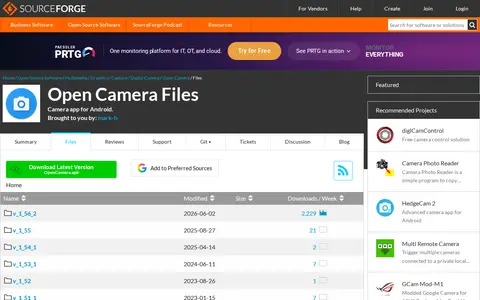
Open Camera is an open source camera app for Android phones and tablets. It offers options such as auto-level, scene modes, color effects, white balance, ISO, HD video, timer, auto-repeat mode and Bluetooth LE remote control. It also supports HDR, exposure bracketing, panorama and manual controls through the Camera2 API.

OSMC is a free and open source media center built on Debian Linux and Kodi Media Center. It offers an App Store for customization and plays major media formats from various devices and streaming protocols. Vero V is the project's flagship device, with support for 4K, HDR and HD audio.
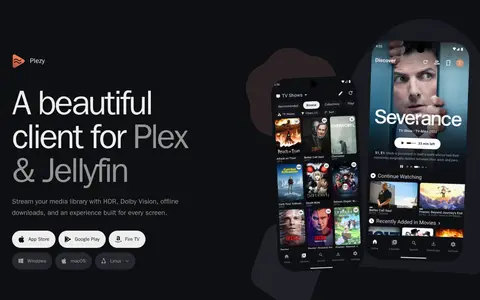
Plezy is a client for Plex and Jellyfin. It is available on iOS, Android, Android TV, tvOS, Windows, macOS and Linux. The site also mentions HDR, Dolby Vision and offline downloads.

SFMLab is an independent site where artists share 3D resources, including models, textures, sceneries and HDRIs, for use in modern 3D tools and Source Filmmaker. Users can upload resource files and download them for free. It is part of the Open3DLab network, alongside Open3DLab and SmutBase.

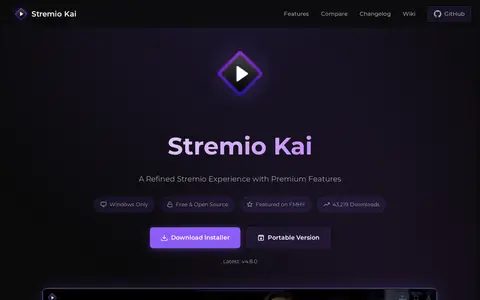
A Windows-only fork of Stremio Community Edition offering HDR passthrough, automatic intro and outro detection, and smart audio and subtitle selection. It also adds enhanced metadata with multiple rating sources, UI-driven player settings, and optional anime upscaling and motion interpolation. The build uses the same account system, so addons and settings sync automatically.

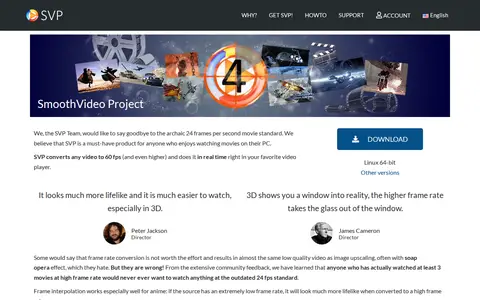
SVP (SmoothVideo Project) performs real-time video frame rate conversion, converting any video to 60 fps or higher within a video player. It uses frame interpolation, supports NVIDIA Optical Flow and RIFE neural network interpolation, and works with most players including Plex and VLC. It also supports 4K/HDR, VR and BD3D in selected players, with a one-click converter and a mobile app.