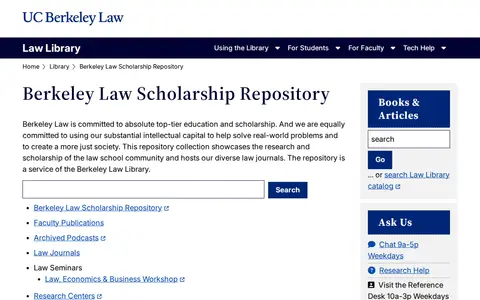

Berkeley Law Scholarship Repository is a service of the Berkeley Law Library. It showcases the research and scholarship of the Berkeley Law community and hosts the school’s diverse law journals. The repository also includes faculty publications, archived podcasts, law seminar materials, and content from Berkeley Law research centers.
Directory
Search results
Published directory entries matching your search.
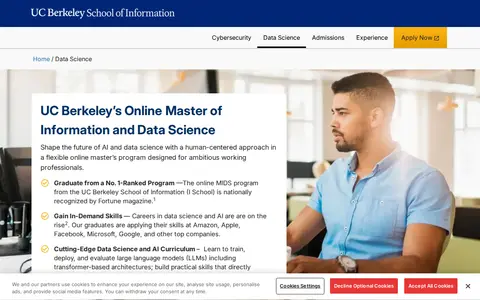
Data Science Degree @ Berkeley refers to the UC Berkeley School of Information's online Master of Information and Data Science (MIDS) program. The program is designed for working professionals, features a rigorous holistic curriculum, flexible program paths, and a capstone component, and is nationally recognized by Fortune.
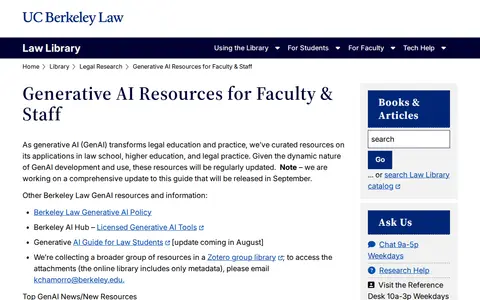
A curated UC Berkeley Law Library guide collecting resources on generative AI applications in law school, higher education, and legal practice. It links news, studies, ethics materials and access-to-justice research, and notes that the resources will be regularly updated.
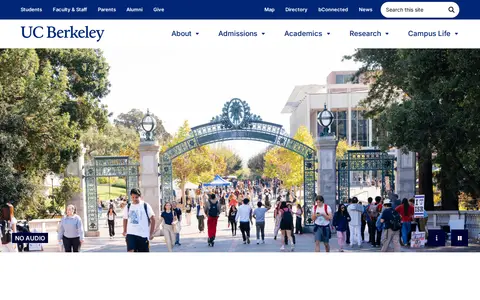
University of California, Berkeley is a public research university offering over 115 undergraduate and 300 total degree programs across 15 schools and colleges. It conducts research in areas including Alzheimer's treatment, artificial intelligence, and space exploration, employs 11 Nobel laureates on faculty, is ranked the top public research university in the US by multiple major publications, and has created hundreds of inventions from its research including malaria and cancer treatments, gene editing tools, and search engines.
The Berkeley Drosophila Genome Project is a consortium of the Drosophila Genome Center that provides genome sequence data, annotations, clones and analysis tools. BDGP will conclude operations on January 1, 2026, and fruitfly.org will be retired soon after; users are directed to self-host the splice-site and promoter prediction tools.
Independent newsroom covering Berkeley government, schools, housing, public safety and neighborhood life.
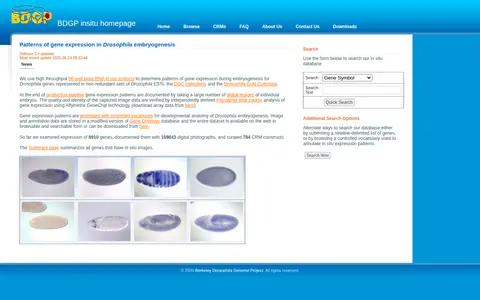
Database of Drosophila embryogenesis gene expression patterns generated with a high-throughput RNA in situ protocol. Expression patterns are documented with digital embryo images, annotated with controlled vocabulary, and stored in a modified Gene Ontology database. The dataset is browsable, searchable, and downloadable.
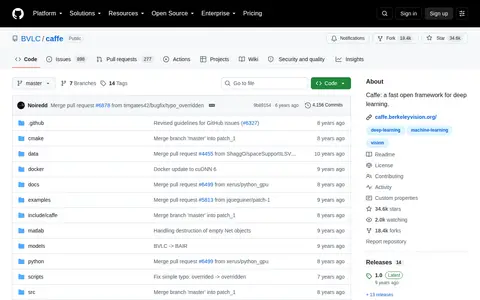
Caffe is a deep learning framework developed by Berkeley AI Research and community contributors, designed with expression, speed, and modularity in mind. It is released under the BSD 2-Clause license and includes associated reference models.
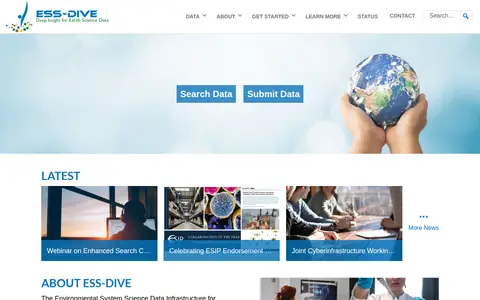
ESS-DIVE is a data repository for Earth and environmental sciences. It collects, stores, manages and shares environmental systems data from research sponsored by the U.S. Department of Energy. It offers data submission, review, publication, storage and search services, and lists support for curating FAIR and AI-ready data. It is maintained by Lawrence Berkeley National Laboratory.
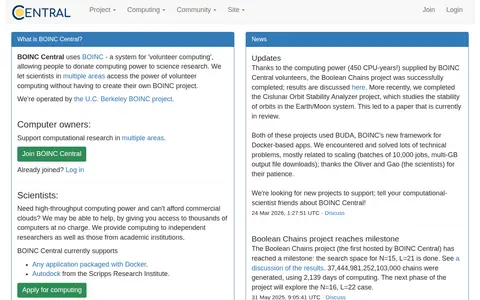
BOINC Central is a volunteer computing service operated by the U.C. Berkeley BOINC project. It lets scientists in multiple areas access volunteer computing power without creating their own BOINC project. It currently supports any application packaged with Docker, and provides computing to independent researchers as well as those from academic institutions. Computer owners donate computing power to support computational research in multiple areas.
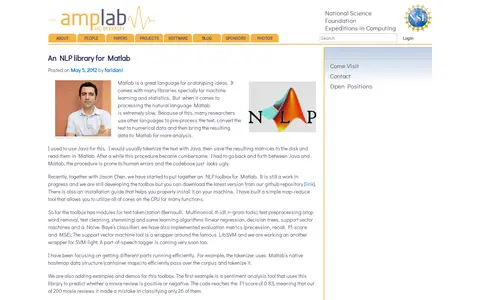
An NLP toolbox for Matlab under development by researchers at UC Berkeley's AMPLab, intended to process natural language within Matlab rather than switching to other languages. It includes modules for text tokenization, text preprocessing such as stop word removal and stemming, and learning algorithms including linear regression, decision trees, support vector machines and a Naive Bayes classifier.
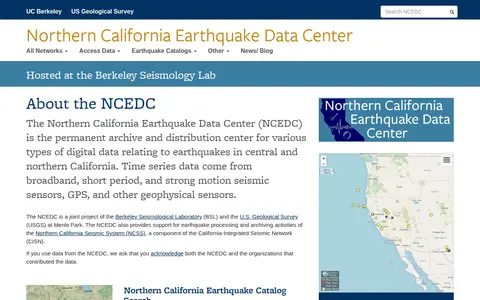
The Northern California Earthquake Data Center is a joint project of the Berkeley Seismological Laboratory and the U.S. Geological Survey. It serves as a permanent archive and distribution center for digital data on earthquakes in central and northern California, including time series data from seismic, GPS and other geophysical sensors. Online catalogs and web services support data queries.
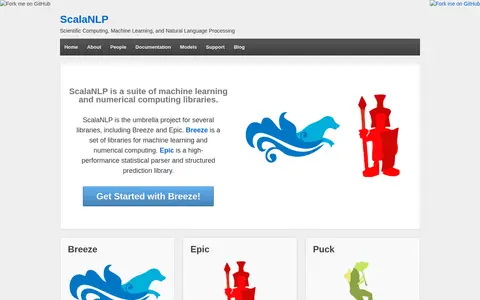
ScalaNLP is an umbrella project for machine learning and numerical computing libraries, including Breeze and Epic. Breeze covers linear algebra, numerical computing and optimization. Epic is a statistical parser and structured prediction library. The site also lists Puck, a GPU-powered parser built on grammars produced by the Berkeley Parser.
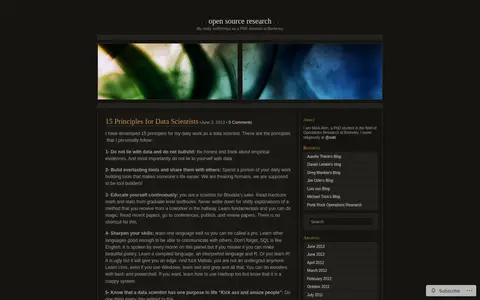
A personal blog by a PhD student at Berkeley that hosts notes and posts on data science, programming and machine learning topics. Entries include 15 principles for data scientists, C++11 learning notes, a Mandelbrot fractal in Python and notes from conference talks.
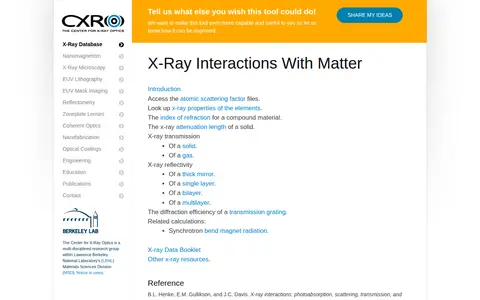
The X-Ray Database is a reference from the Center for X-Ray Optics at Lawrence Berkeley National Laboratory. It provides access to atomic scattering factor files and lookups of x-ray properties of the elements, plus calculations for index of refraction, attenuation length, transmission, reflectivity and diffraction efficiency. It cites X-ray interaction data covering E=50-30000 eV for Z=1-92.