
archive.org
Annotations Data Archive is an Internet Archive item or collection for preserved media, files, or records.
Directory
Published directory entries matching your search.
Annotations Data Archive is an Internet Archive item or collection for preserved media, files, or records.

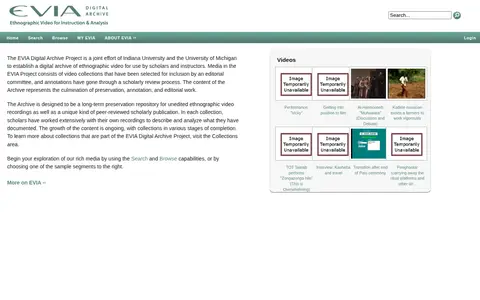
A joint project of Indiana University and the University of Michigan that maintains a digital archive of ethnographic video for scholars and instructors. Collections are chosen by an editorial committee and annotations undergo scholarly review. The archive serves as a long-term preservation repository for unedited ethnographic recordings and a peer-reviewed scholarly publication; content growth is ongoing across collections.

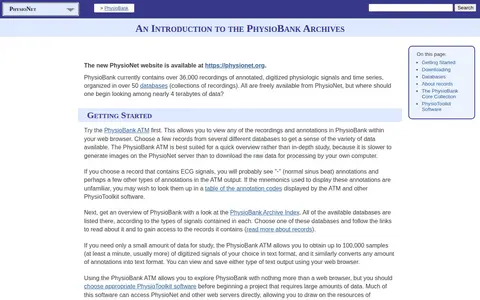
PhysioBank is an archive of annotated, digitized physiologic signals and time series, organized into more than 50 databases with over 36,000 recordings. The recordings are freely available from PhysioNet. A browser-based PhysioBank ATM allows viewing records and annotations or obtaining limited samples in text format. PhysioToolkit software can read data directly from the PhysioNet server without downloading files first.
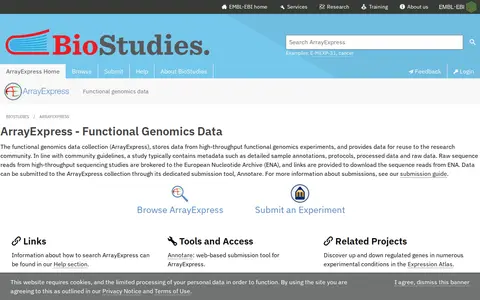
ArrayExpress is a functional genomics data collection that stores data from high-throughput functional genomics experiments and provides data for reuse to the research community. A study typically contains metadata such as sample annotations, protocols, processed data and raw data. Raw sequence reads are brokered to the European Nucleotide Archive, with links provided.

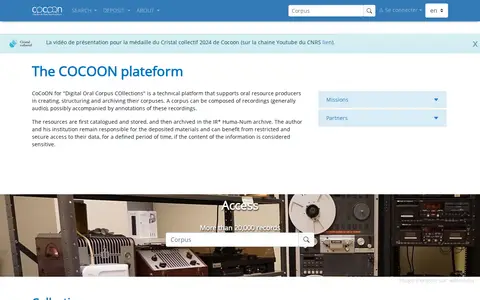
CoCoON is a technical platform that supports producers of oral resources in creating, structuring and archiving corpora, which may contain audio recordings and annotations. Resources are catalogued, stored and archived in the Huma-Num archive, while authors and their institutions remain responsible for deposited materials. The platform is jointly managed by LACITO, LLL and Huma-Num.

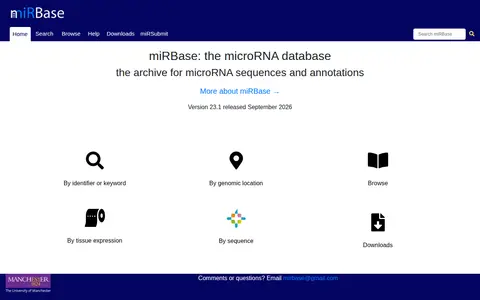
miRBase is a database described as the archive for microRNA sequences and annotations. It supports searching by identifier or keyword, by genomic location, and by tissue expression, and offers downloads. The site notes version 23.1, released September 2026.

CVAT is a data annotation platform for turning images, videos, audio and 3D data into datasets for AI models. It supports importing data from local files and cloud storage, managing projects, tasks and jobs, labeling with manual and automated tools, validating annotations, monitoring progress and exporting datasets in formats including COCO, YOLO, KITTI, Cityscapes and Pascal VOC. CVAT began as an internal tool at Intel in 2017 and was released as open source on GitHub in 2018.