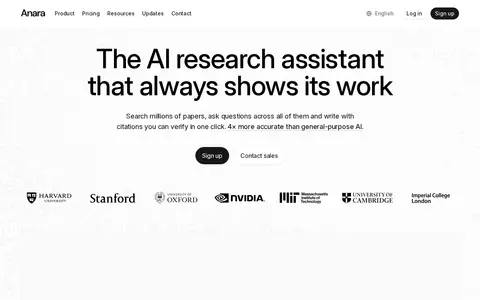

Anara is an AI research assistant and workspace designed for research workflows. It allows users to search personal document libraries and the web, write with automatically generated source citations, and access answers that link to the exact source passage for verification. The tool is intended for high-stakes research use cases including academia.
Directory
Search results
Published directory entries matching your search.
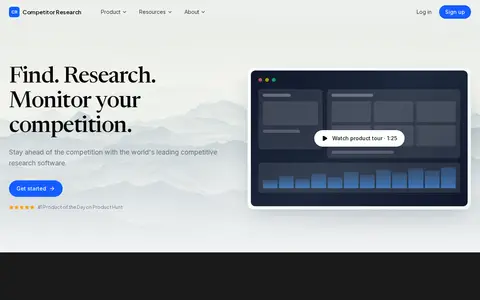
Competitor Research is a competitive research tool. It takes a website URL and produces a ranked list of competitors, which users can curate into watchlists. It provides profiles covering positioning, pricing, launches, and other data, and sends weekly signals about competitor changes. Some features, including real-time change alerts and SEO and keyword movement, are listed as coming soon.
The Journal of Artificial Intelligence Research (JAIR) is a journal dedicated to the rapid dissemination of important research results to the global AI community. Its scope encompasses all areas of AI, including agents and multi-agent systems, automated reasoning, knowledge representation, machine learning, natural language, planning and scheduling, robotics and vision, and uncertainty in AI.
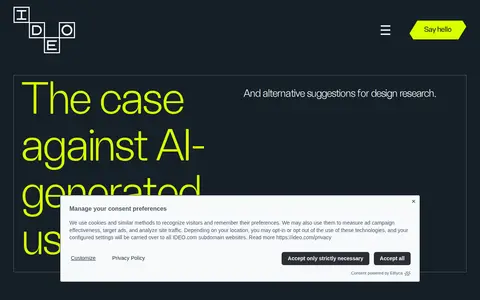
The case against AI-generated users is an IDEO journal article that explores the use of AI-generated synthetic users for design research. It discusses alternative methods to meet research goals, compares the value of traditional design research to outputs from large language models, and offers forward-looking perspectives on design research practices.
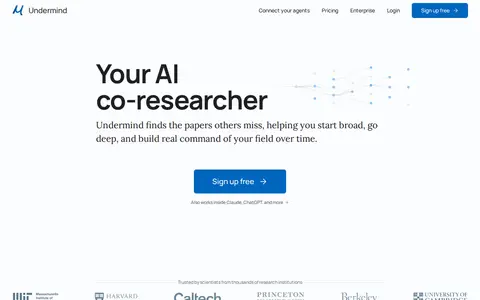
Undermind - AI-Powered Scientific Research Assistant supports AI-assisted research, knowledge retrieval, summarization, or source analysis.
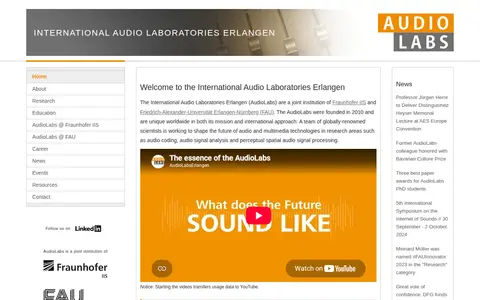
Audiolabs, formally the International Audio Laboratories Erlangen, is a joint research institution operated by Fraunhofer IIS and Friedrich-Alexander-Universität Erlangen-Nürnberg (FAU), founded in 2010. The organization conducts research in audio and multimedia technologies, with focus areas including audio coding, audio signal analysis, and perceptual spatial audio signal processing. It also hosts academic events including the International Symposium on the Internet of Sounds.
Helps find, analyze or synthesize information for research and knowledge discovery.
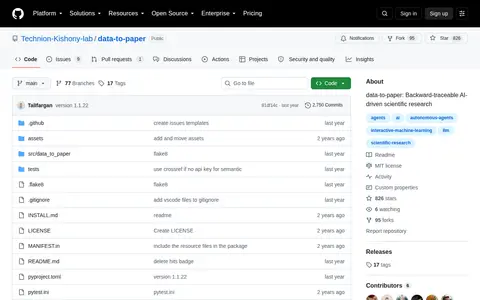
Data-to-paper: AI-driven research from data to human-verifiable research papers.
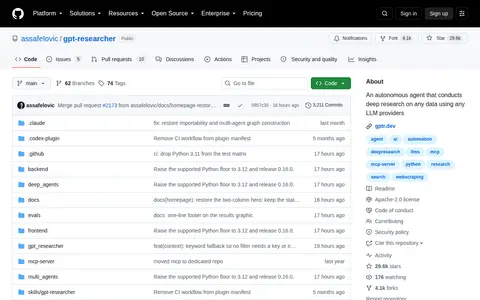
GPT Researcher is an open deep research agent for web and local research. Its sources describe planner and execution agents that break tasks into research questions, with findings aggregated into cited research reports.
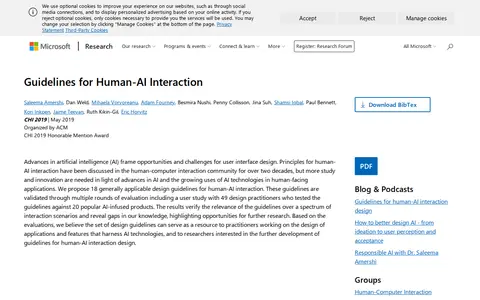
Microsoft Research publication proposing 18 generally applicable design guidelines for human-AI interaction. The guidelines were validated through evaluation rounds, including a user study with 49 design practitioners who tested them against 20 AI-infused products. The authors state the guidelines can serve as a resource for practitioners designing AI applications and for researchers developing interaction design guidelines.
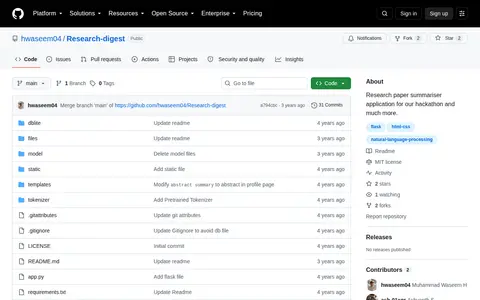
Research-Digest is a Flask application that scrapes arXiv weekly for newly published papers in fields including computer vision and machine learning, then offers a summarization feature so users can grasp key points. Summarization uses a T5 model finetuned on scientific articles, with weights and tokenizers stored locally.
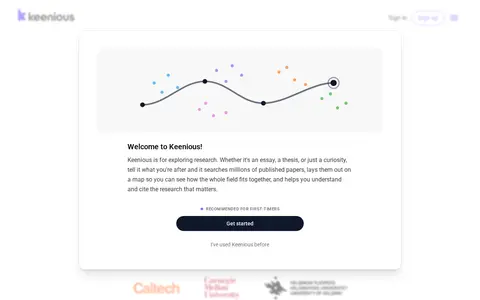
Keenious is an AI-assisted tool for exploring published academic research. It searches about 177M publications, groups results into research areas on a map, and explains unfamiliar terms, methods, and statistics beside the paper. It also translates studies published in other languages. The source states it does not write essays, paragraphs, or assignment outlines.
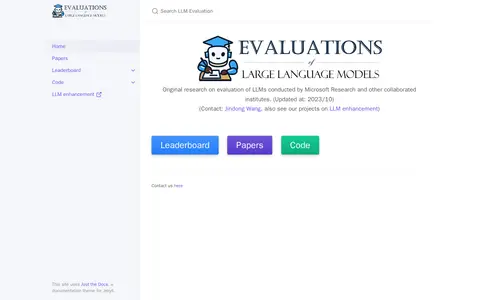
Research on evaluation of LLMs conducted by Microsoft Research and other collaborated institutes. (Updated at: 2023/10).
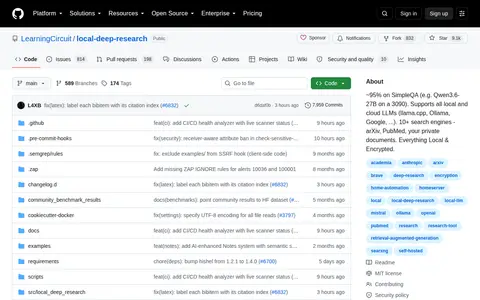
Local Deep Research is a tool that achieves approximately 95% accuracy on the SimpleQA benchmark, with an example run using Qwen3.6-27B on an RTX 3090. It supports all local and cloud LLMs including llama.cpp, Ollama, and Google models, integrates over 10 search engines such as arXiv, PubMed, and private document sources, and operates with local and encrypted processing.
Multi-Agent AI - Deep Research is a Hugging Face Space developed by bstraehle. Users provide an OpenAI API key and a research topic, and the application generates a detailed research article based on the provided input. The space is currently sleeping due to inactivity.
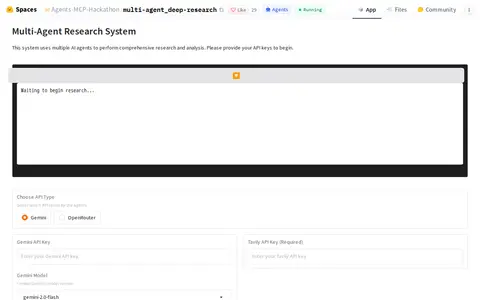
Multi-agent Deep-research System is a Hugging Face Space created by Agents-MCP-Hackathon. The system uses AI agents to perform web searches and analyze information, generating detailed research reports in response to user-provided research questions. Users must supply API keys for web search functionality. The space is currently running.
Phenaki is a Google Research model that synthesizes realistic videos from textual prompt sequences. It uses an encoder-decoder tokenizer for variable-length videos and a transformer that translates text embeddings to video tokens, trained jointly on image-text and video-text data.

Gemini Notebook supports AI-assisted research, knowledge retrieval, summarization, or source analysis.
Helps find, analyze or synthesize information for research and knowledge discovery.
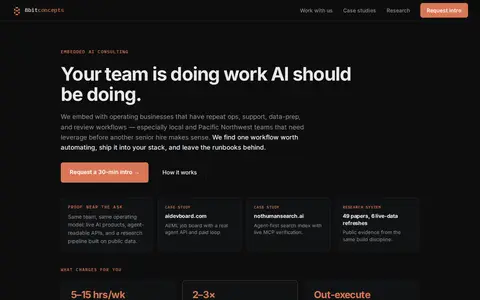
8bitconcepts is an embedded AI consulting practice that works inside operating businesses to ship AI workflow and process systems. It targets repetitive operations, support, data-preparation and review workflows, and publishes research papers and data snapshots alongside live AI products.
An article by Andy Baio examining how AI companies use datasets and models from academic and nonprofit research groups. It describes Meta's Make-A-Video using Shutterstock clips and YouTube videos collected by Microsoft, and notes nonprofit datasets used for Stable Diffusion and other models. It argues this outsourcing shifts accountability and legal liability away from corporations.
25th Aug, 2023 Feature: Adding TextArea for custom prompts.
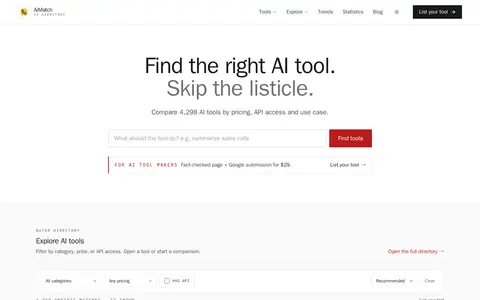
aimatchpro supports AI-assisted research, knowledge retrieval, summarization, or source analysis.