The Triticeae Toolbox hosts public breeding databases for wheat, oat and barley. It includes publicly accessible curated databases for wheat and oat, sandbox versions of these databases for user testing, a private wheat database for approved WheatCAP participants, and discontinued classic versions of the wheat and oat databases containing data up to early 2020.
Directory
Search results
Published directory entries matching your search.
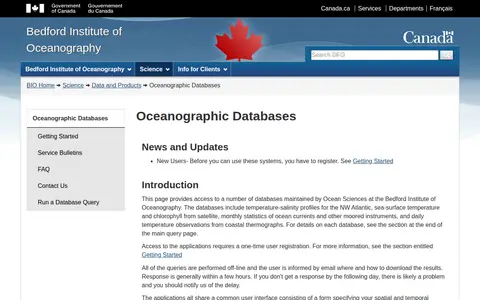
The Bedford Institute of Oceanography provides access to oceanographic databases maintained by Ocean Sciences. The databases cover temperature-salinity profiles for the NW Atlantic, satellite sea-surface temperature and chlorophyll, monthly statistics of ocean currents and moored instruments, and daily coastal thermograph observations. Access requires a one-time user registration, and queries run off-line with results sent by email.
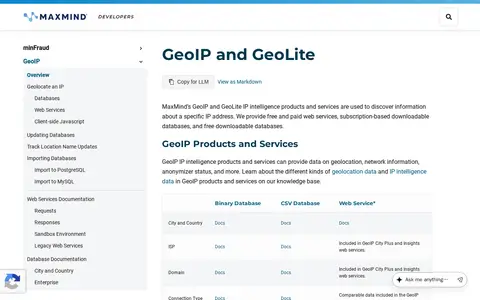
GeoLite databases and web services from MaxMind provide free geolocation and limited network data for IP addresses. The data is less accurate than MaxMind's paid GeoIP products. A free GeoLite account is required to download databases or query the web services, which use the same integration methods and documentation as GeoIP with minor modifications.
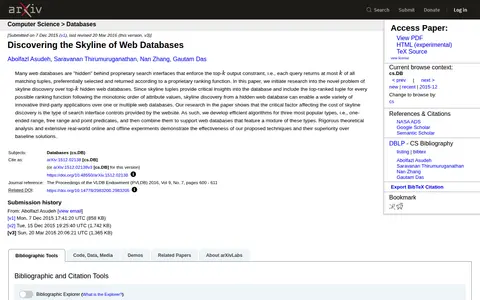
An arXiv paper on discovering skylines over hidden web databases whose search interfaces enforce a top-k output constraint. It examines how search interface controls affect discovery cost and develops algorithms for one-ended range, free range and point predicates, combined for mixed interfaces. Experiments over real-world online and offline databases are reported.
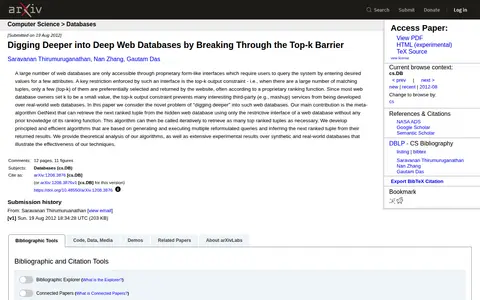
An arXiv paper on digging deeper into hidden web databases limited by the top-k output constraint. It presents the GetNext meta-algorithm, which retrieves the next ranked tuple through a restrictive interface without prior knowledge of the ranking function, and algorithms that generate and execute multiple reformulated queries. Theoretical analysis and experiments over synthetic and real-world databases are reported.
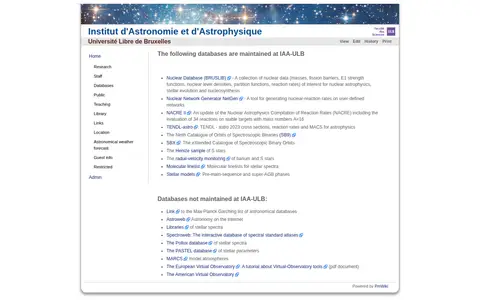
The Institut d'Astronomie et d'Astrophysique at Université Libre de Bruxelles maintains databases for nuclear and spectroscopic data relevant to astrophysics. Listed resources include BRUSLIB, a collection of nuclear data, NetGen, a tool for generating nuclear-reaction rates on user-defined networks, and an updated compilation of reaction rates. Spectroscopic databases and molecular linelists are also listed.
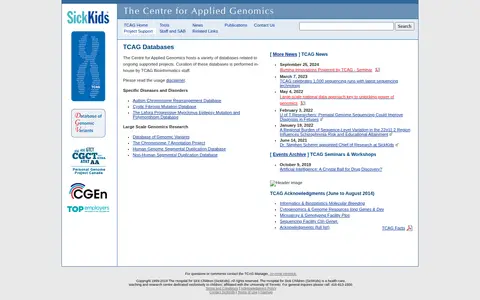
The Centre for Applied Genomics hosts databases related to its ongoing supported projects. Curation is performed in-house by TCAG Bioinformatics staff. The databases cover specific diseases and disorders, including autism and cystic fibrosis, as well as genomic research topics such as genomic variants, chromosome 7 annotation, and segmental duplications.
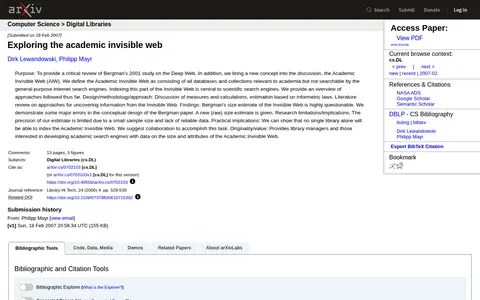
This arXiv paper by Dirk Lewandowski and Philipp Mayr provides a critical review of Bergman's 2001 study on the Deep Web. It introduces the concept of the Academic Invisible Web, defined as databases and collections relevant to academia but not searchable by general-purpose internet search engines, and reviews approaches for indexing it. The authors question Bergman's size estimate and suggest collaboration.
Al Manhal is a Dubai-based provider of Arabic scholarly content databases and an online Arabic bookstore. It offers full-text searchable databases of eBooks, eJournals, eTheses, children's Arabic levelled readers, Middle East strategic studies content, and Islamic finance resources for academic, government, corporate and library institutions. It also provides library services including MARC21 record creation, metadata extraction, Arabic transliteration and digitization. Its Al Manhal eStore sells over 90,000 Arabic book titles in digital and print formats, with 24/7 customer support and flexible payment options.
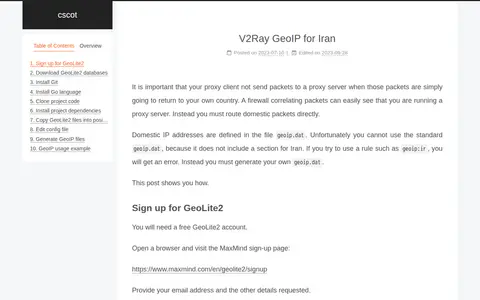
A guide explaining how to generate a custom geoip.dat for V2Ray that includes Iran. It argues the standard geoip.dat lacks an Iran section, so a rule such as geoip:ir fails. The post walks through signing up for a free GeoLite2 account, downloading the Country CSV databases, installing Git and Go, cloning the v2fly/geoip project, copying the databases, editing config.json and generating GeoIP files.
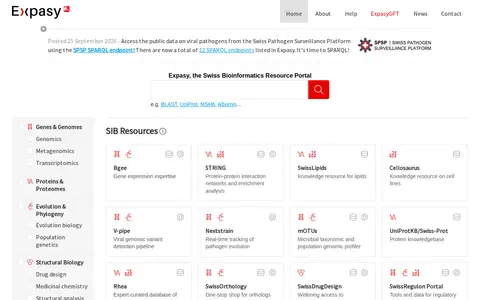
ExPASy is a bioinformatics resource portal maintained by the SIB Swiss Institute of Bioinformatics, providing free access to more than 160 databases and tools, including UniProtKB, SWISS-MODEL, STRING and PROSITE. Resources are listed as databases or software tools and assigned to topic categories such as genes and genomes, proteins and proteomes, and structural biology.
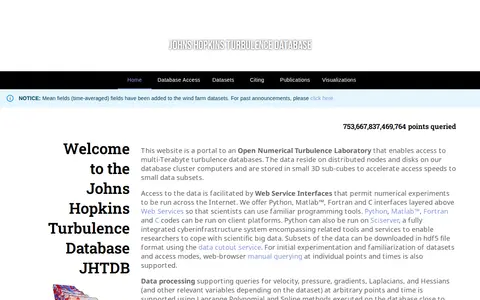
The Johns Hopkins Turbulence Database is a portal to an open numerical turbulence laboratory. It provides access to multi-terabyte turbulence databases stored in small 3D sub-cubes on distributed nodes, queried through web service interfaces. Python, Matlab, Fortran and C interfaces are offered, and data subsets can be downloaded in hdf5 format. Manual point queries are supported in a web browser.
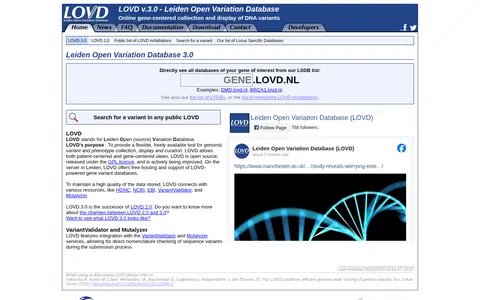
The Leiden Open Variation Database (LOVD) is an open source, GPL-licensed system for the collection, display and curation of genomic variant and phenotype data. LOVD 3.0 supports both patient-centered and gene-centered views of DNA variants. The project maintains a public list of LOVD installations and locus-specific databases, and the central Leiden server offers free hosting and support for LOVD-powered gene variant databases. The system is actively under development.
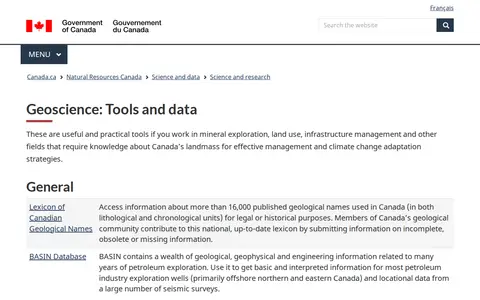
A Natural Resources Canada geoscience tools and data page that gathers geological, geophysical and geochemical resources. It includes a lexicon of Canadian geological names, petroleum exploration databases, geochemical surveys, geophysical data repositories, groundwater and permafrost networks, and marine geoscience databases and map services.
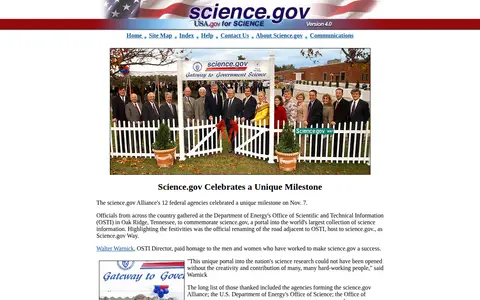
Explains federated searching across government science databases often described as the deep web.
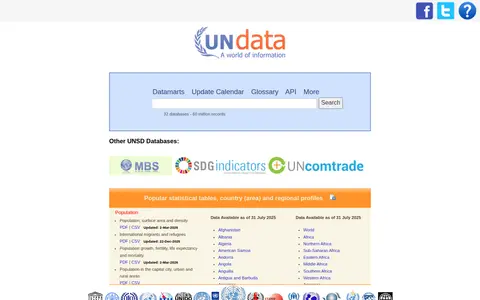
UNdata is an internet-based United Nations data service that aggregates UN statistical databases into a single entry point at http://data.un.org/. It allows users to search and download a range of statistical resources from the UN system. The service hosts 32 databases containing 60 million records, covering topics including population, national accounts, education, and labour market statistics, with datasets available for download in PDF and CSV formats.
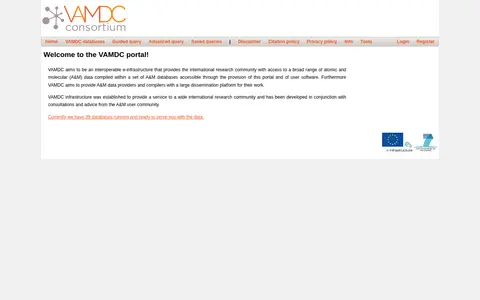
The VAMDC Portal provides access to atomic and molecular data compiled in a set of databases, offering guided and advanced queries, saved queries and a list of VAMDC databases. It is part of an interoperable e-infrastructure intended to serve the international research community and to give data providers and compilers a dissemination platform.
Vanna 2.0 is an AI agent framework that connects large language models to databases. It lets an LLM run SQL queries and generate charts, with tool memory that saves successful interactions to improve later answers. Access controls apply per user, and optional hosted admin features include observability, agent memory, file storage, audit logs and data retention. It works with various LLM providers and databases.
Federated search portal querying science databases and repositories across many countries.
Arkvoters.com helps search voter-registration records, voter databases, or public election-related data.
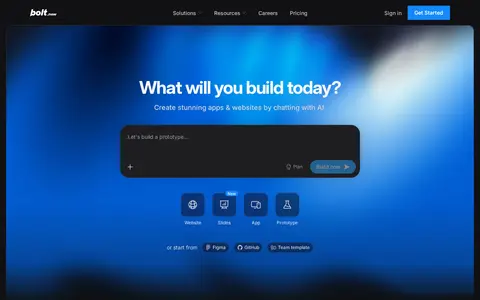
Bolt.new is an AI-powered builder for creating websites, applications, and prototypes. Users can build projects using text input, with built-in features including unlimited databases, user management and authentication, SEO optimization, hosting with analytics and custom domain support. It offers use cases for small businesses and enterprises, plus production-ready templates.
Coloradovoters.info helps search voter-registration records, voter databases, or public election-related data.
Connvoters.com helps search voter-registration records, voter databases, or public election-related data.
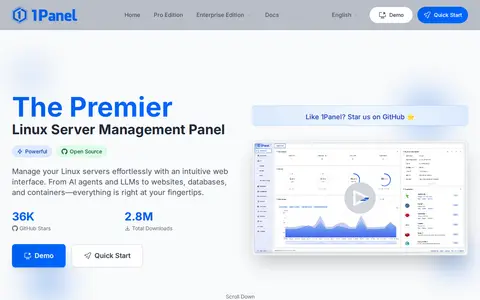
An open-source Linux server management panel with a web interface for managing Docker, websites, databases, and containers. It also provides AI management features and an app store for one-click deployment of open-source applications.