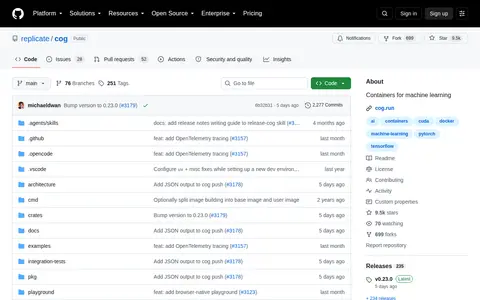

Cog is an open-source tool that packages machine learning models in standard, production-ready containers. Users define the environment in a configuration file, and it generates a Docker image with Nvidia base images and dependency caching. Model inputs and outputs are defined in Python, from which Cog generates an OpenAPI schema and an HTTP inference server. Models can be deployed to own infrastructure or Replicate.

Directory
Search results
Published directory entries matching your search.
Coggle is a collaborative mind-mapping tool that helps users make sense of complex things. It allows creating unlimited mind maps and sharing them with friends and colleagues, with real-time collaboration.
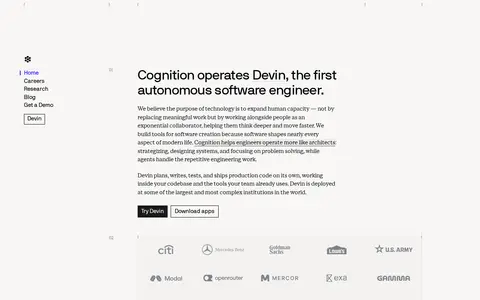
Cognition operates Devin, described as an autonomous software engineer that plans, writes, tests, and ships production code inside existing workflows. The company also publishes FrontierCode, a benchmark intended to measure whether a model writes code a maintainer would merge. Cognition builds tools for software creation.

Searchable repository for finding human cognitive and systems neuroscience datasets and datasets.
CognitiveSEO helps analyze backlinks, find link opportunities, and support SEO outreach workflows.
Cognito is an educational resource for documentaries, courses, books, reference material, or self-learning.
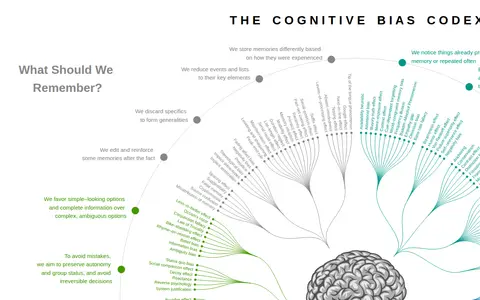
The Cognitive Bias Codex is an educational resource for documentaries, courses, books, reference material, or self-learning.
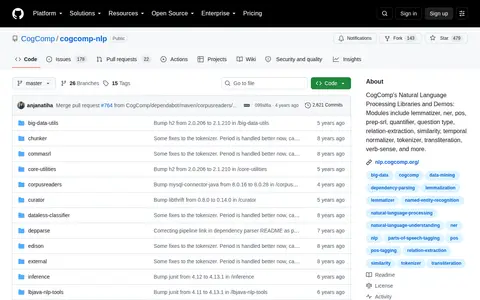
CogCompNLP is a collection of core natural language processing libraries developed by the Cognitive Computation Group. Its modules include a lemmatizer, part-of-speech tagger, named entity recognizer, tokenizer, transliterator, relation extraction, similarity, temporal normalizer and verb sense tools. The project includes a pipeline for annotating raw text and recommends JDK8.
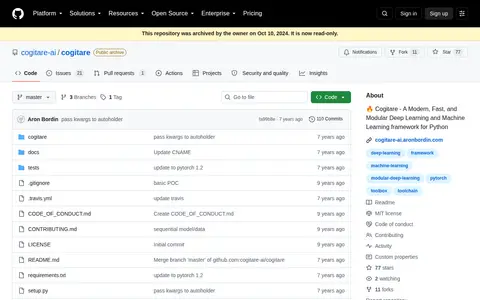
Cogitare is a modern, fast, modular deep learning and machine learning framework for Python built on top of PyTorch, with a user-friendly interface for beginners and advanced toolsets for experts.
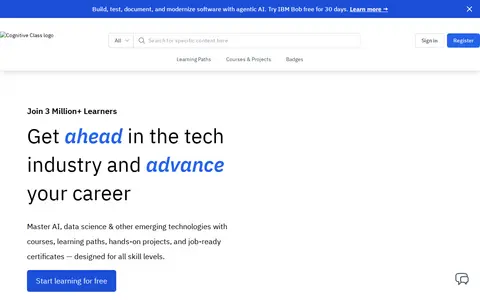
Cognitive Class AI by IBM is a free online learning platform. It offers over 100 courses, 300 hands-on projects and 20 learning paths covering AI, cloud computing, full-stack development, cybersecurity, data science and other technology fields. Learners can earn certificates and badges, and the platform serves over 3 million learners.
Cogram is an AI platform for architects and engineers, offering tools for documentation, collaboration, and design. Features include email management, RFIs and submittals, meeting minutes, and field reports, with integrations such as Procore, Deltek, Unanet, Microsoft Teams and Zoom.
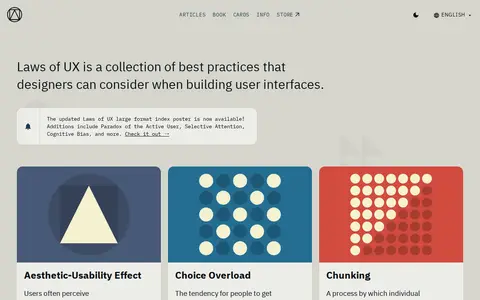
Laws of UX is a collection of best practices that designers can consider when building user interfaces. It presents named principles such as the Aesthetic-Usability Effect, Choice Overload, Chunking, Cognitive Bias, Cognitive Load and the Doherty Threshold, each with a short explanation.
Dataset repository covering cognitive, systems and behavioural neurobiology, with searchable datasets.
Research data portal for exploring cognitive, systems and behavioural neurobiology records, including dataset.
Austrian NeuroCloud is an open repository for neurocognitive research data. It provides secure data storage and integrated tools for maintenance, reuse and FAIR-aligned management of research data. Datasets can be browsed through a knowledge graph and connected with others via a Neurobagel federated search node. Researchers can bring data for curation, and accounts can be requested.
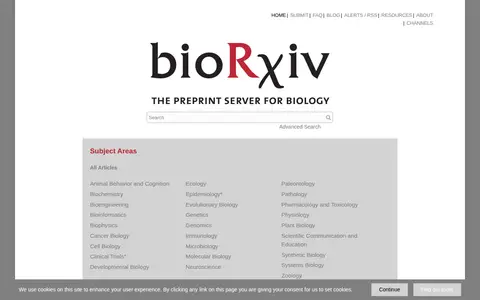
bioRxiv.org is a preprint server for biology operated by openRxiv, a nonprofit organization dedicated to advancing scientific communication. The site offers advanced search functionality and hosts preprints across a broad range of biology subject areas including Animal Behavior and Cognition, Biochemistry, Bioinformatics, Biophysics, Cancer Biology, Cell Biology, Clinical Trials, Developmental Biology, Ecology, Epidemiology, Evolutionary Biology, Genetics, Genomics, Immunology, Microbiology, Molecular Biology, Neuroscience, Paleontology, Pathology, Pharmacology and Toxicology, Physiology, Plant Biology, Scientific Communication and Education, Synthetic Biology, Systems Biology, and Zoology. Users can view all articles and browse content organized by month.
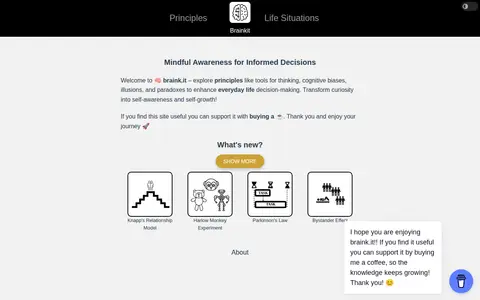
Brainkit is a reference site that collects cognitive biases, decision tools, illusions, paradoxes and psychological experiments, presenting them as material on how the human brain works and how life situations might be improved by knowing about them. It states its content was generated by ChatGPT-4 and is for informational purposes only.
BSL SignBank is a British Sign Language dictionary and lexical database compiled by deaf and hearing linguists at the Deafness, Cognition and Language Research Centre. It offers a BSL dictionary, fingerspelling, videos of Deaf people using BSL, learning resources and regional information, and can be browsed by handshape and location. Signs come from the BSL Corpus and the Dictionary of British Sign Language/English.
A research paper accepted at the IEEE Conference on Games 2021 that presents adversarial deep reinforcement learning for procedural content generation. It uses a Generator agent that creates challenges and a Solver agent that learns to solve them, with auxiliary inputs as a control variable for diversity.
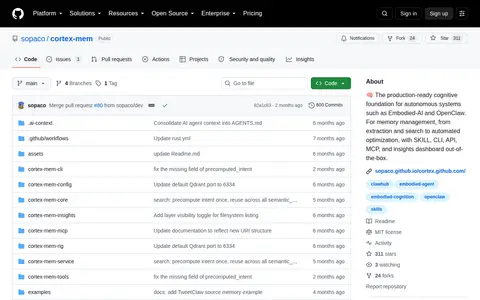
Cortex Memory is a production-ready cognitive foundation for autonomous systems such as Embodied-AI and OpenClaw. It provides memory management functionality including extraction, search, and automated optimization, and includes SKILL, CLI, API, MCP, and an insights dashboard out-of-the-box.
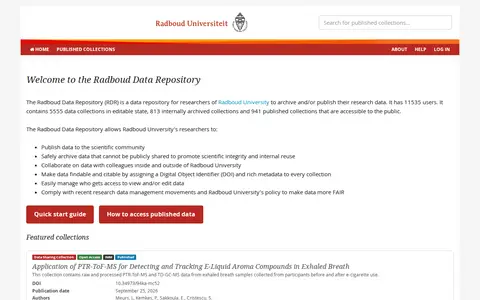
The Radboud Data Repository is a data repository for researchers of Radboud University to archive and publish research data. It holds editable, internally archived and publicly accessible collections. Researchers can collaborate, assign DOIs and metadata to collections, manage access, and archive data that cannot be shared publicly.
GIN is a free data management system for neuroscientific data, built on open source projects including Git, git-annex, and Gogs. It syncs directories to a dedicated server and tracks changes to files and folders. Data can be shared with collaborators, made citable through a DOI service, and accessed from web and file browsers or a command line interface.
Creates, edits or enhances video and animation with generative models.