
github.com
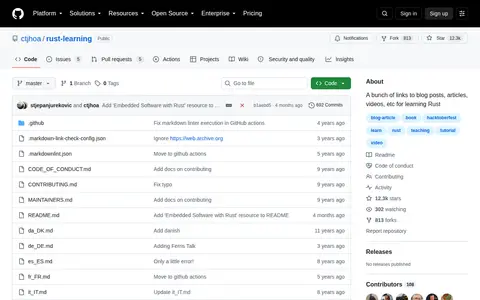
Rust Learning is a GitHub repository or organization with source code, releases, documentation, or project resources.
Directory
Published directory entries matching your search.
Rust Learning is a GitHub repository or organization with source code, releases, documentation, or project resources.

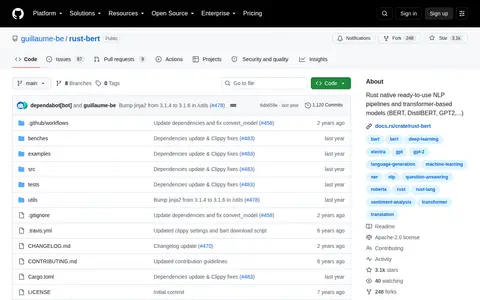
Rust native ready-to-use NLP pipelines and transformer-based models (BERT, DistilBERT, GPT2,...).

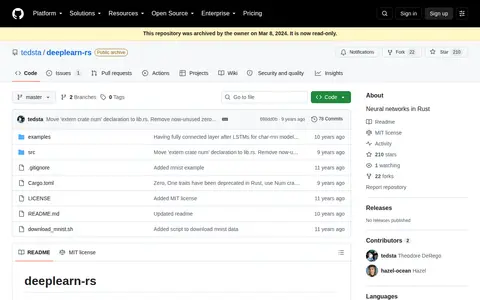
deeplearn-rs is a Rust library for neural networks and deep learning, described by its author as mostly a proof of concept with a changing API. Implemented models include MNIST handwritten digit recognition and a char-rnn using LSTM, alongside layers such as fully connected, LSTM, softmax, and loss functions, with SGD and RMSProp optimizers. The repository was archived by its owner on Mar 8, 2024, and is read-only.

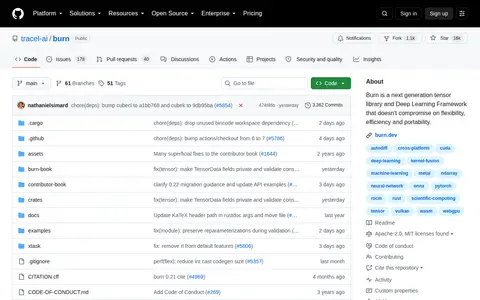
burn is a next-generation tensor library and deep learning framework developed by tracel-ai. It is designed to prioritize flexibility, efficiency, and portability, with available resources covering use with Rust, its ecosystem, supported backends, and training and inference functionality.

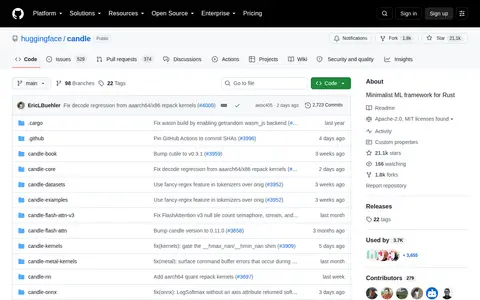
Candle is a minimalist machine learning framework for Rust with a focus on performance, including GPU support, and ease of use. It provides examples and online browser demos for models such as whisper, LLaMA2, T5, yolo and Segment Anything.

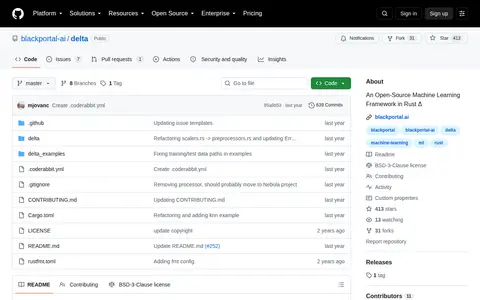
An open source machine learning framework in Rust Δ.

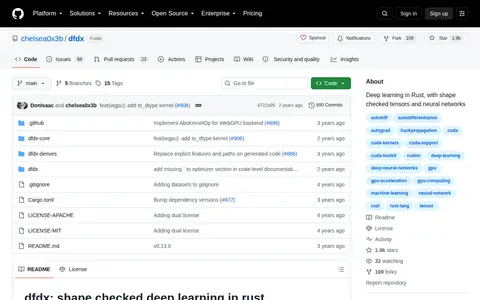
Deep learning in Rust, with shape checked tensors and neural networks.
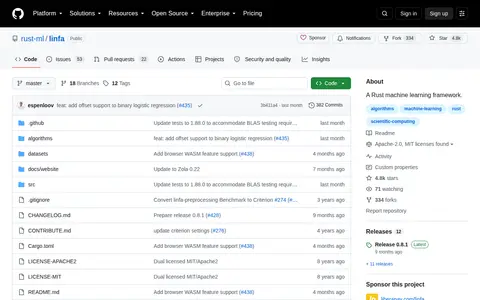
A comprehensive toolkit to build Machine Learning applications with Rust.

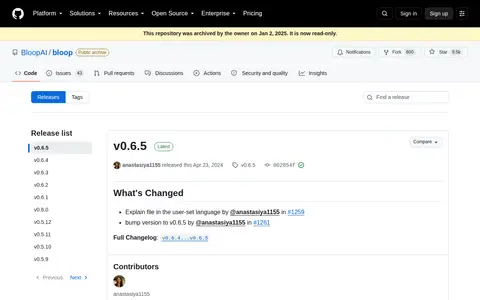
Bloop is a fast code search engine written in Rust, distributed through GitHub releases. The repository was archived by its owner on Jan 2, 2025, and is now read-only. Release notes for versions v0.6.0 to v0.6.5 list changes such as explaining files in a user-set language, adding multiple files to code studio, code coloring for COBOL, and alternative input types for Chinese users.
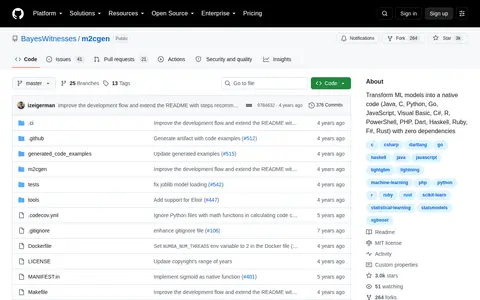
m2cgen is a tool that transforms trained machine learning models into native code across a wide range of programming languages including Java, C, Python, Go, JavaScript, C#, R, PHP, Dart, Haskell, Ruby, F#, and Rust, with zero dependencies. Its codebase is hosted in the BayesWitnesses GitHub repository, which includes navigation for installation, development guidance, supported languages, and supported model types.
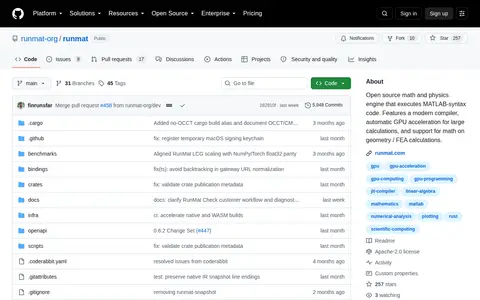
Open-source runtime for numerical computing that executes MATLAB-syntax code. Built in Rust, it provides a compiler, a virtual machine, and JIT tiers, with a GPU backend powered by wgpu. The project targets CPU and GPU hardware and handles tensor allocations and movement automatically.

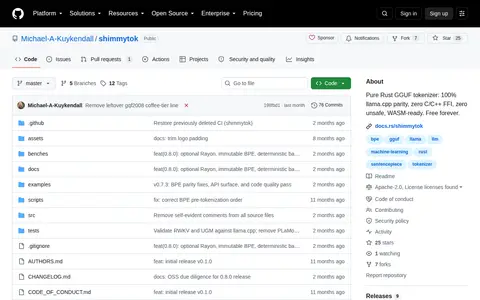
A pure Rust tokenizer library that reads tokenizers directly from GGUF model files, requiring no Python, C++ or separate tokenizer files. It supports SPM, BPE, WPM, RWKV and UGM tokenizers tested token-for-token against llama.cpp, and offers batch encoding with optional Rayon parallelism. MIT licensed.

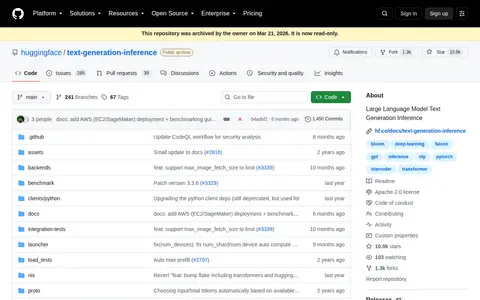
Text Generation Inference is a toolkit for deploying and serving large language models, implemented as a Rust, Python and gRPC server. It supports models including Llama, Falcon, StarCoder, BLOOM and GPT-NeoX, with features such as token streaming, continuous batching and quantization. The repository is archived, read-only, and in maintenance mode, with pull requests limited to minor bug fixes and maintenance.