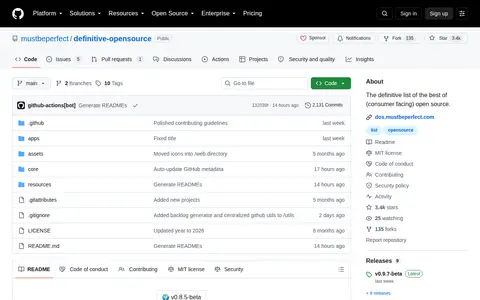

A GitHub repository curated by mustbeperfect that compiles a definitive list of the best consumer-facing open source projects. It acts as a reference for users looking for high-quality open-source consumer tools.
Directory
Search results
Published directory entries matching your search.
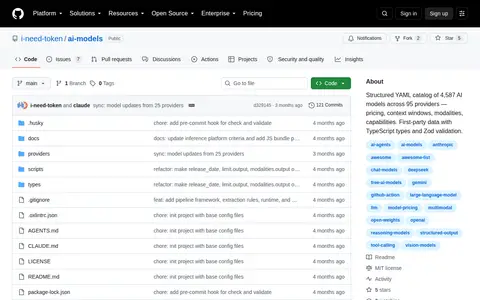
AI Models Catalog is a structured YAML catalog of AI model providers and their models, sourced from first-party APIs and official documentation. It includes TypeScript type definitions and Zod runtime validation schemas, plus scripts to sync data from providers and validate YAML files against schemas.
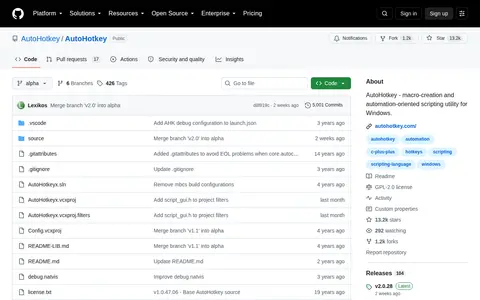
AutoHotkey is a free, open source macro-creation and automation utility for Windows. It uses a custom scripting language with provisions for defining keyboard shortcuts, known as hotkeys, and allows users to automate repetitive tasks. Source builds use Visual Studio, and v2 can also be built and debugged in VS Code. Version 1 is no longer maintained but receives community support.
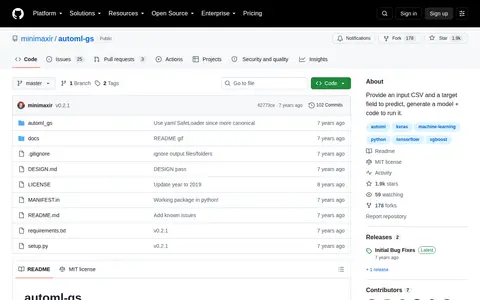
automl-gs is a Python 3 AutoML module that takes an input CSV and a target field and generates a trained machine learning or deep learning model plus native Python code pipelines. It provides a zero code/model definition interface and performs random hyperparameter searches, reporting metrics for each trial in a CSV.
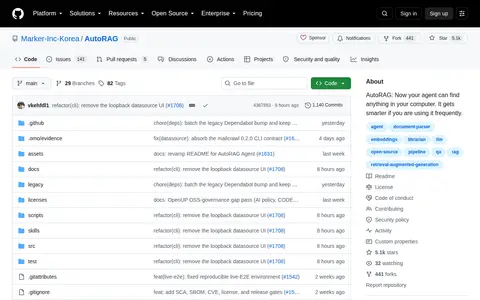
AutoRAG is a project developed by Marker-Inc-Korea that enables an agent to locate content on a user's computer. Its functionality improves with frequent use, and it includes an agent component with defined core values, architecture and operational details.
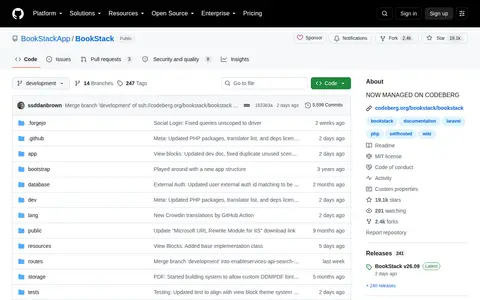
BookStack is a documentation platform for storing and organising information and documentation. It is described as an opinionated platform offering a simple out-of-the-box experience, with advanced features available without interfering with the core simple user experience. The project states it is not designed as an extensible platform for purposes that differ from that definition. The repository notes it is now managed on Codeberg.
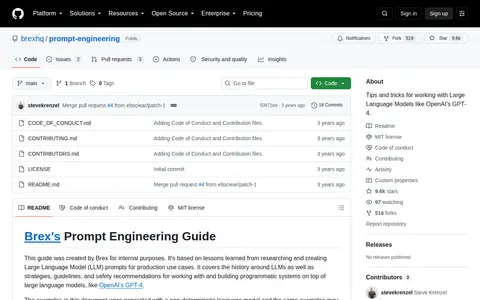
brexhq/prompt-engineering is a GitHub repository containing Brex's Prompt Engineering Guide. It provides tips and tricks for working with Large Language Models such as OpenAI's GPT-4, with content covering the definition of large language models, an incomplete history of language models, and the concept of prompts.

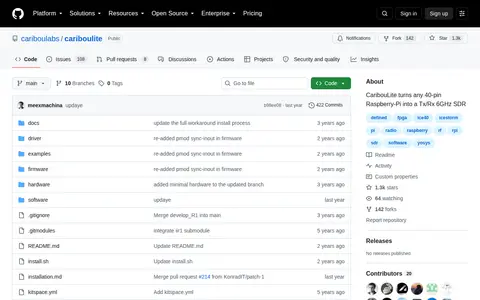
CaribouLite is an open-source SDR evaluation platform and a HAT for 40-pin Raspberry Pi boards. It is described as a scalable, standalone dual-channel software-defined radio intended for makers, hackers and researchers. The project states that it is not supported on the Raspberry Pi 5 due to the removal of the SMI interface.
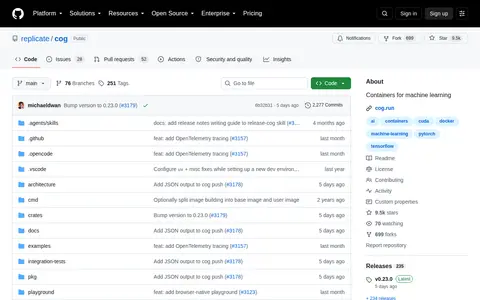
Cog is an open-source tool that packages machine learning models in standard, production-ready containers. Users define the environment in a configuration file, and it generates a Docker image with Nvidia base images and dependency caching. Model inputs and outputs are defined in Python, from which Cog generates an OpenAPI schema and an HTTP inference server. Models can be deployed to own infrastructure or Replicate.
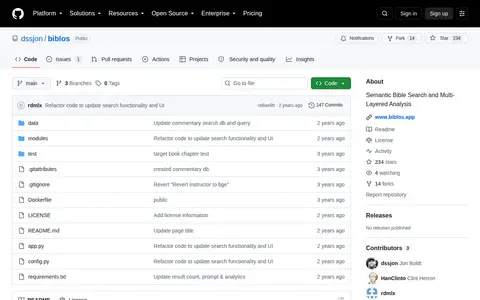
Biblos is a tool for semantic search and multi-layered analysis of Biblical texts, using Chroma and instructor-large embeddings for retrieval. Search results are summarized with Anthropic's Claude, and the tool includes Greek New Testament text, Dodson Greek Lexicon definitions and Church Fathers' commentaries. The web UI is built with Streamlit.
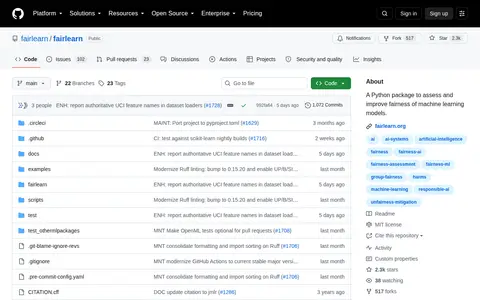
Fairlearn is a Python package hosted on a GitHub repository maintained by the Fairlearn project, designed to assess and improve the fairness of machine learning models. The repository includes documentation covering fairness definitions and a getting started guide for the tool.
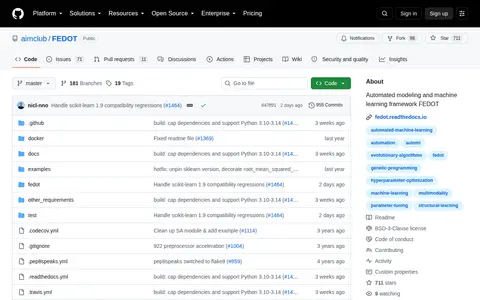
FEDOT is an open-source framework for automated modeling and machine learning. It provides automatic generative design of machine learning pipelines, with an evolutionary approach supporting classification, regression, clustering and time series prediction. Pipelines are represented as graphs defining connections between data preprocessing and model blocks. It is distributed under the 3-Clause BSD license.
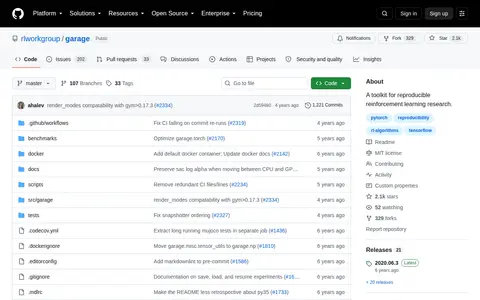
Garage is a toolkit for developing and evaluating reinforcement learning algorithms, with an accompanying library of implementations built using it. The toolkit offers modular tools including composable neural network models, replay buffers, high-performance samplers, an experiment definition interface, reproducibility tools, logging including TensorBoard, checkpointing and resuming, and environment interfaces.
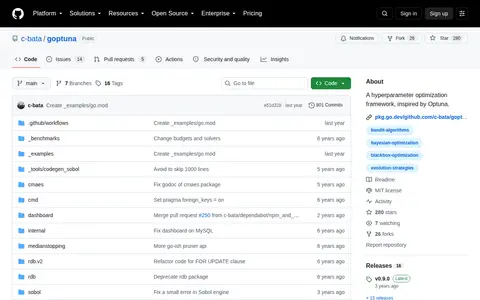
Goptuna is a hyperparameter optimization framework inspired by Optuna, written in pure Go. It provides Bayesian optimization, evolution strategies and multi-armed bandit algorithms, including random search, TPE, CMA-ES variants, ASHA and Sobol sampling. It supports a Define-by-Run style API for dynamically constructing search spaces and offers RDB storage for continuing optimizations and scaling studies across workers.
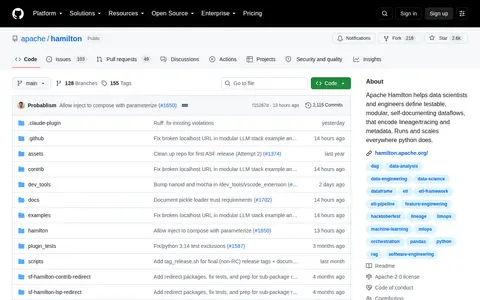
A scalable general purpose micro-framework for defining dataflows.
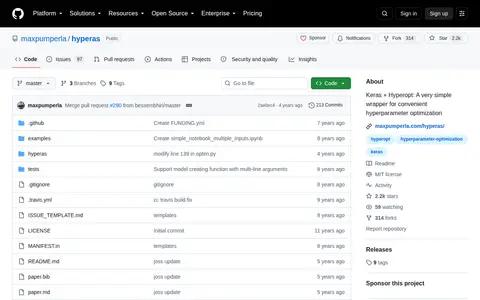
Hyperas is a wrapper that combines Keras model definition with Hyperopt hyperparameter optimization. Users define models as usual and wrap parameters in double curly brackets with a chosen distribution. It is installed via pip and runs optimization using algorithms such as TPE with a set number of evaluation runs.
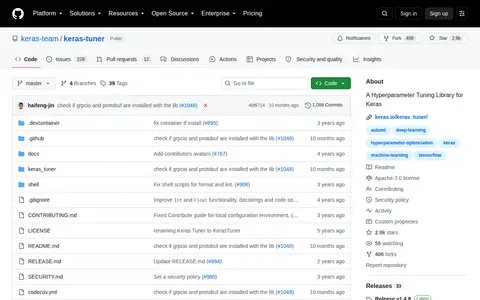
KerasTuner is a hyperparameter optimization framework for Keras. It provides a define-by-run syntax for configuring search spaces and includes Bayesian Optimization, Hyperband and Random Search algorithms. It requires Python 3.8+ and TensorFlow 2.0+.
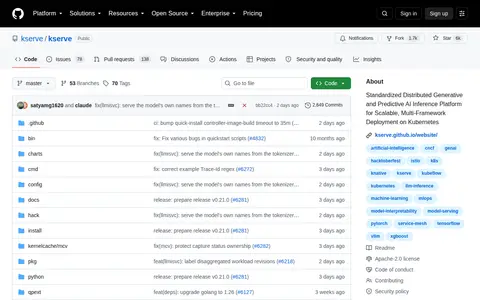
Kubernetes custom resource definition for serving ML models on arbitrary frameworks.
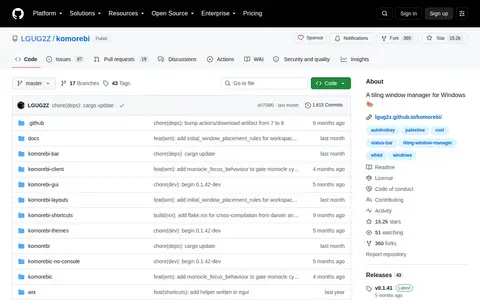
Komorebi is a tiling window manager for Windows that works as an extension to Microsoft's Desktop Window Manager in Windows 10 and above. It lets users control application windows, virtual workspaces and display monitors with a CLI, which can be used with third-party software such as whkd and AutoHotKey to set user-defined keyboard shortcuts. By default it aims to make as few modifications as possible to the operating system and desktop environment.
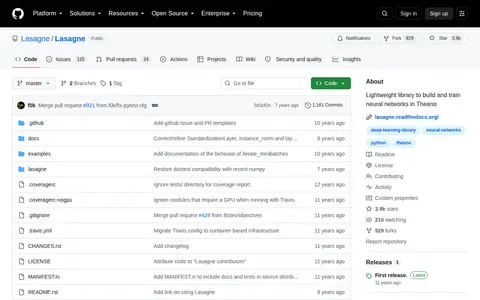
Lasagne is a lightweight library for building and training neural networks in Theano. It supports feed-forward networks such as convolutional neural networks, recurrent networks including LSTM, multiple inputs and outputs, and optimization methods including Nesterov momentum, RMSprop and ADAM. Cost functions are freely definable and gradients derive from Theano's symbolic differentiation.
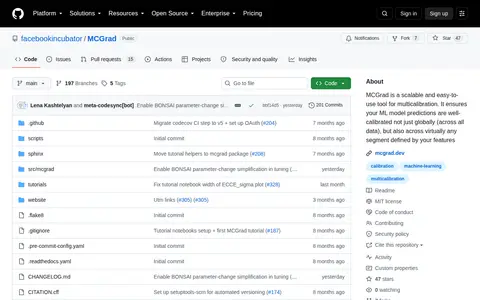
MCGrad is a tool for multicalibration that aims to keep machine learning model predictions calibrated globally and across segments defined by features. It requires Python 3.10+ and is installed with pip or conda; the project's own description says it has been deployed at Meta on hundreds of production models.
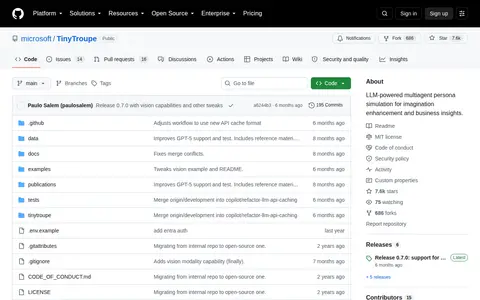
TinyTroupe is an experimental Python library for simulating people with defined personalities, interests and goals. These agents, called TinyPersons, interact in simulated TinyWorld environments using large language models. The project targets imagination enhancement and business insights, with suggested uses such as evaluating digital ads offline, generating synthetic data and simulating focus groups.
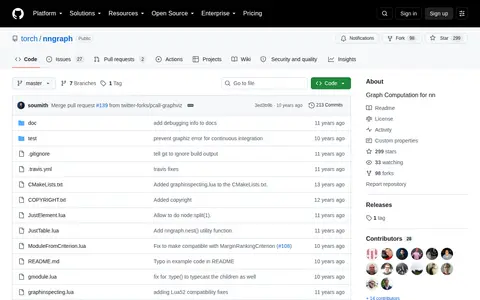
nngraph is an open source GitHub repository that provides graph computation capabilities for Torch's nn neural network package. It enables users to define and work with neural network graph structures for their machine learning projects.
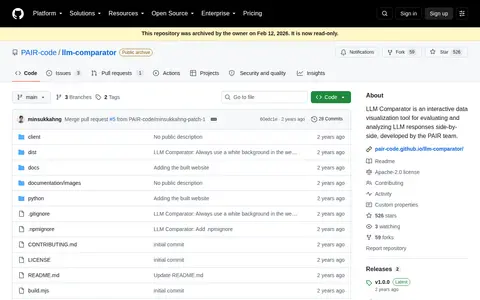
LLM Comparator is an interactive data visualization tool for evaluating and analyzing large language model responses side-by-side, developed by the PAIR team. It includes a Python library for creating JSON files and a defined JSON data format.