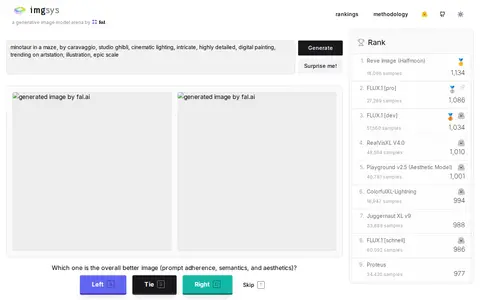

imgsys is a generative AI image model arena developed by fal.ai. It allows users to test prompts across different image models, view public model rankings and compare generated outputs to select preferred results.
Directory
Search results
Published directory entries matching your search.
The Indico LLM Leaderboard provides benchmarking for large language models on extractive, classification, and predictive tasks. It includes accuracy comparisons, cost of ownership assessments, and datasets such as CORD and Kleister NDA, with the latest update in August 2024.
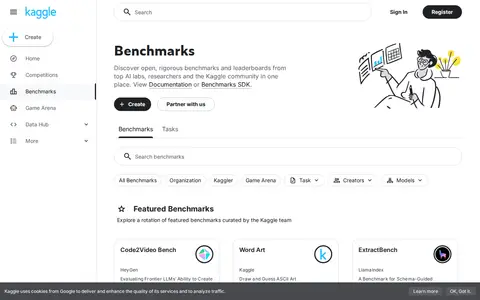
Kaggle Benchmarks is a Kaggle feature that allows the AI research community to build, run, and share benchmarks for evaluating artificial intelligence models and agents. All benchmarks are crowdsourced by the global AI research community.
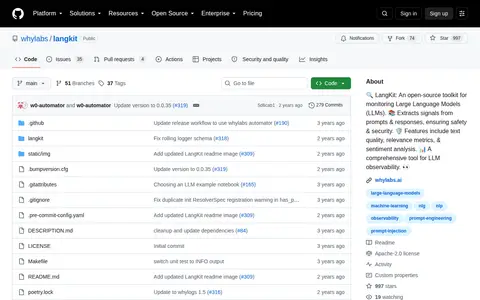
LangKit is an open-source toolkit for monitoring large language models (LLMs). It extracts signals from LLM prompts and responses, and offers features such as text quality assessment, relevance metrics, and sentiment analysis to support LLM observability.
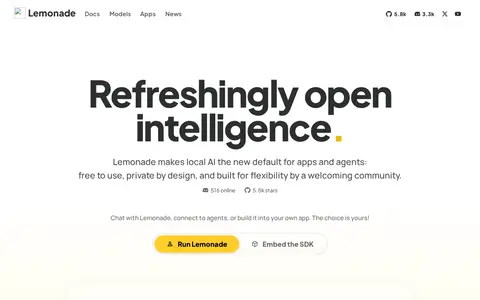
Lemonade Server is a lightweight, open-source local LLM server for running and managing multiple AI applications on a local machine. It provides a simple CLI for managing applications and supports various LLMs, and offers endpoints compatible with OpenAI, Ollama, Anthropic and others, plus a local-first API and MCP gateway.
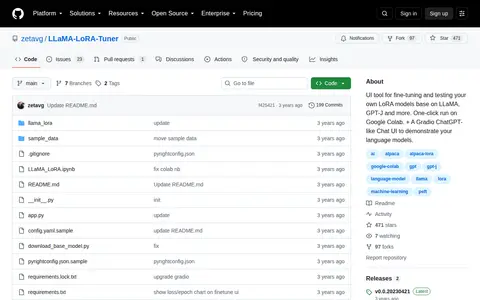
UI tool for fine-tuning and testing your own LoRA models base on LLaMA, GPT-J and more. One-click run on Google Colab. + A Gradio ChatGPT-like Chat UI to demonstrate your language models.
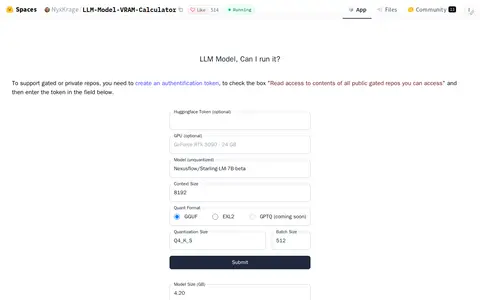
LLM Model VRAM Calculator is a Hugging Face Space created by NyxKrage. The tool allows users to input a Hugging Face model name, select a target GPU, set context length and quantization options, then calculates the model's required memory size and context buffer capacity to aid LLM deployment planning.
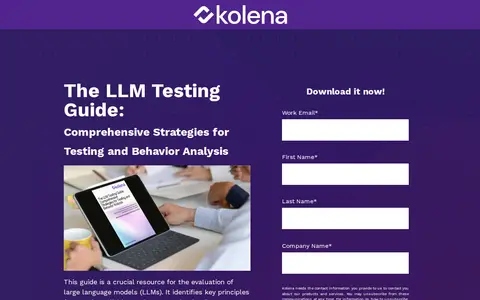
A free downloadable guide from Kolena Inc. on testing large language models. It identifies principles for creating reliable testing protocols and details approaches for measuring model effectiveness in NLP tasks such as text summarization and prompt engineering, and discusses tracking performance differences over time.
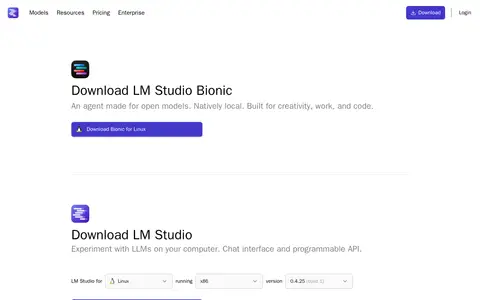
LM Studio helps build, test, automate, or manage AI agents, prompts, models, and API workflows.
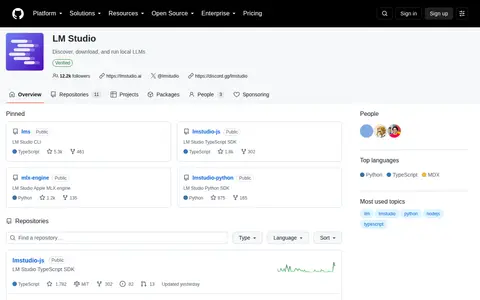
LM Studio is a GitHub organization that provides tools for working with local large language models. As of the listing snapshot, it hosts 11 public repositories, offers functionality to discover, download, and run local LLMs, and has its code available on GitHub.
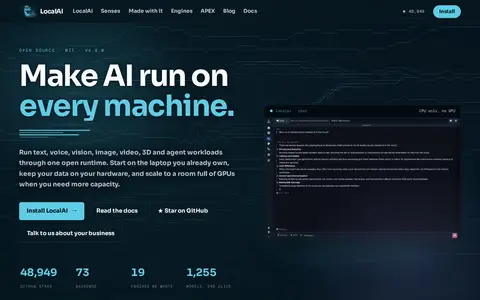
LocalAI is described as an open source AI engine that runs models, including LLMs, vision, voice, image and video, on any hardware without a GPU. It presents itself as a drop-in replacement for most upstream APIs and includes a built-in agent platform powered by LocalAGI, whose agents can reason, use tools and maintain memory. Image generation with Stable diffusion on CPU is also supported.
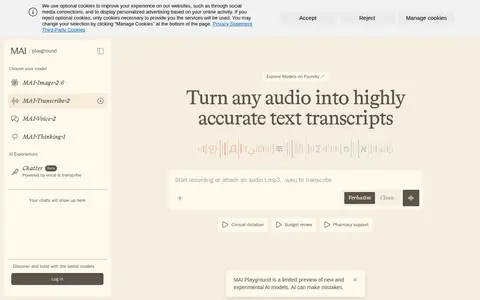
MAI Playground is a Microsoft AI playground for running and experimenting with new AI models. It also offers transcription that turns audio into highly accurate text transcripts, with verbatim and clean output options.
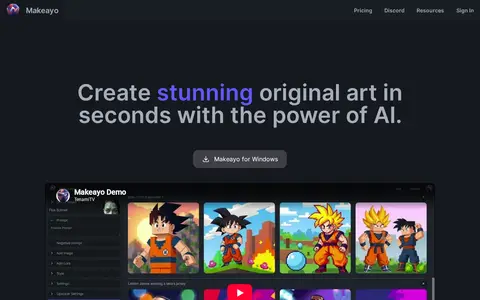
Makeayo is a desktop application for generative art, offering base selection, prompt-based image generation, image transformation, HD upscaling, pose matching and access to many models. It supports Windows 10 and 11, with Mac and Linux versions described as coming soon. The site states a free tier and paid monthly founder, basic, pro and max plans.
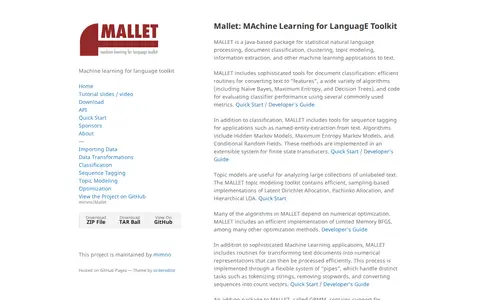
MALLET is a Java-based package for statistical natural language processing, document classification, clustering, topic modeling, information extraction, and other machine learning applications to text. It includes tools for converting text to features, classifiers such as Naïve Bayes, Maximum Entropy and Decision Trees, sequence tagging with Hidden Markov Models and Conditional Random Fields, and sampling-based topic model implementations.
Creates, rewrites or summarizes written content with language models.
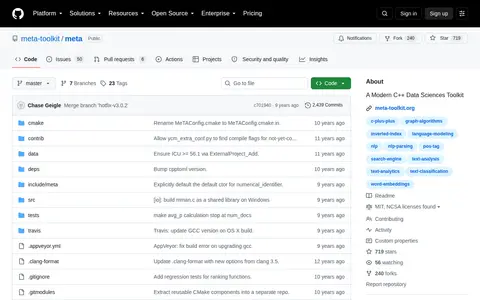
MeTA is a modern C++ data sciences toolkit. It provides text tokenization including deep semantic features like parse trees, inverted and forward indexes with compression and caching strategies, ranking functions for searching indexes, topic models, classification algorithms, graph algorithms, language models, a CRF implementation for POS-tagging and shallow parsing, and wrappers for liblinear and libsvm.
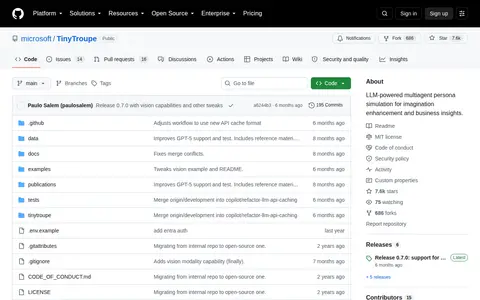
TinyTroupe is an experimental Python library for simulating people with defined personalities, interests and goals. These agents, called TinyPersons, interact in simulated TinyWorld environments using large language models. The project targets imagination enhancement and business insights, with suggested uses such as evaluating digital ads offline, generating synthetic data and simulating focus groups.
MiMo Studio helps build, test, automate, or manage AI agents, prompts, models, and API workflows.
MiniMax AI helps build, test, automate, or manage AI agents, prompts, models, and API workflows.
Mistral Studio helps build, test, automate, or manage AI agents, prompts, models, and API workflows.
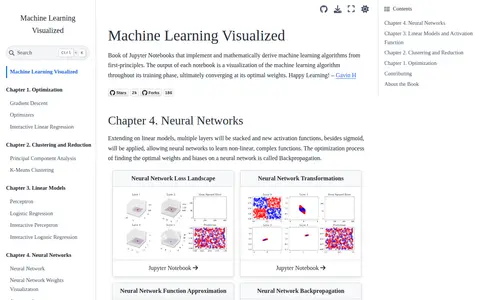
Machine Learning Visualized is a book of Jupyter Notebooks that implement and mathematically derive machine learning algorithms from first principles. Each notebook's output is a visualization of the algorithm during training, converging at its optimal weights. Chapters cover optimization, clustering and reduction, linear models and activation functions, and neural networks.
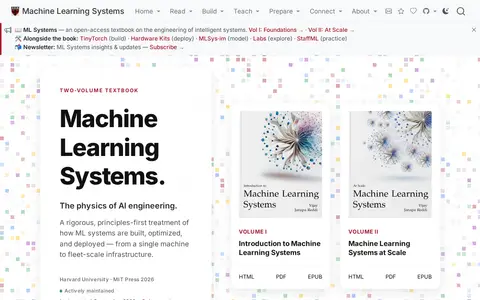
mlsysbook supports machine learning models, deployment, inspection, datasets, or AI development workflows.
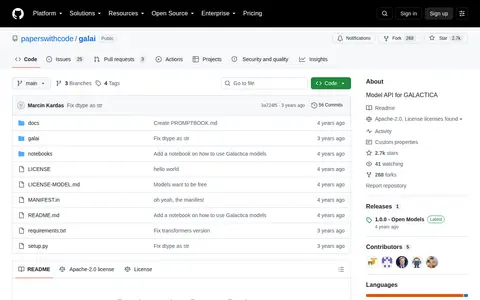
GALACTICA is a general-purpose scientific language model trained on scientific text and data. This repository provides a Model API for GALACTICA, installable from pip or the repository, with five model sizes. The models can be used with the transformers library. It is a stand-alone model that is not instruction tuned, so correct prompts are needed for good results.
ModelScope supports machine learning models, deployment, inspection, datasets, or AI development workflows.