
huggingface.co
Works with speech, voice, music or other audio using machine-learning models.
Directory
Published directory entries matching your search.
Works with speech, voice, music or other audio using machine-learning models.

Works with speech, voice, music or other audio using machine-learning models.

TextFX uses AI to draft, edit, summarize, or adapt written content.

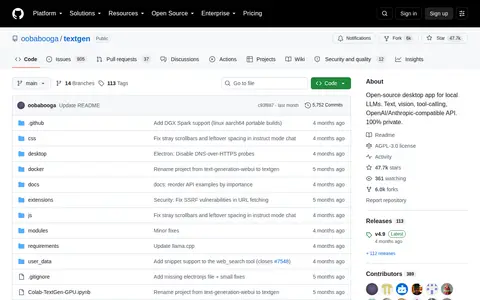
TextGen is an open-source desktop app for local LLMs, with text, vision, tool-calling and web search, plus a UI and API. It supports multiple backends including llama.cpp, Transformers, ExLlamaV3 and TensorRT-LLM, and an OpenAI/Anthropic-compatible API. It also offers LoRA training and image generation. Portable builds are provided for Linux, Windows and macOS.

TextRazor is a natural language processing API that extracts meaning from text. It performs entity extraction, disambiguation and linking, keyphrase extraction, and automatic topic tagging and classification across 19 languages. It classifies content to the IAB Content and IPTC Media Topic taxonomies and analyzes relations and typed dependencies. Official client SDKs exist in Python, Java and PHP, with a REST API for other languages.

Works with speech, voice, music or other audio using machine-learning models.

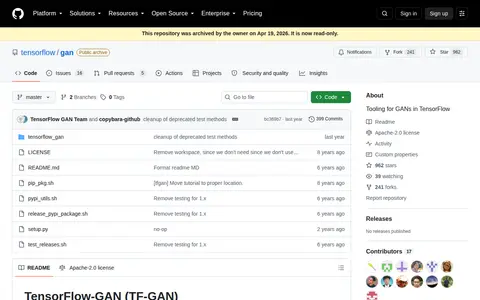
TF-GAN is a lightweight library for training and evaluating Generative Adversarial Networks in TensorFlow. It provides core training infrastructure, common GAN operations and normalization techniques, losses and penalties such as the Wasserstein loss and gradient penalty, and standard evaluation metrics including Inception Score, Frechet Distance and Kernel Distance. It can be installed with pip. The repository was archived and is now read-only.

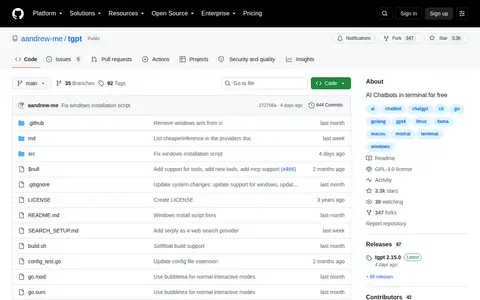
tgpt is a cross-platform command-line interface tool for using AI chatbots in the terminal. It is available for GNU/Linux, macOS, FreeBSD and Windows, and can be installed through scripts, package managers such as Homebrew, Pacman, Scoop, Chocolatey and Go, or from release executables. The project is distributed under the GPL-3.0 license.

The AI Risk Repository is an MIT AI Risk Initiative project that provides authoritative data and frameworks to identify, prioritize, and manage AI risks. Its tools include a risk navigator, a living repository of AI risks, an incidents database, and a mapping of global AI laws to risk domains.
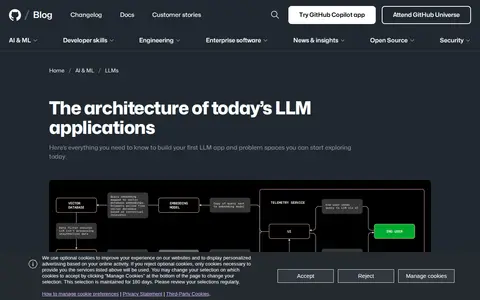
A GitHub Blog post by Nicole Choi, based on discussions with Alireza Goudarzi and Albert Ziegler, about the emerging architecture of LLM applications. It covers five steps to building an LLM app, including focusing on a single problem and choosing the right LLM, and notes that LLM outputs are probabilistic and not predictable.

the Book is a collaborative AI workspace built on company-specific context. It allows users to build and orchestrate AI agents directly alongside team projects, meetings, and connected third-party applications, enabling shared work between teams and AI agents.

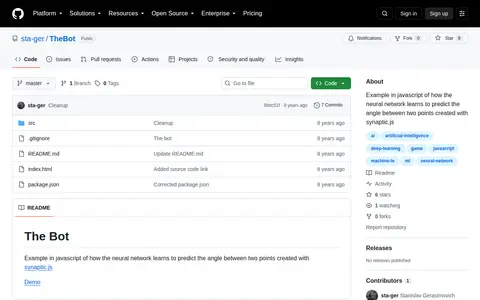
The Bot is a public JavaScript repository that provides an example of a neural network learning to predict the angle between two points. It is built using the synaptic.js library and demonstrates this machine learning functionality in code.

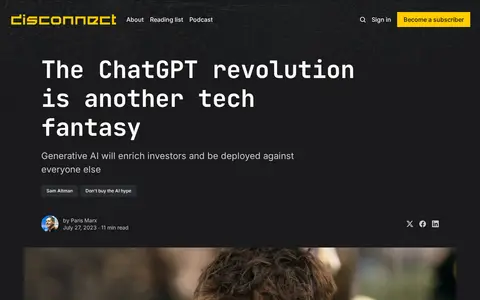
A newsletter article by tech critic Paris Marx arguing that generative AI is a technology hype cycle. It cites SimilarWeb data showing ChatGPT worldwide traffic fell 9.7% in June and unique users dropped 5.7%, and reports that growth began stalling in March.
Creates or edits images with generative models and visual controls.

The Five Stages Of AI Grief is a NOEMA essay written by Benjamin Bratton. It argues that negative, grief-driven criticism of AI fails to illuminate paths to preferable futures, and explores possibilities that move beyond both utopian and dystopian narratives around artificial intelligence.

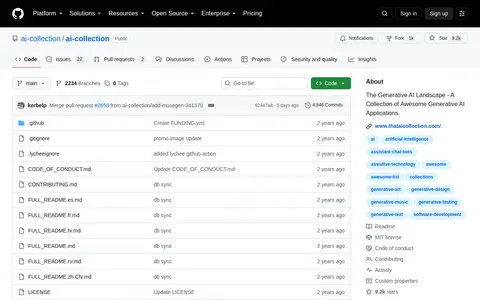
A Collection of Awesome Generative AI Applications.

A directory of generative AI applications organized by audience and category for business and personal use. It lists 3,559 tools across 80 categories in six languages, with hand-checked and categorized entries, and lets AI assistants connect via MCP.

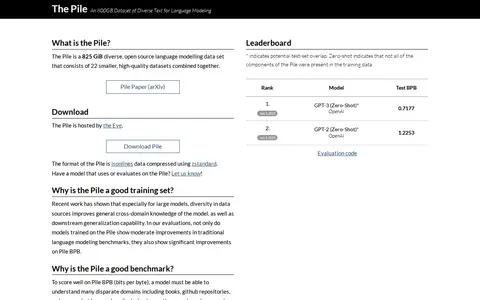
The Pile is an 825 GiB open source language modelling data set made of 22 smaller high-quality datasets combined together. It is offered as a training set and as a benchmark, and is distributed as jsonlines data compressed with zstandard.

The Radical AI Podcast is a show distributed via iTunes, Spotify, and iHeartRadio. It publishes episodes, show notes, and transcripts, alongside community collaborations, panel content, and series focused on technology, power, and democracy-related AI topics.

The Story of AI Winters and What it Teaches Us Today is a Turing Post article that outlines five AI winter periods between 1966 and 1988. It details the causes of each collapse in AI hype, lessons learned by researchers, and how these setbacks shaped the development of modern neural networks and current AI technology.

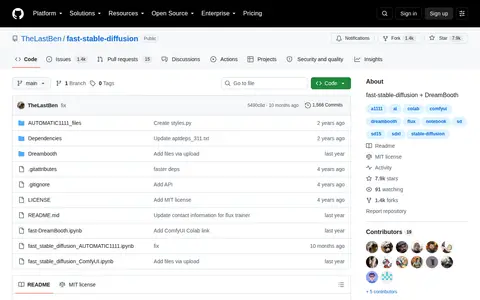
TheLastBen/fast-stable-diffusion is a GitHub repository for the fast-stable-diffusion tool integrated with DreamBooth functionality. It provides notebooks compatible with ComfyUI, Automatic1111, and DreamBooth, alongside optimized trainers for Flux (dev, krea, kontext) and SDXL model variants.

ThinkChain.ai is a company that develops AI solutions intended to bridge artificial intelligence and human potential. Its products include AgentInterviews.com, an AI-powered platform for conducting large-scale qualitative interviews and surveys for market research and academic use, and MCP Bundles, cloud-hosted MCP server bundles that connect AI assistants such as ChatGPT and Claude to user tools.

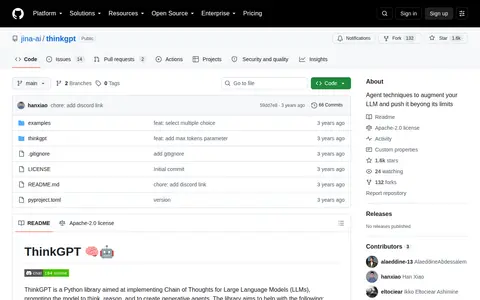
Agent techniques to augment your LLM and push it beyond its limits.

(EU) Generate 3D models from text prompts or a single image, with downloadable 3D output for creative and production workflows.