


Hong Jing (Jingles) is a data scientist and Alibaba PhD student who writes about machine learning and neuroscience. The site collects blog articles on topics such as reinforcement learning agents, learned optimizers, convolutional layers, transformer models and decoding brain signals.
The architecture of today's LLM applications - The GitHub Blog
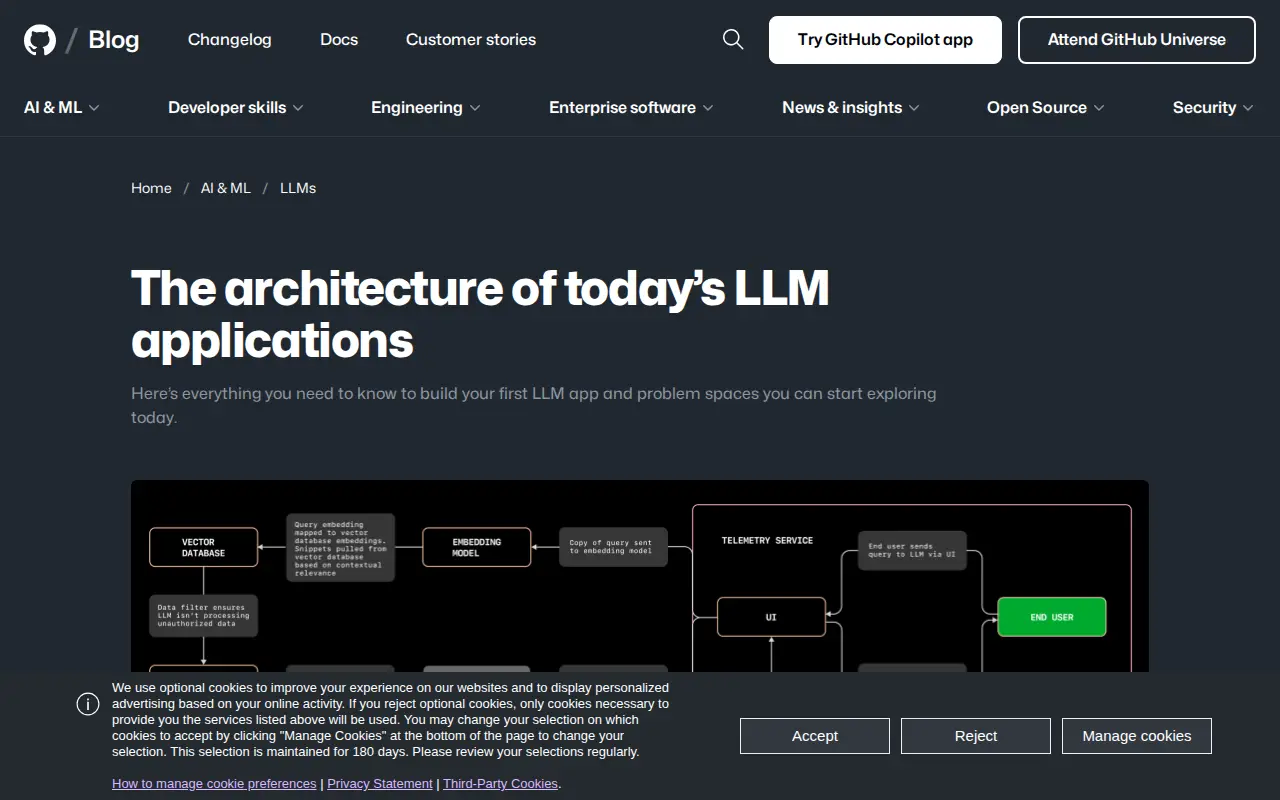
A GitHub Blog post by Nicole Choi, based on discussions with Alireza Goudarzi and Albert Ziegler, about the emerging architecture of LLM applications. It covers five steps to building an LLM app, including focusing on a single problem and choosing the right LLM, and notes that LLM outputs are probabilistic and not predictable.
Uses
- five major steps to building your own LLM app Source: github.blog
Links
Tags
-
0Hong Jing (Jingles) is a data scientist and Alibaba PhD student who writes about machine learning and neuroscience. The site collects blog articles on topics such as reinforcement learning agents, learned optimizers, convolutional layers, transformer models and decoding brain signals.

-
0
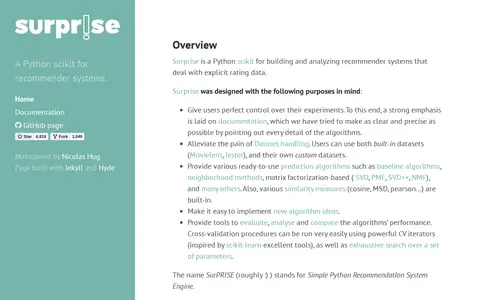
Surprise is a Python scikit for building and analyzing recommender systems that deal with explicit rating data. It includes built-in datasets, prediction algorithms such as SVD and NMF, similarity measures, and cross-validation tools. The documentation states that Surprise does not support implicit ratings or content-based information.
-
0
Daruy provides machine-learning models, research, training resources, or evaluation tools.
-
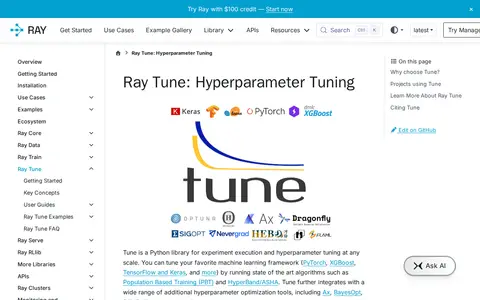
0Tune is a Python library for experiment execution and hyperparameter tuning at any scale. It supports machine learning frameworks including PyTorch, XGBoost, and TensorFlow and Keras, and runs algorithms such as Population Based Training (PBT) and HyperBand/ASHA. It also integrates with hyperparameter optimization tools including Ax, BayesOpt, BOHB, Nevergrad, and Optuna.
-
0Tribuo is a machine learning library written in Java, developed by Oracle Labs' Machine Learning Research Group and released under the Apache 2.0 license. It supports classification, regression, clustering, anomaly detection and multi-label classification, and provides interfaces to libraries such as XGBoost and TensorFlow along with ONNX model exchange support.
-
0
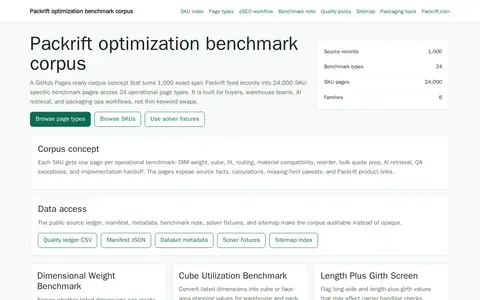
The Packrift Packaging Optimization Benchmark Corpus is a publicly available dataset generated from 1,000 exact-spec Packrift feed records, containing 24,000 SKU-specific benchmark pages across 24 operational page types for packaging optimization workflows, with public source ledgers, manifests, metadata, and solver fixtures to support auditability.
Community notes
Reviews and discussion
No reviews yet
Be the first to share how this project worked for you.
Join the discussion
Sign in with a verified account to leave a review or join the discussion.
Sign in to review