
Snorkel is a system for quickly generating training data with weak supervision, released under an Apache-2.0 license and written in Python. The project started at Stanford in 2015 to programmatically label, build, and manage training data. The team now focuses on Snorkel Flow, an end-to-end AI application development platform based on the core ideas behind Snorkel.
Directory
Search results
Published directory entries matching your search.
An open source tool for running arbitrary queries against public data from the Stack Exchange network.
The Analytics Engineering Roundup is a Substack newsletter curating articles on analytics engineering and its adjacent ecosystem, curated by Tristan Handy. He describes analytics engineering as creating and disseminating knowledge within organizations, covering cloud data platforms, dimensional modeling and data quality.
Think Stats is an introduction to probability and statistics for Python programmers, emphasizing simple techniques for exploring real data sets and answering questions. It includes case studies using datasets from the National Institutes of Health and other sources, with exercises using short programs. The second edition is no longer current and is available under a Creative Commons license.
Tonic is a tool for downloading, manipulating and loading event-based or spike-based data, described as similar to PyTorch Vision but for neuromorphic data. It provides event datasets and transformations, and the project states it is looking for a new maintainer.
Upgini is an open-source data search and enrichment library for Machine Learning and AI pipelines. It enables users to find and add relevant features from hundreds of public and premium external data sources, including open and commercial large language models.
Handbook and recipes for data-driven solutions of real-world problems.
Open CC-BY-4.0 dataset of evidence-graded dietary-supplement data covering dosing, bioavailability, drug-nutrient interactions and cost-per-effective-dose, with every clinical claim tied to a PubMed PMID. Compiled by Verified Supplement Data, it is mirrored on Hugging Face and Kaggle and offered as a free live JSON API.
An article comparing Topological Data Analysis results with those from t-SNE and UMAP packages. It discusses advantages of TDA coupled with self-supervised learning and covers case studies in IoT, image analysis and text analysis, plus open-source libraries for starting with TDA.
AI Models Catalog is a structured YAML catalog of AI model providers and their models, sourced from first-party APIs and official documentation. It includes TypeScript type definitions and Zod runtime validation schemas, plus scripts to sync data from providers and validate YAML files against schemas.
AICaller.io is a robocaller that makes automated outbound phone calls using AI for sales and marketing. It supports lead qualification, meeting booking, appointment booking and data gathering, offers a choice of voices, and connects to over 6,000 applications via Zapier. It can be used through a web portal or APIs.
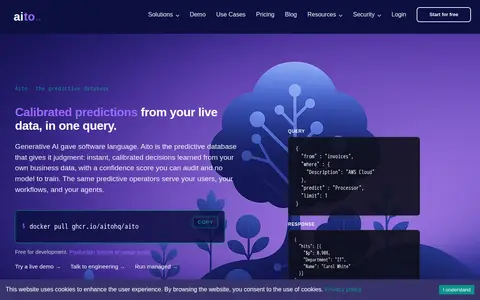
Aito.ai is a predictive database that delivers instant, calibrated predictions from a user's live data through single queries. It supports use cases including predictive accounting, ERP, e-commerce, and application functionality, with capabilities for predictions, recommendations, classification, smart search, knowledge graphs, and AI agents. It offers a free tier for development and production licensing scaled to usage.
Analyzes structured data and helps produce queries, insights or visualizations.
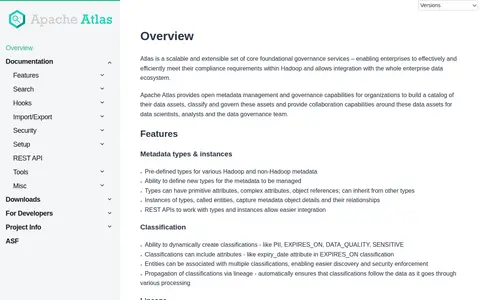
Apache Atlas – Data Governance and Metadata framework for Hadoop.
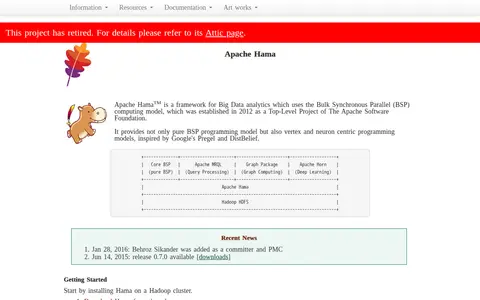
Apache Hama is a retired Apache Software Foundation Top-Level Project established in 2012. It is a framework for Big Data analytics that uses the Bulk Synchronous Parallel (BSP) computing model. It also provides vertex-centric and neuron-centric programming models inspired by Google's Pregel and DistBelief. Its components include core BSP, Apache MRQL for query processing, a graph computing package, and Apache Horn for deep learning, and it integrates with Hadoop HDFS.


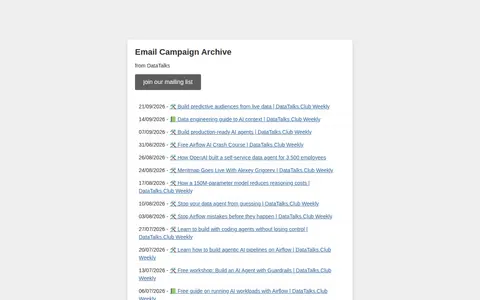
DataTalks.Club. A weekly newsletter about data-related things..
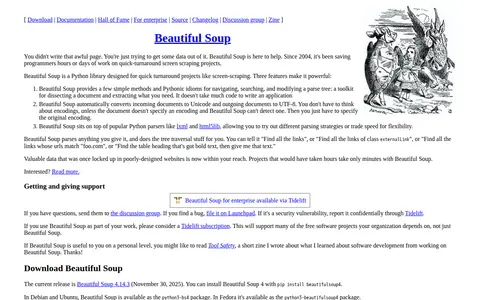
Beautiful Soup is a Python library for pulling data out of HTML and XML files. It provides simple methods and Pythonic idioms for navigating, searching, and modifying a parse tree, and it works with parsers such as lxml and html5lib. The project has been used for screen-scraping work since 2004.
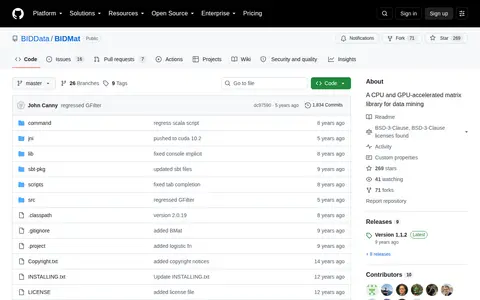
CPU and GPU-accelerated matrix library intended to support large-scale exploratory data analysis.
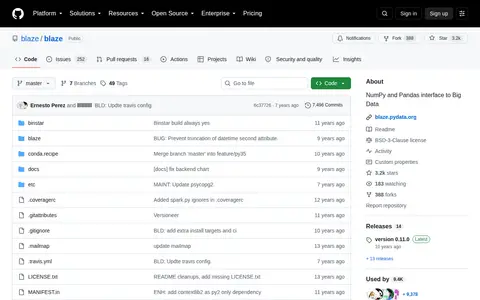
NumPy and Pandas interface to Big Data.
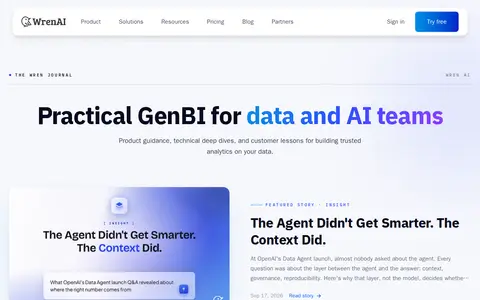
This is the official blog for Wren AI, which publishes practical guides covering GenBI, text-to-SQL, context layers, AI agents, embedded analytics, and secure self-hosted deployment for data teams. Posts include topics such as the role of context in AI agent performance and migrating open-source Wren projects to the cloud.
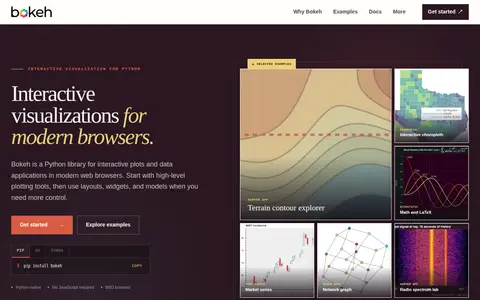
Bokeh is a Python library for creating interactive plots, dashboards, and data applications in modern web browsers. Plots can go in Jupyter notebooks, be saved as standalone HTML, or run with live Python callbacks through the Bokeh server or embedded in an ASGI app. It includes tools for pan, zoom, hover, and selection.
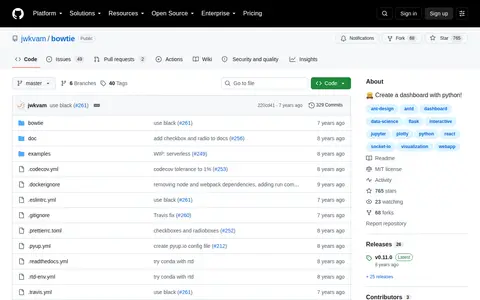
Bowtie is a library for writing dashboards in Python. It wraps the code needed for interactive data exploration and visualization, so users can build functionality without knowing web frameworks or JavaScript. It can be installed with conda or pip, and Docker images are provided.
Cerberus is a lightweight and extensible data validation library for Python. It provides type checking and other base functionality out of the box, is designed to be non-blocking and extensible for custom validation, and has no dependencies. It is available on PyPI and maintained according to semantic versioning since version 1.2.