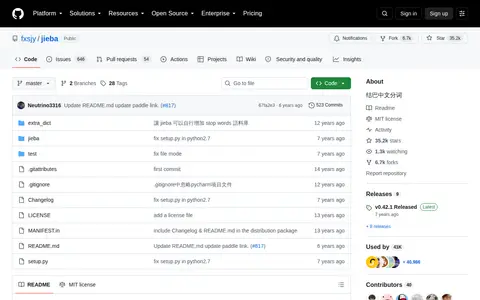

Jieba is a Chinese text segmentation module for Python. It supports four segmentation modes, including precise, full, search-engine and a paddle mode using PaddlePaddle, and offers keyword extraction based on TF-IDF and TextRank.
Directory
Search results
Published directory entries matching your search.
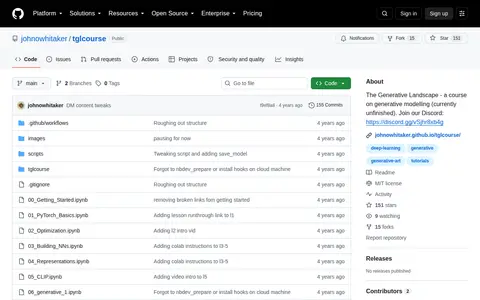
A course on generative modelling, currently unfinished, with the first approximately five lessons mostly done. It covers topics such as PyTorch basics, representations, CLIP, GANs, sequence modelling and transformers. No prior deep learning knowledge is assumed, though comfort with some Python and Jupyter Notebooks is expected.
Jupyter Notebooks as Markdown Documents, Julia, Python or R scripts.
Kartograph.py is a Python library for rendering beautiful SVG maps. The project is currently unmaintained, but its source code remains available on GitHub. It allows users to create map visualizations programmatically.
Kubeflow Katib is a Kubernetes-native project for automated machine learning (AutoML). It supports hyperparameter tuning, early stopping and neural architecture search, and is agnostic to machine learning frameworks, natively supporting frameworks such as TensorFlow, PyTorch and XGBoost. Training jobs can use any Kubernetes Custom Resources, with out-of-box support for Kubeflow Training Operator, Argo Workflows and Tekton Pipelines. A Python SDK simplifies creating tuning jobs.
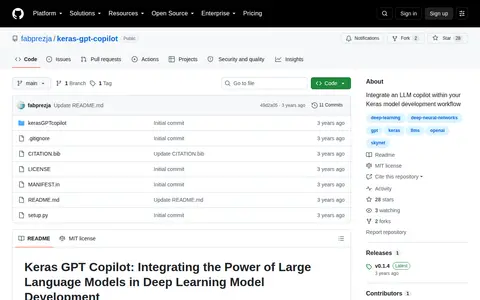
Keras GPT Copilot is a Python package that integrates an LLM copilot within the Keras model development workflow, generating feedback from model configuration, optimizer details and experiment results. It interacts with OpenAI's GPT models and offers a prompt-only mode for compatibility with other large language models.
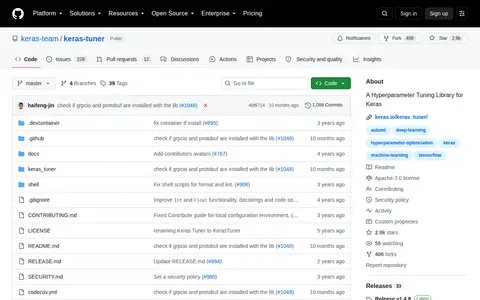
KerasTuner is a hyperparameter optimization framework for Keras. It provides a define-by-run syntax for configuring search spaces and includes Bayesian Optimization, Hyperband and Random Search algorithms. It requires Python 3.8+ and TensorFlow 2.0+.
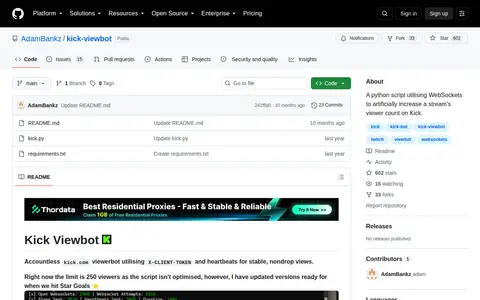
A python script utilising WebSockets to artificially increase a stream's viewer count on Kick.

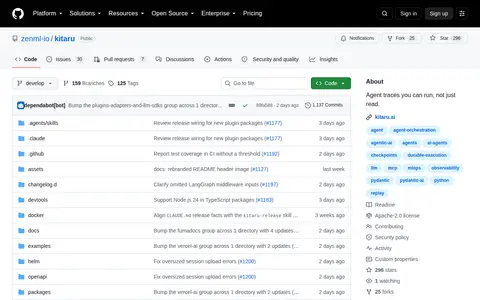
Kitaru is an open-source, self-hosted tool providing replay-based evaluations for AI agents. It records or imports production runs as sessions and replays them against a changed model, prompt, or code, with tool calls answered from the recording. It is available for Python and TypeScript and comes from the team behind ZenML.
A Python framework for building LLM-powered applications through a multi-agent paradigm. Developers set up agents, equip them with optional components such as LLMs, vector stores and tools, assign tasks, and have them exchange messages to solve problems. It works with practically any LLM and does not use LangChain.
Lifelines is a complete survival analysis library, written in pure Python.
LightlySSL is a Python computer vision framework for self-supervised learning on images, written in a PyTorch-like style. It exposes low-level building blocks such as loss functions and model heads, supports custom backbone models for self-supervised pre-training, and supports distributed training using PyTorch Lightning. Sample code covers models including MoCo, SimCLR, BYOL and DINO.
Lightwood is an AutoML framework that generates and customizes machine learning pipelines using a declarative JSON-AI syntax. It handles data types such as numbers, dates, categories, tags, text, arrays and multimedia formats, and includes a time-series mode. Users can override defaults or replace pipeline steps, and the framework generates Python code for the pipeline.
Little Ball of Fur is a graph sampling extension library for Python and a graph sampling extension library for NetworKit and NetworkX. It consists of methods that can sample from graph structured data, covering vertex, edge, and exploration sampling techniques with a unified application public interface.
A self-hosted proxy providing OpenAI and Anthropic compatible API endpoints for multiple LLM providers, so existing applications can use any supported provider through a single API key. It includes a FastAPI proxy application and a reusable Python resilience library for API key management, rotation, and failover.
LLMFlows is a Python framework for building LLM applications such as chatbots, question-answering systems and agents. It provides abstractions for using LLMs and vector stores, with explicit classes that avoid hidden prompts or LLM calls, aiming to make monitoring, maintenance and debugging easier.
LocalGPT is an on-premise document intelligence platform that lets users chat with their documents on their local device using GPT models. It supports PDF, DOCX, HTML, Markdown, and TXT files and combines dense vector search with LanceDB full-text search and a cross-encoder reranker. It runs with a plain Python RAG core and offers generation models via Ollama.
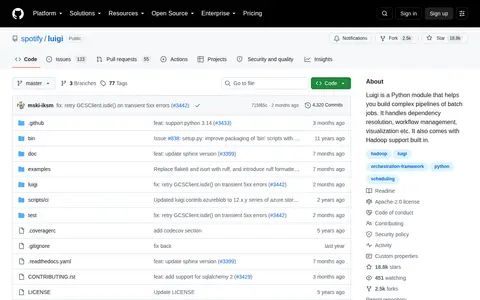
Luigi is a Python package for building complex pipelines of batch jobs. It handles dependency resolution, workflow management, visualization, handling failures and command line integration, and includes Hadoop support. It is intended to stitch together long-running tasks such as Hive, Pig, Hadoop, Spark or database jobs.
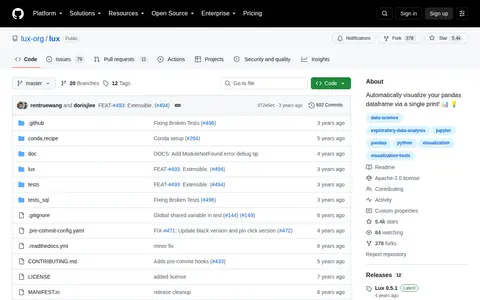
Lux is a Python library for automated data exploration. When a pandas dataframe is printed in a Jupyter notebook, Lux recommends a set of visualizations highlighting trends and patterns, shown in an interactive widget for browsing and exploring the dataset.
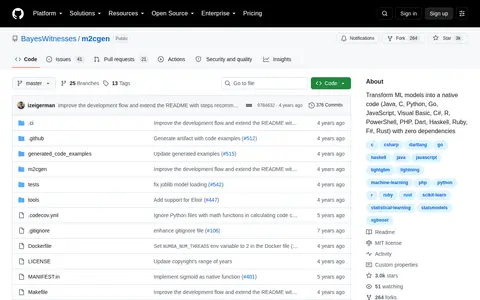
m2cgen is a tool that transforms trained machine learning models into native code across a wide range of programming languages including Java, C, Python, Go, JavaScript, C#, R, PHP, Dart, Haskell, Ruby, F#, and Rust, with zero dependencies. Its codebase is hosted in the BayesWitnesses GitHub repository, which includes navigation for installation, development guidance, supported languages, and supported model types.
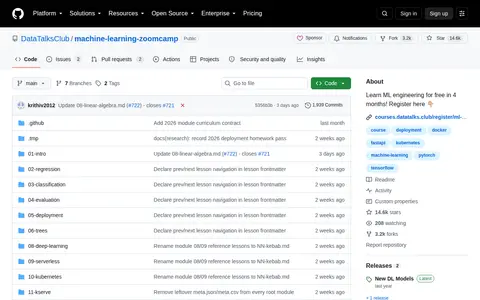
Machine Learning Zoomcamp is a free, hands-on course on building, evaluating, and deploying machine learning systems. It covers the path from framing a problem to preparing data, training and evaluating models, and deploying them, using Python, scikit-learn, TensorFlow, PyTorch, FastAPI, Docker, Kubernetes and AWS Lambda. No prior machine learning experience is required.
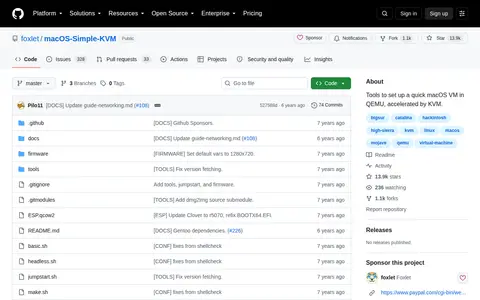
macOS-Simple-KVM provides tools to set up a quick macOS virtual machine in QEMU, accelerated by KVM. It requires a Linux system with qemu 3.1 or later, python3, pip and the KVM modules enabled; a Mac is not required. Installation media is downloaded by running jumpstart.sh, with Catalina as the default version and options for High Sierra, Mojave or Catalina, and basic.sh starts the machine.
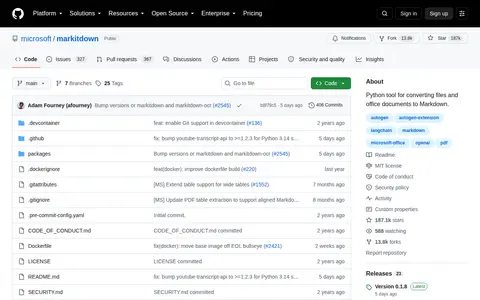
MarkItDown is a lightweight Python utility for converting various files to Markdown for use with LLMs and related text analysis pipelines. It preserves document structure and content as Markdown, including headings, lists, tables, and links, and supports formats such as PDF, PowerPoint, Word, Excel, images, audio, HTML, and ZIP files.
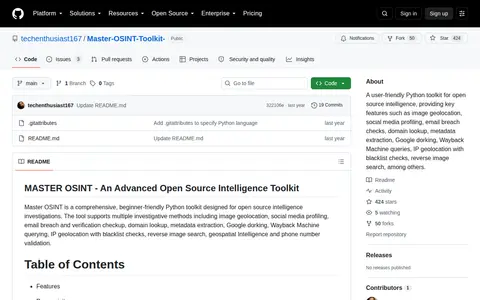
A user-friendly Python toolkit for open source intelligence, providing key features such as image geolocation, social media profiling, email breach checks, domain lookup, metadata extraction, Google dorking, Wayback Machine queries, IP geolocation with blacklist checks, reverse image search, among others.