profiles.nlm.nih.gov
US National Library of Medicine's digital archive of scientists, physicians, and others who have advanced science.
Directory
Published directory entries matching your search.
US National Library of Medicine's digital archive of scientists, physicians, and others who have advanced science.

Redalyc is a scientific information system and network of scientific journals. It describes an open access, non-profit model owned by the academy, and lists journals across social sciences, natural and exact sciences, and arts and humanities. Its interface is available in Spanish, English, Portuguese and other languages.

GDM Science Skills to speed up agentic scientific workflows with better grounding and higher token efficiency. Integrate insights from AlphaGenome, AFDB, UniProt and 30+ other databases and tools.
The Algorithms - C++ is a repository of open-source implementations of various algorithms in C++, released under the MIT License. It covers topics including computer science, mathematics, statistics, data science, machine learning and engineering, and is intended as a learning resource for educators and students. The documentation is generated from the source code.

The Borr Project is a free educational initiative providing self-paced learning paths modeled on top university curricula for computer science, pre-college math, data science, and mathematics. It offers help via a Discord chat room and a public FAQ.

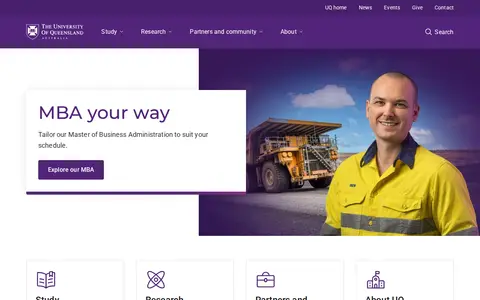
The University of Queensland is a university whose website presents study options, postgraduate study, research, and partnerships with communities. It lists application steps and scholarships, and offers a searchable database of experts across over 1,000 specialisations. It also publishes events and news.

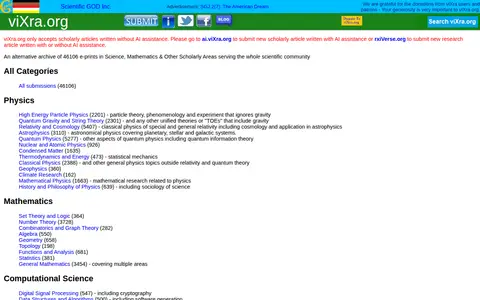
viXra.org is an open e-print archive launched in 2009 as an alternative to arXiv.org. It hosts e-prints in science, mathematics and other scholarly areas, organized into categories including physics, mathematics, computational science, biology, chemistry and humanities. The archive states that it only accepts scholarly articles written without AI assistance.

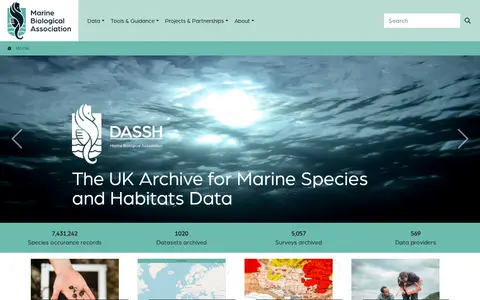
DASSH is a data archive that holds marine species occurrence records, archived datasets and archived surveys. It provides a data mapper for searching data, data access and tools, a citizen science hub, and a route for data providers to submit data.
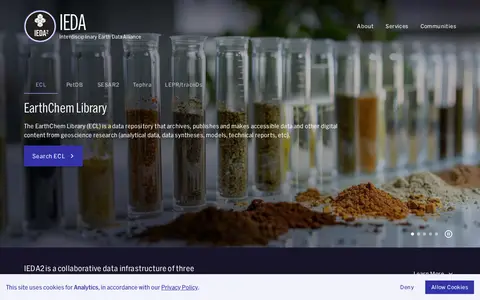
IEDA2 is a collaborative data infrastructure of three complementary data systems: EarthChem, LEPR/traceDs and SESAR. It supports geoscience researchers in sharing and accessing sample data following FAIR data principles, and its mission is open, reproducible and transparent science practices. Components include the EarthChem Library data repository and PetDB geochemical data access.
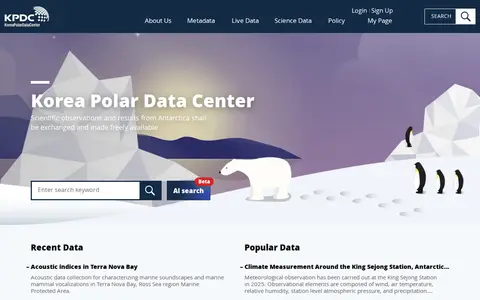
The Korea Polar Data Center (KPDC) manages diverse data obtained from Korean polar scientific research in the Arctic and Antarctic. Its site provides metadata keyword search, data collection browsing by type, and advanced search. It also lists science data resources and live data such as the IBRV ARAON route and weather.
MatDB is a database hosted within the European Commission Joint Research Centre's ODIN Portal, which operates as the EU's science and knowledge service to support European policies with independent evidence across the full policy cycle. The platform offers open access data catalogs, data summaries, citable datasets and catalogs, and DOI listings for frequently viewed, recently published, and recently uploaded data. The open access module only provides access to a limited subset of ODIN's hosted data, with full feature and data access requiring user registration and login. Downloading data from MatDB requires agreement to the licenses accompanying individual datasets and the ODIN terms and conditions.

The National Microbiome Data Collaborative is a Department of Energy program providing data infrastructure for microbiome science, including a Submission Portal, Data Portal and API. It offers community-driven data standards with expert curation and standardized bioinformatics workflows. The program is concluding, with core functionalities merging into DOE-BRIDGE; generated data will remain available through that infrastructure.
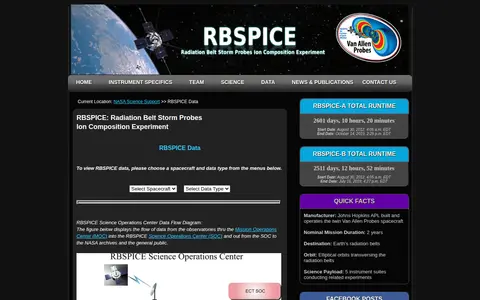
RBSPICE is the Radiation Belt Storm Probes Ion Composition Experiment. The page provides access to RBSPICE data for the twin Van Allen Probes spacecraft, RBSPICE-A and RBSPICE-B, through menus for selecting a spacecraft and data type. It links to science operations center data, a data handbook, calibration data, quick look data, interactive plots, daily plots and reports.
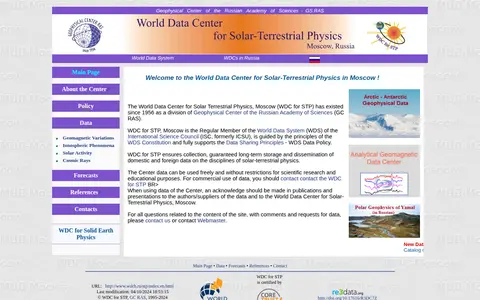
The World Data Center for Solar-Terrestrial Physics, Moscow, a division of the Geophysical Center of the Russian Academy of Sciences, has existed since 1956. It collects, stores and disseminates data on solar-terrestrial physics disciplines, with online data and data search. Its data can be used freely for scientific research and educational purposes.
The World Data Centre for Microorganisms is a global microbial resources data center. It applies information technology to improve access to and use of data and information and to optimize the interoperability of microbial data. It facilitates the exchange of open data and supports international open science exchanges and cooperation between scientists from culture collections and other user communities.

The Yale University Open Data Access (YODA) Project advocates for responsible sharing of clinical research data, open science, and research transparency. It partners with data partners that transfer full jurisdiction over data access to the project, and researchers can request data. The site states that 513 trials have been identified as available.
The Bjerknes Climate Data Centre (BCDC) is a platform for accessing and submitting climate and Earth system data. It hosts datasets across categories including remote sensing, paleo data, model output, oceanography, and atmospheric science. The centre publishes data highlights, lists partner organizations, and provides access to associated research outputs for its hosted datasets.

The Research Data Center provides external researchers with access to economic and social science research data for non-commercial research or teaching at universities. Its data offerings include microdata on R&D activities of German companies, aggregated R&D data, higher education course catalogues and a startup monitor comparing university entrepreneurship support. The center advises on data selection, access and analysis.

IG PAS Data Portal is an open data platform for the Institute of Geophysics Polish Academy of Sciences. It is used to collect and share IG PAS data, including access to data from external repositories.

The Materials Data Facility (MDF) is a service for publishing, discovering and accessing materials science datasets. It supports minting DOIs for datasets and offers curated collections covering simulations, experimental data and machine-learning-ready data. Data can be uploaded from local storage, Globus endpoints or Google Drive, and datasets can be loaded with a Python package.

The Climate Data Guide is an expert knowledge portal offering concise information on the strengths and limitations of climate data used for measuring and predicting the evolution of the Earth system. It publishes data summaries with access links, intercomparisons, and expert commentaries on data utility for climate science questions, organized into categories including atmosphere, climate indices, cryosphere, land, ocean, paleoclimate, and reanalysis.

Qualiservice is a data service center for archiving and sharing qualitative research data in the social sciences. It lets researchers find and use qualitative research data from various fields, submit and share their own data, and get support in organizing the collection and preparation of reusable data. Contextual information is provided on a personalized basis, and the service is contactable by email.
The Forest Service Research Data Archive contains research data collected or funded by Forest Service Research and Development, U.S. Department of Agriculture. It provides access to short- and long-term research data, including Experimental Forest and Range data, and serves to preserve and share researchers' science.

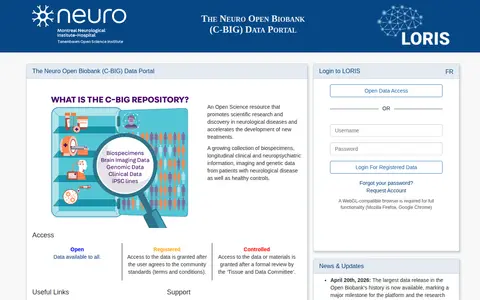
The Neuro Open Biobank (C-BIG) Data Portal is an Open Science resource for research in neurological diseases. It holds biospecimens, longitudinal clinical and neuropsychiatric information, imaging and genetic data from patients with neurological disease and healthy controls. Open Data is available to all, Registered Access requires agreeing to community standards, and Controlled Access requires review by the Tissue and Data Committee.