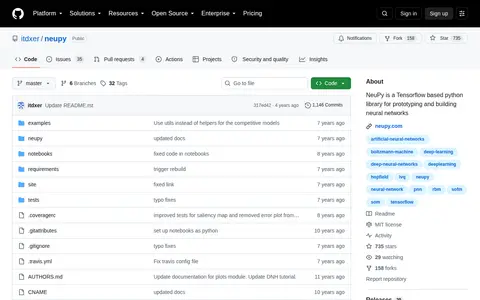

NeuPy is a Python library built on Tensorflow for prototyping and building neural networks. The repository notes that the library is no longer actively maintained. It includes examples and notebooks covering algorithms such as Boltzmann machines and self-organizing maps.
Directory
Search results
Published directory entries matching your search.
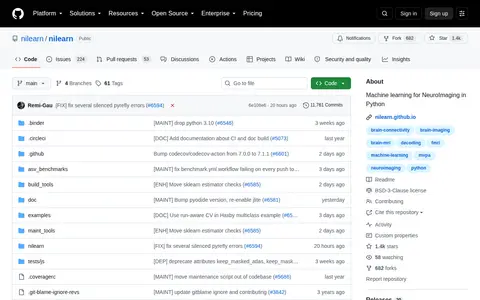
Nilearn provides statistical and machine-learning tools for analyses of brain volumes and surfaces, with documentation and a community. It supports general linear model based analysis and uses the scikit-learn toolbox for multivariate statistics, with applications such as predictive modeling, classification, decoding and connectivity analysis. It is written in Python and installable with pip.

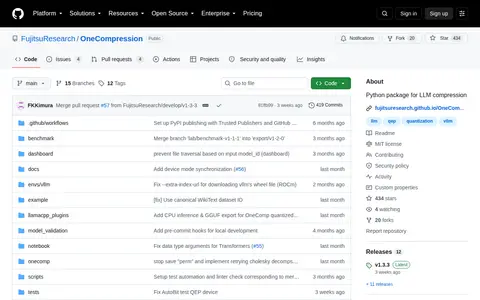
OneComp is a Python package for large language model (LLM) compression, hosted as a public repository under the FujitsuResearch GitHub organization. The project is designed for LLM compression tasks and accepts community contributions to its codebase.
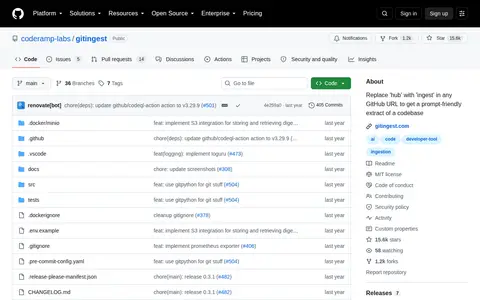
Gitingest converts any Git repository into a prompt-friendly text ingest for LLMs. Users can replace hub with ingest in any GitHub URL to access the corresponding digest. It provides a text digest from a repository URL or directory, with smart formatting for LLM prompts and statistics on file and directory structure, extract size and token count. It is available as a CLI tool and Python package.
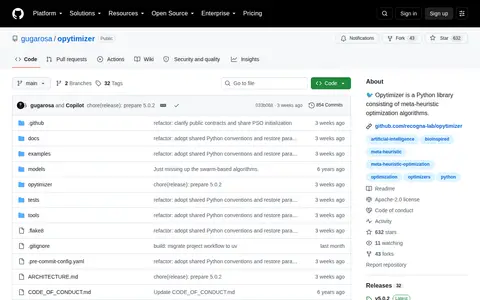
Python-based meta-heuristic optimization techniques.
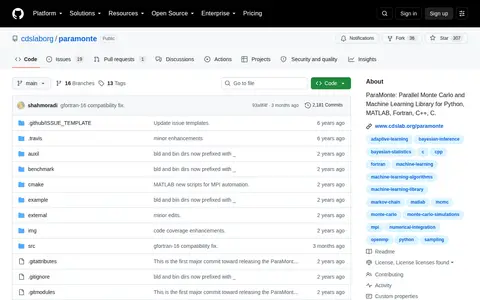
ParaMonte is a serial and parallel library of Monte Carlo routines for sampling mathematical density functions of arbitrary dimensions and machine learning algorithms for scientific inference. It is designed for interoperability with C, C++, Fortran, MATLAB and Python, and supports shared-memory OpenMP threads and MPI distributed communications.
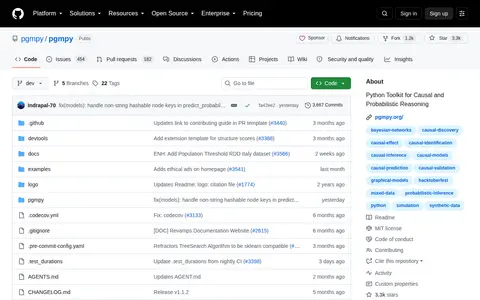
pgmpy is a Python toolkit for causal and probabilistic reasoning using graphical models. It implements data structures for models such as DAGs, PDAGs, MAGs, PAGs, Bayesian Networks, Dynamic Bayesian Networks and Structural Equation Models, with algorithms for tasks including causal discovery, causal identification, inference, model validation, parameter estimation and simulations. Algorithms follow a unified composable API and are scikit-learn compatible when possible. It is available on PyPI and conda.
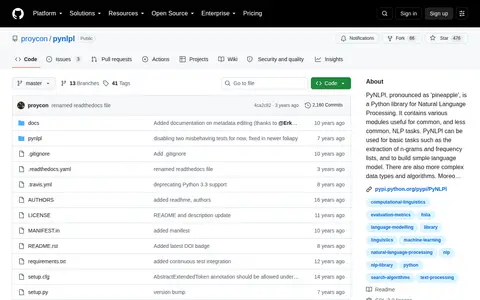
PyNLPl, pronounced "pineapple", is a Python library for natural language processing. It includes modules for common and less common NLP tasks, such as n-gram and frequency list extraction, simple language model building, parsers for common NLP file formats including FoLiA, Giza, Moses, ARPA, Timbl and CQL, clients for NLP-specific servers, and extensive tools for working with FoLiA XML linguistic annotation.
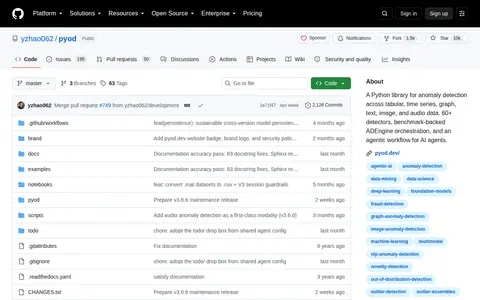
PyOD is an open-source Python library hosted on GitHub for anomaly detection across tabular, time series, graph, text, image and audio data. It includes over 60 anomaly detectors, an ADEngine orchestration tool, and supports agentic workflows for use with AI agents.
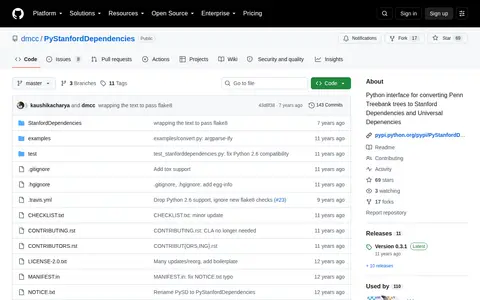
PyStanfordDependencies is a Python interface for converting Penn Treebank trees to Stanford Dependencies and Universal Dependencies. It offers a get_instance() function with subprocess or jpype backends, and convert_tree() or convert_trees() methods returning Token objects. Visualization options include asciitree, Graphviz dotgraphs, and interactive xdot windows. A Stanford CoreNLP or Parser jar file can be supplied, or downloaded automatically.
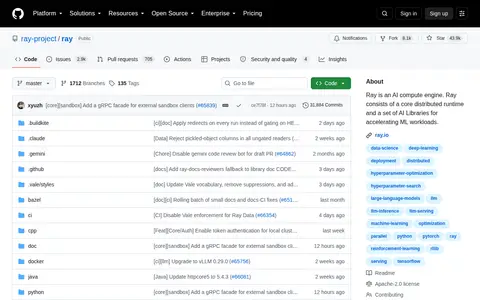
Ray is an AI compute engine consisting of a core distributed runtime and AI libraries for scaling AI and Python applications. It runs on any machine, cluster, cloud provider, and Kubernetes, and is installed with pip install ray.
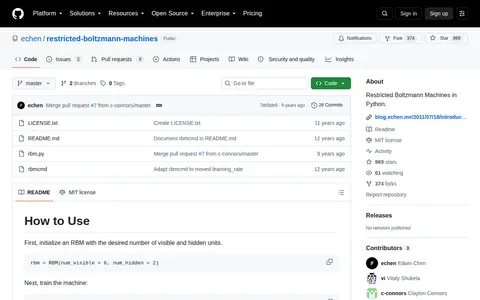
A Python implementation of Restricted Boltzmann Machines. It lets users initialize an RBM with a chosen number of visible and hidden units, train it on a matrix of training examples, run visible or hidden data, and let the network run freely. It is released under an MIT license.
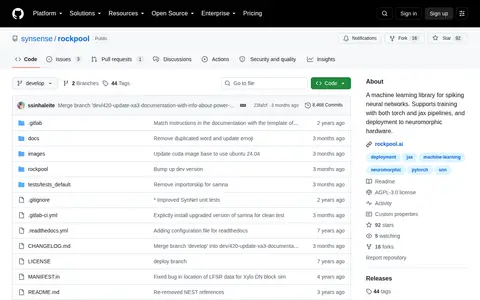
Rockpool is a Python package for developing signal processing applications with spiking neural networks. It allows users to build networks, simulate, train and test them, and deploy them in simulation or on event-driven neuromorphic compute hardware. It provides layers with simulation backends including Brian2, Torch, JAX, Numba and raw numpy.
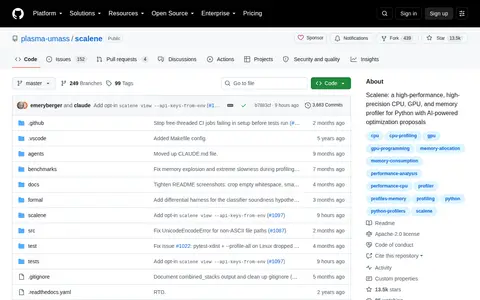
Scalene is a Python profiler that measures CPU, GPU and memory usage. It identifies inefficiencies and can request optimization suggestions from AI providers, including Amazon Bedrock, Microsoft Azure, OpenAI and local models via Ollama. It can be used at the command line or as a Visual Studio Code extension, and installs via pip or conda.
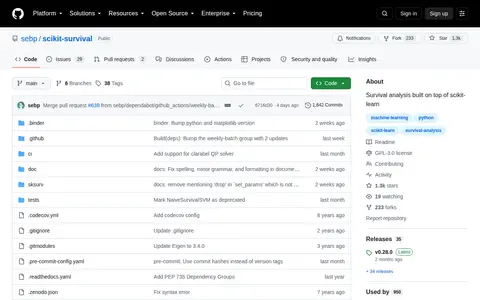
Scikit-Survival is a Python library that implements survival analysis functionality built on top of the scikit-learn framework. It is hosted as a public open source repository on GitHub for community contributions.
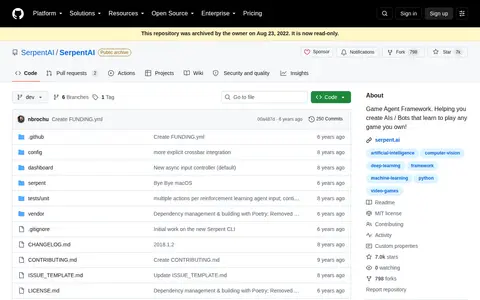
Serpent.AI is a Python-based Game Agent Framework intended to help users create artificial intelligences and bots that learn to play video games. The project was marked as end of life in November 2018, with a revival update released in May 2020.
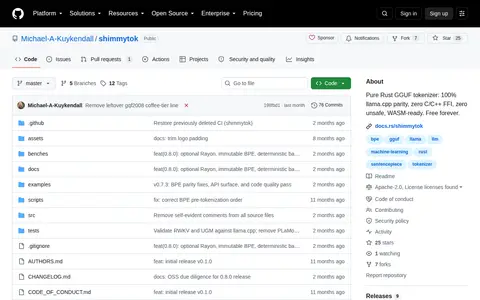
A pure Rust tokenizer library that reads tokenizers directly from GGUF model files, requiring no Python, C++ or separate tokenizer files. It supports SPM, BPE, WPM, RWKV and UGM tokenizers tested token-for-token against llama.cpp, and offers batch encoding with optional Rayon parallelism. MIT licensed.
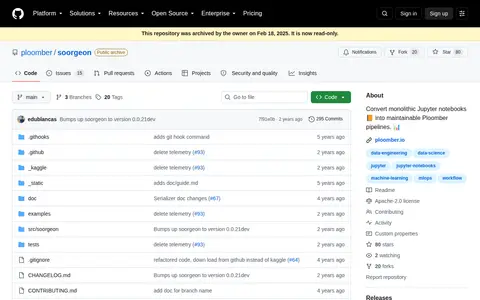
Soorgeon is a tool that converts monolithic Jupyter notebooks into Ploomber pipelines. It is compatible with Python 3.7 and higher and installs via pip. The repository was archived by its owner on Feb 18, 2025, and is now read-only. The project describes itself as being in alpha.
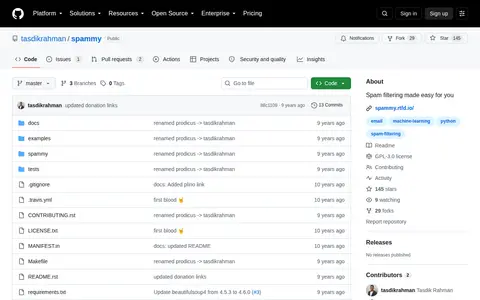
spammy is a Python spam filtering library built on nltk that powers the plino web app. Users can train the classifier on their own dataset to classify emails into spam or ham.
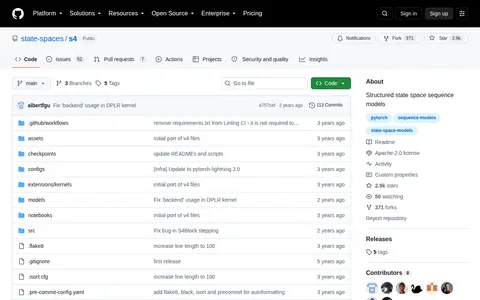
Structured State Spaces for Sequence Modeling is a GitHub repository providing official implementations and experiments for models related to S4, including HiPPO, LSSL, SaShiMi, DSS, S4D and S4ND. It states requirements of Python 3.9+ and Pytorch 1.10+, and is released under an Apache-2.0 license.
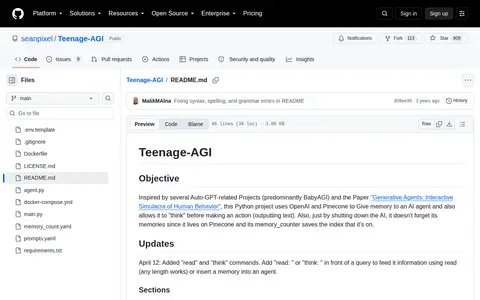
Teenage-AGI is a Python project inspired by Auto-GPT-related projects and the Generative Agents paper. It uses OpenAI and Pinecone to give an AI agent memory and let it think before acting. The agent stores queries and answers in a Pinecone vector database.
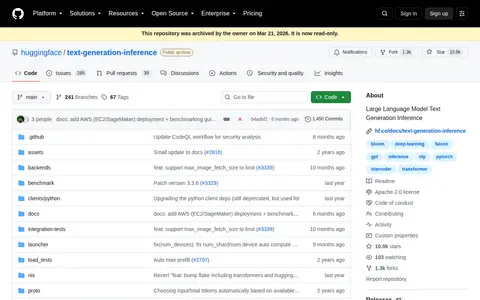
Text Generation Inference is a toolkit for deploying and serving large language models, implemented as a Rust, Python and gRPC server. It supports models including Llama, Falcon, StarCoder, BLOOM and GPT-NeoX, with features such as token streaming, continuous batching and quantization. The repository is archived, read-only, and in maintenance mode, with pull requests limited to minor bug fixes and maintenance.
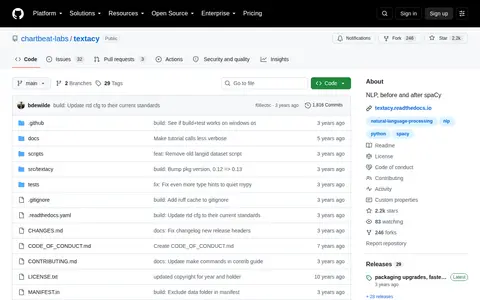
textacy is a Python library for natural language processing tasks built on the spaCy library. It focuses on tasks before and after spaCy processing, with tokenization, part-of-speech tagging and dependency parsing delegated to that library. Features include cleaning and normalizing raw text, extracting n-grams, entities, acronyms and keyterms, similarity metrics, and training topic models.
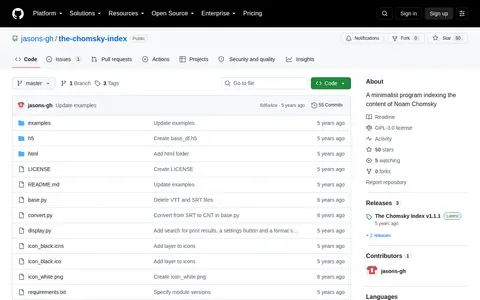
The Chomsky Index is a minimalist open-source program that indexes the content of Noam Chomsky. It is available for Windows, macOS, and Ubuntu, and supports normal, separate, and nearby search queries for indexed content. Users can install pre-built executables for their system or build from source using Python 3.7. The project is released under the GPL-3.0 license.