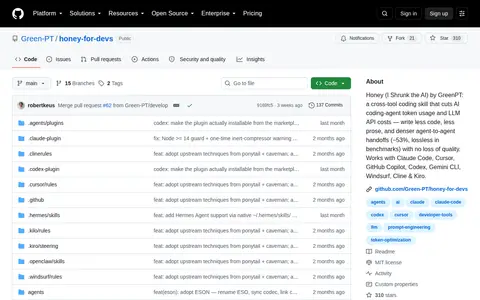

Honey (I Shrunk the AI) by GreenPT is a cross-tool coding skill that reduces AI coding-agent token usage and LLM API costs. It enables writing less code and prose and supports denser agent-to-agent handoffs, with reported 53% cost reduction and no quality loss in benchmarks. It is compatible with Claude Code, Cursor, GitHub Copilot, Codex, Gemini CLI, Windsurf, Cline, and Kiro.
Directory
Search results
Published directory entries matching your search.
Hydrosphere Mist is a serverless proxy for Spark clusters. It offers a functional programming framework and deployment model for Spark applications, with a REST HTTP and messaging API for Scala and Python Spark jobs. Sessions are managed across EMR, Hortonworks, Cloudera, DC/OS and vanilla Spark clusters.
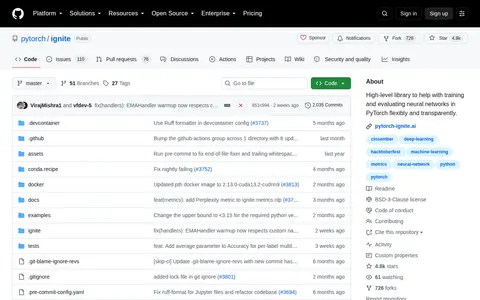
Ignite is a high-level library for training and evaluating neural networks in PyTorch. It provides a simple engine and event system, out-of-the-box metrics to evaluate models, and built-in handlers for composing training pipelines and saving artifacts. The library aims to require less code than pure PyTorch while keeping maximum control, with an extensible API for metrics and experiment managers.
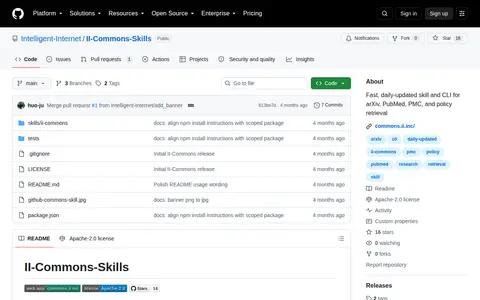
II-Commons-Skills provides fast, deterministic retrieval across arXiv, PubMed / PMC and supported US policy corpora, distributed as an npm package and CLI requiring Node.js 18 or newer. Basic usage works without authentication, and an API token is available for higher usage limits. It is licensed under Apache-2.0.
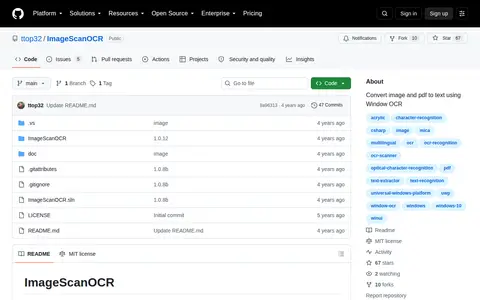
ImageScanOCR is an application that recognizes text from images and PDF files using the Windows OCR API, converting images to editable plain text. Users can edit, copy and save results as plain text files, use batch processing, and rotate images. It supports multiple OCR languages when the Windows language pack is installed and can process OCR offline.
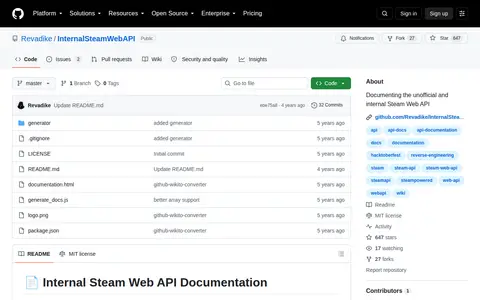
Documenting the unofficial and internal Steam Web API
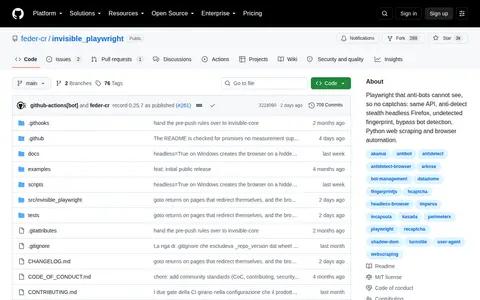
invisible_playwright is a Python package providing Playwright-compatible browser automation on an anti-detect Firefox patched at the C++ source level. It humanizes clicks, hover and drag actions in the driver. Supported platforms are Windows x86_64 and Linux x86_64/arm64; tracing, HAR, CDP and the API request context are out of scope.
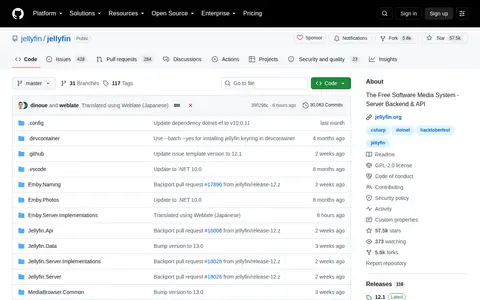
Jellyfin is a free software media system comprising a server backend and API. It is an open-source project that provides media server functionality, with its server component development hosted on GitHub.
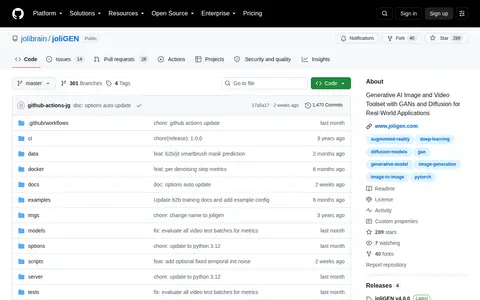
joliGEN is an integrated framework for training custom generative AI image-to-image models. It implements GAN, diffusion and consistency models for paired and unpaired image-to-image translation, including domain and style adaptation that preserves semantics such as image and object classes and masks. A server with REST API is provided for deployment, and documentation includes quickstarts and dataset guidance.
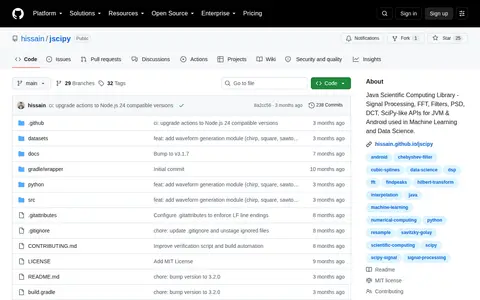
Open-source Java scientific computing library for JVM and Android platforms, with SciPy-like APIs for use in machine learning and data science workflows. It provides functionality for signal processing, FFT, filters, PSD, and DCT operations.
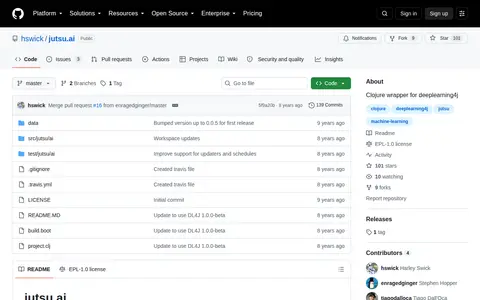
A Clojure wrapper for deeplearning4j with added syntactic sugar, aiming to provide a declarative API for machine learning on the JVM. It translates Clojure keywords into Java method calls, making many deeplearning4j configuration options accessible. The project is a work in progress, and configurations have been tested on basic feedforward nets, RNNs and CNNs.
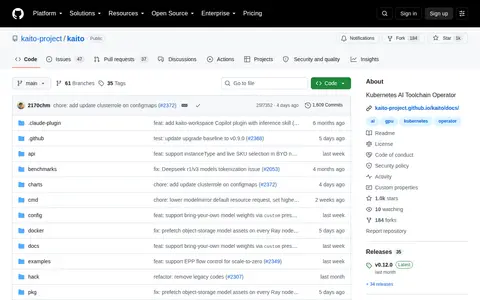
Kaito is the Kubernetes AI Toolchain Operator, an operator suite that automates LLM inference, fine-tuning and RAG engine deployment in a Kubernetes cluster. It simplifies the CRD API and provides optimized preset configurations for inference engine scheduling parameters. Workspaces are the basic CRD for managing inference and tuning workloads, and all vLLM-supported models can be run.
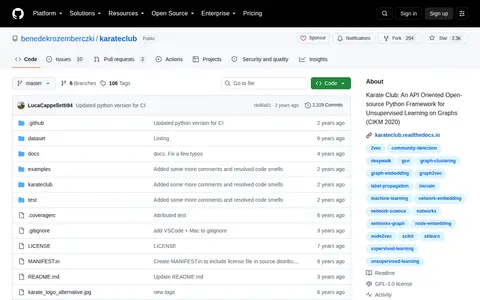
An unsupervised machine learning extension library for NetworkX with a Scikit-Learn like API.
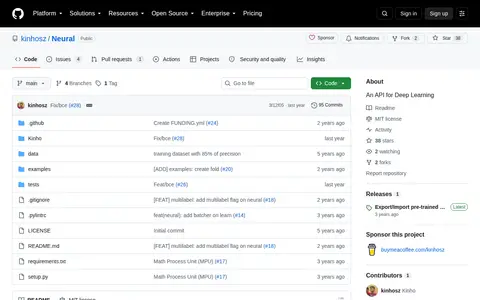
Simple API for Neural Network. Better for image processing with CPU/GPU + Transfer Learning.
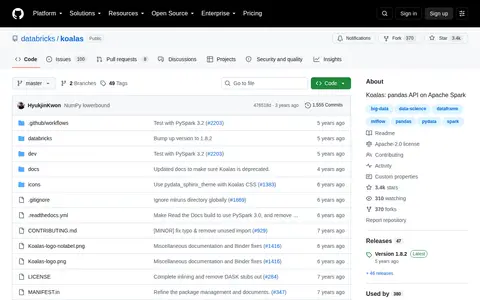
Koalas, from Databricks, implements the pandas DataFrame API on top of Apache Spark. The repository is marked deprecated and in maintenance mode; Koalas supports Apache Spark 3.1 and below, and PySpark is recommended directly for Spark 3.2 and above. It is available under the Apache-2.0 license.
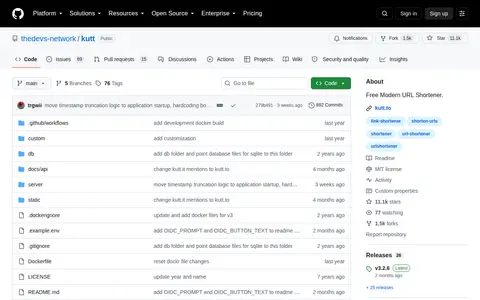
Kutt is a self-hosted URL shortener with custom domain support. It allows creating and editing links, setting custom URLs, passwords and expiration times, viewing statistics, and managing users. It supports SQLite, Postgres and MySQL databases, OpenID Connect login and a RESTful API.
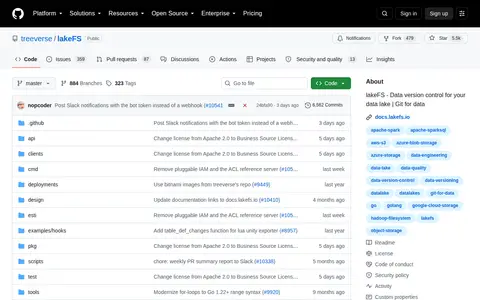
lakeFS is a source-available data version control tool that turns object storage into a Git-like repository, allowing data lakes to be managed like code. It supports AWS S3, Azure Blob Storage and Google Cloud Storage, is API compatible with S3, and works with frameworks such as Spark, Hive, AWS Athena, DuckDB and Presto.

🏷️ Expose your Discord presence and activities to a RESTful API and WebSocket in less than 10 seconds
Libfolia is a C++ library for working with the Format for Linguistic Annotation (FoLiA), providing a high-level API to read, manipulate, and create FoLiA documents. It is intended for C++ developers and serves as a dependency for other tools that use FoLiA. The software is distributed under the GNU Public Licence v3.
Agentic components of the Llama Stack APIs.
llama.cpp is a C/C++ implementation for large language model and vision language model inference with minimal setup across a range of hardware, locally and in the cloud. It is built on the ggml library and offers command-line and server tools, an OpenAI-compatible API server, and multiple hardware backends.
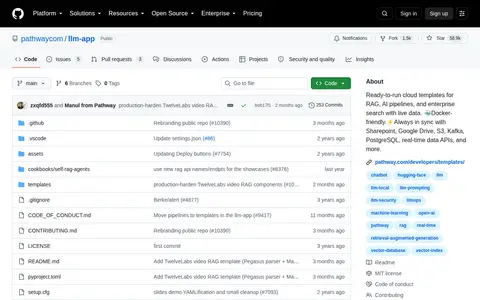
LLM App is an open-source project providing ready-to-run cloud templates for retrieval-augmented generation (RAG), AI pipelines and enterprise search with live data. It is Docker-friendly and designed to stay synchronized with data sources including Sharepoint, Google Drive, S3, Kafka, PostgreSQL and real-time data APIs, hosted by pathwaycom on GitHub.
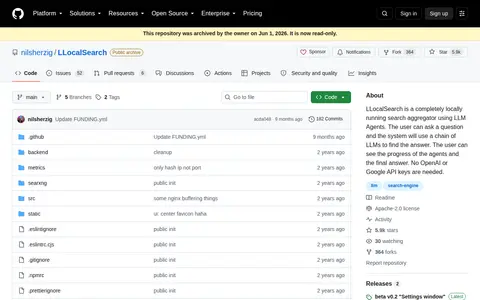
LLocalSearch is a fully locally running search aggregator that uses LLM agents to answer user questions. It uses a chain of LLMs to find answers, displays agent progress and final results, and does not require OpenAI or Google API keys to operate.
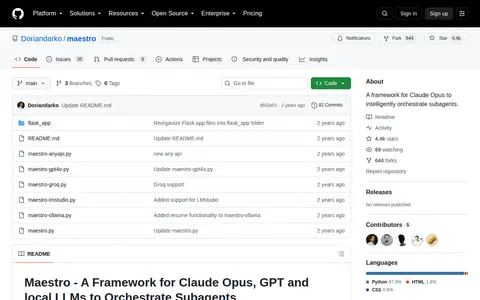
Maestro is a framework for Claude Opus, GPT and local large language models to orchestrate subagents. It supports use with APIs from providers including Anthropic, Gemini, OpenAI and Cohere, and has been updated to support Claude 3.5 Sonnet.