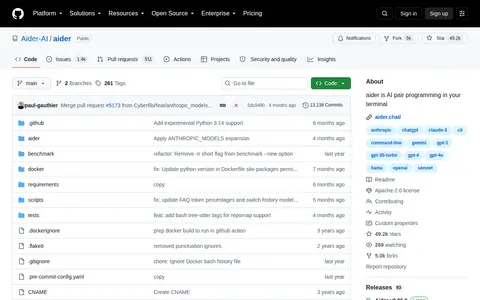

Aider is an AI pair programming tool that runs in the terminal. It connects to cloud or local LLMs to start new projects or build on existing codebases, maps the codebase, and works with many programming languages. Changes are committed automatically with git, and aider can lint and test code after edits.
Directory
Search results
Published directory entries matching your search.
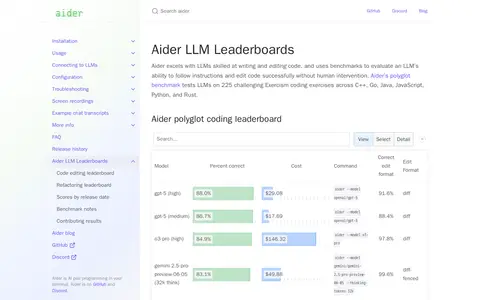
Aider LLM Leaderboards presents quantitative benchmarks of LLM code editing skill. The polyglot benchmark tests LLMs on 225 Exercism coding exercises in C++, Go, Java, JavaScript, Python and Rust, and benchmarks evaluate an LLM's ability to follow instructions and edit code without human intervention.
Open-source project that provides machine-learning models, research, training resources, or evaluation tools.
AirTable is a platform that enables teams to build custom business applications, automate workflows, and deploy AI agents. It provides relational databases, interfaces, reporting, and governance features, and integrates with tools such as Slack, Google Drive, and Salesforce.
Alien Dreams: An Emerging Art Scene - ML@B Blog provides machine-learning models, research, training resources, or evaluation tools.

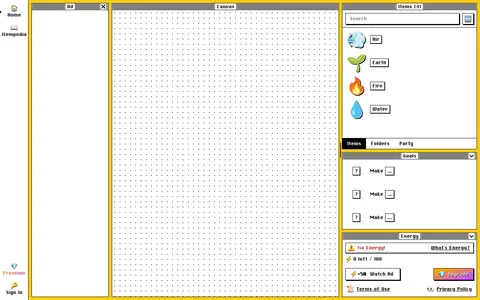
Allchemy is an AI-powered infinite crafting game in the browser. Players begin with four items and can create anything. The site also mentions organizing items into folders, joining or creating a party to play with friends on a collaborative canvas, and goals.
Code for Data Science at Olin College, Spring 2014.
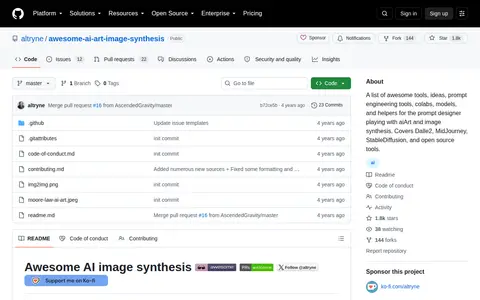
A GitHub repository compiling tools, ideas, prompt engineering resources, Colabs, models and helpers for prompt designers working with AI art and image synthesis. The list covers Dalle2, MidJourney, StableDiffusion and open source tools, and includes sections on commercial and free hosted tools, prompt engineering, post-processing and communities.
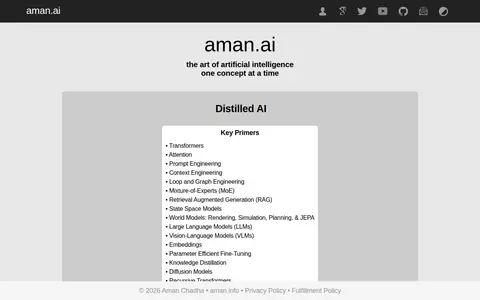
A site offering course notes and learning material for Stanford artificial intelligence and deep learning classes. It lists primers on topics such as transformers, attention and retrieval augmented generation, alongside links to Stanford CS229, CS230, CS231n and CS224n.
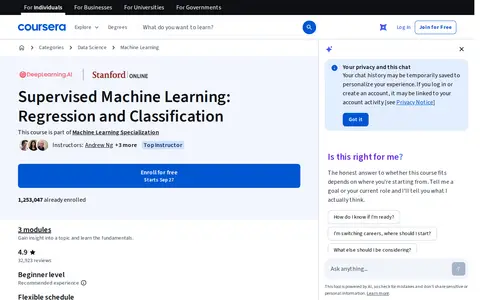
Andrew Ng’s Machine Learning at Stanford University is a Coursera course titled 'Supervised Machine Learning: Regression and Classification'. It is the first course of the Machine Learning Specialization. The course teaches how to build machine learning models in Python using NumPy and scikit-learn, covering regression and classification. It is aimed at beginners, requires flexible scheduling over three weeks at ten hours per week, and offers a shareable certificate.
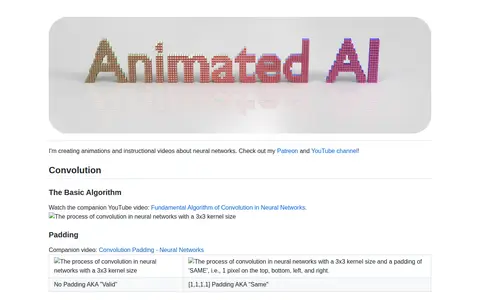
Animated AI is a project of animations and instructional videos about neural networks. Its topics cover convolution basics, padding, stride, grouped and depthwise-separable convolution, and pixel shuffle. It is licensed under the MIT License.
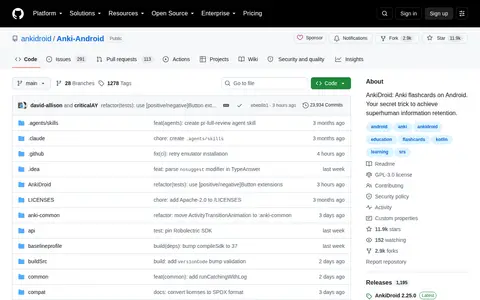
AnkiDroid is the official Android port of the open-source Anki spaced repetition flashcard system. It supports spaced repetition learning using the AI-optimized FSRS algorithm, and allows users to create flashcards with text, images, sounds and MathJax content. It offers features including night mode, AnkiWeb syncing, text-to-speech integration, access to over 10,000 premade decks, and the ability to add cards from other applications.
Anki Export provides AI-assisted learning, courses, tutorials, or study support.
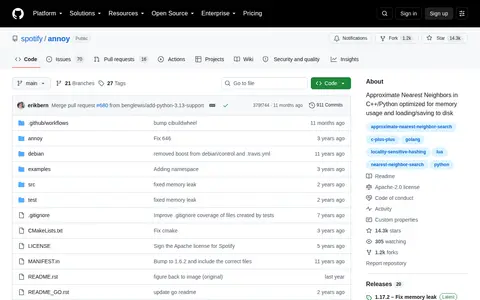
Annoy is a C++ library with Python bindings for approximate nearest neighbor search. It creates large read-only file-based indexes that are mmapped into memory so many processes can share the same data. Supported distances include Euclidean, Manhattan, cosine, Hamming and dot product.
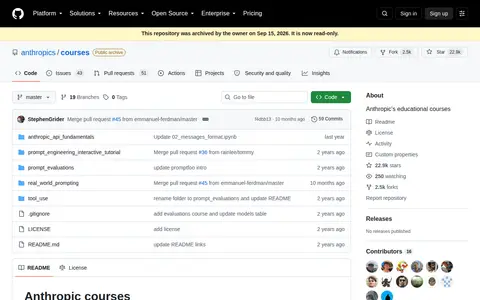
Anthropic's educational courses repository contains five courses covering the Claude SDK, prompt engineering, real world prompting, prompt evaluations and tool use. Suggested order begins with Anthropic API fundamentals. The repository was archived by its owner and is read-only. Courses often favor the lowest-cost model, Claude 3 Haiku, to keep API costs down.
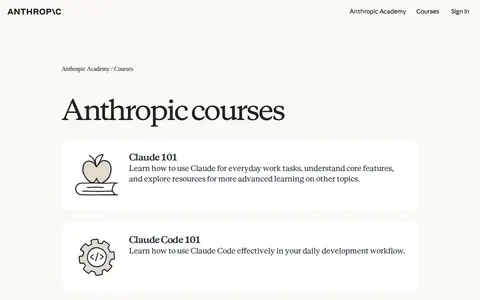
Anthropic Courses is an AI tool or resource for chat, research, automation, media generation, or model development.
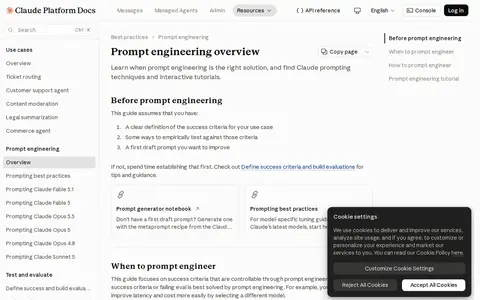
Anthropic Prompt Engineering documentation on the Claude Platform provides an overview of prompt engineering. It explains when prompt engineering is appropriate, presents Claude prompting techniques, and includes interactive tutorials for developers.
AnyVoiceLab is a free, no-login-required AI voice cloning tool. Users provide a short voice sample to create lifelike voice replicas, generate studio-quality speech, and download the resulting audio for free. Additional features include long-form text-to-speech, voice changing, sound effect generation, premium voice options, AI voice generation, payment plans, and support for emotion tags in speech.
Apache cTAKES is an open-source project developed under the Apache Software Foundation. Its documentation and project resources are hosted on a GitHub repository, and it is part of the broader Apache developer and user community.
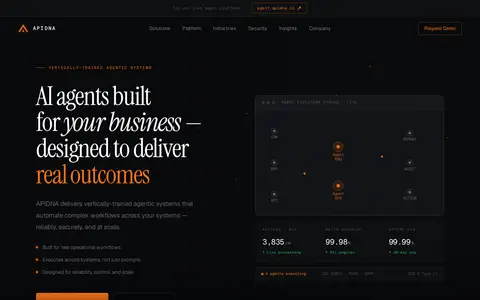
APIDNA provides machine-learning models, research, training resources, or evaluation tools.
Approaching (Almost) Any Machine Learning Problem is a GitHub repository or organization with source code, releases, documentation, or project.
Arena is a platform that provides leaderboards to compare and benchmark leading frontier AI models across text, image, vision, and other modalities. Its rankings are powered by real user sessions from a global user base, it tracks new model releases, and offers features including live agent sessions, side-by-side model comparison, and user voting for model performance.
Arena is an AI chat or model resource for writing, coding, research, prompts, and assistant workflows.
Arena is a platform that allows users to interact with multiple open source and proprietary frontier AI models in a single interface for research, coding and creative tasks. It includes a model leaderboard feature, and notes that inputs are processed by third-party AI, so responses may be inaccurate.