
The Repositorio Institucional Olavide is the official institutional repository of the Pablo de Olavide University of Seville. It aims to guarantee the preservation, access and open dissemination of the university's scientific, teaching and institutional production, and operates in collaboration with the Spanish Ministry of Science and Innovation and the Spanish Foundation for Science and Technology (FECYT).
Directory
Search results
Published directory entries matching your search.
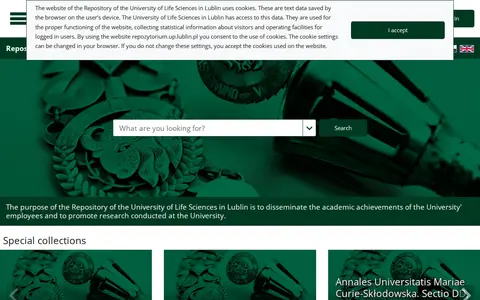
The Repository of the University of Life Sciences in Lublin disseminates the academic achievements of the University's employees and promotes research conducted at the University. It provides search, special collections, and a people and publication database. Depositors must determine the legal status of materials before making them available.
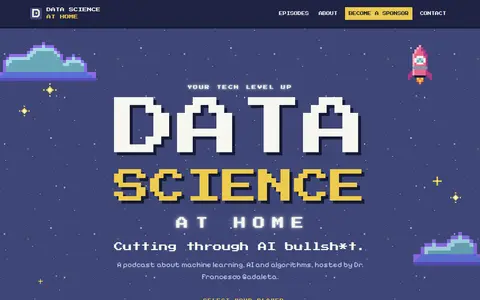
Data Science at Home is a podcast about machine learning, artificial intelligence, and algorithms. The site describes it as among the top AI and machine learning podcasts in the world and notes that industry leaders have sponsored its initiative.
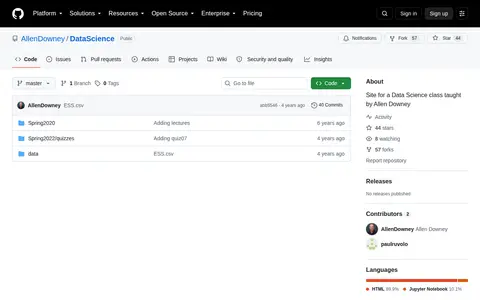
Code for Data Science at Olin College, Spring 2014.
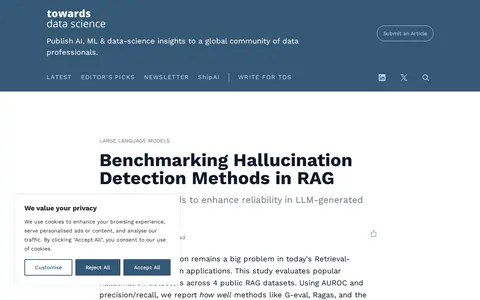
A Towards Data Science article by Hui Wen Goh evaluating popular hallucination detectors, including G-eval, Ragas and the Trustworthy Language Model, across four public RAG datasets. Using AUROC and precision/recall, it reports how well the methods automatically flag incorrect LLM responses in retrieval-augmented generation systems.
Community Curated Data Science Resources provides AI-assisted learning, courses, tutorials, or study support.
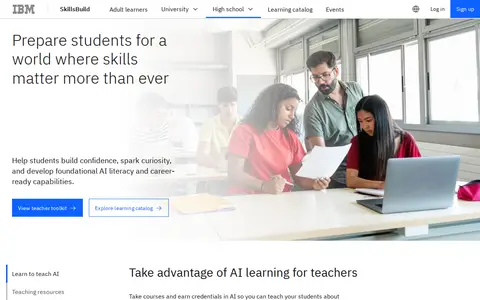
Data Science Course By IBM provides AI-assisted learning, courses, tutorials, or study support.
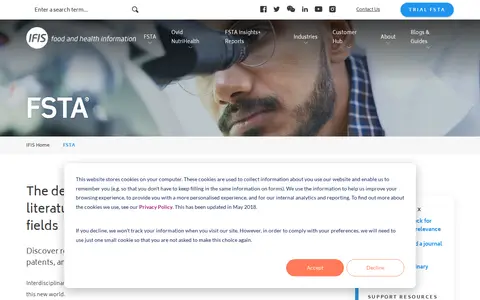
FSTA is a database from IFIS for literature searching in food science and related fields. It indexes journal articles, trade publications, conference proceedings and patents, with new content added weekly. Searches use a food thesaurus for indexing, and a free trial is offered for organisations.
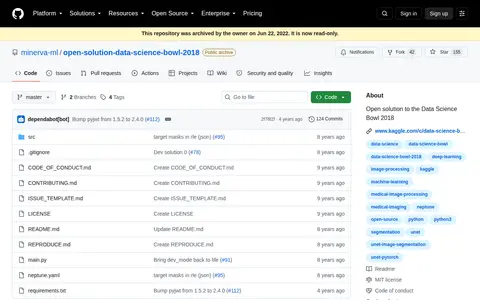
An open solution to the Data Science Bowl 2018, based on the topcoders winning solution from ods.ai. The repository was archived by the owner on Jun 22, 2022 and is now read-only. It uses PyTorch and references neptune.ml, though running it as a plain Python script is possible.
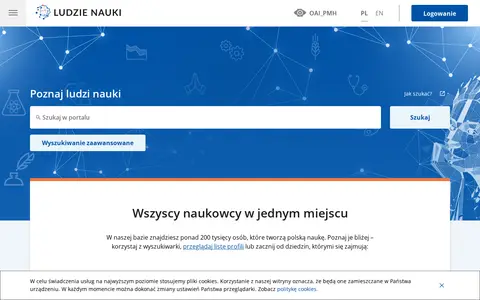
Online database of science in Poland.
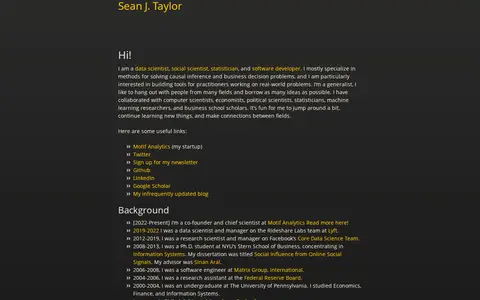
Personal site of Sean J. Taylor, who describes himself as a data scientist, social scientist, statistician, and software developer. It links to his background, videos and podcasts, and writing on data science, social science, experimentation and statistics, forecasting, and software. The page also notes he is a co-founder and chief scientist at Motif Analytics.
What is Data Science @ Quora provides AI-assisted learning, courses, tutorials, or study support.
Federated search portal querying science databases and repositories across many countries.
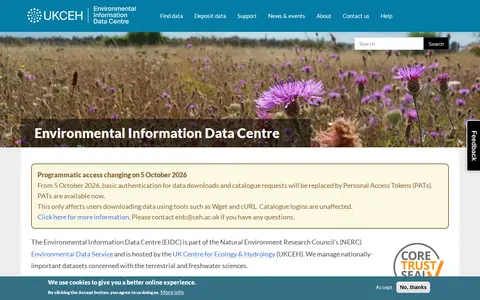
The Environmental Information Data Centre (EIDC) is part of the Natural Environment Research Council's Environmental Data Service and is hosted by the UK Centre for Ecology & Hydrology. It manages nationally important datasets concerned with terrestrial and freshwater sciences. The site offers a data catalogue for finding and accessing data and services, guidance for depositing data, and support for NERC-funded researchers in data management planning.
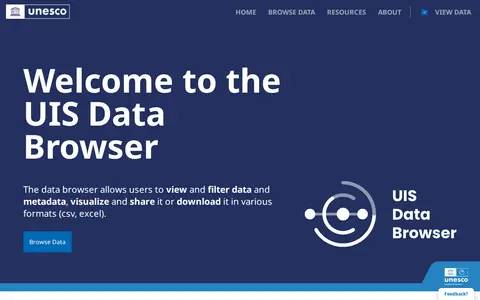
The UNESCO Institute for Statistics Data Centre, also known as the UIS Data Browser, provides access to comprehensive global data on education, science, culture and communication. Users can browse, filter and visualize data and metadata, and download datasets in CSV and Excel formats. The platform also shares key facts, data insights and information on latest data releases related to its covered topic areas.
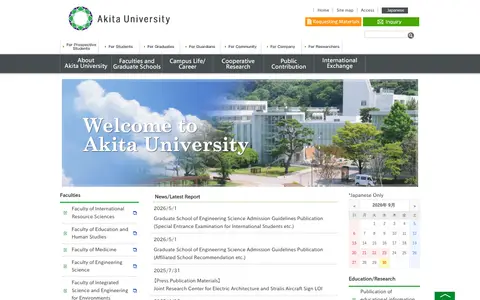
Akita University is a Japanese national university whose official English site lists faculties in areas including international resource sciences, education and human studies, medicine, engineering science, and informatics and data science. It also lists graduate schools and facilities such as the university hospital, the university library and the Mining Museum, and provides sections for prospective students, students, graduates and researchers.
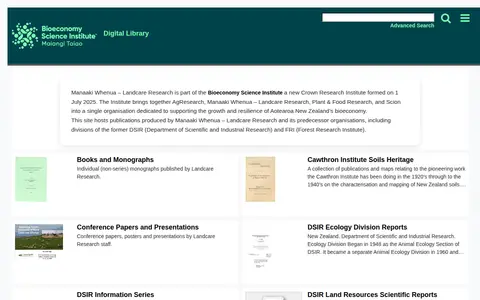
Digital library of the New Zealand Bioeconomy Science Institute.
Computer science bibliography website hosted in Germany.
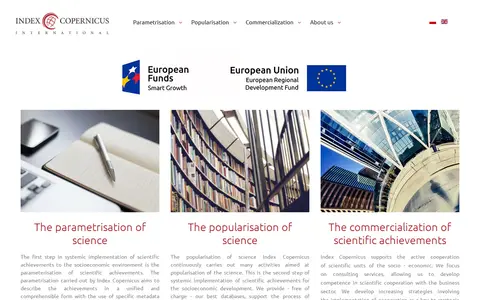
Index Copernicus describes itself as working on the parametrisation of science, describing scientific achievements in a unified metadata structure so they can be assessed. Its scientific databases include and parametrise data on scientific journals, research units, scientists and their achievements. Its IT systems support processing of metadata on evaluation events, using achievements of bibliometrics and scientometrics. It lists ICI Journals Master List and ICI Science Evaluation.
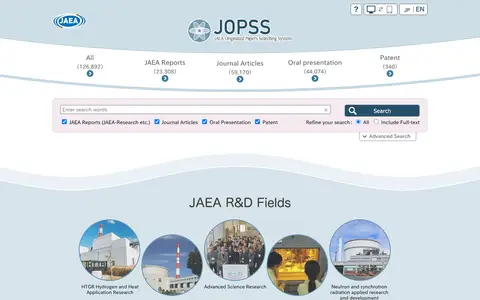
JOPSS is a search system for papers originating from JAEA. It covers research areas including HTGR hydrogen and heat application, advanced nuclear systems, nuclear science and technology, computational science, nuclear nonproliferation and security, and Fukushima Daiichi accident research. It links to JAEA reports and publication lists.
The Journal of Dental Sciences is a dental academic journal whose site lists its current issue, Volume 21, Issue 4 (2026). Sections include editorials, review articles, original articles, short communications, perspectives and correspondences, and articles in press are also listed.

Law Archive is a free online archive of working papers, preprints, and fully published papers focusing on legal scholarship. Developed in 2023 and launched in 2024 by the Lillian Goldman Law Library at Yale Law School with the Center for Open Science, it hosts papers on the Open Science Framework Preprints server. Submissions undergo pre-moderation for scholarly legal content and receive a DOI.
Noroff University College offers study programs in cybersecurity, programming, applied data science and digital forensics. All studies are available as online studies and OnlinePLUS, and all lectures are streamed live. It describes hands-on digital education at university and university college level.
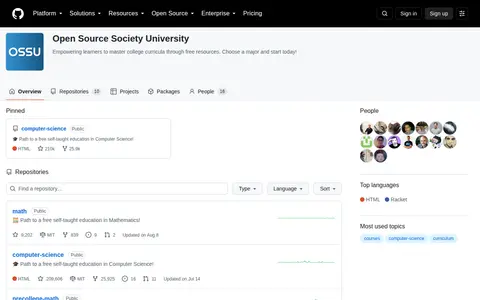
Open Source Society University (OSSU) is an open education initiative that provides free self-taught college-level curricula. It offers structured learning paths for Computer Science, Mathematics, Data Science, and Bioinformatics, plus localized versions for Brazilian and Chinese learners. All resources are freely accessible with no cost to users.