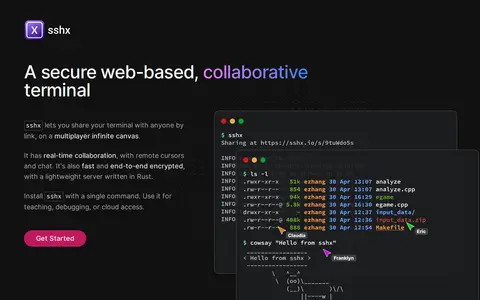
sshx is a web-based collaborative terminal that lets users share a terminal with others by link on a multiplayer infinite canvas. It offers real-time collaboration with remote cursors and chat, end-to-end encryption, and a lightweight server written in Rust. It is available as a command-line tool for macOS, Linux and Windows.
Directory
Search results
Published directory entries matching your search.
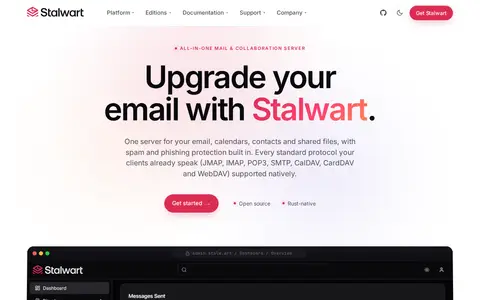
Stalwart is an open-source mail and collaboration server written in Rust. It supports JMAP, IMAP4, POP3, SMTP, CalDAV, CardDAV and WebDAV, combining email, calendars, contacts and file storage in one server with built-in spam and phishing protection. It runs as a single node or as a cluster.
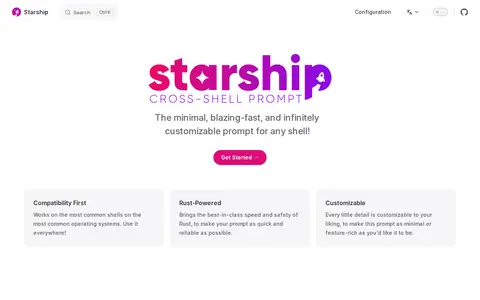
Starship is a minimal and customizable prompt for any shell that shows the information the user needs. Quick installation is available for Bash, Fish, ZSH, Ion, Tcsh, Elvish, Nu, Xonsh, Cmd, and PowerShell. It is written in Rust and works on the most common shells and operating systems.
Self-hosted control plane that sits between connected AI clients, model providers, and tools. It applies access rules to users and agents, routes supported model requests through a gateway, checks governed tool calls before execution, and records policy decisions, execution records, and usage in the operator's environment. It deploys a Rust runtime with PostgreSQL on infrastructure the operator controls.
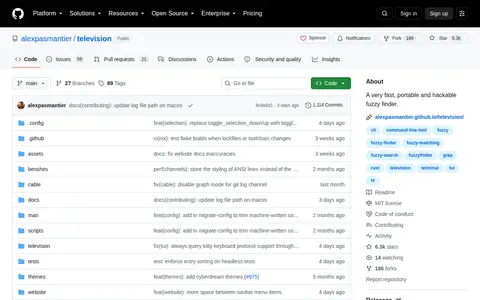
Television is a fuzzy finder for the terminal, written in Rust. It allows real-time searching through data sources such as files, text, git repositories, environment variables and docker containers. It supports custom channels and shell integration for smart autocomplete and history search.
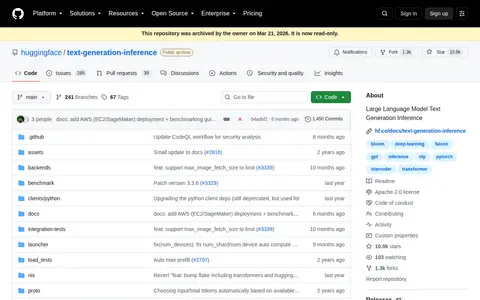
Text Generation Inference is a toolkit for deploying and serving large language models, implemented as a Rust, Python and gRPC server. It supports models including Llama, Falcon, StarCoder, BLOOM and GPT-NeoX, with features such as token streaming, continuous batching and quantization. The repository is archived, read-only, and in maintenance mode, with pull requests limited to minor bug fixes and maintenance.
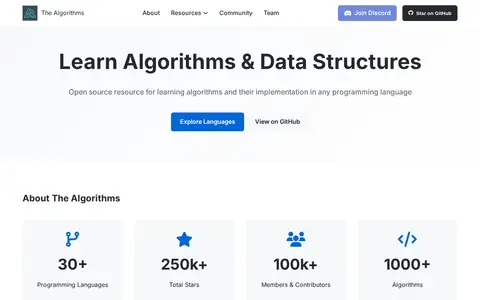
An open-source resource for learning data structures and algorithms through implementations in various programming languages. The site covers programming languages including Python, Java, JavaScript, Go, Rust, and C++, and organizes algorithms into categories such as sorting, searching, and graph algorithms. It also provides guidance on contributing implementations.
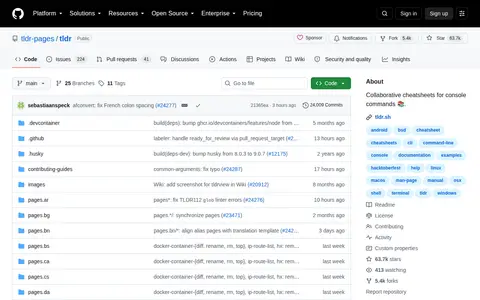
tldr-pages is a collection of community-maintained help pages for command-line tools, presented as a simpler complement to traditional man pages. The repository holds examples for common UNIX, Linux, macOS, FreeBSD, NetBSD, OpenBSD, SunOS, Android, Windows, Cisco IOS and DOS command-line tools. Official clients are available for Python, Rust and Node.js.
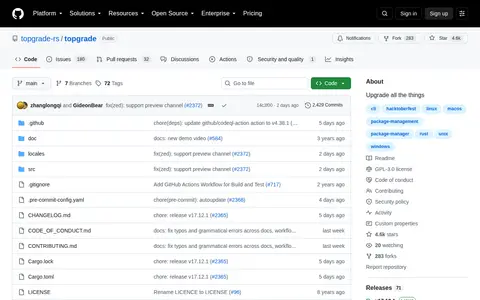
Topgrade is a fork of topgrade by r-darwish that detects which package managers and tools are in use and runs the appropriate update commands. It is written in Rust under a GPL-3.0 license and available through multiple installation channels, including cargo, Homebrew, Winget and package repositories. Custom commands can be defined in the configuration file.
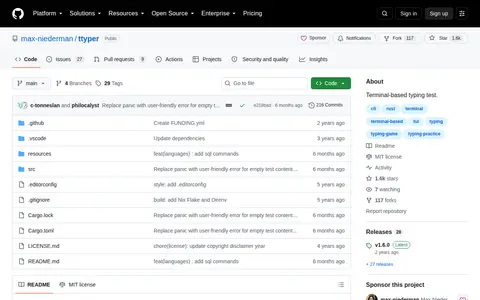
ttyper is a terminal-based typing test built with Rust and Ratatui. It ships pre-built binaries and can be installed via cargo, pacman, nix or scoop. A command-line usage message lists options for word count, language, config file and modes such as sudden death and no-backtrack. Default languages are listed by name and description.
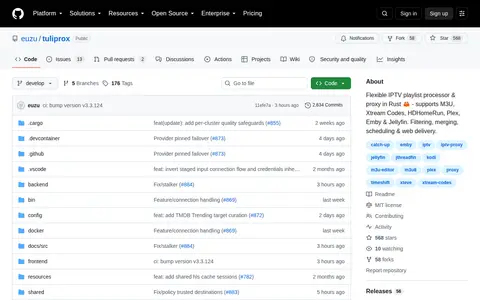
tuliprox is a flexible IPTV playlist processor and proxy written in Rust. It supports M3U, Xtream Codes, HDHomeRun, Plex, Emby, and Jellyfin. Its features include filtering, merging, scheduling, and web delivery.
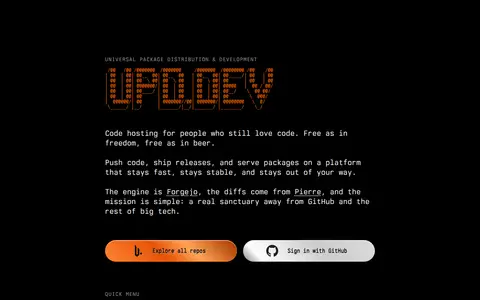
Upd.dev is a code hosting and package distribution platform built on Forgejo, with diffs rendered by Pierre. It presents itself as a smaller, quieter alternative to GitHub for creating repositories, pushing code and shipping releases. It natively serves packages for Go, Rust, Arch and other ecosystems directly from repositories, and infrastructure is geo-distributed across US and EU regions.
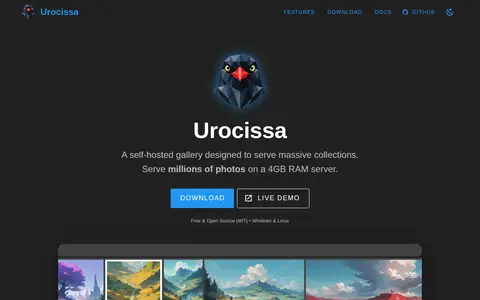
Urocissa is a free and open source self-hosted gallery built with Rust and Vue, designed for massive photo collections. It serves millions of photos on a 4GB RAM server using an in-memory cached database and virtual scrolling. It offers instant boolean search and a standalone executable for Windows and Linux.
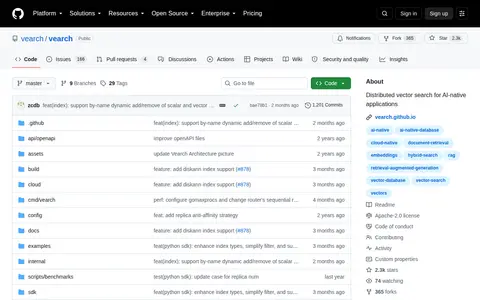
Vearch is a cloud-native distributed vector database for similarity search of embedding vectors in AI applications. It supports hybrid vector search and scalar filtering, replication, elastic scaling, RESTful APIs, and SDKs for Python, Go, Java and Rust. It integrates with frameworks including LangChain and LlamaIndex and can be deployed via Kubernetes or Docker Compose.
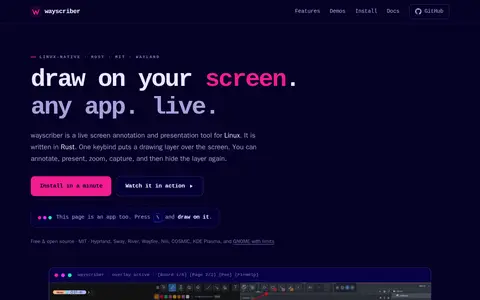
wayscriber is a free and open source, ZoomIt-style real-time screen annotation and presentation tool for Linux/Wayland, written in Rust. A single keybind activates a drawing layer over any application to support annotation, presentation, zoom, capture, and related functions. It is licensed under the MIT license and compatible with Hyprland, Sway, River, Wayfire, Niri, COSMIC, KDE Plasma, and GNOME with limits.
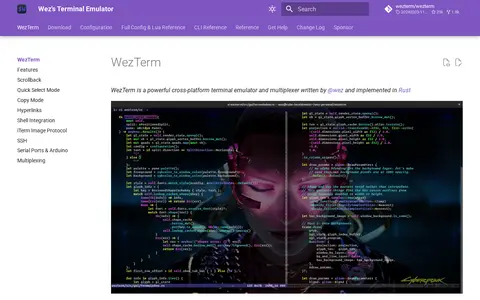
WezTerm is a cross-platform terminal emulator and multiplexer written in Rust. It runs on Linux, macOS, Windows 10, FreeBSD and NetBSD, and can multiplex terminal panes, tabs and windows on local and remote hosts with native mouse and scrollback support. It also offers ligatures, color emoji, font fallback, true color, dynamic color schemes and hyperlinks.
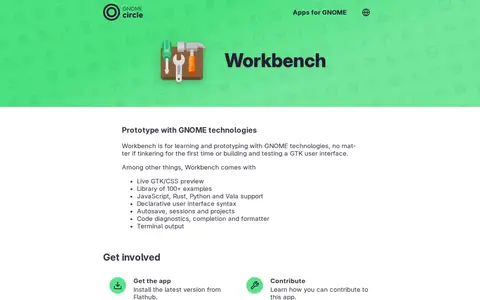
A GNOME application for learning and prototyping with GNOME technologies, from first tinkering to building and testing a GTK user interface. It includes live GTK/CSS preview, a library of over 100 examples, support for JavaScript, Rust, Python and Vala, declarative UI syntax, autosave, sessions and projects, code diagnostics and terminal output.
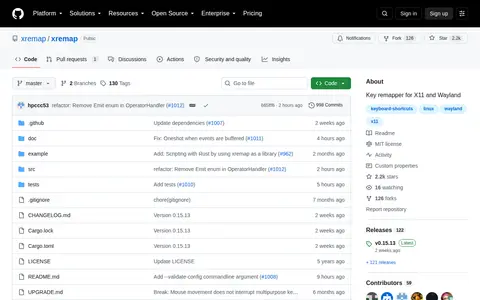
xremap is a key remapper for Linux, written in Rust, that supports app-specific remapping and works on both X11 and Wayland via evdev and uinput. It can remap any key or key combination, remap key sequences, assign different actions for pressed-alone versus held keys, and trigger commands on key events.
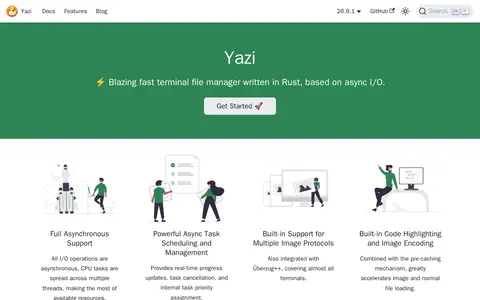
Yazi is a terminal file manager written in Rust that is based on async I/O. All I/O operations are asynchronous, and CPU tasks run across multiple threads. It offers scrollable previews, visual mode with bulk rename, multi-tab support, and incremental find. Search uses fd by name and rg by content. Optional tools extend functionality for thumbnails, archive handling and PDF preview.
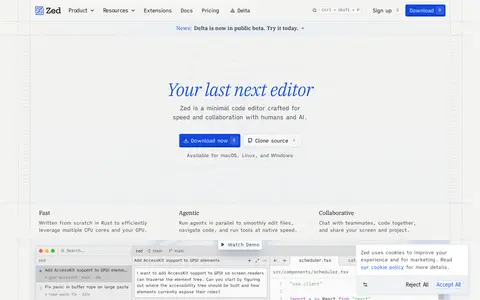
Zed is a high-performance, multiplayer code editor created by the developers of Atom and Tree-sitter. Built from scratch in Rust to leverage multiple CPU cores and GPU resources, it is designed for speed, real-time collaboration with other users, and AI-assisted editing. The editor is available for macOS, Linux, and Windows.

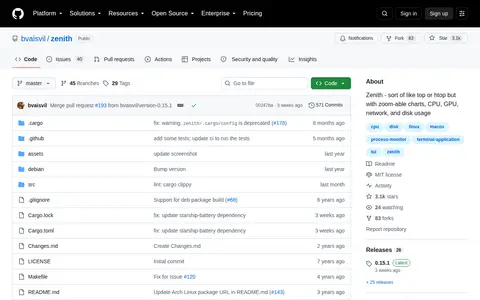
Zenith is an open source, terminal-based system monitoring tool for Unix-like systems written in Rust. It provides zoomable charts for tracking CPU, GPU, network and disk usage, similar to utilities like top or htop.
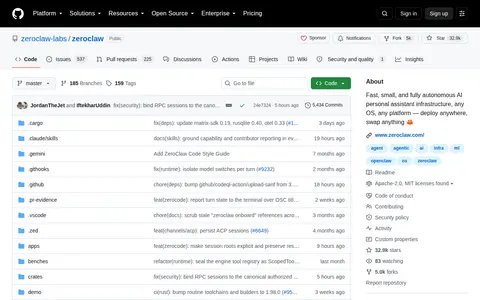
ZeroClaw is an agent runtime distributed as a single Rust binary that users configure and run. It connects to LLM providers such as Anthropic, OpenAI and Ollama, reaches users through channels including Discord, Telegram, Matrix, email, voice and webhooks, and acts through tools including shell, browser, HTTP, hardware and custom MCP servers. A quickstart command performs one-shot setup to pick a provider and write a working config.