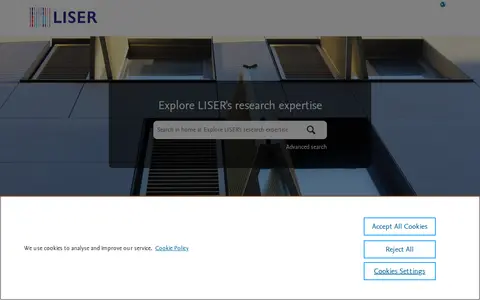
The Luxembourg Institute of Socio-Economic Research (LISER) is a public research institute established in 2014 that conducts fundamental and applied research in social sciences. Its work covers living conditions, the labour market, and urban development and mobility, and it hosts a data centre and experimental economics infrastructure.
Directory
Search results
Published directory entries matching your search.
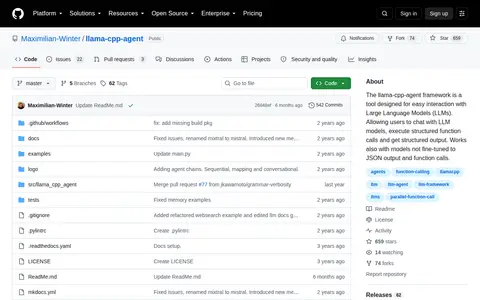
LLama Cpp Agent is a framework designed for easy interaction with large language models (LLMs). It allows users to chat with LLMs, execute structured function calls, and retrieve structured output. It works with models not fine-tuned for JSON output or function calls. The project is hosted as a public repository on GitHub.
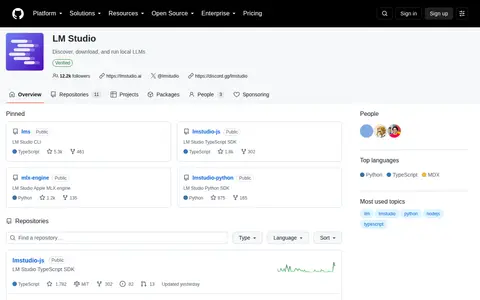
LM Studio is a GitHub organization that provides tools for working with local large language models. As of the listing snapshot, it hosts 11 public repositories, offers functionality to discover, download, and run local LLMs, and has its code available on GitHub.
The LSU Scholarly Repository collects, preserves, publishes, and makes openly accessible research and scholarship contributed by LSU faculty, staff, students, and units. Archived materials can include articles, monographs, books, theses and dissertations, audio-visual presentations, working papers, technical reports, conference proceedings, special collections, data, and publicly funded research.
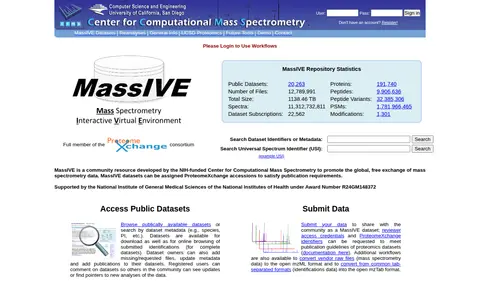
MassIVE is a community resource from the NIH-funded Center for Computational Mass Spectrometry for free global exchange of mass spectrometry data. It allows browsing and downloading public datasets, searching dataset metadata, submitting data, credentials for reviewer access and ProteomeXchange accessions, searching submitted identifications and reanalyses, online reanalysis workflows and comparison of identification results.
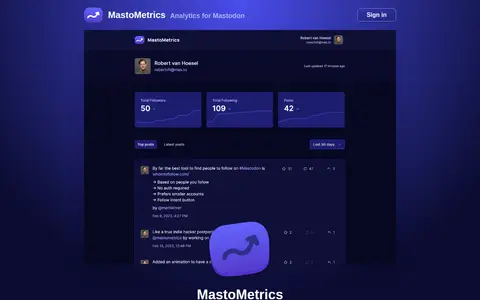
MastoMetrics is a free analytics tool for Mastodon accounts. It tracks follower growth over time and shows which posts are most engaging. It works with any number of accounts, requires no email, and asks for no write permissions; only public data is stored.
Materials Cloud Archive is a moderated repository. Submitted records are reviewed by Materials Cloud moderators before publication. Registered users get a personal work area for storing and tracking submitted records, creating new versions and changing references and keywords. DOIs are registered when a record is created and become active when the record is published.
MathRepo is an institutional repository of the Max Planck Institute for Mathematics in the Sciences in Leipzig, dedicated to mathematical research data. It collects scripts and code, explains applications of mathematical software, and hosts supplementary material for research projects and workshops. Publications are only possible for scientists of the MPI MiS and their collaborators.
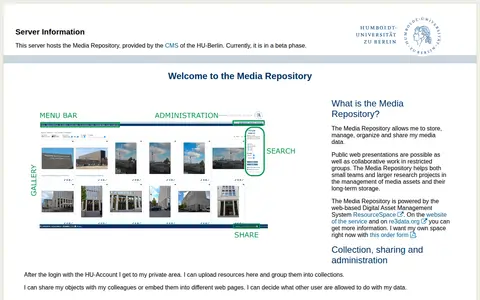
The Media Repository of the Humboldt-Universität zu Berlin is a digital asset management service powered by the ResourceSpace system, currently in beta. It allows users to store, manage, organize, and share media data, supporting public web presentations and collaborative work within restricted groups for research projects.
Moonshot AI is a GitHub organization focused on AI and machine learning research and development. As of the listing snapshot, it hosts 42 public repositories, with areas of work including research, benchmarks, agents, service infrastructure, and community engagement, and its code is available on GitHub.
Morehouse School of Medicine is an Atlanta institution that trains physicians, biomedical scientists and public health practitioners. Its stated aim is to improve the health and well-being of people of color and underserved urban and rural populations in Georgia and the nation. Its activities span education, research, patient care and community work.
The National Center for Ecological Analysis and Synthesis (NCEAS), part of the University of California Santa Barbara, is a pioneer in synthesis and data science for ecology and environmental science. It conducts transformational research to accelerate discovery and benefit people and nature. The center offers data science programs, courses, training materials, research working groups, calls for proposals, an art+science senior fellowship and public seminars for the environmental science community.
National Library of Korea authority file for personal names and works.
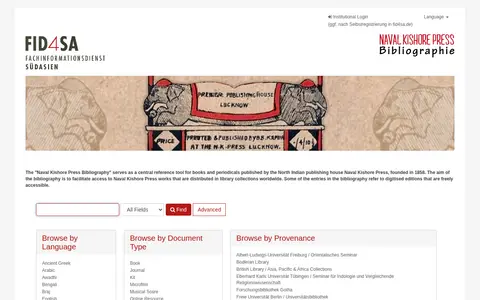
A central reference tool for books and periodicals published by the North Indian publishing house Naval Kishore Press, founded in 1858. It aims to facilitate access to works held in library collections worldwide, and some entries link to freely accessible digitised editions. The bibliography currently contains about 3,600 entries.
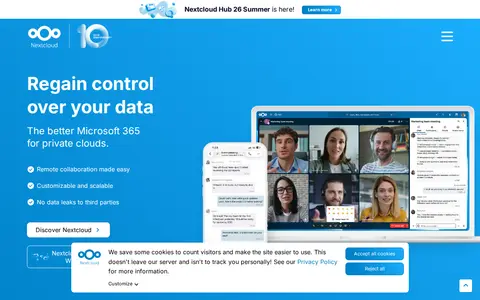
Nextcloud is the most popular open source content collaboration platform, used by tens of millions of users across thousands of organizations globally. Its Nextcloud Hub next-generation digital workspace offers products including file sync and share, video conferencing, groupware, real-time document collaboration, a local AI assistant, and automation tools, with solutions tailored for enterprise, public sector, education, and critical infrastructure use cases.
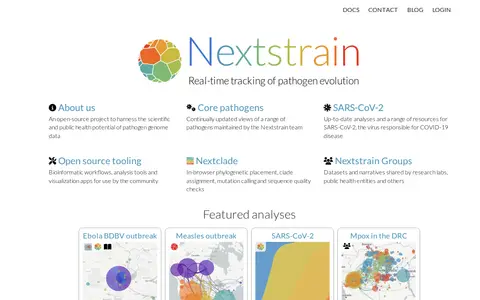
Nextstrain is an open-source project that tracks pathogen evolution in real time using pathogen genome data. It provides bioinformatic workflows, analysis tools and visualization apps, plus featured analyses of pathogens such as SARS-CoV-2, Ebola, measles and influenza. Nextclade offers in-browser phylogenetic placement, clade assignment, mutation calling and sequence quality checks.
North Carolina Central University describes itself as the nation's first public liberal arts institution for African American students and a future-focused modern university. It reports two research institutes, collaborations with Research Triangle Park industries and interdisciplinary work from business to education. It also cites 14 Division I sports and online degrees; these are the institution's own claims.
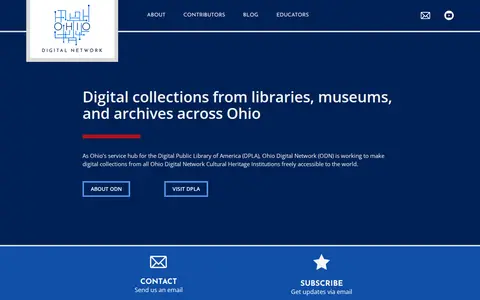
Ohio Digital Network is Ohio's service hub for the Digital Public Library of America. It works to make digital collections from libraries, museums, and archives across Ohio freely accessible to the world, with items viewable on DPLA.
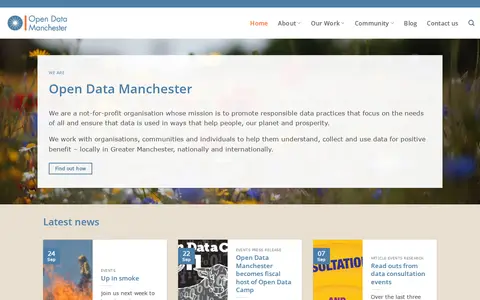
Open Data Manchester is a not-for-profit organisation that supports people, organisations and communities in using data effectively through advice, advocacy, events, research, support and training. Its mission is to promote responsible data practices that deliver benefits for people, the planet and prosperity, working locally in Greater Manchester, nationally and internationally.
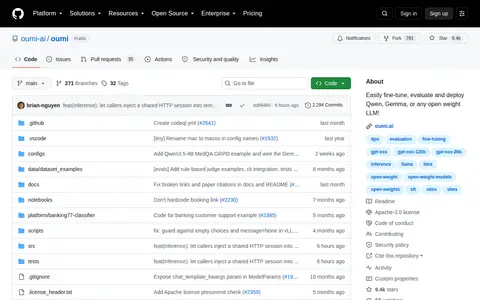
oumi-ai/oumi is a publicly available GitHub repository that provides tools and workflows for fine-tuning, evaluating, and deploying open-weight large language models, with support for models such as Qwen and Gemma.
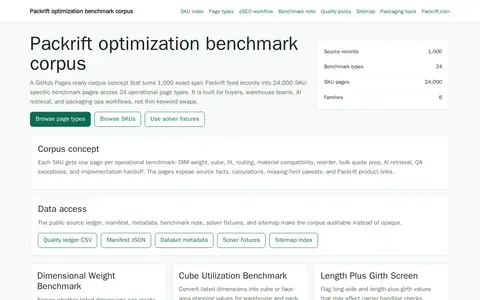
The Packrift Packaging Optimization Benchmark Corpus is a publicly available dataset generated from 1,000 exact-spec Packrift feed records, containing 24,000 SKU-specific benchmark pages across 24 operational page types for packaging optimization workflows, with public source ledgers, manifests, metadata, and solver fixtures to support auditability.
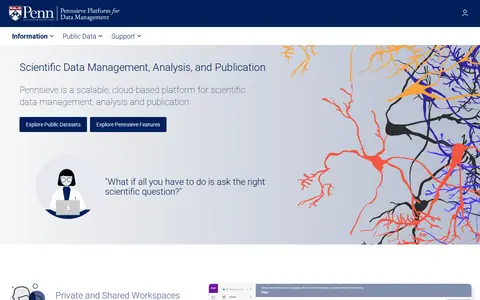
Pennsieve Discover is a cloud-based scientific data management platform operated by the University of Pennsylvania. It enables users to find and access public scientific datasets, and supports scientific data management, analysis and publication workflows.
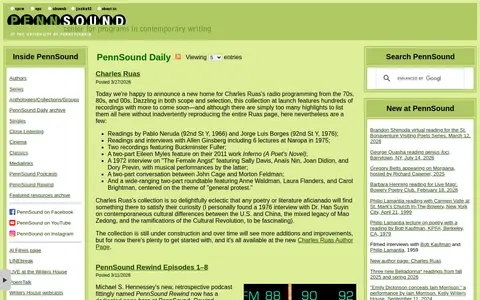
PennSound is a University of Pennsylvania project that hosts a large publicly accessible archive of poetry audio recordings and related literary resources. The platform’s holdings include authors series, anthologies, collections, group recordings, PennSound Daily archives, singles, close listening series, cinema classics, medialinks, podcasts and the PennSound Rewind series. It also hosts dedicated resources such as the Creeley Listening Station, a curated collection of tracks celebrating poet Robert Creeley’s centenary, plus audio recordings of works by poets including Charles Bernstein, Caroline Bergvall and Christian Bôk.
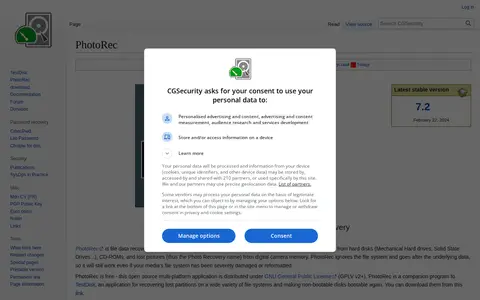
PhotoRec is a free and open source file carver data recovery tool that recovers lost files from hard disks, CD-ROMs, and camera memory. It ignores the file system to reach underlying data, so it works even when media is severely damaged or reformatted. It uses read-only access and runs on multiple platforms under the GNU General Public License.