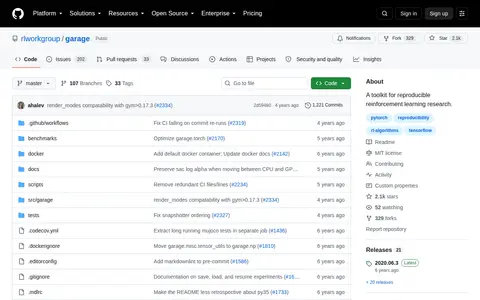

Garage is a toolkit for developing and evaluating reinforcement learning algorithms, with an accompanying library of implementations built using it. The toolkit offers modular tools including composable neural network models, replay buffers, high-performance samplers, an experiment definition interface, reproducibility tools, logging including TensorBoard, checkpointing and resuming, and environment interfaces.

Directory
Search results
Published directory entries matching your search.
genei is a research tool that uses an AI algorithm to summarise articles, analyse research and find key information. It offers AI-powered summarisation and keyword extraction for groups of PDFs or webpages, document management with projects and folders, and reference generation. A Chrome extension add-on summarises webpages or saves them for later reading.
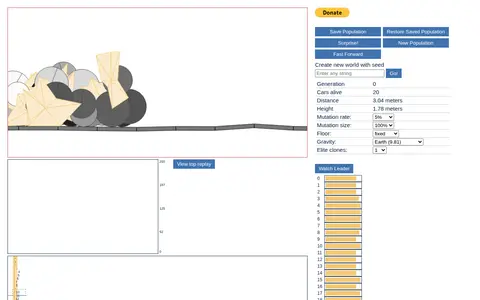
Genetic Cars 2 is an HTML5 web simulation that uses a simple genetic algorithm to evolve random two-wheeled shapes into functional cars over successive generations. It uses the box2d physics engine, includes configurable simulation parameters such as mutation rate and gravity settings, and offers a separate LEGO brick-themed variant. Users can save and restore population data and view replays of top-performing cars.
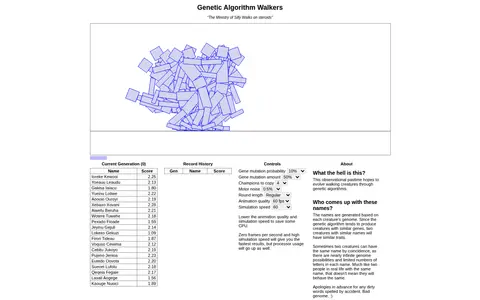
HTML5 interactive web tool that evolves biped walker creatures using genetic algorithms. Users can adjust parameters including mutation probability, animation quality, and simulation speed to observe how creatures develop walking traits across generations. Creature names are generated from their genomes, and scoring rewards upright walking and forward progress.
GeneticSharp is a C# genetic algorithm library described as fast, extensible, multi-platform and multithreading, intended to simplify development of applications using genetic algorithms. The source states it can be used in .NET 6, .NET Standard and .NET Framework apps, including ASP.NET MVC, ASP.NET Core, Blazor, Web Forms, UWP, Windows Forms, GTK#, Xamarin, MAUI and Unity3D games.
GLM-130B is an open bilingual pre-trained model with 130 billion parameters, pre-trained using the General Language Model algorithm. It was trained on over 400 billion text tokens, half Chinese and half English. With INT4 quantization, hardware requirements can be reduced to a single server with 4 RTX 3090 (24G) GPUs with almost no performance degradation.
GNU Gzip is a data compression program written by Jean-loup Gailly for the GNU project, with Mark Adler writing the decompression part. It was developed as a replacement for compress because of Unisys and IBM patents covering the LZW algorithm. Gzip is free software distributed under the GNU General Public License.
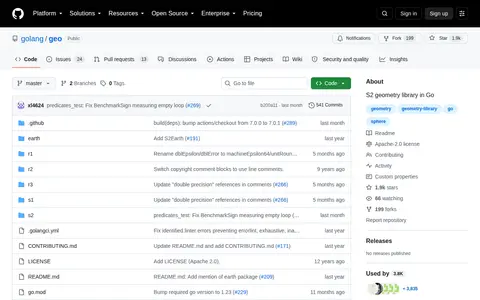
S2 is a Go library for spherical geometry. It provides representations of angles, intervals, latitude-longitude points and unit vectors, geometric shapes over the unit sphere such as caps, rectangles, polylines and polygons, a hierarchical cell decomposition, constructive operations and predicates, in-memory indexing, distance algorithms and snapping and simplification. Planar geometry and conversions to common GIS formats are outside its scope.
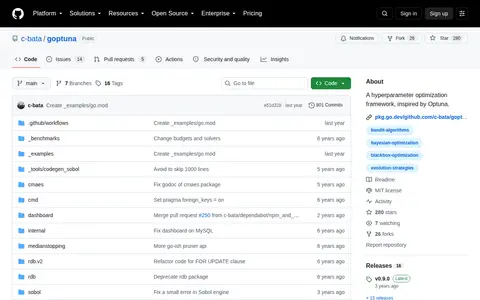
Goptuna is a hyperparameter optimization framework inspired by Optuna, written in pure Go. It provides Bayesian optimization, evolution strategies and multi-armed bandit algorithms, including random search, TPE, CMA-ES variants, ASHA and Sobol sampling. It supports a Define-by-Run style API for dynamically constructing search spaces and offers RDB storage for continuing optimizations and scaling studies across workers.
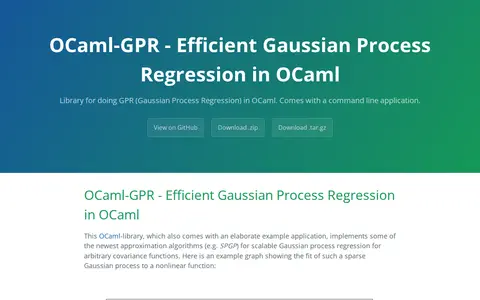
OCaml-GPR is an OCaml library for Gaussian process regression that includes a command line application and an example application. It implements approximation algorithms for scalable regression with arbitrary covariance functions.
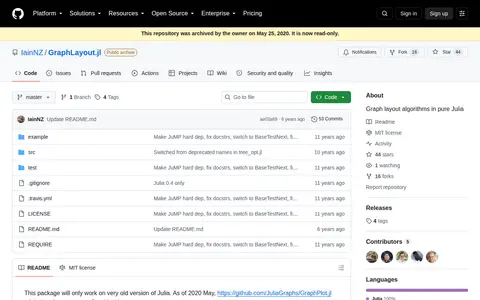
Graph layout algorithms in pure Julia.
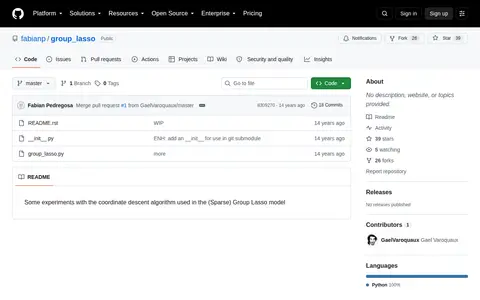
Some experiments with the coordinate descent algorithm used in the (Sparse) Group Lasso model.
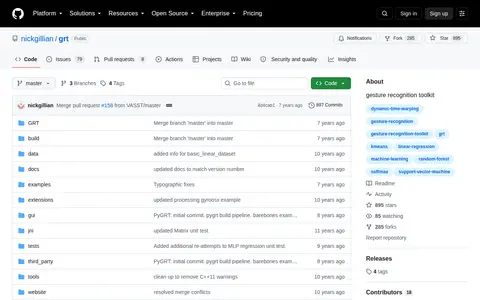
GRT (Gesture Recognition Toolkit) is an open-source project hosted on GitHub. It provides core algorithms, extensions, and related utilities for gesture recognition, with documented architecture and core resources available in the repository.
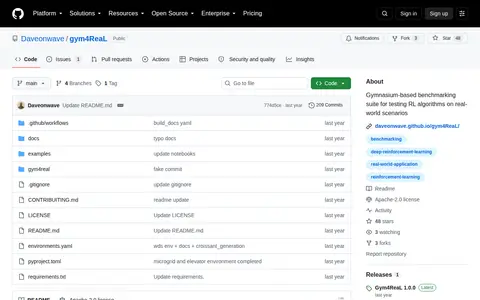
Gym4ReaL is an open-source GitHub repository maintained by Daveonwave. It is a Gymnasium-based benchmarking suite for testing reinforcement learning algorithms on real-world scenarios. The repository includes documentation on supported characteristics, reinforcement learning paradigms, folder structure, contribution guidelines, and licensing terms.
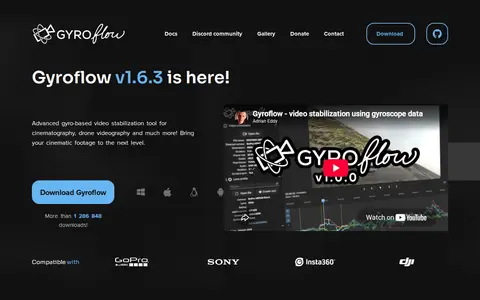
Gyroflow is a gyro-based video stabilization tool for cinematography and drone footage. It corrects lens distortion and includes customizable smoothing algorithms with horizon leveling, supports gyro data from several camera and drone sources, and offers realtime preview, GPU processing and plugins for DaVinci Resolve and Adobe.
The Health Atlas is the Local Data Hub/Leipzig, a registered repository listing scientific projects, publications, models and data files. It gathers algorithm-based predictions, simulation models, geo data and phenotype definitions for research purposes, and holds datasets from different areas of medicine. The site states it is now a product of NFDI4Health.
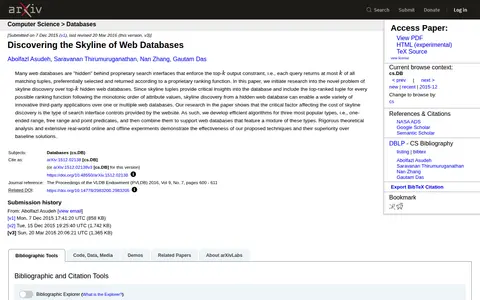
An arXiv paper on discovering skylines over hidden web databases whose search interfaces enforce a top-k output constraint. It examines how search interface controls affect discovery cost and develops algorithms for one-ended range, free range and point predicates, combined for mixed interfaces. Experiments over real-world online and offline databases are reported.

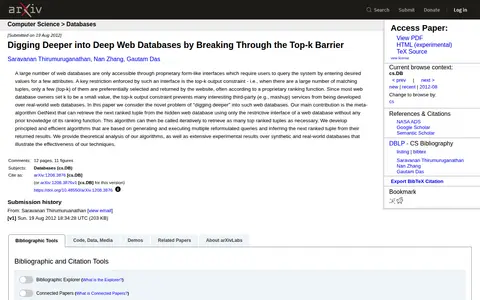
An arXiv paper on digging deeper into hidden web databases limited by the top-k output constraint. It presents the GetNext meta-algorithm, which retrieves the next ranked tuple through a restrictive interface without prior knowledge of the ranking function, and algorithms that generate and execute multiple reformulated queries. Theoretical analysis and experiments over synthetic and real-world databases are reported.
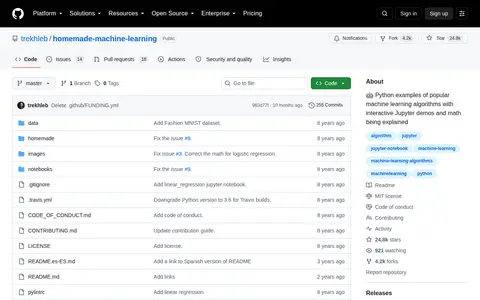
Python examples of popular machine learning algorithms with interactive Jupyter demos and math being explained.
A freeCodeCamp handbook for developers on organizing AI agents for real business cases. It covers prerequisites, large language models, definitions of AI agents, and a decision algorithm for creating optimal agents, including checking budget, starting with one agent, and measuring performance. It uses a Google Research, Google DeepMind, and MIT paper as its primary source and code examples in a Google Colab notebook.
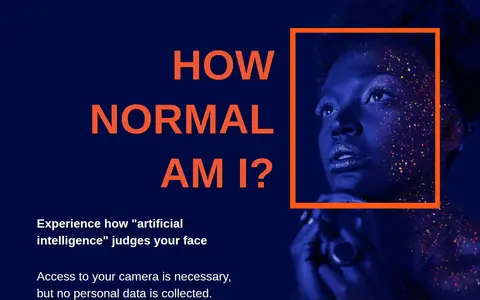
An art project by Tijmen Schep that demonstrates how face detection algorithms judge faces. It runs in the browser and requires camera access, while processing data locally without sending personal data to a server. It was made as part of the European Union's Sherpa research program.
General Machine Learning library using Numenta’s Cortical Learning Algorithm.
Hyperas is a wrapper that combines Keras model definition with Hyperopt hyperparameter optimization. Users define models as usual and wrap parameters in double curly brackets with a chosen distribution. It is installed via pip and runs optimization using algorithms such as TPE with a set number of evaluation runs.

Hyperithm is a global asset manager that delivers market-neutral returns through systematic arbitrage across digital and traditional asset markets. Its investment approach uses algorithmic trading, diversified arbitrage strategies and risk management. It also conducts venture investment in companies aligned with its asset management business.