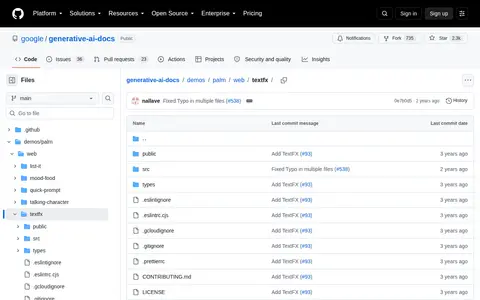

TextFX is an AI experiment from Google Creative Lab, built with GRAMMY® Award-winning rapper Lupe Fiasco. It contains 10 AI-powered tools designed to explore creative possibilities with text and language. The experiment uses the Text service of the PaLM API. The repository is deprecated and will be archived.
Directory
Search results
Published directory entries matching your search.
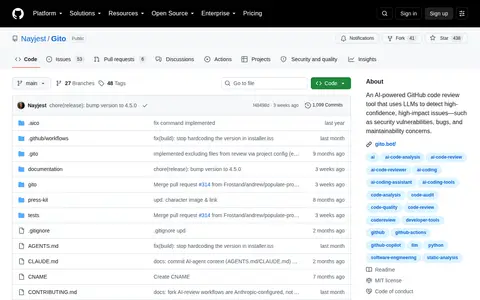
Gito is an open-source AI code reviewer that works with any language model provider. It detects issues in GitHub pull requests or local codebase changes, posts results as PR comments, and reacts to maintainer comments. GitLab support is in beta; Bitbucket support is planned.
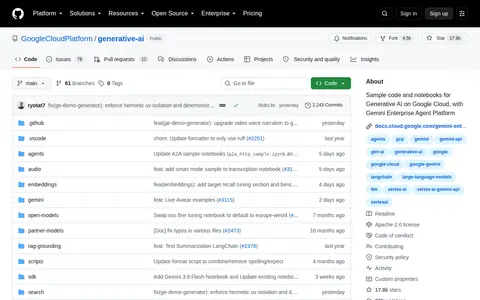
Sample code and notebooks for Generative AI on Google Cloud.

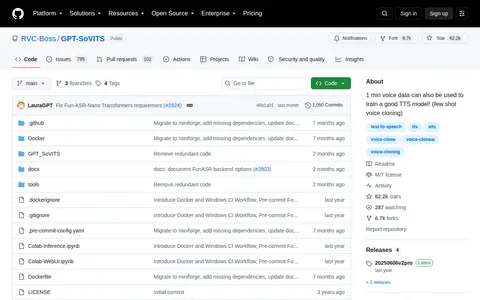
GPT-SoVITS is a few-shot voice conversion and text-to-speech WebUI. It supports zero-shot TTS from a five-second vocal sample and fine-tuning with one minute of training data. Cross-lingual inference covers English, Japanese, Korean, Cantonese and Chinese. Integrated WebUI tools include voice accompaniment separation, training set segmentation, Chinese ASR and text labeling.
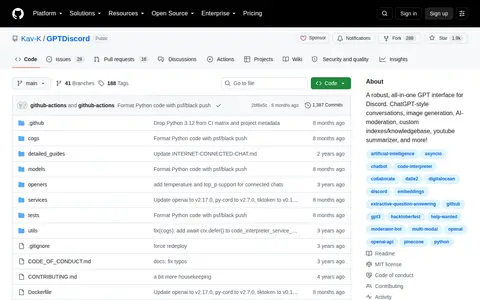
A robust, all-in-one GPT interface for Discord. ChatGPT-style conversations, image generation, AI-moderation, custom indexes/knowledgebase, youtube summarizer, and more!
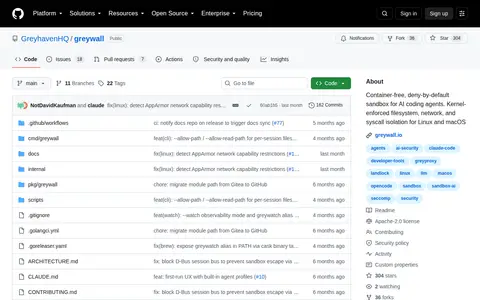
Greywall is a container-free, deny-by-default sandbox designed for AI coding agents. It provides kernel-enforced filesystem, network, and syscall isolation for Linux and macOS operating systems, and is hosted as a public repository on GitHub.
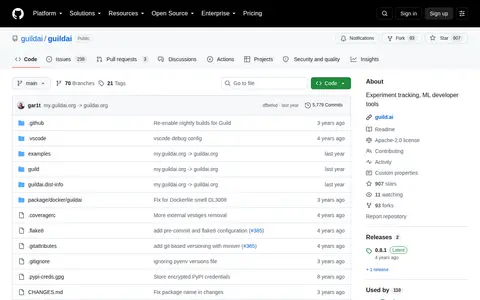
Guild AI is the source repository for an open source toolkit that automates and optimizes machine learning experiments. It runs unmodified training scripts, captures each run result as a unique experiment, and automates trials using grid search, random search and Bayesian optimization.
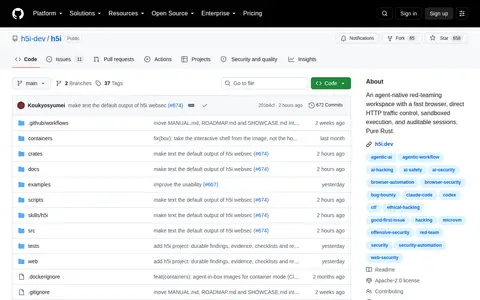
h5i is a workspace for securing web applications through two approaches: finding vulnerabilities with AI agents and proving correctness with formal verification. It provides AI agents a toolkit for browser automation, HTTP traffic manipulation and reconnaissance, and includes h5i-app, an Axum-based Rust framework for verification with Lean 4.
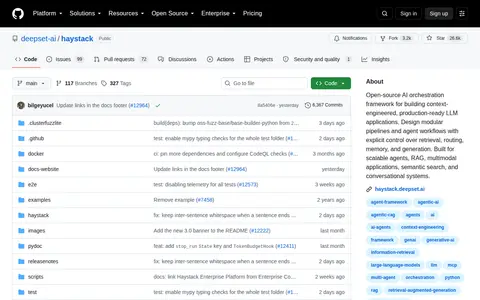
Haystack is an open-source AI orchestration framework for building production-ready LLM applications in Python. It provides modular pipelines and agent workflows with explicit control over retrieval, routing, memory and generation, and is intended for RAG systems, multimodal applications, semantic search, question answering and autonomous agents. Installation is available via pip.
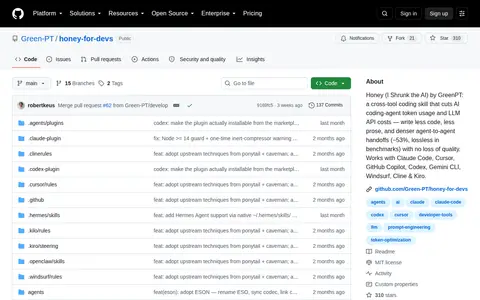
Honey (I Shrunk the AI) by GreenPT is a cross-tool coding skill that reduces AI coding-agent token usage and LLM API costs. It enables writing less code and prose and supports denser agent-to-agent handoffs, with reported 53% cost reduction and no quality loss in benchmarks. It is compatible with Claude Code, Cursor, GitHub Copilot, Codex, Gemini CLI, Windsurf, Cline, and Kiro.
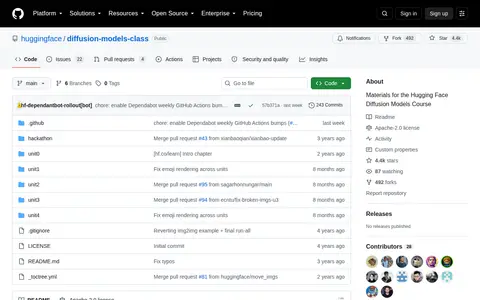
Materials for the Hugging Face Diffusion Models Course, a free course on diffusion models. It covers theory, generating images and audio with Diffusers, training and fine-tuning models, and conditional generation. Prerequisites include Python skills and basics in deep learning and PyTorch.
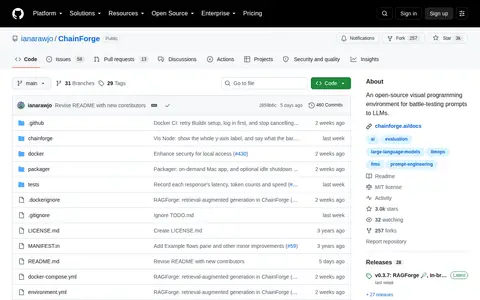
ChainForge is an open-source visual programming environment for battle-testing prompts to large language models. It supports querying multiple models at once, comparing response quality across prompts, models and model settings, and setting evaluation metrics to visualize results. Built on ReactFlow and Flask, it can be installed locally with pip or tried on the web, where features are limited.
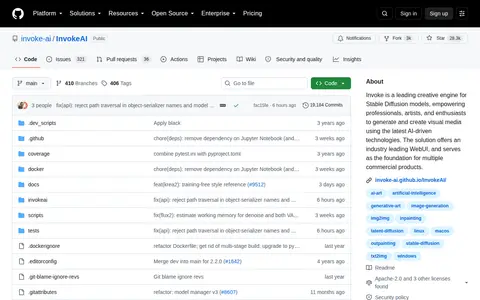
Invoke AI is a creative engine for Stable Diffusion models hosted on GitHub, designed to enable professionals, artists, and enthusiasts to generate visual media using AI-driven technologies, featuring an industry-standard web user interface and serving as the foundation for multiple commercial products.
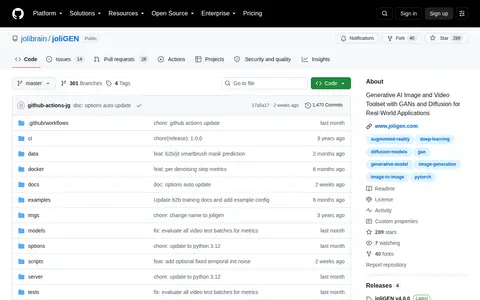
joliGEN is an integrated framework for training custom generative AI image-to-image models. It implements GAN, diffusion and consistency models for paired and unpaired image-to-image translation, including domain and style adaptation that preserves semantics such as image and object classes and masks. A server with REST API is provided for deployment, and documentation includes quickstarts and dataset guidance.
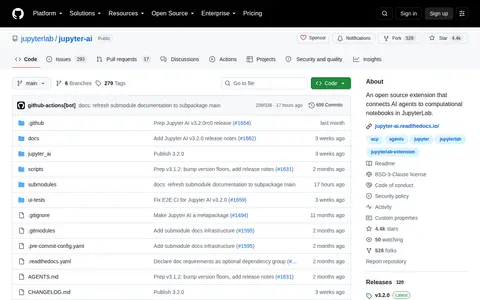
Jupyter AI is an open source extension that connects AI agents to computational notebooks in JupyterLab. It provides a native chat UI and integrates agents through the Agent Client Protocol, with a permission system requiring approval before files are written or commands executed. It is under incubation in the JupyterLab organization.
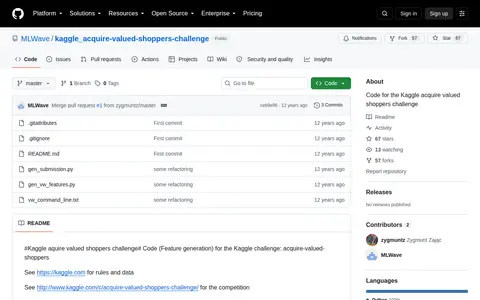
A GitHub repository holding code for the Kaggle acquire valued shoppers challenge, including feature generation scripts. The README points to Kaggle for rules and data and to a competition page and MLWave site for tutorials and discussion.
Supports software work with AI-assisted coding, testing or application development.
Open-source project that uses AI for speech, voice, transcription, music, or other audio workflows.
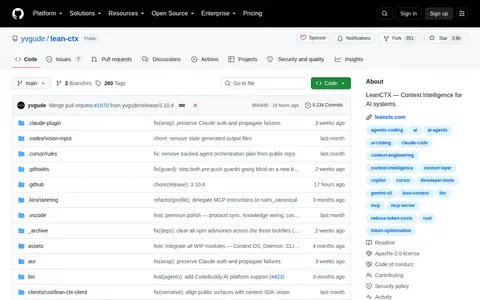
LeanCTX is an open-source context gateway that sits between AI tools and the information they read. It selects task-relevant context, applies supported access and content controls, and records observable context operations and evidence. The engine can run locally through CLI, MCP, hooks and proxy paths, and an SDK embeds supported engine capabilities in applications.
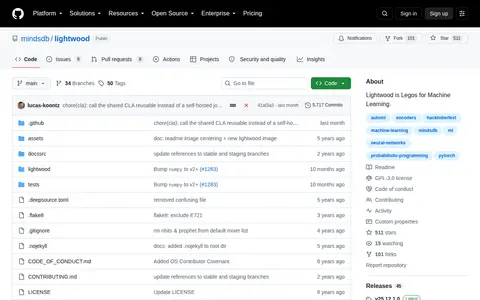
Lightwood is an AutoML framework that generates and customizes machine learning pipelines using a declarative JSON-AI syntax. It handles data types such as numbers, dates, categories, tags, text, arrays and multimedia formats, and includes a time-series mode. Users can override defaults or replace pipeline steps, and the framework generates Python code for the pipeline.
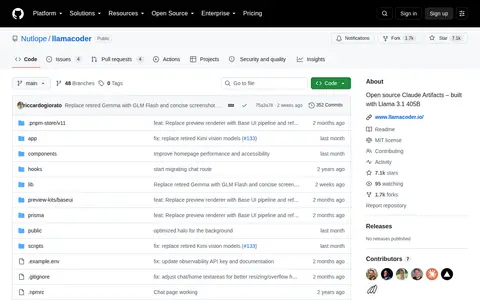
Llama Coder is an open source Claude Artifacts alternative that generates small apps with one prompt, powered by Llama 3 on Together.ai. It uses Llama 3.1 405B from Meta for the LLM and an in-browser preview renderer.
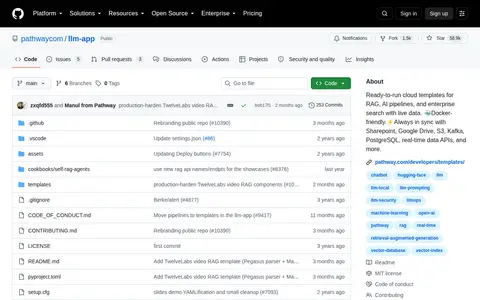
LLM App is an open-source project providing ready-to-run cloud templates for retrieval-augmented generation (RAG), AI pipelines and enterprise search with live data. It is Docker-friendly and designed to stay synchronized with data sources including Sharepoint, Google Drive, S3, Kafka, PostgreSQL and real-time data APIs, hosted by pathwaycom on GitHub.