
Official PyTorch implementation of the CVPR 2019 paper on deep high-resolution representation learning for human pose estimation. The network maintains high-resolution representations through the whole process and connects multi-resolution subnetworks in parallel with repeated multi-scale fusions. Results are reported on the COCO keypoint detection dataset and the MPII Human Pose dataset.
Directory
Search results
Published directory entries matching your search.
Listof - Community based data collection, packed in gem. Get list of pretty much anything (stop words, countries, non words) in txt, JSON or hash.
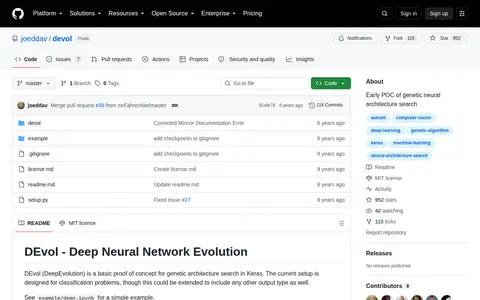
Basic proof of concept for genetic architecture search in Keras.
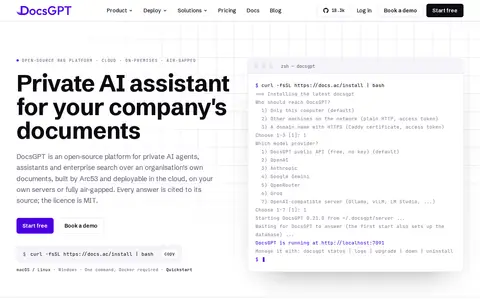
DocsGPT is described as an open-source private AI assistant and self-hosted RAG platform for an organization's own documents, with cited answers. It is built by Arc53 and deployable in the cloud, on-premises or air-gapped. The platform covers knowledge, agents, workflows and governance.
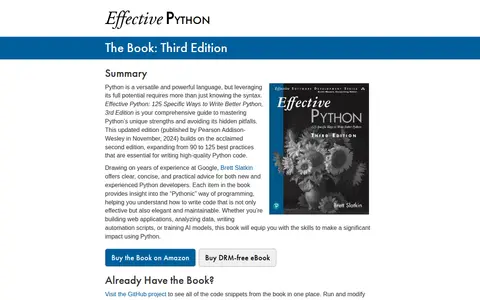
Effective Python: 125 Specific Ways to Write Better Python, 3rd Edition is a book by Brett Slatkin, published by Pearson Addison-Wesley in November 2024. It expands on the second edition from 90 to 125 best practices for writing Python code, adds new chapters on robustness and performance, and covers the language through Python version 3.13.
Enigma is a business data platform that provides access to millions of public, private and proprietary data points on businesses and people, supporting workflows including know-your-business verification, customer onboarding, go-to-market operations, payment risk assessment and customer screening.
Explainpaper is a tool for reading research papers. Users highlight confusing text to get explanations, and can ask follow-up questions. It offers plans from a free tier to paid Pro and Teams options, with Pro including advanced AI models and clickable explanations for graphs, figures and equations.
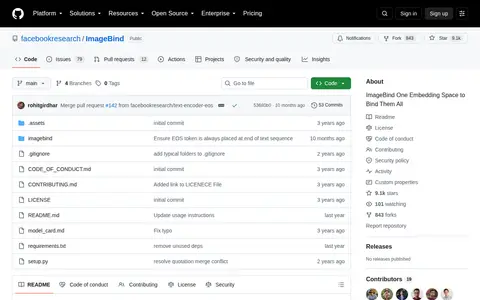
ImageBind is a PyTorch implementation with pretrained models from FAIR, Meta AI. It learns a joint embedding across six modalities: images, text, audio, depth, thermal, and IMU data. The release includes code and model weights under the CC-BY-NC 4.0 license.
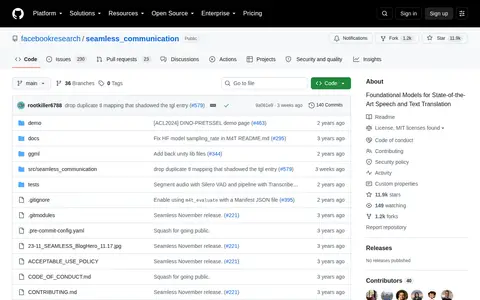
Foundational Models for State-of-the-Art Speech and Text Translation.
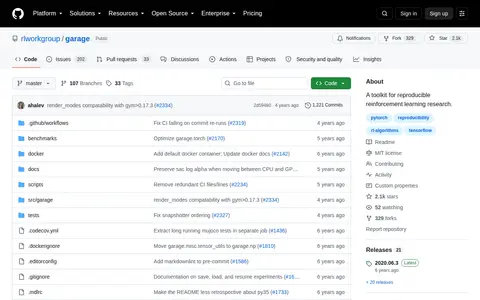
Garage is a toolkit for developing and evaluating reinforcement learning algorithms, with an accompanying library of implementations built using it. The toolkit offers modular tools including composable neural network models, replay buffers, high-performance samplers, an experiment definition interface, reproducibility tools, logging including TensorBoard, checkpointing and resuming, and environment interfaces.
Gestell studies PTX, SASS, compiler lowering, and GPU execution behavior.
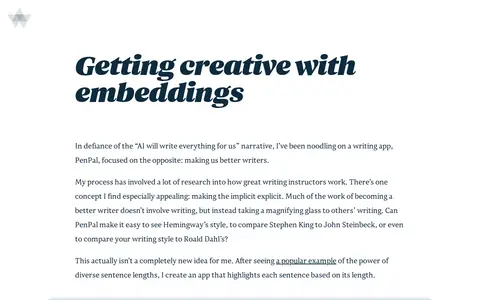
This is an article by Amelia Wattenberger exploring creative uses of embeddings, including her development of the PenPal writing app and a sentence length highlighting tool for analyzing writing style.
A page of content on TensorFlow, including academic papers and links to related topics.
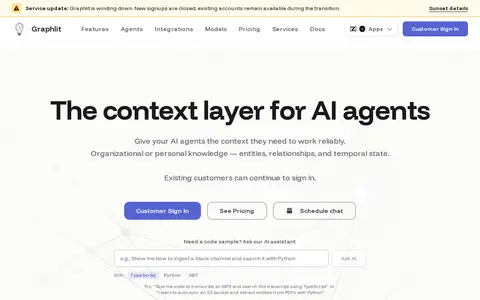
Graphlit is a context layer for AI agents. It provides real-time synchronization across services including Slack, GitHub, and Jira, operates via a single API with no operations overhead, and includes built-in semantic search.
Microsoft Research publication proposing 18 generally applicable design guidelines for human-AI interaction. The guidelines were validated through evaluation rounds, including a user study with 49 design practitioners who tested them against 20 AI-infused products. The authors state the guidelines can serve as a resource for practitioners designing AI applications and for researchers developing interaction design guidelines.
Explore any niche. Discover pain points, content opportunities, and what solutions people are eager to pay for.
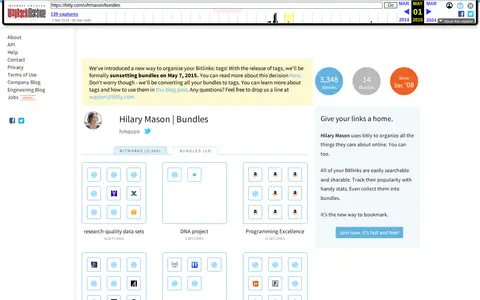
An archived Bitly bundles page belonging to Hilary Mason, listing link collections on topics such as research-quality data sets, programming, data stories and data science blogs. The page notes that Bitly sunset bundles on May 7, 2015 and converted them to tags.
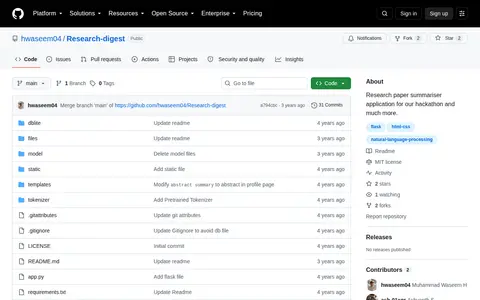
Research-Digest is a Flask application that scrapes arXiv weekly for newly published papers in fields including computer vision and machine learning, then offers a summarization feature so users can grasp key points. Summarization uses a T5 model finetuned on scientific articles, with weights and tokenizers stored locally.
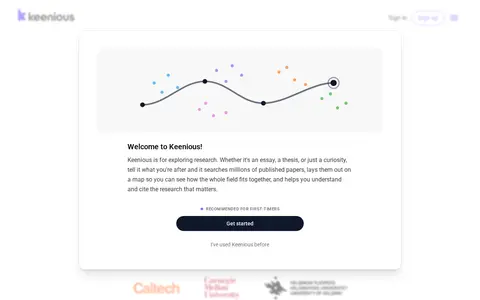
Keenious is an AI-assisted tool for exploring published academic research. It searches about 177M publications, groups results into research areas on a map, and explains unfamiliar terms, methods, and statistics beside the paper. It also translates studies published in other languages. The source states it does not write essays, paragraphs, or assignment outlines.
A collaborative AI workspace, built on your company context. Build and orchestrate agents right alongside your team.
PyTorch Meta-learning Framework for Researchers.
Limitless describes personalized AI powered by what a user has seen, said, and heard. The company states it has been acquired by Meta. Existing Pendant customers are to be supported throughout 2026 and receive the unlimited plan for free, while non-Pendant functionality such as Rewind is being sunset.
Collection of infrastructure and tools for research in neural network interpretability.
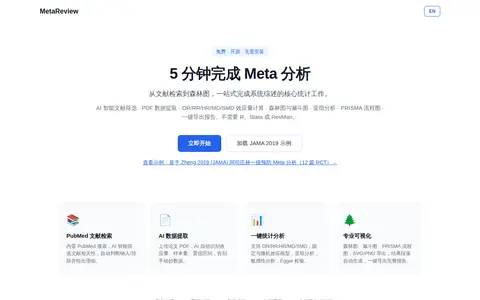
MetaReview is a free, open-source online meta-analysis tool that combines PubMed literature search, AI screening and data extraction, effect-size calculation for OR/RR/HR/MD/SMD, forest and funnel plots, subgroup and sensitivity analysis, PRISMA flow diagrams and report export. It runs in the browser without R, Stata or RevMan. A comparison page states the tool is free.