
docs.trychroma.com
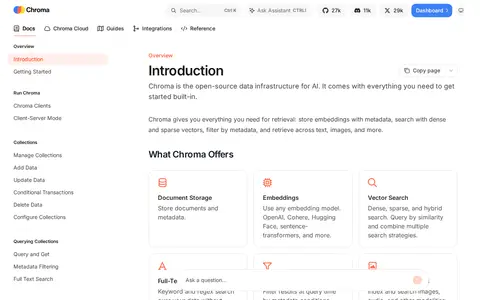
Chroma - Open-source search and retrieval database for AI applications. Vector, full-text, regex, and metadata search. or Cloud available.
Directory
Published directory entries matching your search.
Chroma - Open-source search and retrieval database for AI applications. Vector, full-text, regex, and metadata search. or Cloud available.

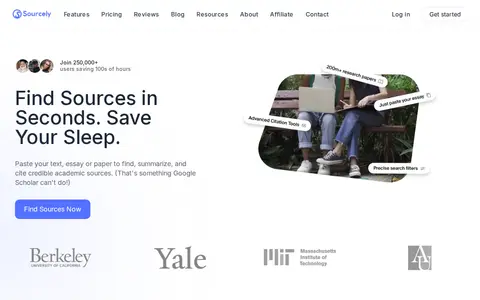
Sourcely is an AI-powered academic source finder that searches over 200 million papers based on pasted text, an essay, or a paper. It finds and summarizes credible sources and exports citations. Advanced filters, deep search, and chatting with sources are offered. Plans are billed monthly or annually.
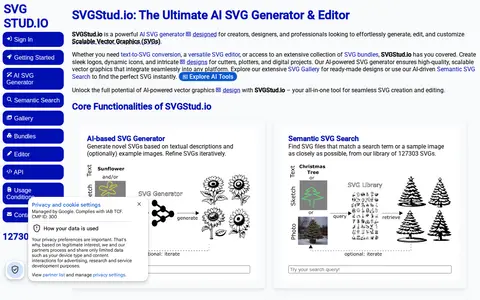
SVGStud.io is an AI-powered SVG generator and editor. It generates SVGs from textual descriptions and optional example images, refines them iteratively, and offers semantic search across a library of 127303 SVGs plus a gallery and in-browser editing. Generated SVGs are licensed under CC-BY-SA 4.0. Inputs are logged and generated SVGs are added to the public library.

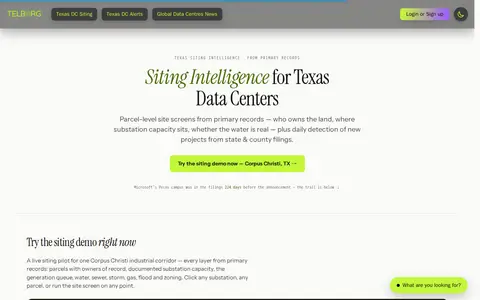
Telborg tracks construction and power developments for Texas data centers, drawing on state and county filings. It reports new campuses, power facilities and semiconductor fabs, along with the operator behind an LLC, design and construction firms, approval stage and power supplier. The site also offers a siting demo for a Corpus Christi industrial corridor.

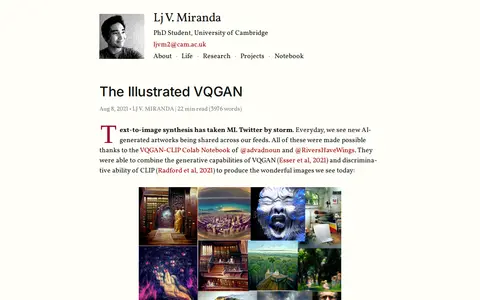
An illustrated explainer article on VQGAN, describing how the model generates images from text at a conceptual level and how VQGAN and CLIP work in tandem. It covers a theory of perception, using transformers to model interactions, expressing images through a codebook, and training the GAN and transformer.

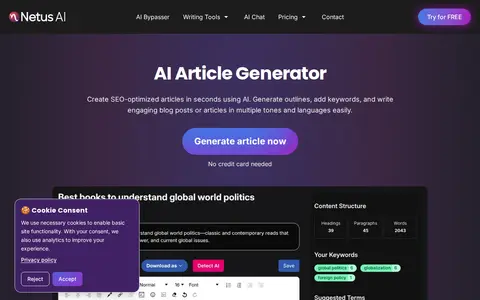
Write SEO-optimized blog posts and articles using AI. Generate outlines, add keywords, and create content quickly with NetusAI’s AI article generator.

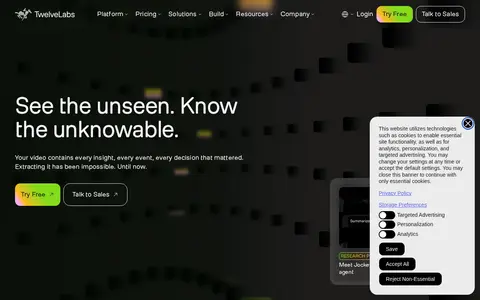
Twelve Labs provides an enterprise video intelligence platform and API powered by multimodal artificial intelligence. The platform allows users to search, analyze, and understand video content across visual, audio, and language modalities, and can process large volumes of video data at high speed.

The University of Aruba Open Knowledge Repository is a work-in-progress repository for the university's research output, showing featured items, recent submissions and communities. It hosts publications such as law articles, reports and academic speeches. Questions and discrepancy reports go to [email protected].

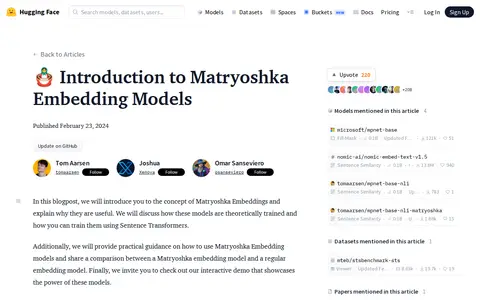
A Hugging Face blog post introducing Matryoshka Embedding models. It explains embeddings as numerical representations and describes how Matryoshka models store more important information in earlier dimensions, allowing large embeddings to be truncated while remaining useful. It covers theoretical training and training with Sentence Transformers, with a comparison to a regular embedding model.

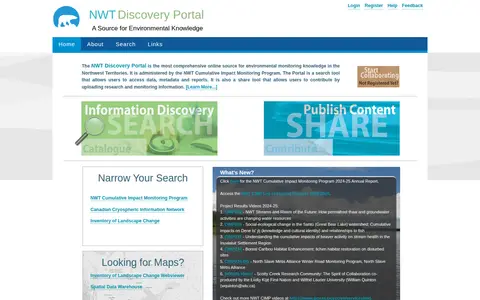
The NWT Discovery Portal is administered by the NWT Cumulative Impact Monitoring Program, and serves as a comprehensive online source for environmental monitoring knowledge in the Northwest Territories. It functions as a search tool for environmental data, metadata and reports, and allows users to upload and share research and monitoring information.
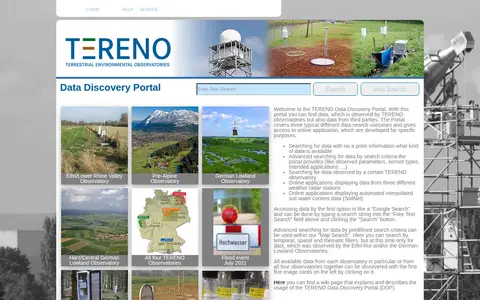
The TERENO Data Discovery Portal is a web portal for finding data observed by TERENO observatories and data from third parties. It supports free text search without prior knowledge of available data, advanced search by criteria such as observed parameters, sensor types and intended applications, and searching for data from a particular observatory. It also links to online applications for weather radar and interpolated soil water content data.
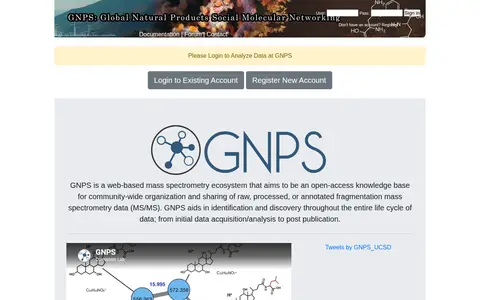
GNPS is a web-based mass spectrometry ecosystem serving as an open-access knowledge base for community-wide organization and sharing of raw, processed or annotated fragmentation mass spectrometry data. It provides tools for molecular networking, library search, MASST search and dataset browsing, supporting identification and discovery across the data life cycle.

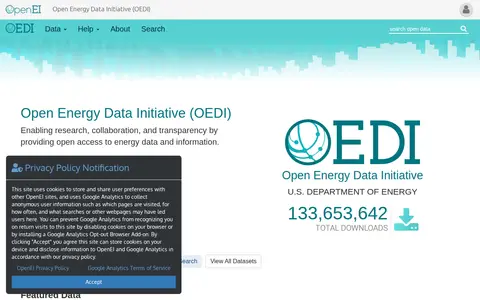
The Open Energy Data Initiative (OEDI) is a searchable online software discovery platform and knowledge base developed by NLR and powered by OpenEI. It provides open access to energy data and information to support research, collaboration and transparency, with features including curated data lakes, solar systems integration data and analytics tools, and a siting lab.

Drivesearch.kwebpia.net is a search tool that enables users to search their Google Drive and associated Google Docs content, along with web content covering topics such as videos, lyrics, songs, knowledge, medical, and science. It also supports content from platforms including Pandora, Last.fm, and SoundCloud, and provides multiple search language options with an auto-detect default.

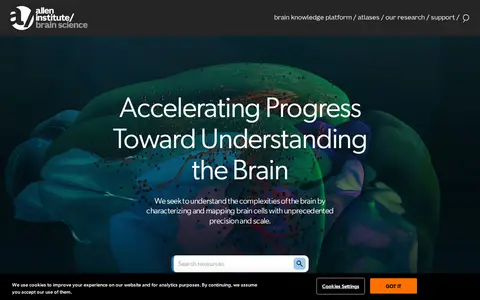
The Allen Brain Map is an Allen Institute for Brain Science resource for characterizing and mapping brain cells. It provides reference anatomical atlases and datasets including adult mouse, adult human and developing brain atlases, alongside a Brain Knowledge Platform for exploring, analyzing and visualizing multi-modal neuroscience data, with documentation covering guides, API references and tutorials.

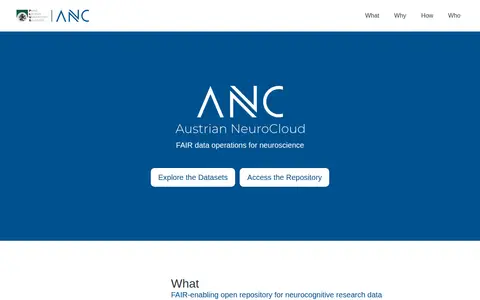
Austrian NeuroCloud is an open repository for neurocognitive research data. It provides secure data storage and integrated tools for maintenance, reuse and FAIR-aligned management of research data. Datasets can be browsed through a knowledge graph and connected with others via a Neurobagel federated search node. Researchers can bring data for curation, and accounts can be requested.
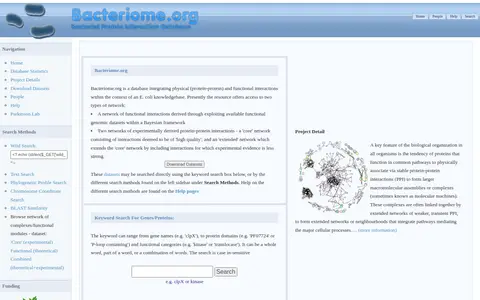
Bacteriome.org is a database integrating physical protein-protein and functional interactions within an E. coli knowledgebase. It offers a functional interaction network derived from genomic datasets using a Bayesian framework, a core network of high-quality experimentally derived protein-protein interactions, and an extended network including less strongly supported interactions. Users can search by gene name, protein domain or functional category.

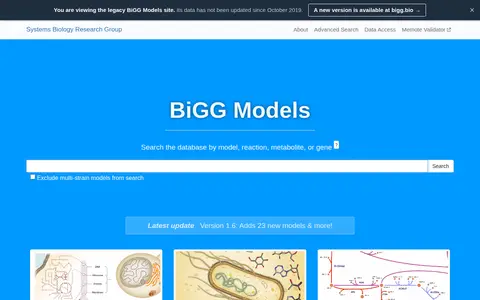
BiGG Models is a knowledgebase of genome-scale metabolic network reconstructions that integrates more than 70 published networks into a single database with standardized BiGG IDs. It can be browsed on the website or accessed using a web API. It is hosted and maintained by the Systems Biology Research Group at the University of California, San Diego.

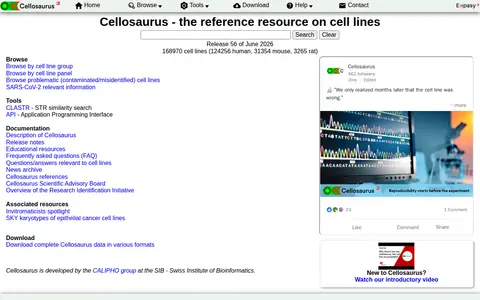
Cellosaurus is a knowledge resource and database that aims to describe cell lines used in biomedical research. Its scope includes immortalized, naturally immortal tissue limited-life distributed cell lines, and vertebrate cell lines with emphasis on human, mouse and rat, plus invertebrate and plant cell lines. Records include names, synonyms, accession numbers, species of origin and comments. It also offers search tools, downloads and documentation.
Research data portal for exploring humanities records, including datasets.
CLARIN-ERIC is a European research infrastructure offering sustainable access to a wide range of language data and tools to support research in humanities and social sciences. It coordinates national consortia, knowledge centres, and projects. It provides resources including a federated data search engine, the Virtual Language Observatory, and the Language Resource Switchboard. It also offers training, education, and outreach activities.
Searchable repository for finding geosciences datasets and compiled data.

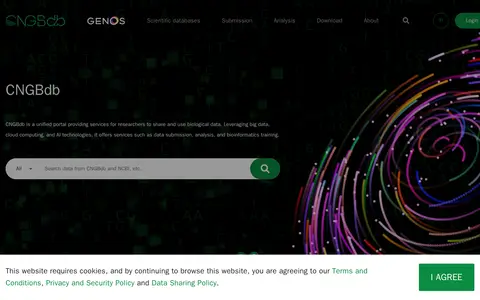
CNGBdb is a unified platform for sharing and applying biological big data with the research community. Built on big data and cloud computing technologies, it offers data services including archiving, analysis, knowledge search, management authorization, and visualization.

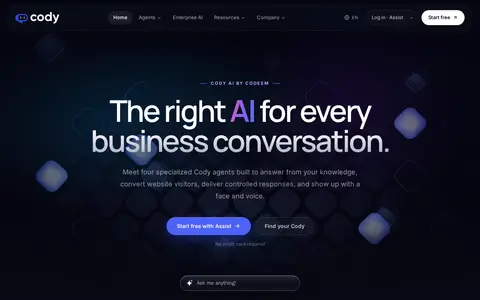
Cody offers three specialized AI agents: Convert, Assist, and Live, built to engage website visitors, answer questions from a knowledge base, and support live event experiences. Documentation describes account setup, an API, security bulletins, and support resources. Paid plans begin at $29 per month.