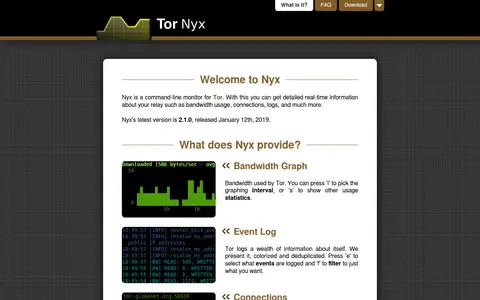
Nyx is a command-line monitor for Tor, providing real-time information about a relay such as bandwidth usage, connections and logs. It is a curses interface suited to ssh connections and tty terminals. It requires Stem 1.5.4 or later and works with Python 2.7 and greater, including Python 3.x.
Directory
Search results
Published directory entries matching your search.
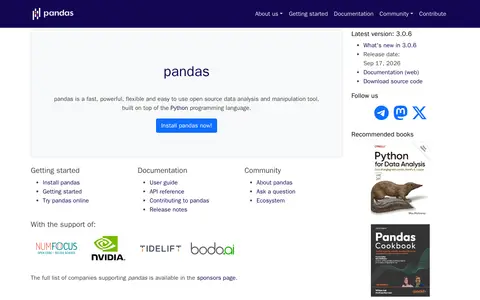
pandas is an open source, BSD-licensed library providing high-performance, easy-to-use data structures and data analysis tools for the Python programming language. It is described as a data analysis and manipulation tool built on top of Python. Documentation, a user guide and an API reference are available.
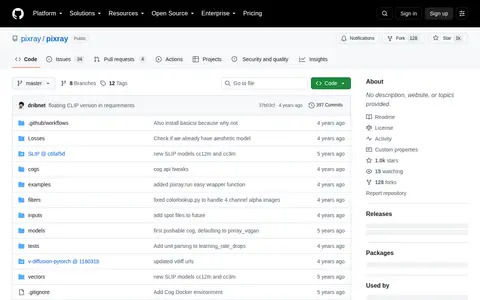
pixray is an image generation system combining perception engines, CLIP-guided GAN imagery and CLIPDraw. It is a Python library and command line utility that can also run in Google Colab notebooks or inside Docker using Cog. Installation requires a recursive git clone and a fresh Python 3.8 environment.
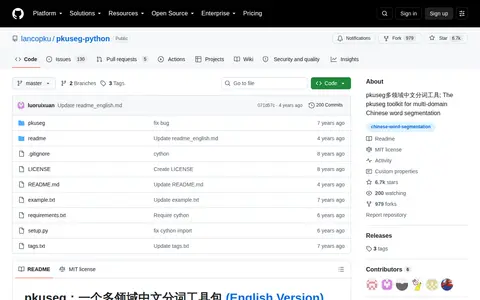
pkuseg is a Python toolkit for multi-domain Chinese word segmentation, based on a 2019 paper. It provides pretrained models for news, web, medicine, tourism, and mixed domains, and supports user-trained models and part-of-speech tagging. It is distributed under the MIT license.
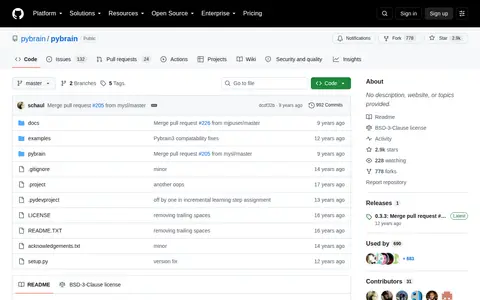
PyBrain is a Python machine learning library distributed under a BSD-3-Clause license. The repository includes documentation, examples, and a setup script; installation requires SciPy and is performed with python setup.py install or by cloning the repository. The project provides a quickstart, tutorials, and an API reference in its documentation.
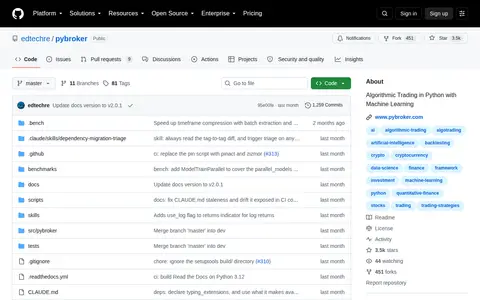
PyBroker is a Python framework for developing algorithmic trading strategies with a focus on machine learning. It provides a backtesting engine built in NumPy and accelerated with Numba, model training and backtesting using Walkforward Analysis, parameter optimization with Optuna, and access to historical data from Alpaca, Yahoo Finance, and AKShare. It supports Python 3.11+ on Windows, Mac, and Linux.
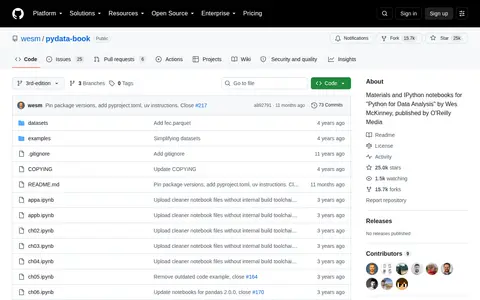
The repository holds materials and IPython notebooks for "Python for Data Analysis, 3rd Edition" by Wes McKinney, published by O'Reilly Media. Notebooks cover chapters on Python basics, NumPy, pandas, data loading, cleaning, visualization, time series and modeling libraries, plus appendices. The code is released under the MIT license.
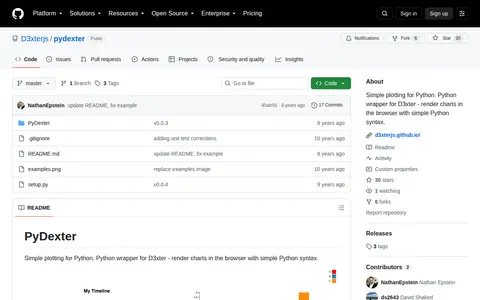
PyDexter is a Python wrapper for D3xter that renders charts in the browser using simple Python syntax. It supports histogram, scatter, plot, pie, timeline and bar chart examples. Installation is done with pip install PyDexter, and charts can be configured with settings such as height, width and title.
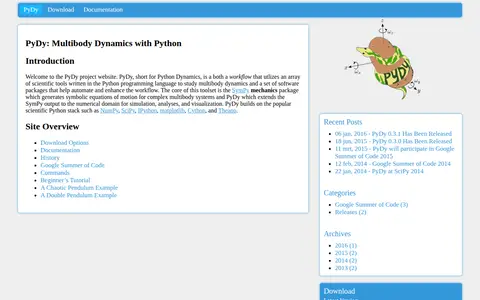
PyDy, short for Python Dynamics, is a workflow and set of software packages for studying multibody dynamics in Python. Its core is the SymPy mechanics package, which generates symbolic equations of motion for multibody systems, and PyDy extends that output to simulation, analyses, and visualization. It builds on NumPy, SciPy, IPython, matplotlib, Cython, and Theano.
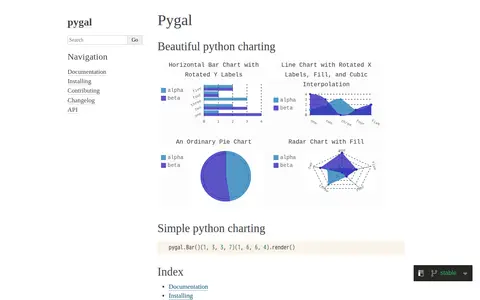
pygal is a Python charting library described as beautiful and simple python charting. Its documentation lists chart types including line, bar, histogram, XY, pie, radar, box, dot, funnel, gauge, pyramid and treemap, and output formats such as SVG, PNG and base 64 data URI.
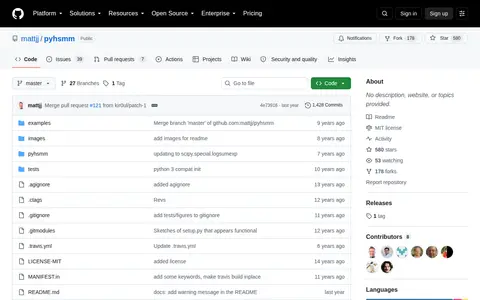
pyhsmm is a Python library for approximate unsupervised inference in Bayesian Hidden Markov Models and explicit-duration Hidden semi-Markov Models, focusing on the HDP-HMM and HDP-HSMM with weak-limit approximations. Extensions include autoregressive models, switching linear dynamical systems and factorial models. The package is stated as no longer maintained and was last tested with Python 3.7.
pyLoad is a free and open source download manager written in Python. It is designed to be lightweight, easily extensible and fully manageable via a web interface. It runs on NAS devices, routers and headless home servers supporting Python, and supports common video sites, one-click hosters and container formats.
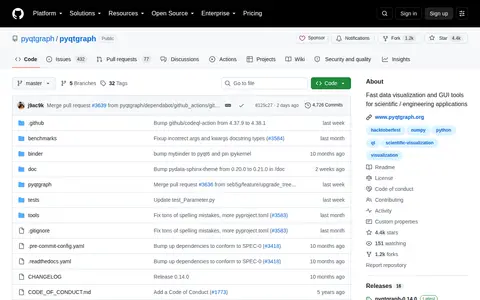
PyQtGraph is a pure-Python graphics library that uses the Qt framework. It is intended for mathematics, scientific and engineering applications, and relies on numpy for number crunching, Qt's GraphicsView for 2D display and OpenGL for 3D display. It supports Python 3.12+, Qt 5.15 or 6.8+, and numpy 2.2+.
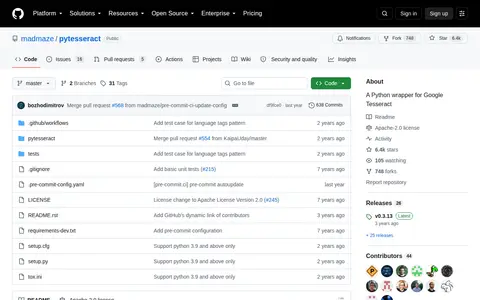
pytessarct is a Python wrapper for the Google Tesseract optical character recognition tool, hosted as a public repository on GitHub. It enables developers to incorporate Tesseract's text recognition capabilities into Python projects.
A hands-on, project-based introduction to programming with Python by Eric Matthes, published in its third edition in December 2022. The book covers basic concepts such as variables, lists, classes, and loops, and guides readers through projects including a Space Invaders-inspired arcade game, data visualizations, and a simple web application.
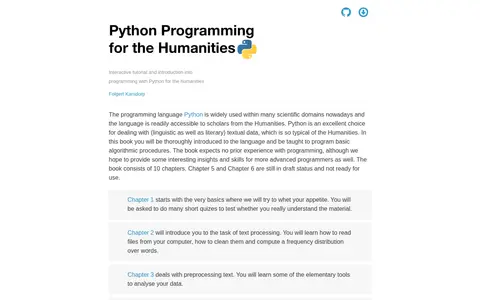
An interactive tutorial and introduction to programming with Python for the humanities by Folgert Karsdorp. The book has 10 chapters covering text processing, preprocessing, programming principles, readability computation, authorship attribution, object-oriented programming, information retrieval, a PDF search web application, classification and hierarchical clustering. It expects no prior programming experience. Chapters 5 and 6 are in draft status.
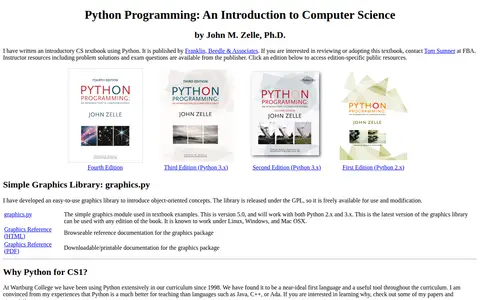
Teaching page by John M. Zelle, Ph.D., for an introductory computer science textbook written in Python and published by Franklin, Beedle & Associates. It links edition-specific public resources for four editions and offers graphics.py, a simple graphics library released under the GPL for introducing object-oriented concepts. Instructor resources including problem solutions and exam questions are available from the publisher.
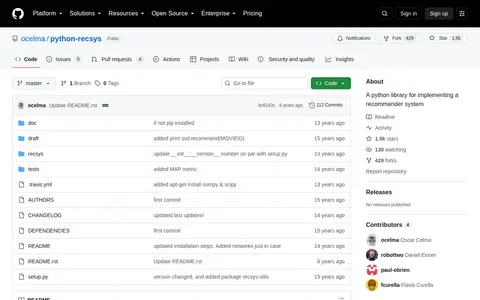
A Python library for implementing a Recommender System.
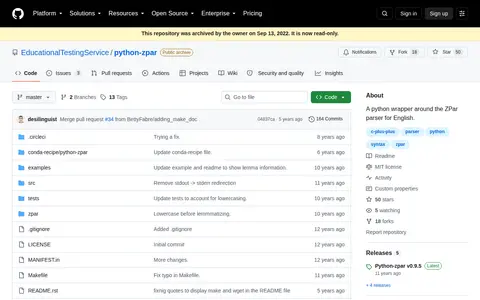
A Python wrapper around the ZPar statistical natural language parser, providing a ctypes-based interface and an XML-RPC ZPar server for batch processing. It works only with English ZPar models and supports 64-bit Linux and OS X. The repository was archived on Sep 13, 2022 and is read-only; the project is no longer under active development.
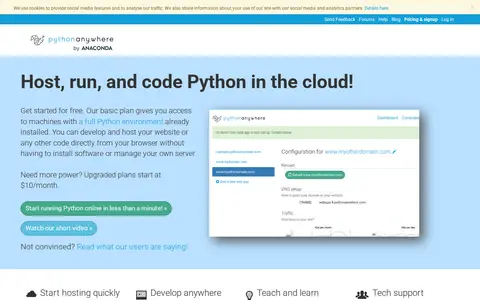
PythonAnywhere is a cloud service for hosting, running and coding Python. The basic plan provides access to machines with a full Python environment already installed, and quickstart installers are available for Django, web2py, Flask and Bottle.
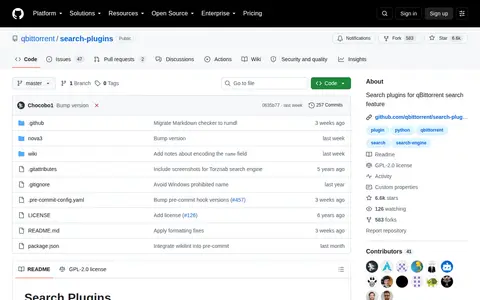
A GitHub repository containing search plugins used by the search feature in qBittorrent. It serves as a hub for third-party contributors to gather and share plugins and is maintained by community contributors rather than the qBittorrent core team. Python 3 is required since Python 2 support was removed.
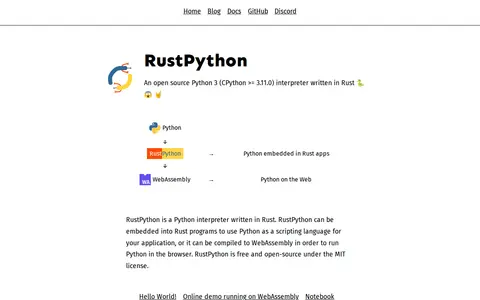
RustPython is an open source Python 3 interpreter written in Rust. It can be embedded into Rust programs as a scripting language or compiled to WebAssembly to run Python in the browser. It is released under the MIT license.
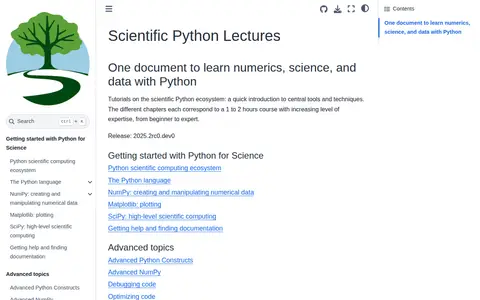
A document for learning numerics, science and data with Python, consisting of tutorials on the scientific Python ecosystem. Chapters correspond to one- to two-hour courses with increasing expertise, from beginner to expert, covering topics such as NumPy, Matplotlib, SciPy, statistics, scikit-image and scikit-learn.
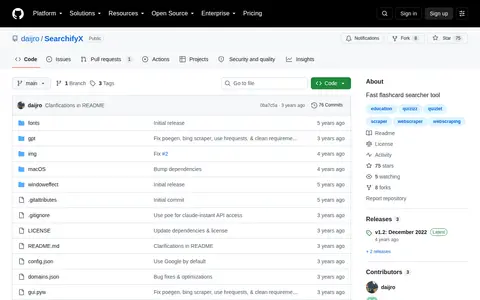
SearchifyX is a fast flashcard searcher tool and the predecessor to Searchify. It acts as a webscraper for Quizlet, Quizizz, and Brainly, letting users query questions from these sites and sort results by similarity to the input query. The tool includes a screen OCR scanner, customizable global hotkeys, and stealth features to prevent websites from detecting window focus changes, and is available as both a GUI application and CLI tool for Linux, Mac OS, and Windows. It was created strictly for educational purposes to demonstrate asynchronous webscraping in Python, requiring Python 3.8 dependencies and Tesseract for OCR functionality.