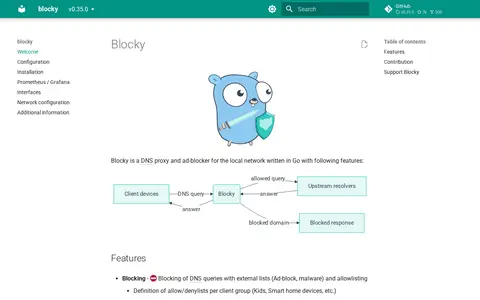

Blocky is a DNS proxy and ad-blocker for the local network written in Go. It blocks DNS queries using external ad-block and malware lists, with allowlists configurable per client group and periodic reloading of lists. It supports DNS over UDP, TCP, HTTPS, TLS, QUIC and HTTPS/3, and does not collect user data or telemetry.
Directory
Search results
Published directory entries matching your search.
Bloom is a large language model documented within the Hugging Face Transformers library. The official documentation provides implementation resources, configuration classes, model classes, and guidance for integrating BLOOM into artificial intelligence and machine learning workflows, as part of Hugging Face's open-source and open science initiative to advance and democratize AI.


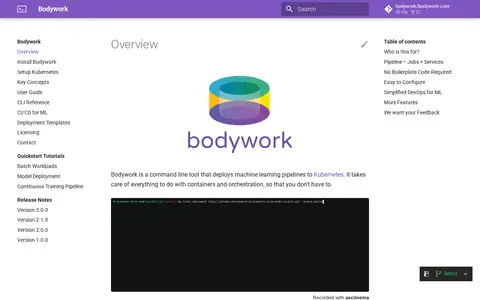
Bodywork is a command line tool that deploys machine learning pipelines to Kubernetes, handling containers and orchestration. Any pipeline stage runs either a batch job or a long-running process. It is presented as a lightweight alternative to Kubeflow or building a platform around workflow tools such as Apache Airflow, Argo Workflows or Dagster. Stages are defined as Python modules or Jupyter notebooks and configured in a single bodywork.yaml file.
HTML5 Boilerplate is a professional front-end template for building fast, robust and adaptable web apps or sites. It provides a starter index.html with recommended meta tags, a main.css with base styles, helpers, media queries and print styles, and independently maintained server configs for multiple platforms.
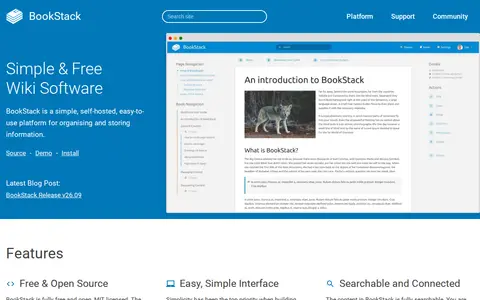
BookStack is a free, open-source, self-hosted platform for organising and storing information, positioned as simple wiki software. Content is organised into books, chapters and pages, with a WYSIWYG or Markdown editor, built-in diagrams.net drawing, search, configurable branding and multi-lingual support. It runs on PHP with the Laravel framework and MySQL.
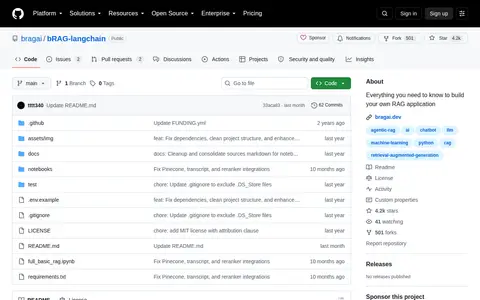
This repository collects notebooks that explore Retrieval-Augmented Generation (RAG) for various applications, from introductory to advanced implementations. It includes a full_basic_rag.ipynb starter and notebooks on multi-querying, routing, query construction, indexing, and advanced retrieval. The materials cover environment setup, data loading, embedding generation, and vector store configuration with ChromaDB or Pinecone.
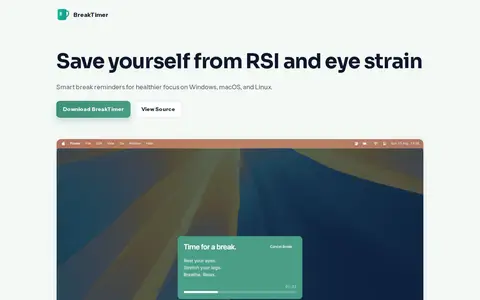
BreakTimer is break reminder software for Windows, macOS and Linux. It reportedly lets users set how often breaks happen and how long each one lasts, customize app colours and messages shown during breaks, configure working hours, and receive notifications when breaks are about to start.
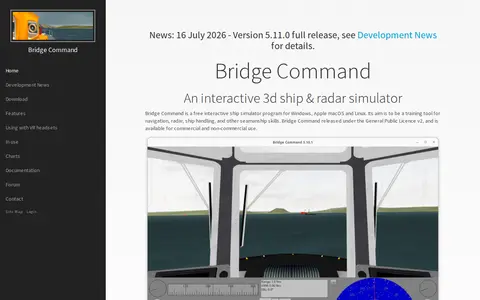
Bridge Command is a free, open source interactive 3D ship and radar simulator for Windows, Apple macOS and Linux, released under the General Public Licence v2. It is intended as a training tool for navigation, radar, ship handling and other seamanship skills, with configurable ships, buoys, environmental models and scenarios.
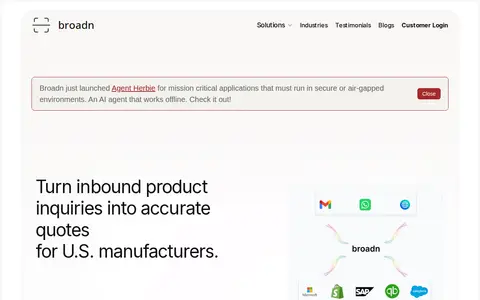
broadn is an AI tool designed for manufacturing sales operations. It automates quoting and order processing from inbound emails to enterprise resource planning (ERP) systems, converting unstructured requests for quotes and sales orders into clean outputs including quotes sent to CRM and orders sent to ERP. It offers features such as instant quoting, rule-based discounts, product configuration, and margin control, and has launched Agent Herbie for operation in secure or air-gapped offline environments.
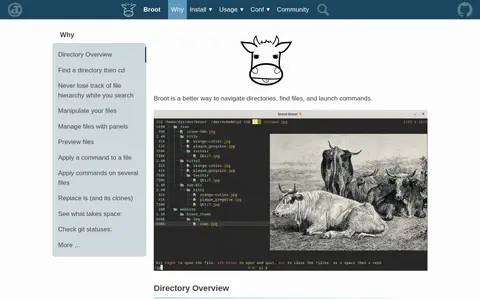
broot is a tree-oriented file manager that provides a directory overview, finds files, and launches commands. It supports searching by file name or content with regular expressions and logical operators, and lets users apply verbs such as opening files in the default program or preferred editor. Configuration files can be written in TOML or Hjson.
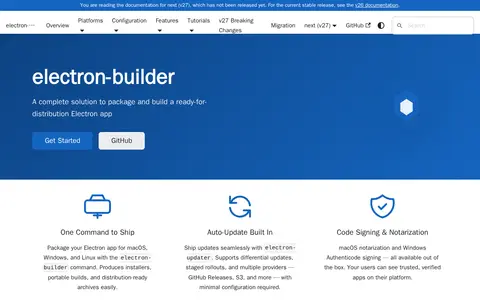
electron-builder is a tool for packaging and building Electron apps for distribution with auto-updating support. It packages apps for macOS, Windows and Linux, producing installers, portable builds and distribution archives. Auto updates are enabled by the electron-updater package and are ideally configured to run in a CI pipeline. Code signing and macOS notarization are available out of the box.
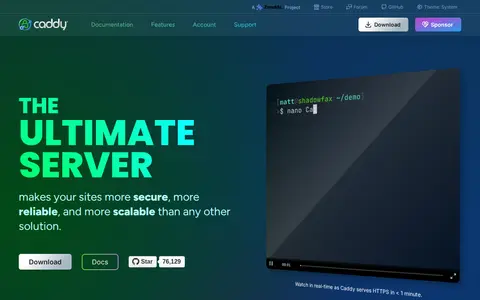
Caddy is an open source web server written in Go that automatically obtains and renews TLS certificates for sites. It includes a JSON configuration with an on-line config API, a static file server, and an HTTP reverse proxy, and can coordinate certificate management across multiple instances sharing storage.
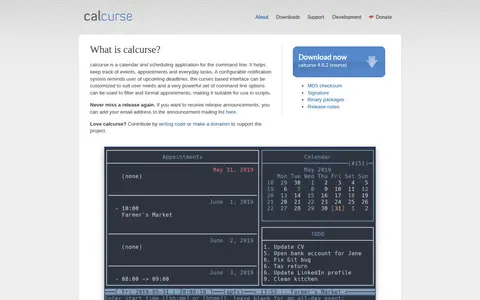
calcurse is a calendar and scheduling application for the command line that keeps track of events, appointments and everyday tasks. It includes a configurable notification system, a customizable curses-based interface and command line options for filtering and formatting appointments, making it suitable for scripts.
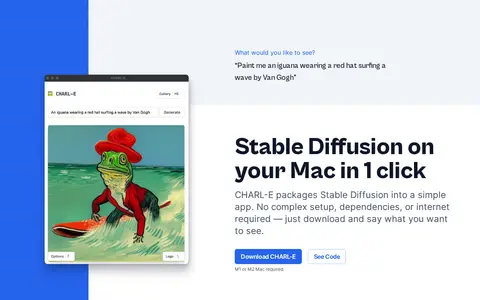
CHARL-E is a macOS app that packages Stable Diffusion for generating images from text prompts. It automatically downloads weights, allows model configuration, and generates images locally without sending data to servers after the initial install. An M1 or M2 Mac is required.
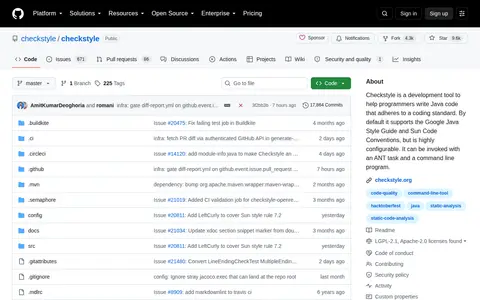
Checkstyle is a development tool to help programmers write Java code that adheres to a coding standard. By default it supports the Google Java Style Guide and Sun Code Conventions, but is highly configurable. It can be invoked with an ANT task and a command line program.
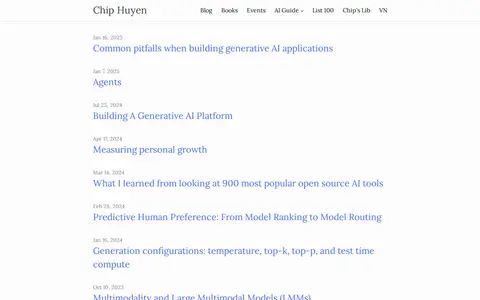
A personal blog about AI system design and bringing AI into production. Posts cover topics including generative AI applications, agents, multimodal models, LLM research challenges, model routing, generation configurations, and machine learning systems.
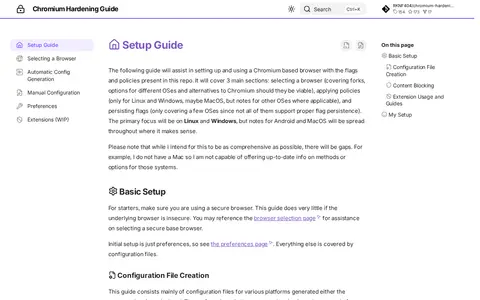
Chromium Hardening Guide is a setup guide for using a Chromium-based browser with flags and policies. It covers selecting a browser, applying policies and persisting flags, with primary focus on Linux and Windows and notes for Android and MacOS where applicable. Configuration files can be generated by an automated script or edited by hand.
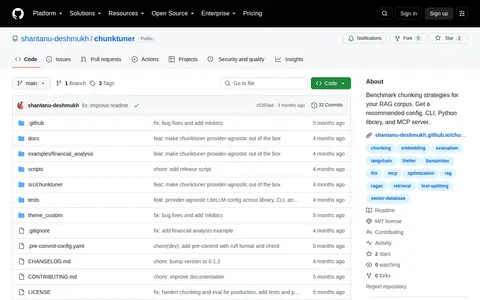
Chunk Tuner is a tool that benchmarks chunking strategies for a RAG corpus and recommends a configuration. It benchmarks strategies such as fixed-token windows, recursive character splitting, semantic splitting and PDF structural chunking, scoring each against retrieval metrics. It is available as a Python library, a CLI and an MCP server.
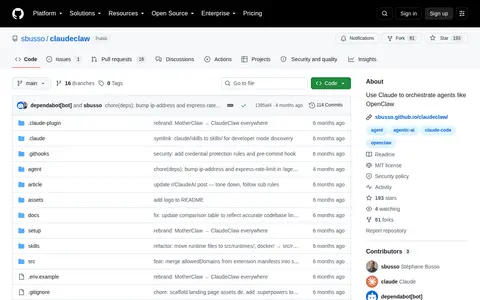
ClaudeClaw is a Claude Code plugin presented as a persistent agent orchestrator. It provides an always-on message loop, routing messages from Slack, WhatsApp and Telegram to Claude agents in isolated sandboxes, with structured memory, webhook triggers, per-group agent configuration and cost tracking. It is built on NanoClaw and uses a pluggable extension system.
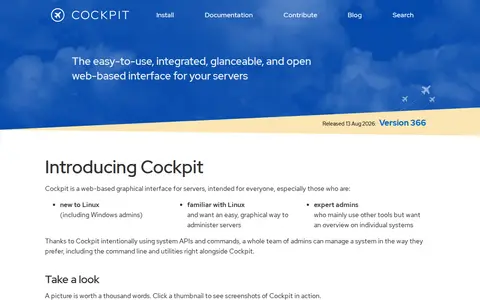
Cockpit is a web-based graphical interface for administering Linux servers through a browser. It uses existing system APIs and commands, defaults to normal user logins and privileges, and runs on demand via systemd socket activation. Tasks include managing storage, configuring networks and firewalls, running containers, and managing virtual machines and user accounts.
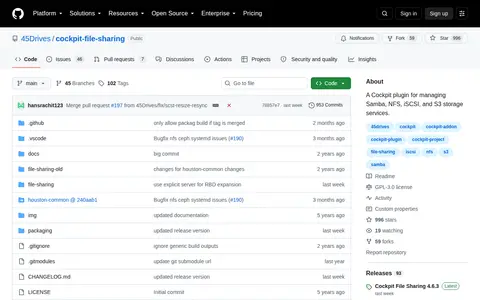
A Cockpit plugin for managing Samba, NFS, iSCSI, and S3 storage services. It provides management of shares, users, targets, and buckets through the Cockpit web interface, with export and import of configuration in the standard formats for each service.
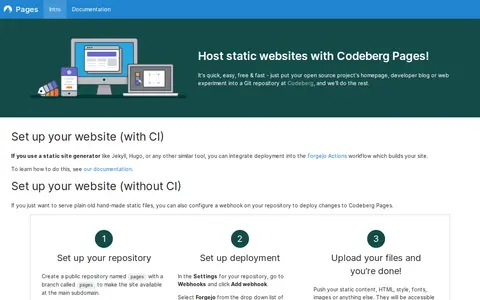
Codeberg Pages hosts static websites from Git repositories at Codeberg. A public repository named pages, or a pages branch in a public repository, makes the site available at the main subdomain. Site generators such as Jekyll and Hugo can deploy through Forgejo Actions, and deployment can also be configured with a webhook. Custom domains are supported through DNS records.
Codec Guide hosts the K-Lite Codec Pack, a free software bundle for playback of music and video files. It offers many configuration options and supports formats including MKV, MP4, AVI, and FLV. The page also lists driver and codec pack update news.
CodSpeed provides continuous performance testing for CI. It runs benchmarks in the CI pipeline, reports regressions in pull requests, and offers autonomous performance optimization. A documentation quickstart describes connecting a repository and setting up benchmarks, either through an automated wizard or manual configuration, including plugins for languages such as Python and C++.