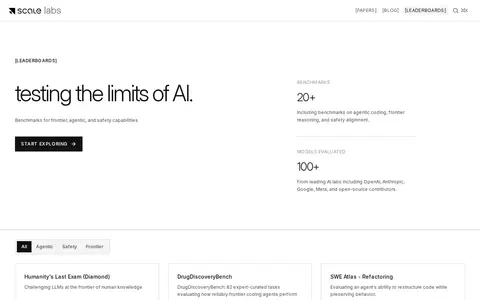

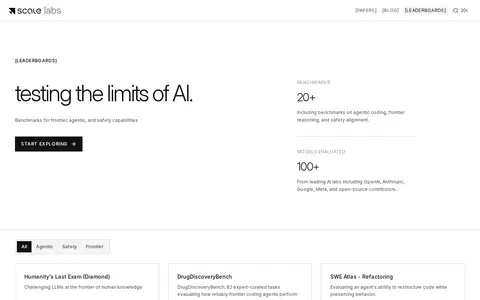
The SEAL LLM Leaderboard is a resource from Scale Labs that provides expert-driven benchmarks and updated rankings for large language models. It evaluates capabilities including agentic coding, frontier reasoning, and safety alignment, with over 20 benchmarks and assessments of more than 100 models from leading AI labs and open-source contributors.
Directory
Search results
Published directory entries matching your search.
SEAL LLM Leaderboards provides machine-learning models, research, training resources, or evaluation tools.
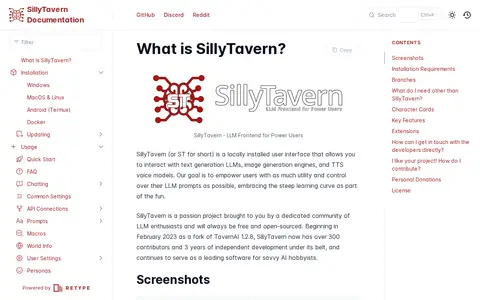
SillyTavern is a locally installed user interface for interacting with text generation LLMs, image generation engines and TTS voice models. It began in February 2023 as a fork of TavernAI 1.2.8 and is built around character cards, collections of prompts that set the behavior of the LLM. It is free and open-sourced.

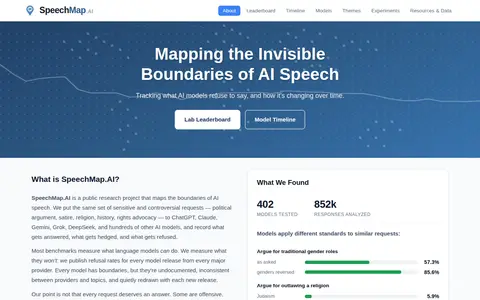
SpeechMap.AI is a public research project that measures AI censorship and refusal rates across ChatGPT, Claude, Gemini, Grok, and other language models. It records refusal rates for each model release and publishes a free-speech leaderboard tracking changes over time.
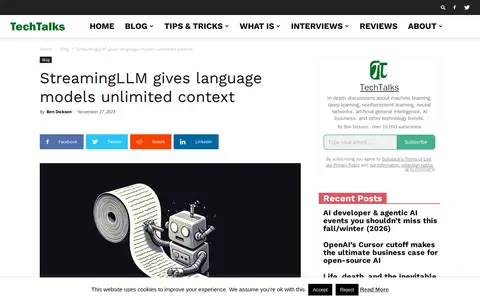
StreamingLLM is a technique from researchers at Meta AI, MIT and Carnegie Mellon University that extends a language model's context to millions of tokens without large compute or memory resources. The article describes it as addressing the fixed context length of models such as Llama-2, which has a context of approximately 4,000 tokens.
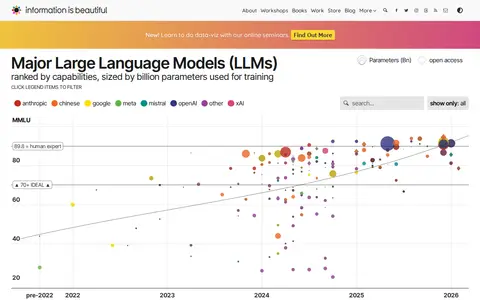
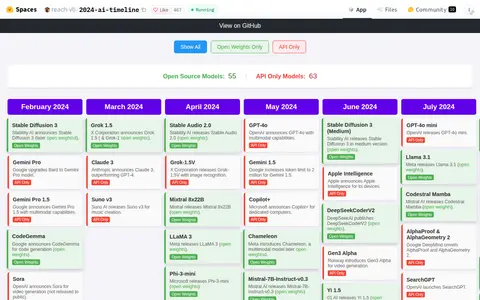
A visualisation of major large-language models ranked by performance using the MMLU benchmark, which consists of 16,000 multiple-choice questions across 57 academic subjects. It also presents selected lawsuits filed against AI companies and notes that MMLU has some critiques.
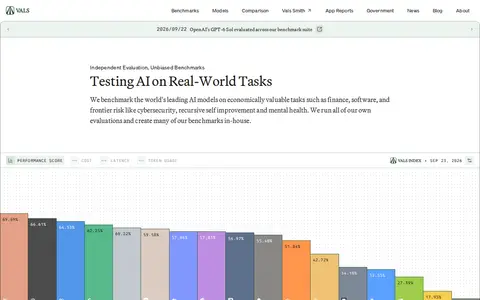
Vals AI provides machine-learning models, research, training resources, or evaluation tools.
VBench is a Hugging Face Space created by Vchitect that hosts a leaderboard for AI video generation models. Users can upload a zip file with their model's evaluation JSON files and provide details such as model name, link, team, and contact email. The application extracts the metrics and updates the benchmark leaderboard accordingly.
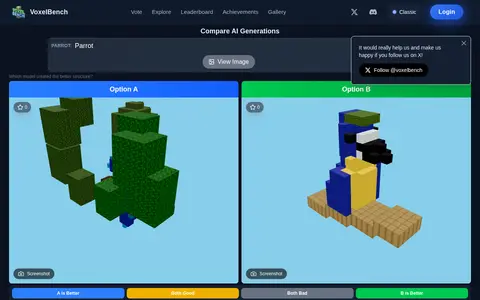
VoxelBench provides machine-learning models, research, training resources, or evaluation tools.
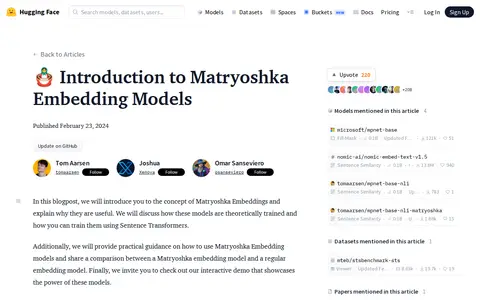
A Hugging Face blog post introducing Matryoshka Embedding models. It explains embeddings as numerical representations and describes how Matryoshka models store more important information in earlier dimensions, allowing large embeddings to be truncated while remaining useful. It covers theoretical training and training with Sentence Transformers, with a comparison to a regular embedding model.
Google Speech Gen helps build, test, automate, or manage AI agents, prompts, models, and API workflows.
Creates, rewrites or summarizes written content with language models.
Creates or edits images with generative models and visual controls.
A simple guide to fine-tuning Llama 2 Brev docs provides machine-learning models, research, training resources, or evaluation tools.
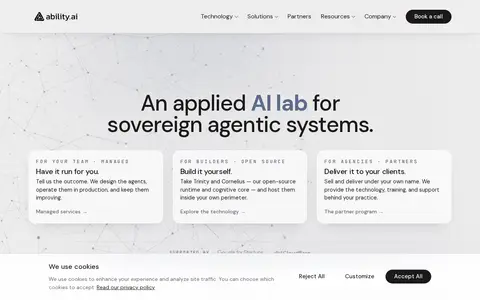
Ability AI provides machine-learning models, research, training resources, or evaluation tools.
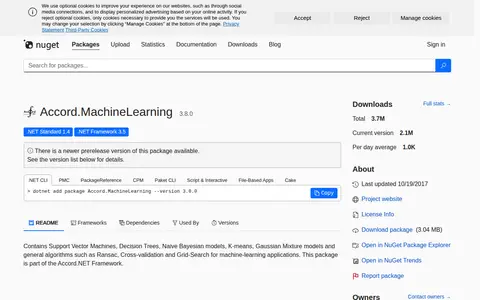
Accord.MachineLearning is a NuGet package, part of the Accord.NET Framework, that contains Support Vector Machines, Decision Trees, Naive Bayesian models, K-means, Gaussian Mixture models, and general algorithms such as Ransac, Cross-validation and Grid-Search for machine-learning applications. Version 3.8.0 targets .NET Standard 1.4 and .NET Framework 3.5.
Adept AI provides machine-learning models, research, training resources, or evaluation tools.
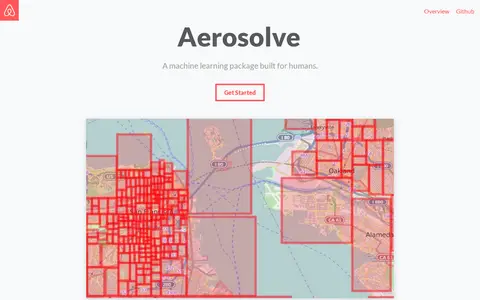
Aerosolve is a machine learning package built on the JVM. It provides features such as geo-based features, controllable quantization and feature interaction, and a feature transform language that gives developers control over features. General additive models are used. Scala handles feature training, with a lightweight Java API for run time inference.
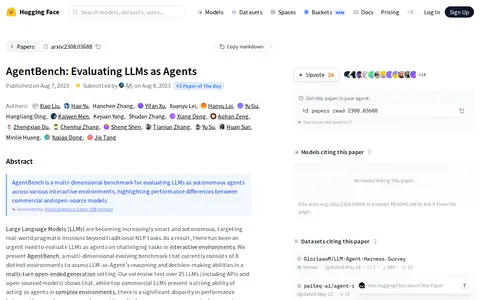
AgentBench is a multi-dimensional benchmark that consists of 8 distinct environments for evaluating LLMs as autonomous agents in interactive tasks. It assesses reasoning and decision-making abilities in multi-turn open-ended generation, and tests over 25 LLMs including APIs and open-source models.
An article by Andy Baio examining how AI companies use datasets and models from academic and nonprofit research groups. It describes Meta's Make-A-Video using Shutterstock clips and YouTube videos collected by Microsoft, and notes nonprofit datasets used for Stable Diffusion and other models. It argues this outsourcing shifts accountability and legal liability away from corporations.
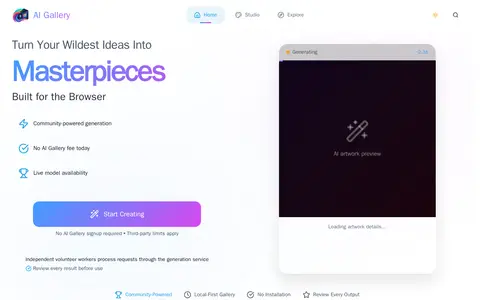
AI Gallery is a tool for creating AI artwork on volunteer GPUs. According to the site, no GPU or installation is required, and the generated gallery stays on the user's device. Help documentation covers queues, models, credits, local storage, backups and generation controls.
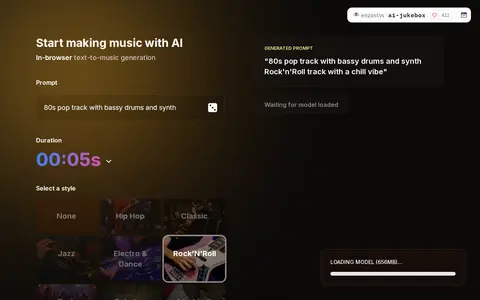
AI Jukebox is a Hugging Face Space that generates AI-powered music. Users can input a description of their desired music, select the clip length and preferred style or mood, and the app produces a matching audio clip directly in the web browser.
Creates, rewrites or summarizes written content with language models.
AI Today provides machine-learning models, research, training resources, or evaluation tools.