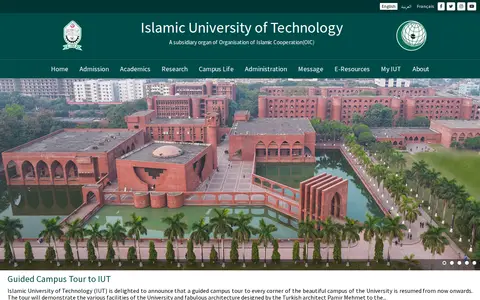

Islamic University of Technology is a subsidiary organ of the Organisation of Islamic Cooperation, based in Bangladesh. It offers academic programs, provides guided campus tours, hosts convocations, and its student teams participate in national and international academic and technical competitions.
Directory
Search results
Published directory entries matching your search.
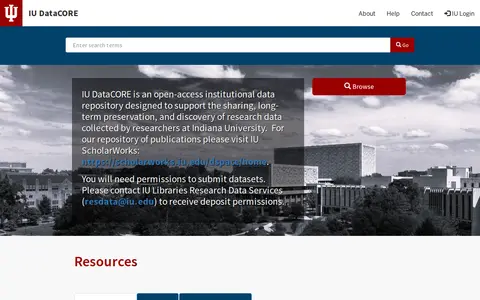
IU DataCORE is an open-access institutional data repository for sharing, long-term preservation and discovery of research data from Indiana University researchers. Submitting datasets requires permissions obtained by contacting IU Libraries Research Data Services.
Japan Advanced Institute of Science and Technology over in Nomi Shi, Japan is legit for Biochemistry, Genetics and Molecular Biology and Energy.
JavaDecompiler provides an online interface for extracting source code from .class and .jar binary files. It presents several Java decompilers, including CFR, JD, Procyon, Fernflower and JAD, with notes on each. The site also links to an APK decompiler and a knowledge base. JAD is listed for historical reasons only.
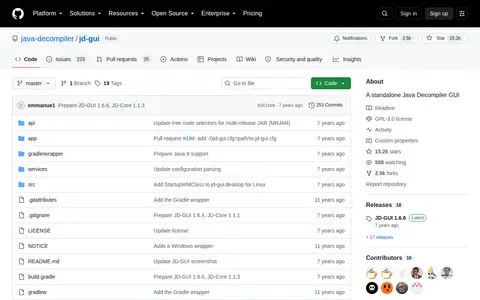
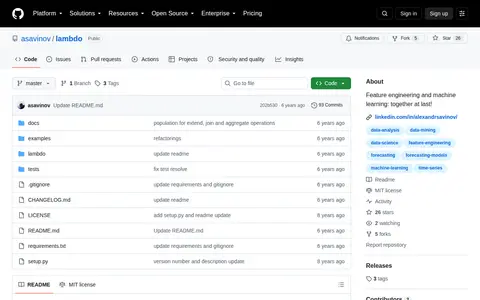
jd-gui is a GitHub repository or organization with source code, releases, documentation, or project resources.
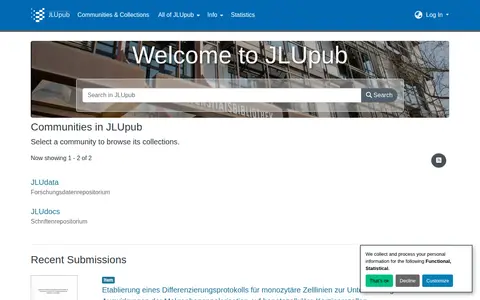
JLUpub is the institutional repository platform of Justus Liebig University Giessen. It hosts two community repositories: JLUdata for research data and JLUdocs for scholarly publications. The platform hosts recent academic submissions, including a 2026 study on bias correction of ERA5-Land air temperature in remote tropical regions using participatory monitoring data.
Jozef Stefan International Postgraduate School in Ljubljana, Slovenia is legit for Environmental Science and Agricultural and Biological Sciences.
Karnataka Open Data Portal is part of India's Open Government Data Platform, serving as a single point of access to open format resources published by Indian government ministries, departments and organizations. It also provides information on open data events, visualizations, blogs and infographics.

Keele University is a higher education institution located in Staffordshire, operating on a 600-acre green campus. It delivers a range of undergraduate, postgraduate and foundation year courses, provides on-site student accommodation, and hosts open days for prospective learners. The university carries out research with regional, national and international impact.
The Khazar University Institutional Repository (KUIR) is a DSpace-based digital repository that captures, distributes and preserves digital research products. It holds articles, working papers, preprints, technical reports, conference papers and data sets in various digital formats. Content is organized around communities and collections, and users can browse by community, title, author, subject or date.
KonDATA is the research data repository of the University of Konstanz, operated by its Communication, Information and Media Center (KIM). It lets researchers publish research data with lasting visibility and citability. Published data receive a Digital Object Identifier, and metadata are transferred via standardized interfaces to RADAR and other meta search engines. The KIM performs formal curation of published data.
Kookmin University is a Korean higher education institution established in 1946. Its site lists 14 colleges, 13,806 enrolled students and 403 exchange partners, and highlights research on AI-based autonomous driving technology.
Korea Advanced Institute of Science and Technology — Daejeon, South Korea — is legit for Pharmacology, Toxicology and Pharmaceutics.
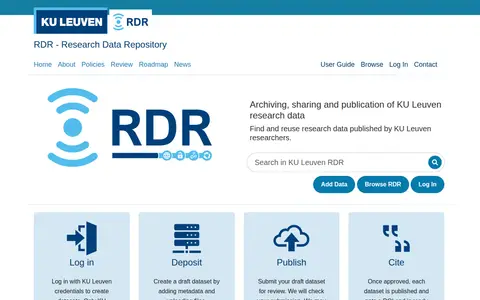
RDR is KU Leuven's Research Data Repository for archiving, sharing and publishing KU Leuven research data. Users can find and reuse datasets published by KU Leuven researchers. Only KU Leuven personnel can create datasets; after review, published datasets receive a DOI and can be cited.
KU ScholarWorks is the institutional repository of the University of Kansas. It contains archived scholarly work by KU faculty, staff and students. Users can browse communities and collections or search by author name, keywords, titles or department names.
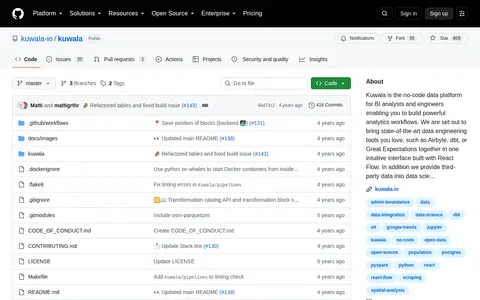
Kuwala is the no-code data platform for BI analysts and engineers enabling you to build powerful analytics workflows. We are set out to bring state-of-the-art data engineering tools you love, such as Airbyte, dbt, or Great Expectations together in one intuitive interface built with React Flow. In addition we provide third-party data into data science models and products with a focus on geospatial data. Currently, the following data connectors are available worldwide: a) High-resolution demograph
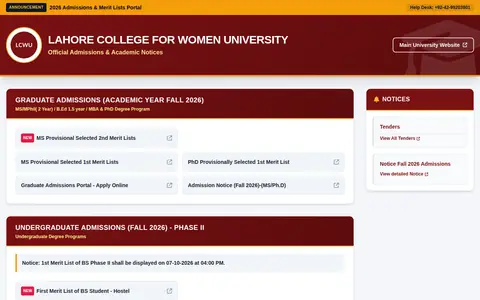
Lahore College for Women University is a university that publishes undergraduate and graduate admissions information, including merit lists and fee challans. Its site lists Fall 2026 admissions for BS, MS/MPhil, B.Ed, MBA and PhD degree programs.
Lambdo is a workflow engine that unifies feature engineering and machine learning operations. In its workflows, nodes can be treated as features or predictions, and both can be trained. It uses column-oriented data processing and provides functions for time-series analysis and forecasting.
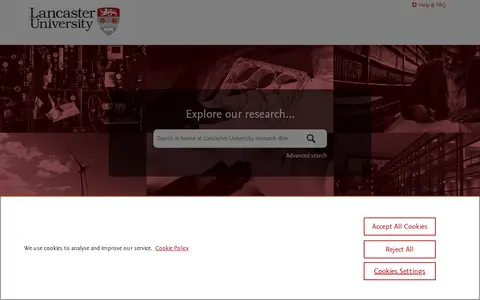
The Lancaster University Research Directory is a public repository of research activity and output from Lancaster University. It hosts records including 4764 researcher profiles, 404 research units, 113781 research outputs, 6051 projects, 1791 datasets, equipment listings, research activities, prizes and impact reports. The directory also displays the university's collaborative research partnerships from the past five years.

LangChain is an open agent engineering platform that enables organizations to own, control, govern, and compound their intelligence. Its LangSmith platform offers tools for autonomous agent improvement, observability, performance evaluation, production deployment, safe code execution sandboxes, LLM call control, and no-code agent creation. The platform also provides open source agent frameworks including deepagents, langgraph, and langchain.
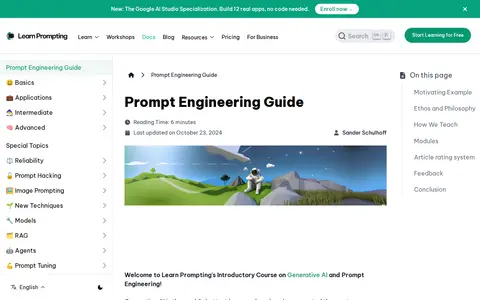
LearnPrompting is a free educational resource focused on generative AI and prompt engineering. It provides a comprehensive guide suitable for both beginners and advanced users, with structured courses, modular learning content, specialized topics including prompt hacking and image prompting, and supplementary resources such as a vocabulary guide and community support.
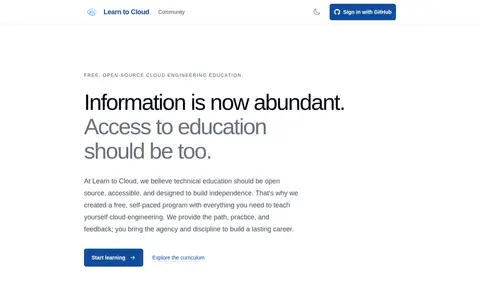
LearnToCloud is a free, open-source, self-paced cloud engineering program. It provides a structured curriculum with resources, practical challenges and clear goals, automated checks and AI-assisted reviews of submitted work, and community support. The curriculum starts with Linux and networking, then builds an AI-powered API that is deployed, automated and secured on a chosen cloud.
The current page for the Leibniz Data Manager displays an Anubis bot verification challenge, a temporary placeholder implemented by the site administrator to prevent aggressive AI scraping of the site. The challenge uses a proof-of-work scheme, and the administrator intends to replace it with more advanced tools to identify headless browsers in the future.
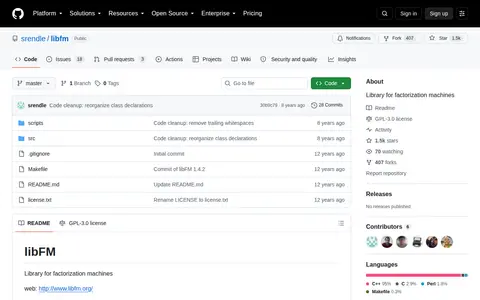
A generic approach that allows to mimic most factorization models by feature engineering.