

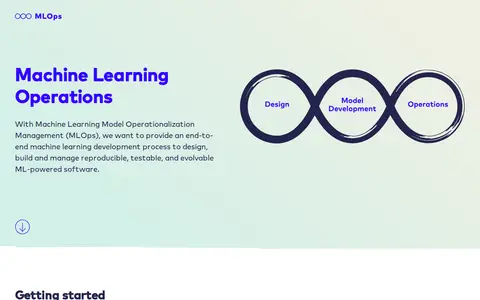
ML-Ops is a site about Machine Learning Operations. It covers motivation for MLOps, designing ML-powered software, the end-to-end ML workflow lifecycle, three levels of ML-based software, MLOps principles, CRISP-ML(Q), the MLOps Stack Canvas and ML model governance. It describes MLOps as aiming to unify the release cycle for machine learning and software.

Lambdo
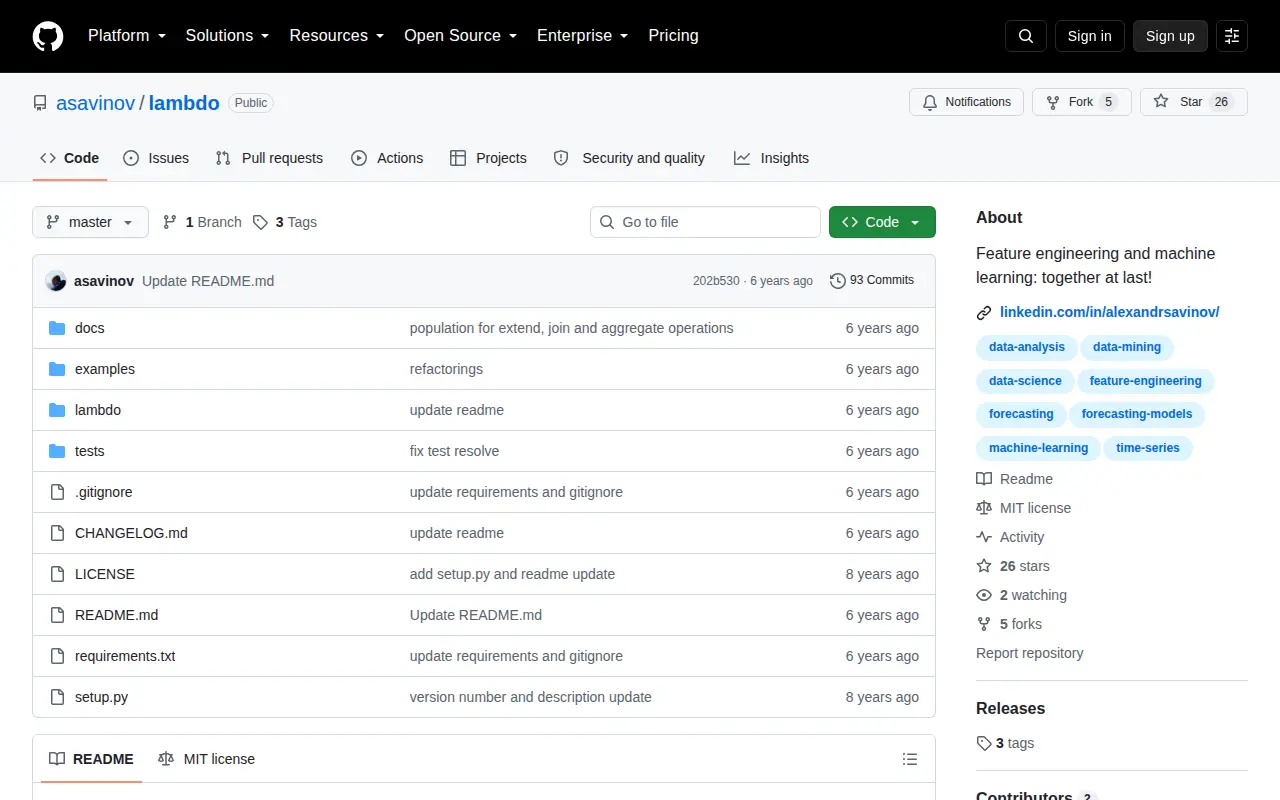
Lambdo is a workflow engine that unifies feature engineering and machine learning operations. In its workflows, nodes can be treated as features or predictions, and both can be trained. It uses column-oriented data processing and provides functions for time-series analysis and forecasting.
Features
- unifying feature engineering and machine learning operations Source: github.com
Links
Tags
-
0ML-Ops is a site about Machine Learning Operations. It covers motivation for MLOps, designing ML-powered software, the end-to-end ML workflow lifecycle, three levels of ML-based software, MLOps principles, CRISP-ML(Q), the MLOps Stack Canvas and ML model governance. It describes MLOps as aiming to unify the release cycle for machine learning and software.

-
0Apache SINGA is an Apache Top Level Project focused on distributed training of deep learning and machine learning models. It supports data parallel training across multiple GPUs on a single node or across different nodes, automatic gradient calculation, and loading and saving ONNX format models. Models trained with SINGA can be queried as stored procedures in an RDBMS.
-
0Charisma.ai is a conversational AI platform for building interactive scenarios for online training and campaigns. It offers realistic conversation simulations and real-time analytics on engagement, with publication to web, VR or game engine experiences through SDKs. Plans include a pay-as-you-go option and an enterprise tier with development options.
-
0Chain of Thought is a podcast hosted by Conor Bronsdon about AI and software infrastructure, featuring conversations with people building AI agents and infrastructure. Guests include people from NVIDIA, Google DeepMind, AMD, Databricks and Vercel. The show has 78 episodes and is available on YouTube, Spotify, Apple Podcasts and RSS.
-
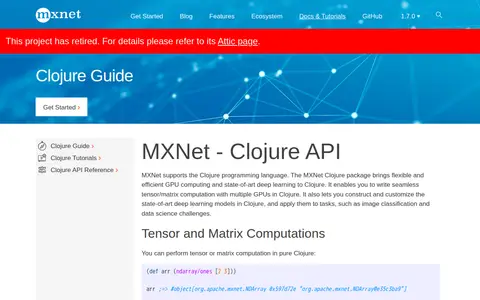
0The MXNet Clojure package brings GPU computing and deep learning to the Clojure programming language. It enables tensor and matrix computation with multiple GPUs in Clojure, and allows constructing and customizing deep learning models for tasks such as image classification and data science challenges.
-
0
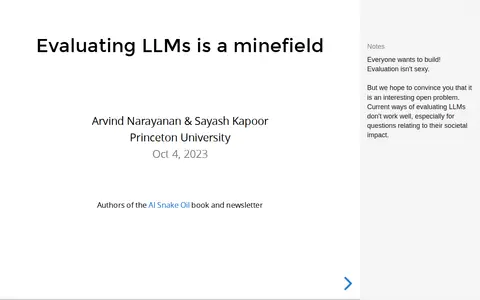
Annotated talk slides by Arvind Narayanan and Sayash Kapoor of Princeton University, dated October 4, 2023, on evaluating large language models. The slides discuss three hard problems in LLM evaluation: prompt sensitivity, construct validity and contamination, and examine questions about ChatGPT's behavior over time and its political bias.
Community notes
Reviews and discussion
No reviews yet
Be the first to share how this project worked for you.
Join the discussion
Sign in with a verified account to leave a review or join the discussion.
Sign in to review