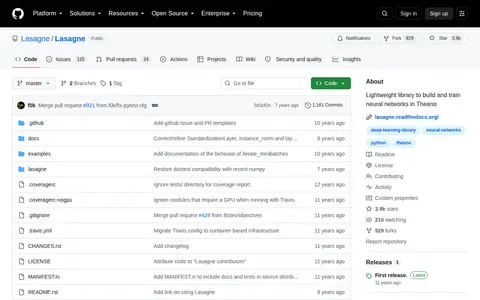

Lasagne is a lightweight library for building and training neural networks in Theano. It supports feed-forward networks such as convolutional neural networks, recurrent networks including LSTM, multiple inputs and outputs, and optimization methods including Nesterov momentum, RMSprop and ADAM. Cost functions are freely definable and gradients derive from Theano's symbolic differentiation.
Directory
Search results
Published directory entries matching your search.
Learn Anything is a GitHub repository or organization with source code, releases, documentation, or project resources.
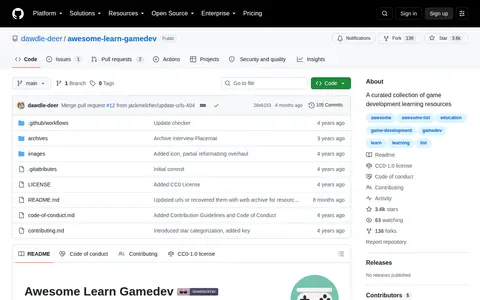
Learn Gamedev is a GitHub repository or organization with source code, releases, documentation, or project resources.
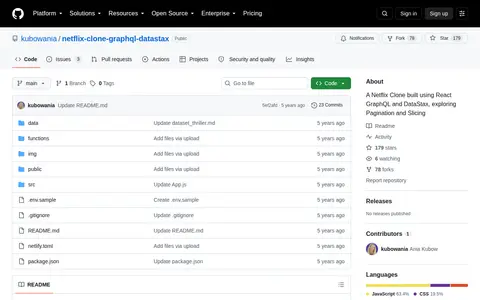
Learn to Make Netflix Clone is a GitHub repository or organization with source code, releases, documentation, or project resources.
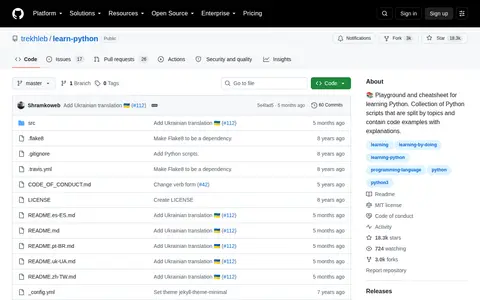
Learn-Python is a GitHub repository or organization with source code, releases, documentation, or project resources.
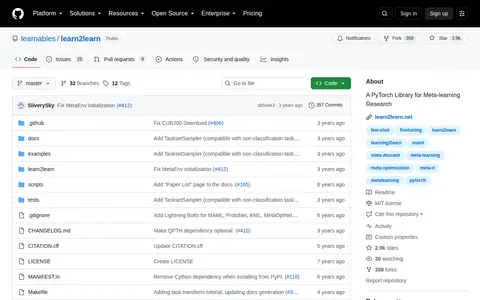
PyTorch Meta-learning Framework for Researchers.
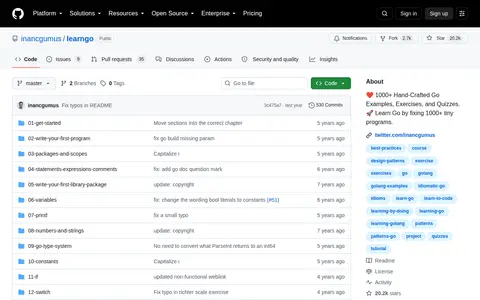
LearnGo is a GitHub repository or organization with source code, releases, documentation, or project resources.
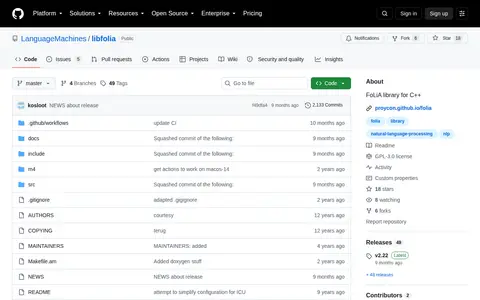
Libfolia is a C++ library for working with the Format for Linguistic Annotation (FoLiA), providing a high-level API to read, manipulate, and create FoLiA documents. It is intended for C++ developers and serves as a dependency for other tools that use FoLiA. The software is distributed under the GNU Public Licence v3.
Lifelines is a complete survival analysis library, written in pure Python.
Lightwood is an AutoML framework that generates and customizes machine learning pipelines using a declarative JSON-AI syntax. It handles data types such as numbers, dates, categories, tags, text, arrays and multimedia formats, and includes a time-series mode. Users can override defaults or replace pipeline steps, and the framework generates Python code for the pipeline.
Linguist Translator is a translation tool hosted on GitHub under the translate-tools/linguist repository. It can translate web pages, highlighted text, Netflix subtitles, and private messages, speak translated text aloud, and save translations to a personal dictionary for offline word learning.
Little Ball of Fur is a graph sampling extension library for Python and a graph sampling extension library for NetworKit and NetworkX. It consists of methods that can sample from graph structured data, covering vertex, edge, and exploration sampling techniques with a unified application public interface.
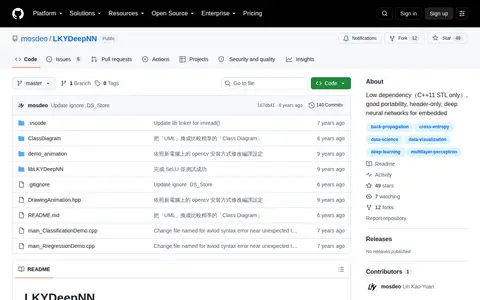
LKYDeepNN is a header-only deep neural network library for embedded systems. It has low dependencies, relying solely on the C++11 standard template library, and offers good portability. The project is hosted as a public repository on GitHub.
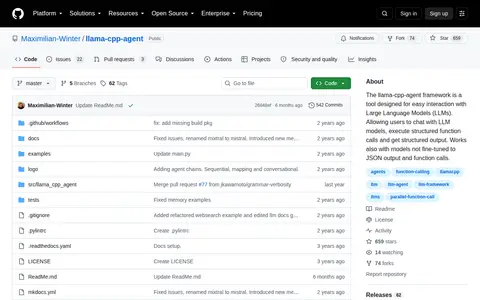
LLama Cpp Agent is a framework designed for easy interaction with large language models (LLMs). It allows users to chat with LLMs, execute structured function calls, and retrieve structured output. It works with models not fine-tuned for JSON output or function calls. The project is hosted as a public repository on GitHub.
Provides a central interface to connect your LLM's with external data.
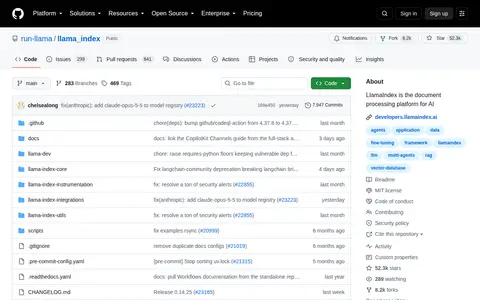
LlamaIndex is an open-source document processing platform built for artificial intelligence applications. It is maintained in a GitHub repository by run-llama, offering tools to handle documents as part of AI workflows.
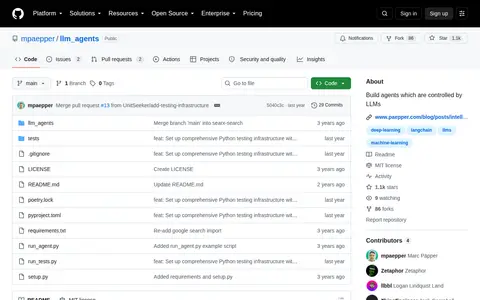
Build agents which are controlled by LLMs.
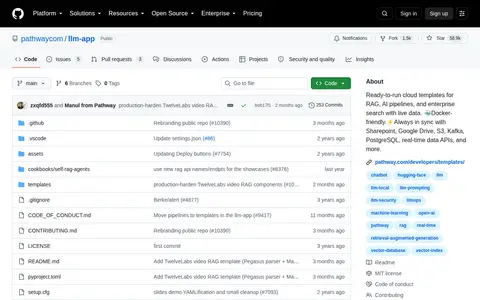
LLM App is an open-source project providing ready-to-run cloud templates for retrieval-augmented generation (RAG), AI pipelines and enterprise search with live data. It is Docker-friendly and designed to stay synchronized with data sources including Sharepoint, Google Drive, S3, Kafka, PostgreSQL and real-time data APIs, hosted by pathwaycom on GitHub.
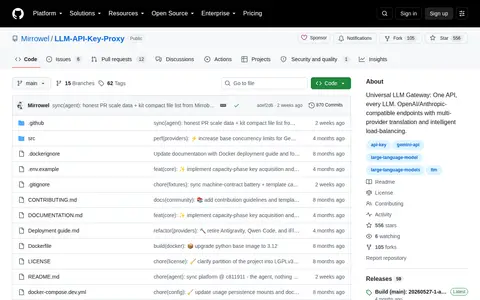
A self-hosted proxy providing OpenAI and Anthropic compatible API endpoints for multiple LLM providers, so existing applications can use any supported provider through a single API key. It includes a FastAPI proxy application and a reusable Python resilience library for API key management, rotation, and failover.
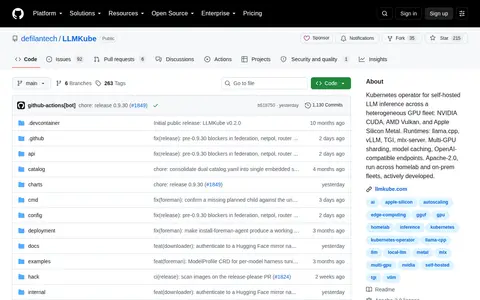
LLMKube is a Kubernetes operator for self-hosted large language model inference across heterogeneous GPU fleets supporting NVIDIA CUDA, AMD Vulkan, and Apple Silicon Metal. It supports runtimes including llama.cpp, vLLM, TGI, and mlx-server, offers multi-GPU sharding, model caching, and OpenAI-compatible endpoints. It is licensed under Apache-2.0 and designed for homelab and on-prem fleet deployment, and is actively developed.
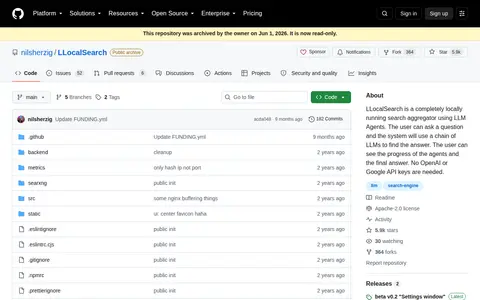
LLocalSearch is a fully locally running search aggregator that uses LLM agents to answer user questions. It uses a chain of LLMs to find answers, displays agent progress and final results, and does not require OpenAI or Google API keys to operate.
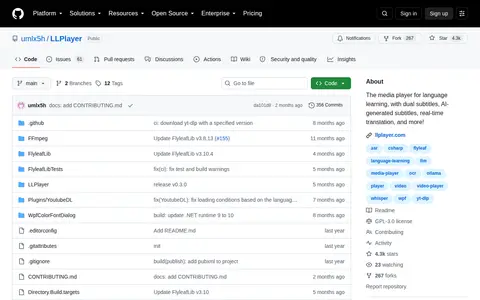
LLPlayer is a GitHub repository or organization with source code, releases, documentation, or project resources.
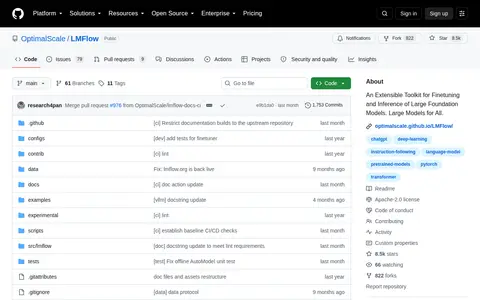
LMFlow is a toolkit for finetuning and inference of large foundation models, presented as extensible, convenient and efficient. It offers support for custom optimizer training, conversation templates, speculative decoding, long context inference with position interpolation for LLaMA models, and Flash Attention-2. The project is released under the Apache-2.0 license and was made available on PyPI.
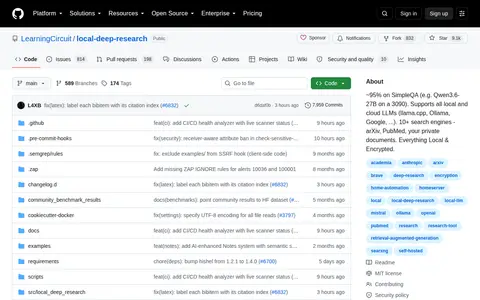
Local Deep Research is a tool that achieves approximately 95% accuracy on the SimpleQA benchmark, with an example run using Qwen3.6-27B on an RTX 3090. It supports all local and cloud LLMs including llama.cpp, Ollama, and Google models, integrates over 10 search engines such as arXiv, PubMed, and private document sources, and operates with local and encrypted processing.