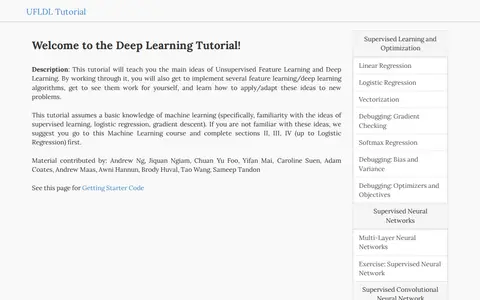
Tutorial teaching the main ideas of unsupervised feature learning and deep learning, with implementation of feature learning and deep learning algorithms. It assumes basic machine learning knowledge, including supervised learning, logistic regression and gradient descent, and suggests completing an earlier machine learning course first.
Directory
Search results
Published directory entries matching your search.
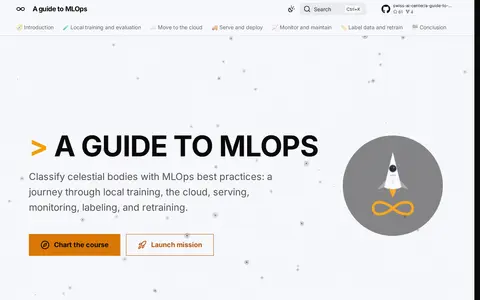
A guide to MLOps is an open-source tutorial from the Swiss AI Center team that walks engineers and small teams from notebook experiments to production. It covers local training and model evaluation, moving the model to the cloud, serving and deploying, monitoring and maintaining, and labeling data and retraining, using tools such as DVC, Git, GitHub Actions, CML, Docker, BentoML, Fluent Bit, Evidently AI, and Label Studio.
Activeloop is the company behind Deeplake, described as a GPU database for agents. Its stack lists three surfaces: Deeplake, a database combining vector and tensor storage with GPU streaming to fine-tuning; Hivemind, which turns agent traces into shared organization memory; and Refinery, a software factory for continuous learning that includes database optimization, kernel generation and physical AI policy optimization.
A genomics processing engine and specialized file format built using Apache Avro, Apache Spark and Parquet. Apache 2 licensed.
Adaptive Reliability Layer is a Python project that sits between an inference pipeline and a monitoring layer. It detects distribution shift, decides whether adaptation is warranted, and learns from delayed revealed labels. It does not replace the model.
AI Expert Roadmap presents a set of charts showing paths and technologies for becoming a data scientist, machine learning or AI expert. An interactive version with links is available online, and the project is published under the MIT license.
AI for Industrial Design shares insights from National University of Singapore students who explored AI's capabilities for design in a semester course directed by Donn Koh at the university's Division of Industrial Design.
A new upcoming pack focused on providing students with the essential AI tools for their education. Currently on a waitlist.
Code for Data Science at Olin College, Spring 2014.
AMIGA, or Analysis of the interstellar Medium in Isolated GAlaxies, is a project focused on multiwavelength study of galaxy evolution, with emphasis on radio astronomical observations. It compares samples of isolated galaxies with matching samples from denser environments such as compact groups. Since 2003 it has combined fundamental science with e-Science research to support reproducible science and access to data and tools.
Andrew Ng’s Machine Learning at Stanford University is a Coursera course titled 'Supervised Machine Learning: Regression and Classification'. It is the first course of the Machine Learning Specialization. The course teaches how to build machine learning models in Python using NumPy and scikit-learn, covering regression and classification. It is aimed at beginners, requires flexible scheduling over three weeks at ten hours per week, and offers a shareable certificate.
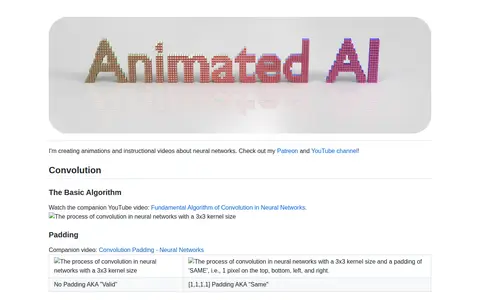
Animated AI is a project of animations and instructional videos about neural networks. Its topics cover convolution basics, padding, stride, grouped and depthwise-separable convolution, and pixel shuffle. It is licensed under the MIT License.
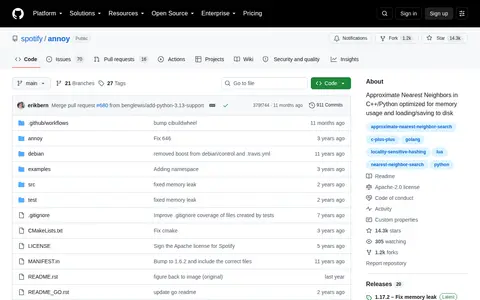
Annoy is a C++ library with Python bindings for approximate nearest neighbor search. It creates large read-only file-based indexes that are mmapped into memory so many processes can share the same data. Supported distances include Euclidean, Manhattan, cosine, Hamming and dot product.

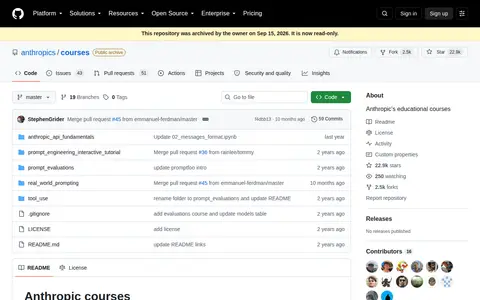
Anthropic's educational courses repository contains five courses covering the Claude SDK, prompt engineering, real world prompting, prompt evaluations and tool use. Suggested order begins with Anthropic API fundamentals. The repository was archived by its owner and is read-only. Courses often favor the lowest-cost model, Claude 3 Haiku, to keep API costs down.
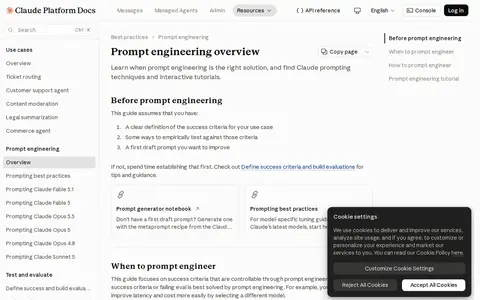
Anthropic Prompt Engineering documentation on the Claude Platform provides an overview of prompt engineering. It explains when prompt engineering is appropriate, presents Claude prompting techniques, and includes interactive tutorials for developers.
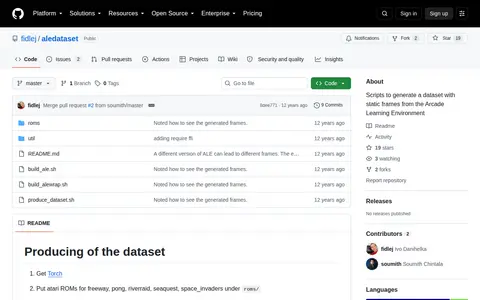
Scripts to generate a dataset with static frames from the Arcade Learning Environment. Instructions cover getting Torch, placing supported Atari ROMs (freeway, pong, riverraid, seaquest, space_invaders), building the environment and Lua wrapper, and producing frames.
Atlantic Technological University is described as a multi-campus technological university in the west and northwest of Ireland. It lists undergraduate and postgraduate courses, online and flexible learning options, apprenticeships, and Springboard+ programmes. The site also covers campuses, research, student support, and global study information.
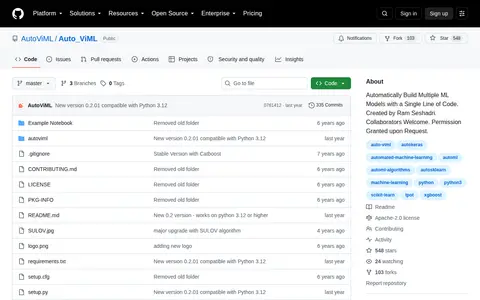
Auto ViML automatically builds multiple machine learning models with a single line of code. It was created by Ram Seshadri, and collaborators are welcome with permission. The tool is available on GitHub.
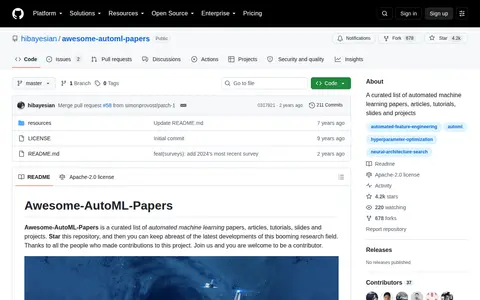
Awesome AutoML Papers is a GitHub-hosted curated list focused on automated machine learning (AutoML). It aggregates academic papers, articles, tutorials, slide decks, and related projects in the AutoML field, serving as a centralized reference for users exploring automated machine learning research and developments.
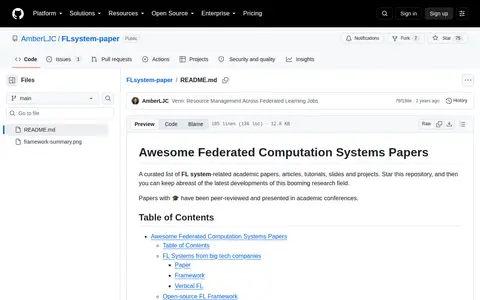
A curated GitHub list of federated learning system papers, articles, tutorials, slides and projects. It groups entries such as systems from big tech companies, vertical FL, open-source frameworks, edge and mobile systems, optimization, security and privacy, applications and surveys. Papers reviewed and presented at academic conferences are marked with a graduation cap symbol.
An AWS program offering students and educators no-cost access to cloud computing skills training developed by AWS experts, plus career pathways for students. It provides a library of free, self-paced online training and hands-on labs covering storage, compute, networking, databases and cloud operations. Learners as young as 13 can register with an email address, and learners 18 and older can access a job board.
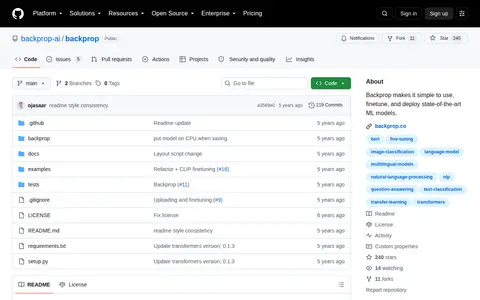
Backprop is a Python library, installable via PyPi, that enables use, finetuning and deployment of machine learning models. It provides task interfaces for conversational question answering, text classification in over 100 languages, image classification, summarisation, emotion detection and text generation, and models can be finetuned with a single line of code.
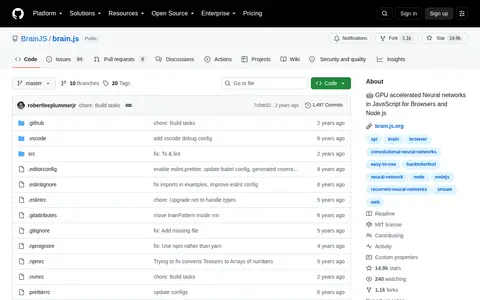
Brain.js is a GitHub-hosted JavaScript library for building and running neural networks. It provides GPU-accelerated neural network functionality compatible with both web browsers and Node.js environments, allowing users to implement machine learning models using JavaScript across different runtime platforms.
British Fiction, 1800–1829 is a database produced in Cardiff University's Centre for Editorial and Intertextual Research, supported by grants from the Arts and Humanities Research Board and Cardiff University. It allows users to examine bibliographical records of 2,272 works of fiction written by approximately 900 authors, along with contemporary materials such as anecdotal records, circulating-library catalogues, newspaper advertisements, reviews and subscription lists. Records can be searched or browsed by author, title or publisher. Access is provided for research, teaching, private study and general interest; prior written permission is required for alteration, redistribution or commercial exploitation.