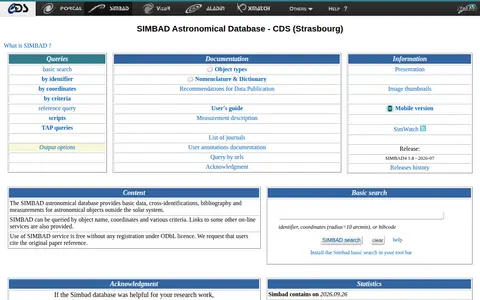
SIMBAD is an astronomical database operated at CDS, Strasbourg, providing basic data, cross-identifications, bibliography and measurements for astronomical objects outside the solar system. It can be queried by object name, coordinates and various criteria. The database is updated every working day, and use is free without registration under the ODbL licence. The CDS team notes that SIMBAD is not a catalogue.
Directory
Search results
Published directory entries matching your search.
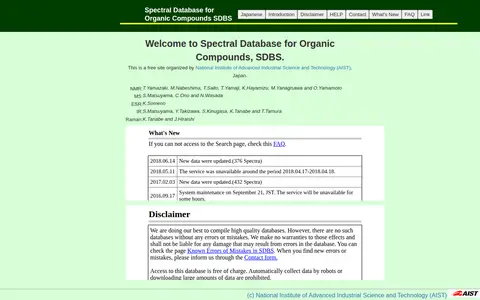
Spectral Database for Organic Compounds (SDBS) is a free public database organized by the National Institute of Advanced Industrial Science and Technology (AIST) in Japan. It hosts spectral data for organic compounds, including nuclear magnetic resonance (NMR), mass spectrometry (MS), electron spin resonance (ESR), infrared (IR), and Raman spectra.
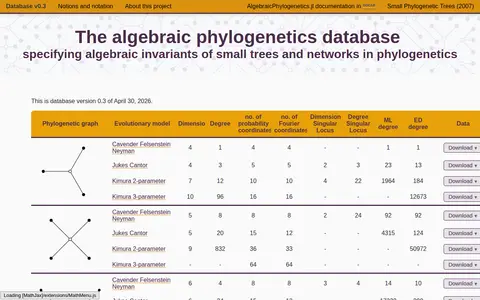
A database of algebraic invariants of small phylogenetic trees and networks. It covers evolutionary models including Cavender-Felsenstein-Neyman, Jukes-Cantor, and Kimura 2- and 3-parameter, with entries for degree, dimension, coordinates, and ML and ED degrees. Downloads are offered as LaTeX, SmallPhylogeneticModel and SmallGroupBasedModel files. The site identifies itself as database version 0.3 of April 30, 2026.
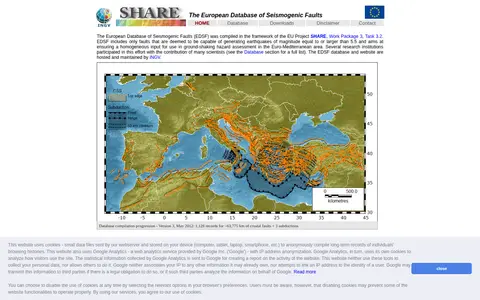
The European Database of Seismogenic Faults was compiled under the EU SHARE project. It includes only faults deemed capable of generating earthquakes of magnitude 5.5 or larger and aims to provide homogeneous input for ground-shaking hazard assessment in the Euro-Mediterranean area. The database and website are hosted and maintained by INGV.
Database with all information on venomous snakes.
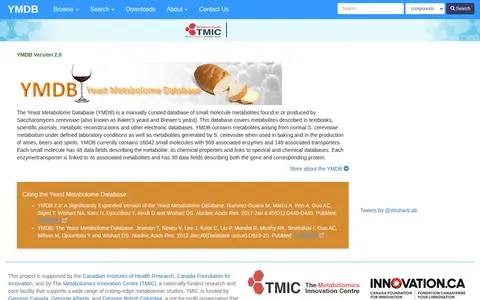
The Yeast Metabolome Database (YMDB) is a manually curated database of small molecule metabolites found in or produced by Saccharomyces cerevisiae (also known as Baker's yeast and Brewer's yeast). It covers metabolites described in textbooks, scientific journals, metabolic reconstructions and other electronic databases, and includes metabolites arising from normal S. cerevisiae metabolism under defined laboratory conditions as well as metabolites generated by S. cerevisiae when used in other contexts.
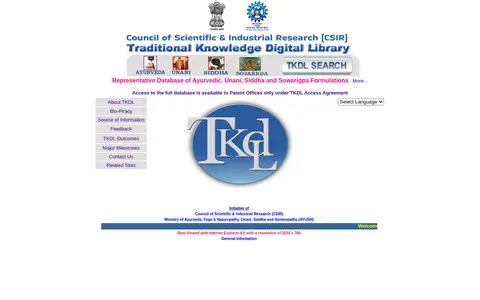
The Traditional Knowledge Digital Library is an initiative of CSIR and the Ministry of AYUSH presenting a representative database of Ayurvedic, Unani, Siddha and Sowarigpa formulations. Full database access is available to patent offices only under a TKDL access agreement.
The CRC1211DB is the project database of the Collaborative Research Centre 1211, funded by the German Research Foundation (DFG). It archives and provides research data created by project participants, including measured or modeled data, reports, presentations, publications and pictures. All data is provided with corresponding metadata, and download access may be restricted depending on the respective rights.
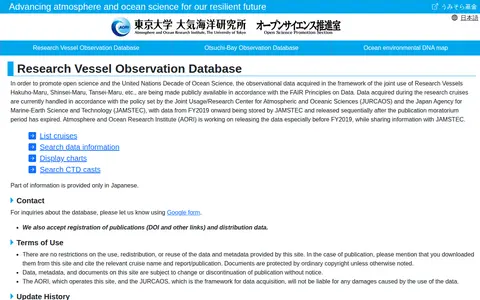
The Research Vessel Observation Database publishes observational data from research vessels including Hakuho-Maru, Shinsei-Maru and Tansei-Maru. Data from FY2019 onward are stored by JAMSTEC and released sequentially after the publication moratorium period expires, while the Atmosphere and Ocean Research Institute works on releasing earlier data. The site offers cruise lists, data searches and CTD cast searches.
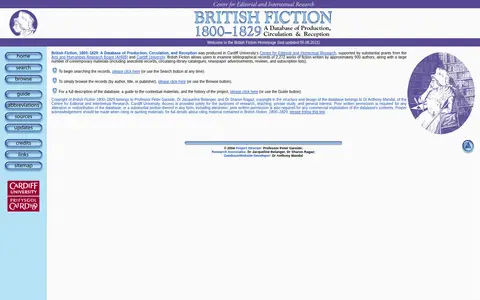
British Fiction, 1800–1829 is a database produced in Cardiff University's Centre for Editorial and Intertextual Research, supported by grants from the Arts and Humanities Research Board and Cardiff University. It allows users to examine bibliographical records of 2,272 works of fiction written by approximately 900 authors, along with contemporary materials such as anecdotal records, circulating-library catalogues, newspaper advertisements, reviews and subscription lists. Records can be searched or browsed by author, title or publisher. Access is provided for research, teaching, private study and general interest; prior written permission is required for alteration, redistribution or commercial exploitation.
The TRR228DB is the project database of the DFG-funded Transregional Collaborative Research Centre 228. It archives and provides research data created by project participants, including measured or modeled data, reports, presentations, publications and pictures, with corresponding metadata. Download access may be restricted depending on the respective rights.
The TR32DB is the project database of the DFG-funded Transregional Collaborative Research Centre 32. It archives and provides research data created by project participants, including measured and modeled data, reports, presentations, publications, and pictures, with corresponding metadata. Download access may be restricted depending on rights.
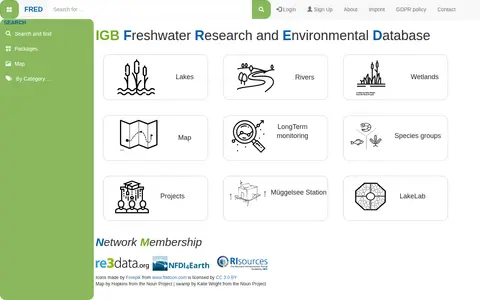
FRED (Freshwater Research and Environmental Database) is a data repository focused on freshwater research. It provides access to datasets related to lakes, rivers, wetlands, long-term monitoring, and species groups. Users can search by categories, view maps of study sites, sampling locations, parameters, and access project information and DOIs.
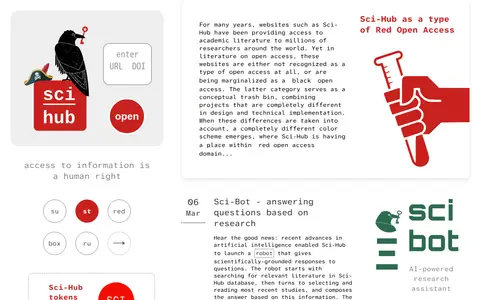
Sci-Hub is a platform that provides access to academic research literature, with a database of over 88 million documents covering most papers published up to 2022 in major academic outlets. It also offers Sci-Bot, a question-answering tool that uses its database to generate cited, scientifically grounded responses to research questions.
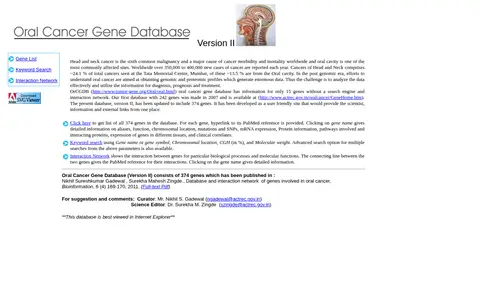
Oral Cancer Gene Database is a research resource focused on oral cancer genomic and proteomic data. It offers access to gene lists, keyword search functionality, and interaction networks to support research into oral cancer diagnosis, prognosis and treatment.
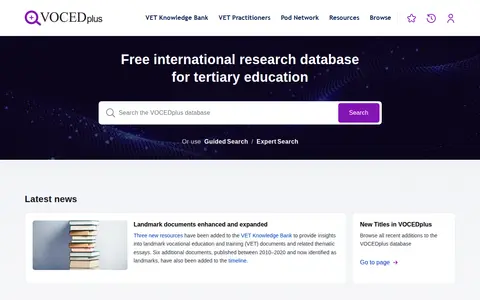
VOCEDplus is described as an international tertiary education and research database. Its homepage offers quick links to a glossary of VET terms, a timeline of VET policy, research topics, special collections, statistical resources and landmark documents about VET in Australia.
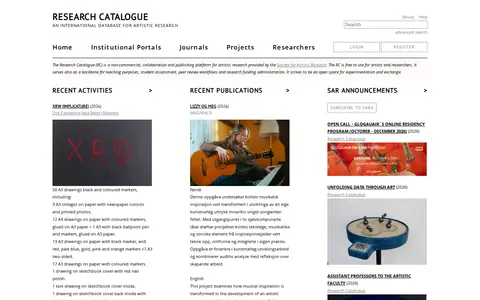
The Research Catalogue is a non-commercial collaboration and publishing platform for artistic research provided by the Society for Artistic Research. It describes itself as an international database for artistic research with institutional portals, journals, projects and researcher listings, and states that it is free to use for artists and researchers.
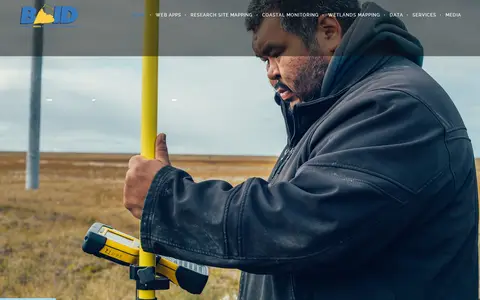
The Barrow Area Information Database (BAID) is a resource for learning about data collection activities in the Barrow area on the North Slope of Alaska. Its team collaborates with scientists and the local community to compile and share information through online web mapping applications. Applications cover historical imagery, coastal erosion, community planning and research sites.
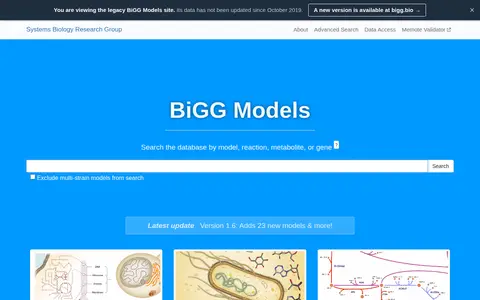
BiGG Models is a knowledgebase of genome-scale metabolic network reconstructions that integrates more than 70 published networks into a single database with standardized BiGG IDs. It can be browsed on the website or accessed using a web API. It is hosted and maintained by the Systems Biology Research Group at the University of California, San Diego.
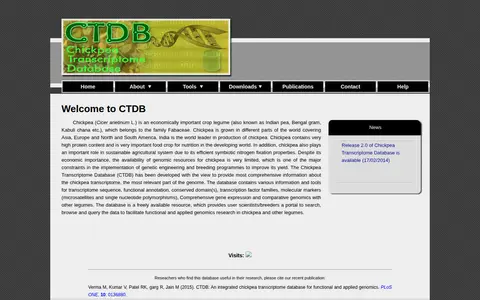
The Chickpea Transcriptome Database (CTDB) is a freely available resource providing information and tools about the chickpea transcriptome, including sequence, functional annotation, conserved domains, transcription factor families, molecular markers and gene expression. It offers a portal to search, browse and query the data to support functional and applied genomics research in chickpea and other legumes.
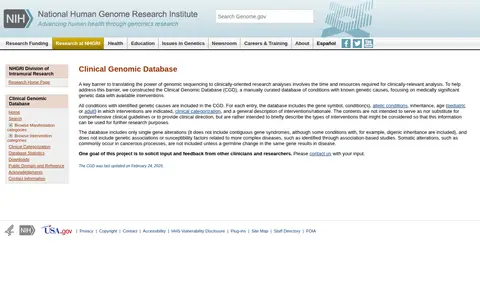
A manually curated database of conditions with known genetic causes, maintained within the NHGRI Division of Intramural Research. It focuses on medically significant genetic data with available interventions and lets users search or browse by manifestation and intervention categories. It offers statistics, downloads and public domain reference information.
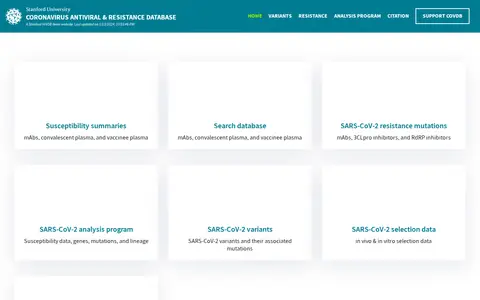
The Stanford Coronavirus Antiviral & Resistance Database (CoVDB) is a curated collection of published data on SARS-CoV-2 variant susceptibility to monoclonal antibodies and plasma from previously infected and vaccinated persons. It also records spike mutations selected by monoclonal antibodies and those emerging in prolonged infections.
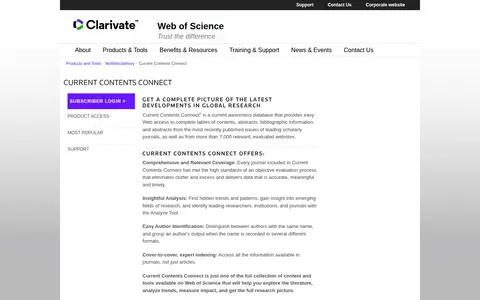
Current Contents Connect is a current awareness database available through Web of Science. It provides web access to complete tables of contents, abstracts and bibliographic information from recent issues of scholarly journals, and also covers more than 7,000 evaluated websites. It includes a subscriber login and an Analyze Tool for examining research trends.
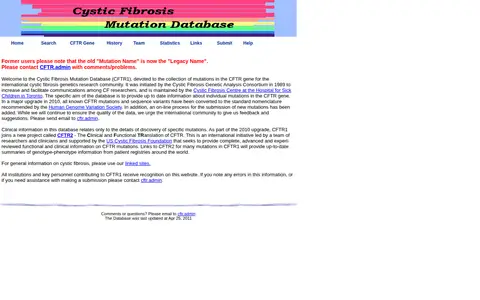
Cystic Fibrosis Mutation Database (CFTR1) collects mutations in the CFTR gene for the international cystic fibrosis genetics research community. It was initiated in 1989 by the Cystic Fibrosis Genetic Analysis Consortium and is maintained by the Cystic Fibrosis Centre at the Hospital for Sick Children in Toronto. Its stated aim is to provide up-to-date information about individual CFTR mutations.