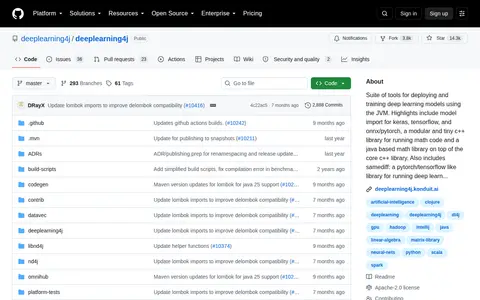

Deeplearning4j is an open-source suite of tools for deploying and training deep learning models using the Java Virtual Machine (JVM). It supports model import from Keras, TensorFlow, and ONNX/PyTorch, includes a modular C++ math library with a corresponding Java library built on top, and offers SameDiff, a library for deep learning operations similar to PyTorch and TensorFlow.
Directory
Search results
Published directory entries matching your search.
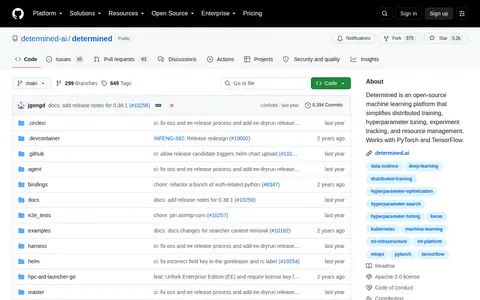
Determined is an open-source machine learning platform that simplifies distributed training, hyperparameter tuning, experiment tracking, and resource management. It works with PyTorch and TensorFlow, offering a Python library, command line interface, and web UI for managing machine learning workflows.
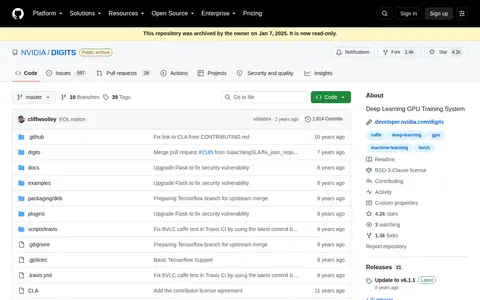
DIGITS, the Deep Learning GPU Training System, is a webapp for training deep learning models. The repository was archived by its owner on Jan 7, 2025 and is now read-only. NVIDIA states it is no longer adding features, fixing bugs, or supporting the software. Users can continue to use it if it meets their needs.
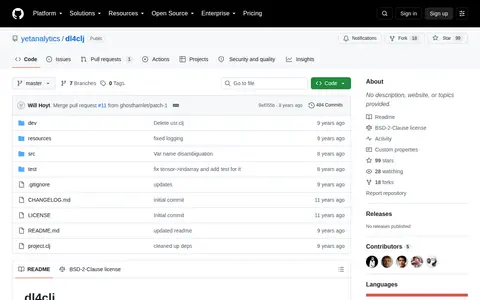
dl4clj is a Clojure port of deeplearning4j. It provides stable features with tests, a neural networks DSL, early stopping, training, transfer learning and evaluation. The project is not yet released to Clojars.
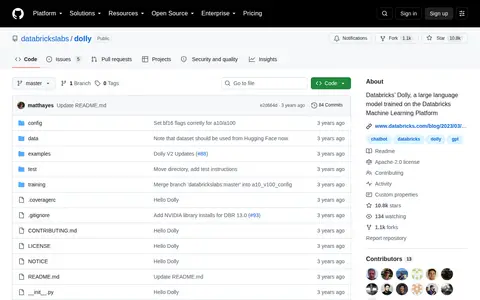
Databricks’ Dolly, a large language model trained on the Databricks Machine Learning Platform.
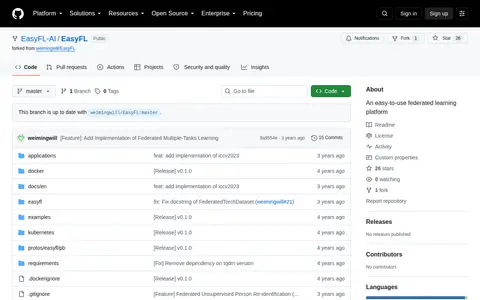
EasyFL is an easy-to-use federated learning platform based on PyTorch. It aims to let users with various levels of expertise experiment and prototype FL applications with little or no coding, and it currently focuses on horizontal FL.
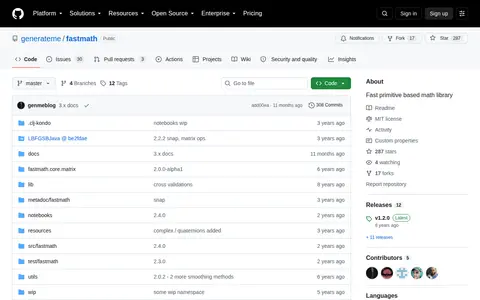
A collection of functions for mathematical and statistical computing, macine learning, etc., wrapping several JVM libraries.
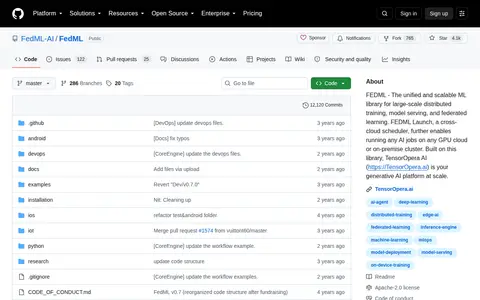
FedML is a unified and scalable open-source machine learning library for large-scale distributed training, model serving, and federated learning. It includes FEDML Launch, a cross-cloud scheduler for running AI workloads on GPU clouds or on-premise clusters, and forms the foundation of the TensorOpera AI generative AI platform.
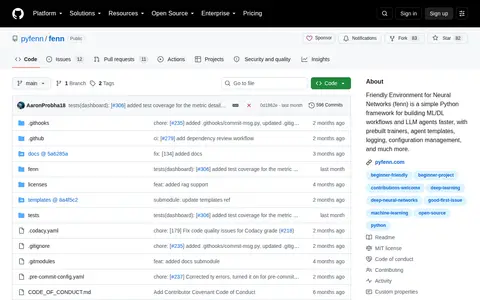
fenn is a Python framework for building machine learning and deep learning workflows and LLM agents. It provides prebuilt trainers, agent templates, logging, and configuration management, with YAML configuration parsed and injected into the entrypoint with CLI override support. It is released under the MIT license.
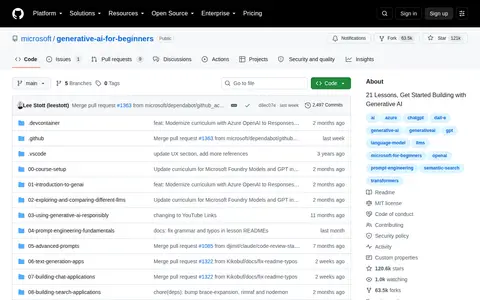
Generative AI For Beginners is a Microsoft-hosted educational resource on GitHub, structured as a 21-lesson course for learning to build generative AI applications. The resource offers multi-language support and is designed for individuals new to generative AI development.
Supports teaching, studying or skills practice with AI-guided learning tools.
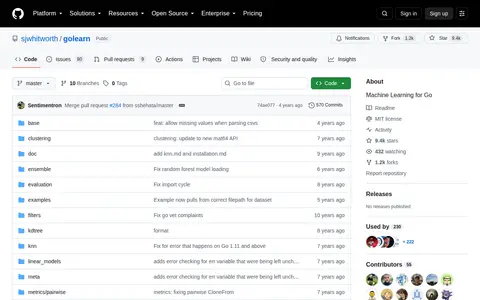
golearn is an open-source GitHub repository maintained by sjwhitworth. It provides machine learning capabilities for the Go programming language. The repository includes installation instructions, getting started guides, example use cases, and full project documentation.
Open-source project that provides AI-assisted learning, courses, tutorials, or study support.
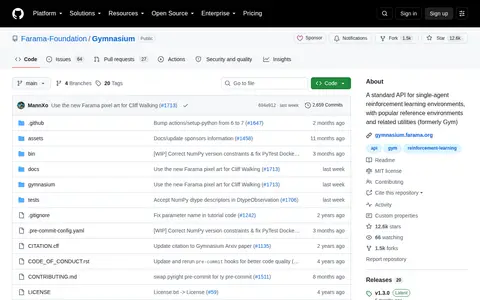
Gymnasium is an open source Python library for developing and comparing reinforcement learning algorithms. It provides a standard API between learning algorithms and environments, plus reference environments including Classic Control, Box2D, Toy Text, MuJoCo and Atari. It is a fork of OpenAI's Gym library maintained by its maintainers.
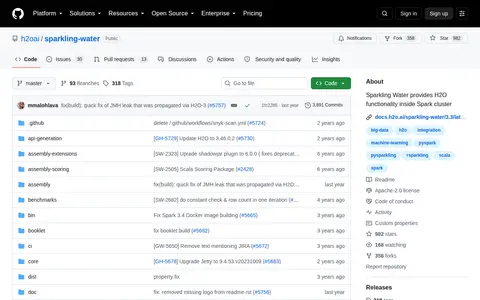
H2O Sparkling Water is an open-source GitHub repository maintained by the h2oai organization. It provides H2O machine learning functionality that can run inside Apache Spark clusters. The repository includes getting started guides, user documentation, binary download options, and resources for testing the tool.
Python examples of popular machine learning algorithms with interactive Jupyter demos and math being explained.
General Machine Learning library using Numenta’s Cortical Learning Algorithm.
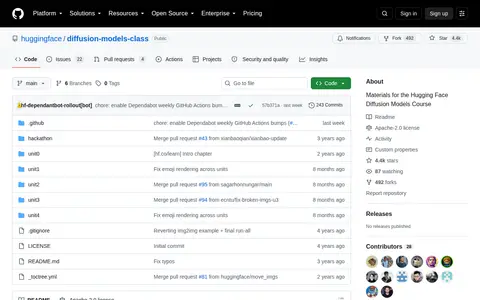
Materials for the Hugging Face Diffusion Models Course, a free course on diffusion models. It covers theory, generating images and audio with Diffusers, training and fine-tuning models, and conditional generation. Prerequisites include Python skills and basics in deep learning and PyTorch.
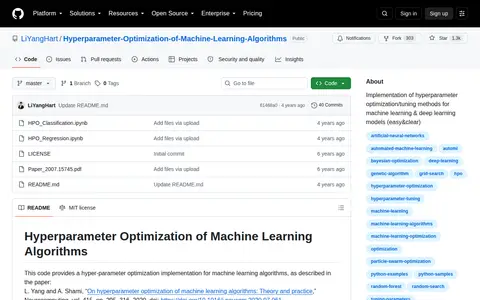
This repository provides a hyperparameter optimization implementation for machine learning algorithms, accompanying a paper on hyperparameter optimization theory and practice. It includes sample code for regression and classification problems using the Boston-Housing and MNIST datasets, covering algorithms such as random forest, SVM, KNN and artificial neural networks.
Open-source project that provides AI-assisted learning, courses, tutorials, or study support.
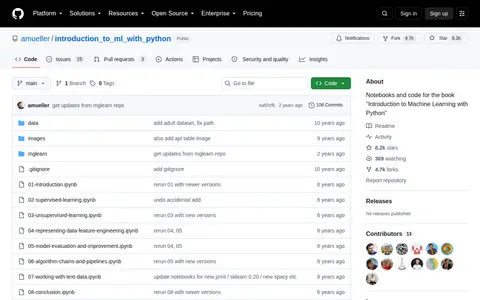
A GitHub repository holding the notebooks and code for the book "Introduction to Machine Learning with Python" by Andreas Mueller and Sarah Guido, together with the mglearn library of helper functions for figures and datasets. The book requires scikit-learn 0.20.0, and the code also needs numpy, scipy, matplotlib, pandas and pillow.

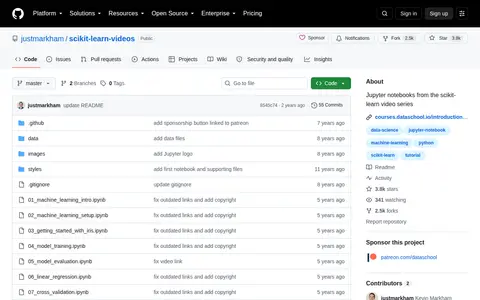
IPython notebooks from Data School's video tutorials on scikit-learn.
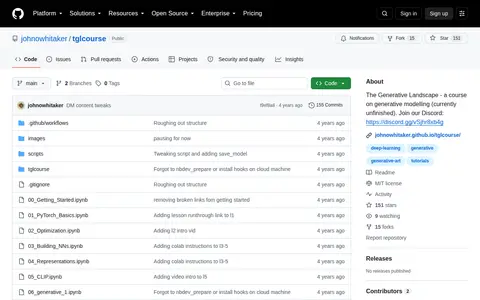
A course on generative modelling, currently unfinished, with the first approximately five lessons mostly done. It covers topics such as PyTorch basics, representations, CLIP, GANs, sequence modelling and transformers. No prior deep learning knowledge is assumed, though comfort with some Python and Jupyter Notebooks is expected.
Supports teaching, studying or skills practice with AI-guided learning tools.