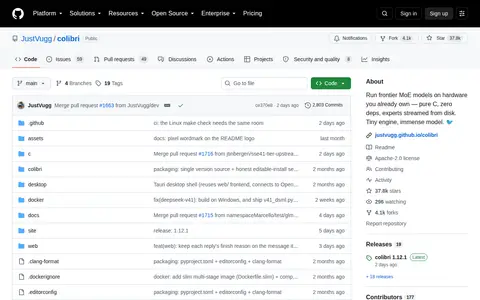

A lightweight tool designed to run frontier mixture of experts (MoE) models on existing user-owned hardware. It is built with pure C programming language, has zero external dependencies, and streams model experts directly from disk, described as a tiny engine capable of running immense models.
Directory
Search results
Published directory entries matching your search.
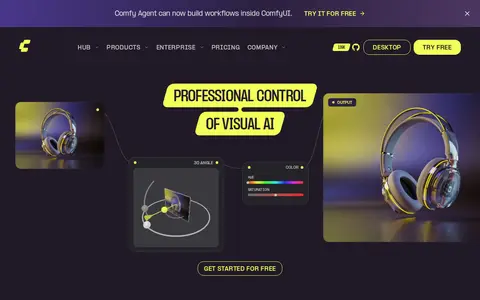
Comfy is a visual AI creation engine built around ComfyUI, a node-based canvas for connecting models, processing steps and outputs. A Comfy Agent can plan, build and run workflows from a description. Workflows can be deployed as a production API, and Comfy Cloud offers pre-loaded models and pre-installed custom nodes. Desktop and enterprise options are also presented.
Context Arena provides machine-learning models, research, training resources, or evaluation tools.
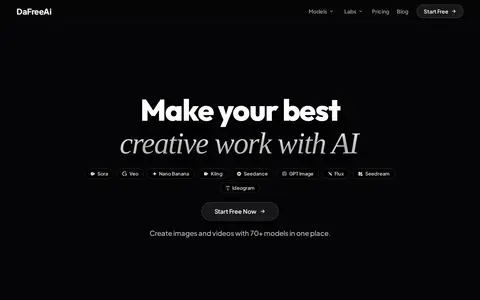
DaFreeAi is a platform for creating images and videos with a choice of AI models, listing over 70 models. It offers a Free Plan and paid membership tiers with monthly credit allowances and parallel generations. Payment and account notices appear on its plans page alongside credit package options.
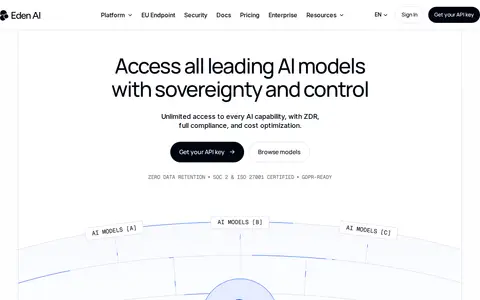
Eden AI offers a unified API for accessing large language models and specialist AI models, including OCR, speech, translation and vision. It standardizes requests, responses, authentication, billing and monitoring across providers, and supports routing requests by cost, performance and region.
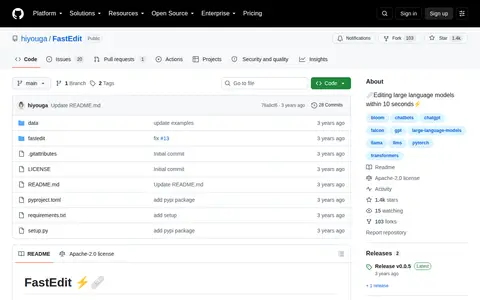
FastEdit is a repository intended to help developers inject fresh and customized knowledge into large language models using one command. It supports models including GPT-J, LLaMA, LLaMA-2, BLOOM, Falcon, Baichuan, and InternLM. The implemented algorithm is Rank-One Model Editing (ROME). It requires Python 3.8+ and PyTorch 1.13.1+.
Fcoijmefliggikpeofhojmkpoooocifk provides machine-learning models, research, training resources, or evaluation tools.
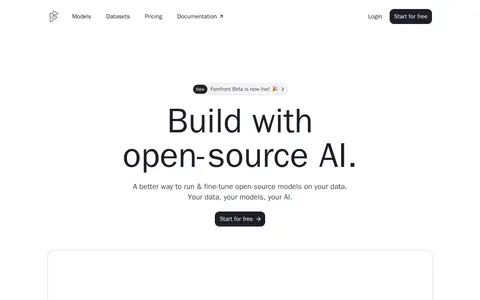
Forefront is described as a platform to fine-tune and inference open-source language models. The site mentions building with open-source AI, fine-tuning models on data, and running inference through serverless API endpoints. It also describes storing training, validation and evaluation data in ready-to-fine-tune datasets. Pricing lists a free tier and a team plan at $99 per month, each including $20 in free credits.

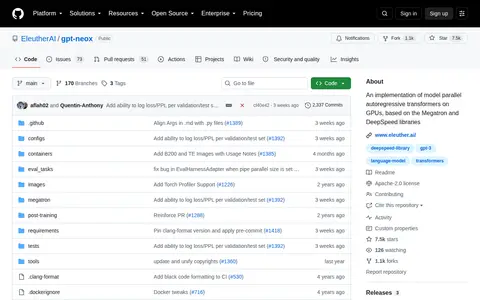
GPT-NeoX is EleutherAI's library for training large-scale language models on GPUs. It builds on NVIDIA's Megatron and adds DeepSpeed techniques plus optimizations. It supports launching via Slurm, MPI and the IBM Job Step Manager, and offers predefined configurations for architectures including Pythia, PaLM, Falcon and LLaMA 1 & 2. The repository states it is likely the wrong library for those not training models with billions of parameters from scratch.
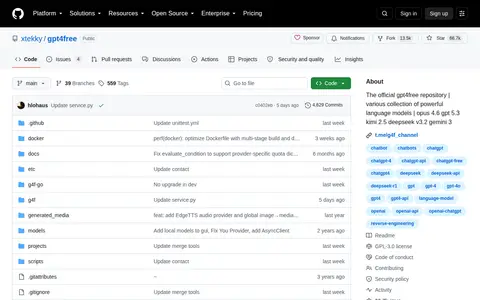
The official GPT4Free repository, a collection of various powerful language models hosted on GitHub. The repository includes access to models such as opus 4.6, gpt 5.3, kimi 2.5, deepseek v3.2, and gemini 3, and accepts community contributions.
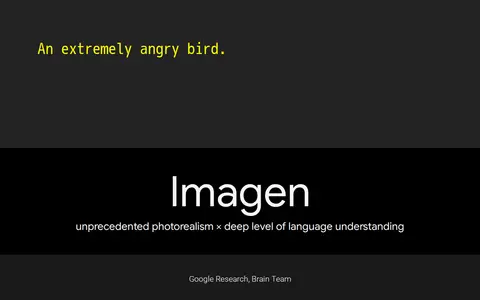
Imagen is a text-to-image diffusion model from Google Research's Brain Team that creates photorealistic images from input text. It builds on large transformer language models for text understanding and cascaded diffusion models for image generation. The project also introduced DrawBench, a benchmark for comparing text-to-image models.
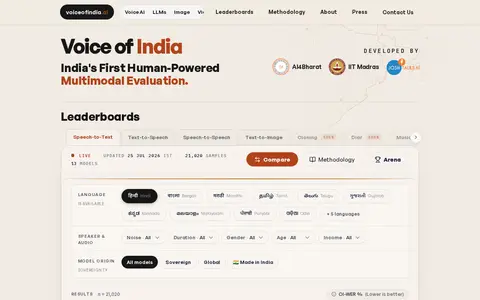
Indic LLM Arena provides machine-learning models, research, training resources, or evaluation tools.
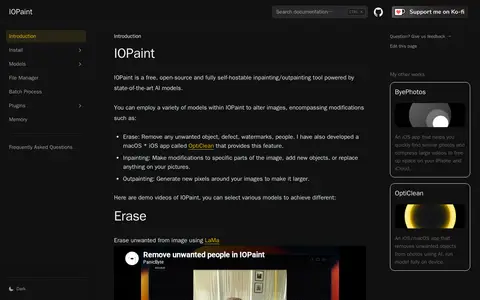
IOPaint is a free, open-source and fully self-hostable image inpainting and outpainting tool powered by AI models. It can erase unwanted objects, add or replace elements in images, generate text, and generate new pixels around images to enlarge them, with various models available for different tasks.

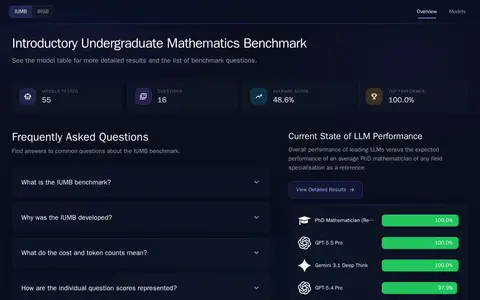
IUMB supports machine learning models, deployment, inspection, datasets, or AI development workflows.
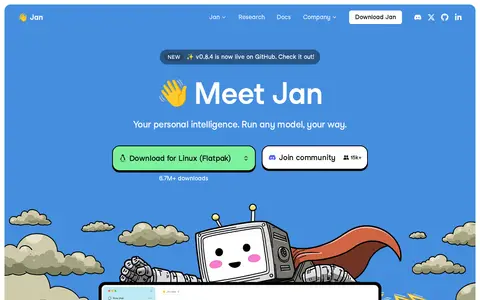
Jan is an open-source alternative to ChatGPT. It runs open-source AI models locally or connects to cloud models such as GPT and Claude. The download is offered for Mac. A memory feature is listed as coming soon.
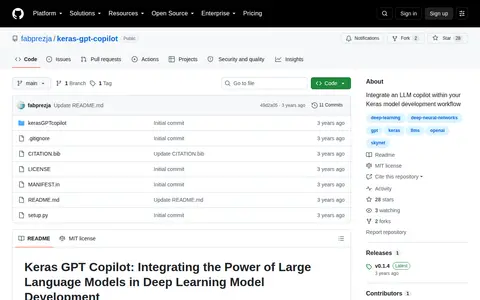
Keras GPT Copilot is a Python package that integrates an LLM copilot within the Keras model development workflow, generating feedback from model configuration, optimizer details and experiment results. It interacts with OpenAI's GPT models and offers a prompt-only mode for compatibility with other large language models.
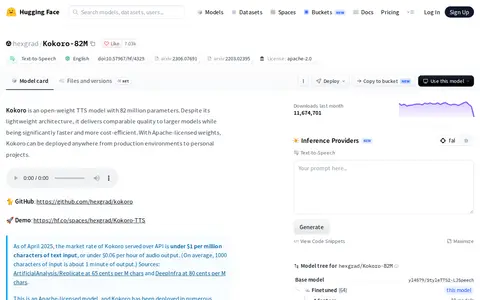
Kokoro-82M is an open-weight text-to-speech model with 82 million parameters, released under the Apache 2.0 license. It delivers audio quality comparable to larger TTS models while being faster and more cost-efficient, and its weights can be deployed in both production and personal environments.
Limits provides machine-learning models, research, training resources, or evaluation tools.

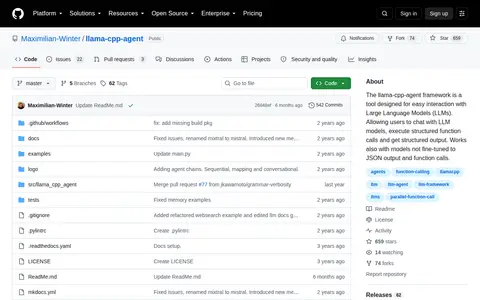
LLama Cpp Agent is a framework designed for easy interaction with large language models (LLMs). It allows users to chat with LLMs, execute structured function calls, and retrieve structured output. It works with models not fine-tuned for JSON output or function calls. The project is hosted as a public repository on GitHub.

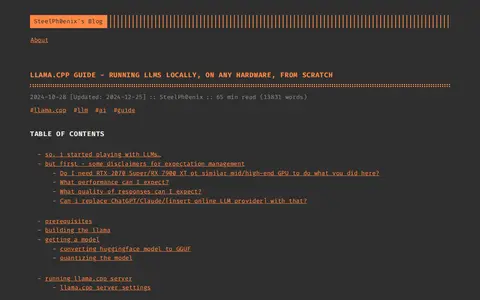
llama.cpp guide is a blog post on SteelPh0enix's blog that explains how to run large language models (LLMs) locally on any hardware using llama.cpp. Published on 2024-10-28 and updated on 2024-12-25, the guide covers building llama.cpp, obtaining and quantizing models, running the server, configuring settings, and hardware requirements.
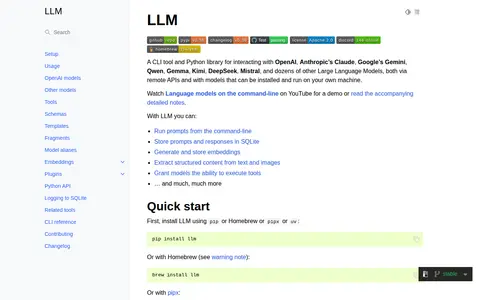
LLM provides machine-learning models, research, training resources, or evaluation tools.
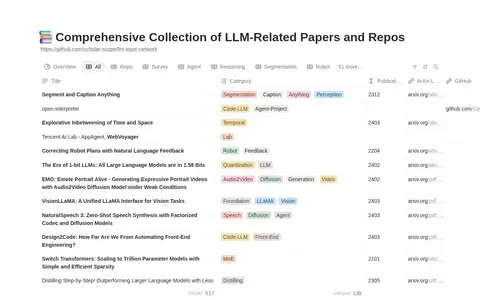
LLM Papers provides machine-learning models, research, training resources, or evaluation tools.
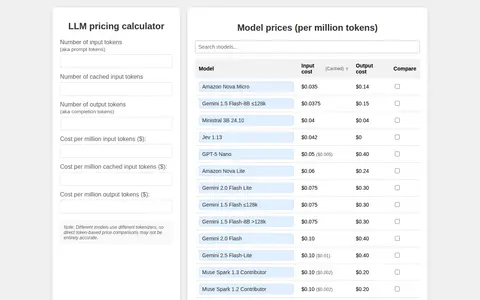
LLM pricing calculator is a web page for estimating model costs per million tokens. It takes input, cached input and output token counts and reports cost per million input tokens, per million cached input tokens and per million output tokens. It notes that direct token-based price comparisons may not be entirely accurate because different models use different tokenizers.
LLM Resources Hub provides machine-learning models, research, training resources, or evaluation tools.