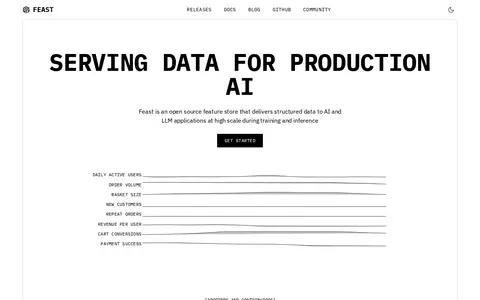
Feast is an end-to-end open source feature store for machine learning. It allows teams to define, manage, discover, and serve features, delivering structured data to AI and LLM applications during training and inference. Documented use cases include real-time recommendations, fraud detection, risk scoring, and customer segmentation.
Directory
Search results
Published directory entries matching your search.
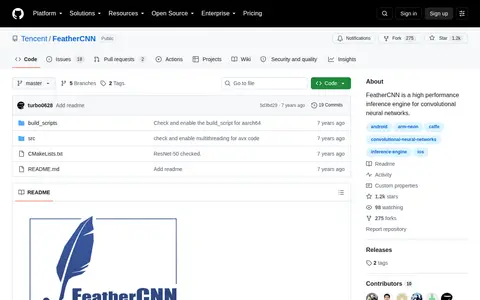
FeatherCNN is a lightweight CNN inference library developed by Tencent AI Platform Department, originating from a game AI project for King of Glory. It targets ARM CPUs and is developed for mobile phones, embedded devices and ARM-based servers. It accepts Caffe models, which are converted into a single binary model.
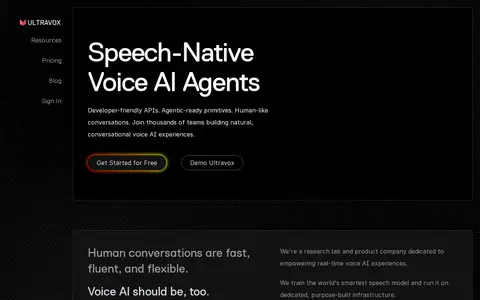
Ultravox is a real-time voice AI infrastructure layer for building voice agents. It trains a speech-native model and manages its own inference and infrastructure stack. The site offers developer-friendly APIs and agentic-ready primitives intended for natural, conversational voice agents. Ultravox has been acquired by Inworld. Pricing lists pay-as-you-go at $0 per month with the first 30 minutes free and $0.05 per minute after that.
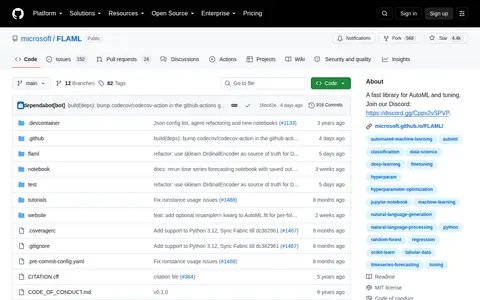
FLAML is a lightweight Python library from Microsoft for automating machine learning and AI operations. It performs model selection and hyperparameter optimization under resource constraints, including tuning foundation model inference hyperparameters. It requires Python 3.10 or later, is installable via pip, and can be used as a scikit-learn style estimator.
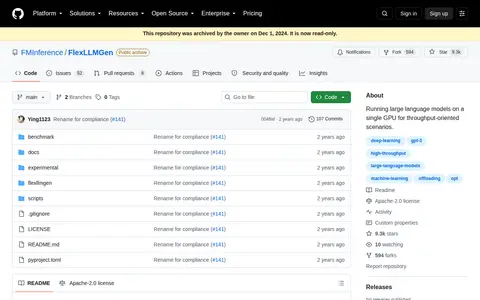
FlexGen is a software project that enables running large language models on a single GPU. It focuses on throughput-oriented scenarios, offering an approach to efficient inference. The project is available on GitHub as FMInference/FlexLLMGen.

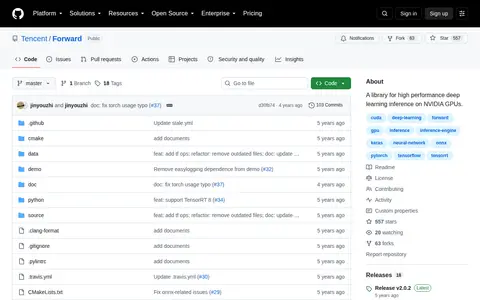
Library for high performance deep learning inference on NVIDIA GPUs.
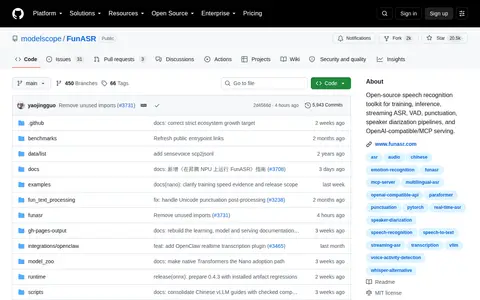
FunASR is an open-source speech recognition toolkit for training, inference, streaming ASR, VAD, punctuation and speaker diarization pipelines, with OpenAI-compatible and MCP serving. An industrial toolkit described for offline, streaming and edge deployment, it also covers emotion and audio-event models and keyword spotting. It is released under an MIT license.
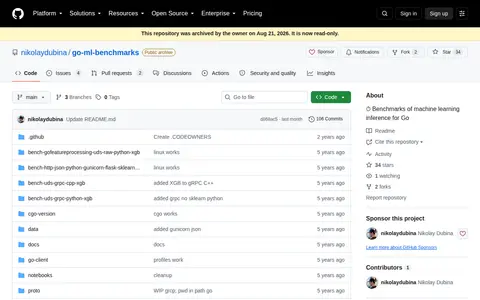
go-ml-benchmarks is a repository of machine learning inference benchmarks for Go, focused on tabular models such as XGBoost. It compares typical implementations using different transports, encodings, preprocessing libraries and models, using the Titanic dataset. The repository was archived by the owner and is now read-only.
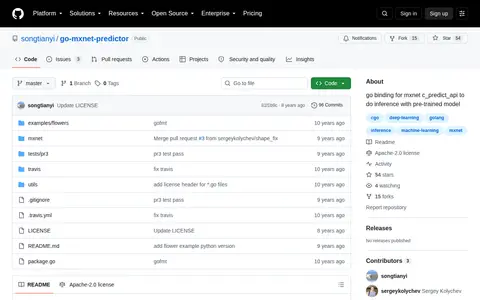
Go binding for MXNet c predict api to do inference with a pre-trained model.
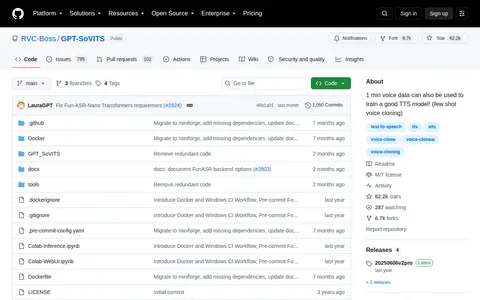
GPT-SoVITS is a few-shot voice conversion and text-to-speech WebUI. It supports zero-shot TTS from a five-second vocal sample and fine-tuning with one minute of training data. Cross-lingual inference covers English, Japanese, Korean, Cantonese and Chinese. Integrated WebUI tools include voice accompaniment separation, training set segmentation, Chinese ASR and text labeling.
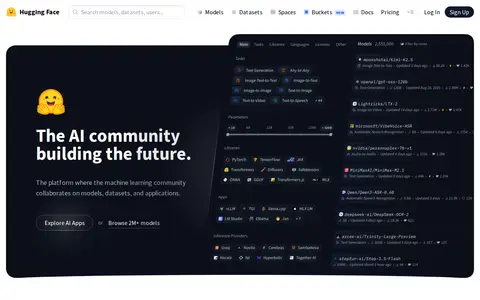
A collaboration platform where the machine learning community shares models, datasets and applications. It hosts public models, datasets and Spaces, and offers an open source stack including libraries such as Transformers, Datasets and Accelerate. It also provides paid Compute and Enterprise solutions, with an Inference Providers API giving access to models from multiple AI providers.
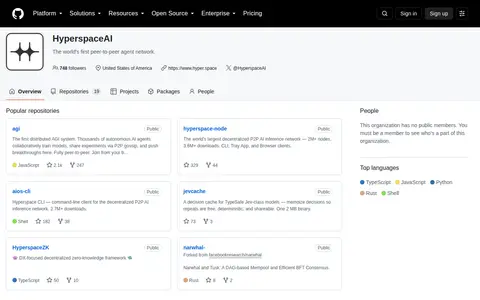
HyperspaceAI describes itself as a peer-to-peer agent network with 19 public repositories on GitHub. Among the repositories is the AGI project, which describes thousands of autonomous AI agents that train models in collaboration and share experiments via P2P gossip. Another repository, hyperspace-node, is described as a decentralized P2P AI inference network with CLI, Tray App and Browser clients.
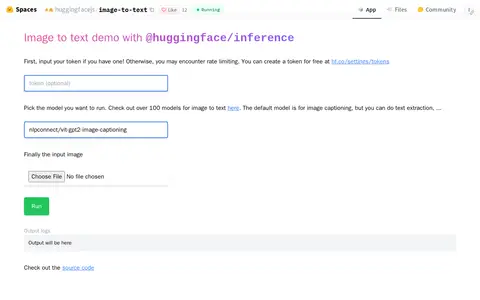
Showcase streaming text generation using the @huggingface/inference JS lib.
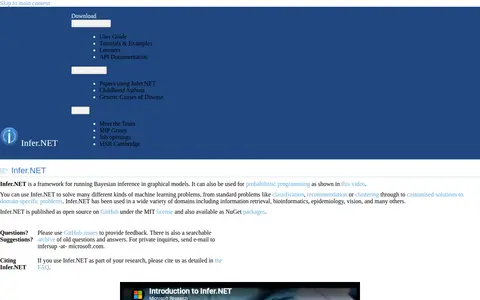
Infer.NET is a framework for running Bayesian inference in graphical models. It can be used for machine learning problems such as classification, recommendation or clustering, and for probabilistic programming. It is published as open source on GitHub under the MIT license and available as NuGet packages.
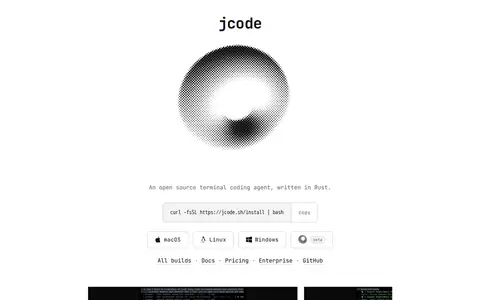
jcode is an open-source terminal coding agent written in Rust. It supports agent swarms, background tasks, and a small RAM footprint, and is installed with one command on macOS, Linux, or Windows. Login flows connect subscription and API model providers, and the agent itself is free while hosted inference plans are available.
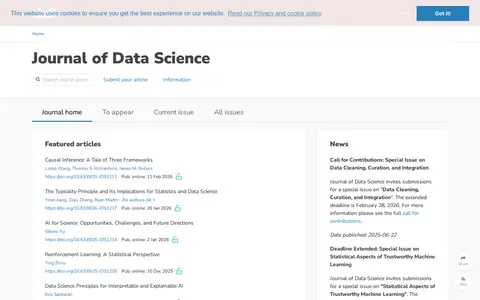
The Journal of Data Science is an academic journal listing featured articles, news, and calls for contributions. Featured articles include items on causal inference, reinforcement learning, and AI for science, each with a DOI and online publication date. The page also lists special issue calls for contributions and most-read articles.
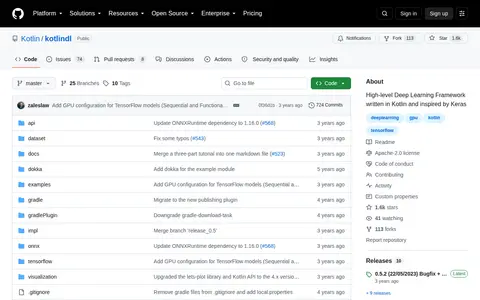
KotlinDL is a high-level deep learning API written in Kotlin and inspired by Keras. It uses TensorFlow Java API and ONNX Runtime API for Java, and offers APIs for training models from scratch, importing Keras and ONNX models for inference, and transfer learning.
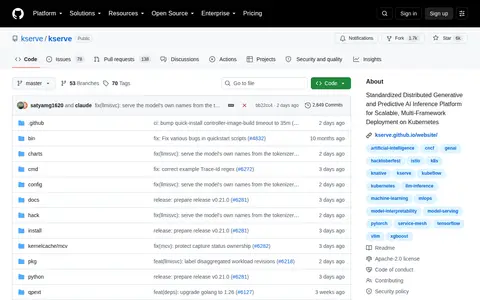
KServe is a standardized distributed generative and predictive AI inference platform for scalable, multi-framework deployment on Kubernetes. It is a Cloud Native Computing Foundation incubating project. The platform supports backends such as vLLM and llm-d for serving LLMs, and multi-framework predictive serving. Standalone installation on standard Kubernetes is described as more lightweight but without canary deployment or request-based autoscaling with scale-to-zero.
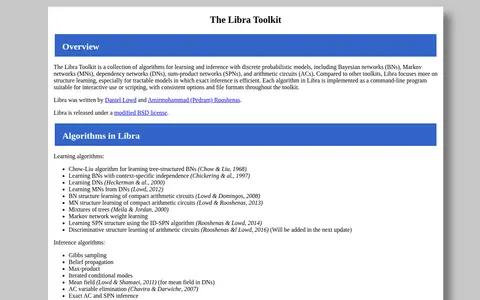
The Libra Toolkit is a collection of algorithms for learning and inference with discrete probabilistic models, including Bayesian networks, Markov networks, dependency networks, sum-product networks and arithmetic circuits. Each algorithm is implemented as a command-line program with consistent options and file formats, and all methods are written in OCaml.
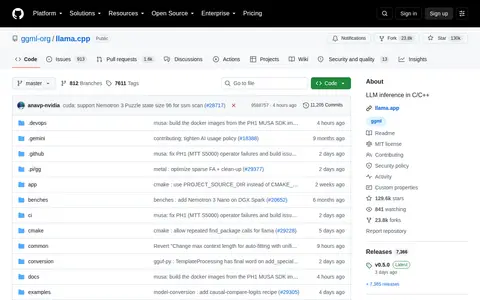
llama.cpp is a C/C++ implementation for large language model and vision language model inference with minimal setup across a range of hardware, locally and in the cloud. It is built on the ggml library and offers command-line and server tools, an OpenAI-compatible API server, and multiple hardware backends.
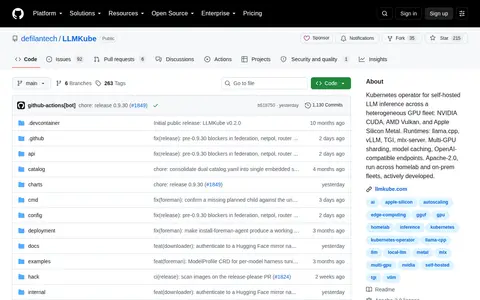
LLMKube is a Kubernetes operator for self-hosted large language model inference across heterogeneous GPU fleets supporting NVIDIA CUDA, AMD Vulkan, and Apple Silicon Metal. It supports runtimes including llama.cpp, vLLM, TGI, and mlx-server, offers multi-GPU sharding, model caching, and OpenAI-compatible endpoints. It is licensed under Apache-2.0 and designed for homelab and on-prem fleet deployment, and is actively developed.
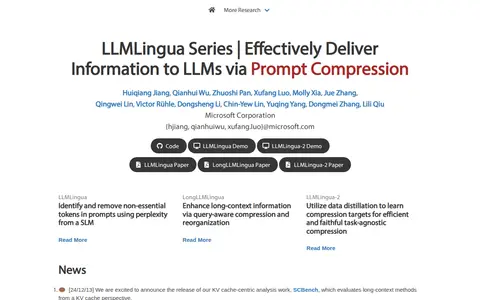
LLMLingua is a Microsoft-developed series of prompt compression tools for large language models, designed to accelerate LLM inference by shortening input prompts. The series includes LLMLingua, LongLLMLingua, LLMLingua-2, and SeCom, each using distinct compression techniques. It supports use cases such as retrieval-augmented generation and online meeting processing, and is integrated with the LangChain and LlamaIndex frameworks.
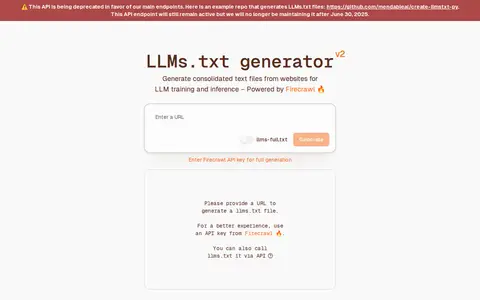
A tool that generates consolidated llms.txt text files from websites for LLM training and inference, powered by Firecrawl. The site states the API is being deprecated in favor of the main endpoints and will no longer be maintained after June 30, 2025, though the endpoint remains active.
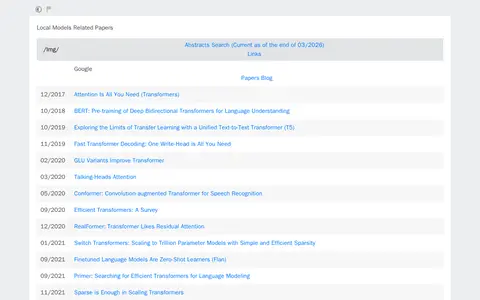
A directory of abstracts and links to academic papers focused on local language models, current as of the end of March 2026. The listing compiles research published between 2017 and 2023, including foundational works such as Attention Is All You Need, BERT, T5, and PaLM, alongside studies on efficient transformer inference, multimodal models, and instruction tuning.