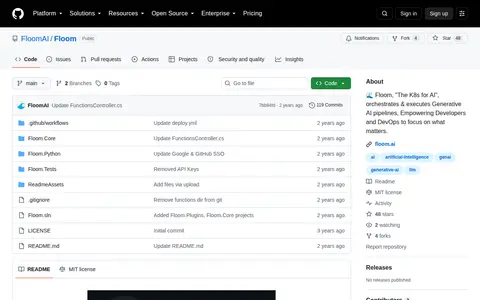

Floom is an open-source orchestration and execution tool for Generative AI pipelines, described as "The K8s for AI" and aimed at Developers and DevOps. Its repository is MIT licensed and the README states that Floom is now open-source and free for everyone, including commercial use.
Directory
Search results
Published directory entries matching your search.
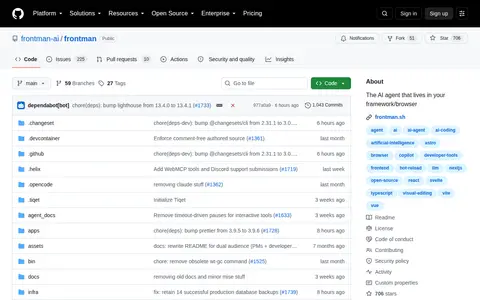
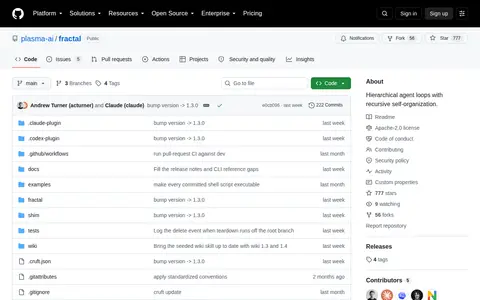
fractal is a tool for hierarchical agent loops with recursive self-organization, in which autonomous agent loops arrange themselves into a tree of git worktrees and spawn child nodes for separable subtasks. Hard caps on iterations, depth, children, cost and time bound each loop, and run metadata, including cost, is stored in a local SQLite database. Nodes run their agents without permission prompts by default.
Open-source project that supports software development with code generation, analysis, debugging, or documentation.
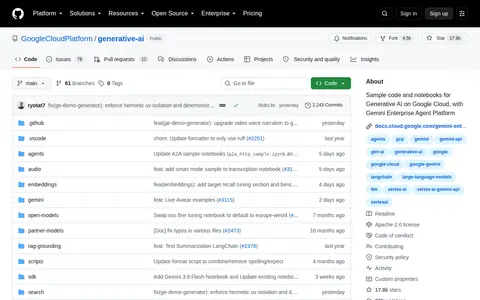
Sample code and notebooks for Generative AI on Google Cloud.
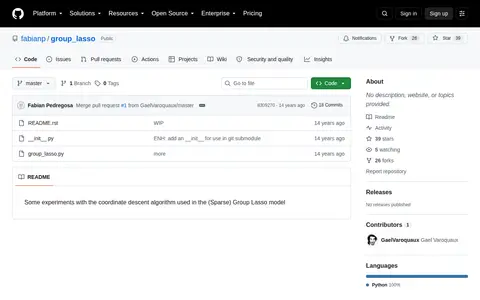
Some experiments with the coordinate descent algorithm used in the (Sparse) Group Lasso model.
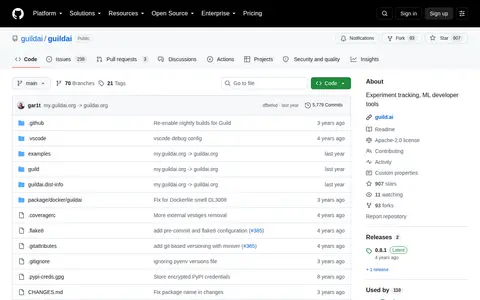
Guild AI is the source repository for an open source toolkit that automates and optimizes machine learning experiments. It runs unmodified training scripts, captures each run result as a unique experiment, and automates trials using grid search, random search and Bayesian optimization.
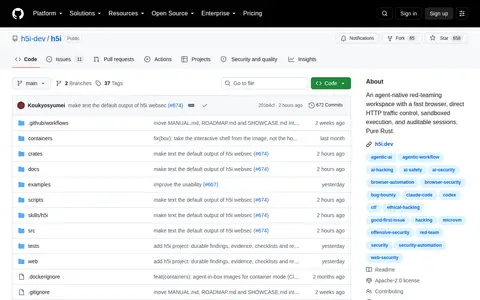
h5i is a workspace for securing web applications through two approaches: finding vulnerabilities with AI agents and proving correctness with formal verification. It provides AI agents a toolkit for browser automation, HTTP traffic manipulation and reconnaissance, and includes h5i-app, an Axum-based Rust framework for verification with Lean 4.
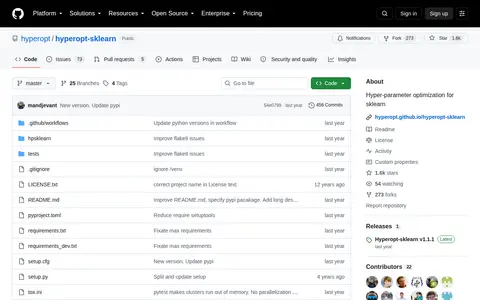
hyperopt (hyperopt-sklearn) is an open-source project that provides hyper-parameter optimization functionality for the scikit-learn (sklearn) machine learning library. It is hosted as a public repository on GitHub for collaborative development.
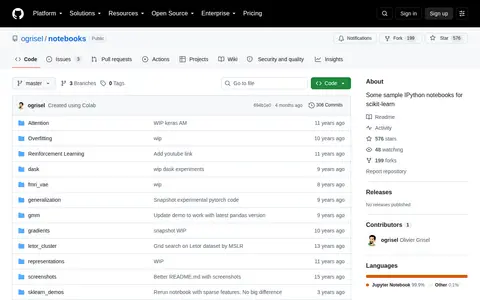
The ipython-notebooks repository, hosted on GitHub under the user ogrisel, contains sample IPython notebooks for use with the scikit-learn machine learning library. It is an open-source project that accepts contributions from GitHub users.
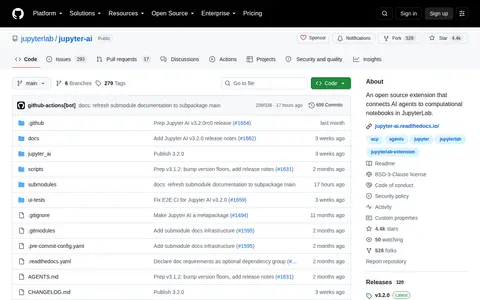
Jupyter AI is an open source extension that connects AI agents to computational notebooks in JupyterLab. It provides a native chat UI and integrates agents through the Agent Client Protocol, with a permission system requiring approval before files are written or commands executed. It is under incubation in the JupyterLab organization.
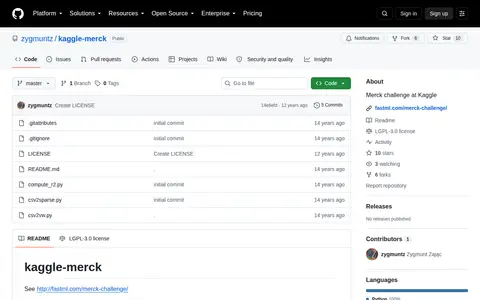
The Kaggle Merck repository, hosted on GitHub under the user zygmuntz, contains code for the Merck challenge hosted on the Kaggle data science platform. It is an open-source project that accepts contributions via GitHub.
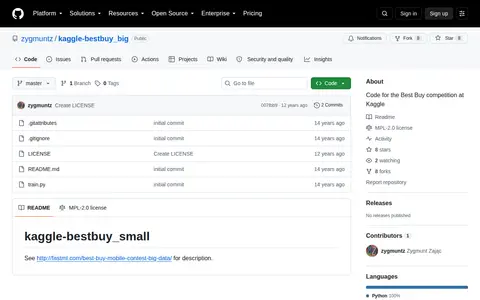
The kaggle-bestbuy big repository, hosted on GitHub under the user zygmuntz, contains code for the Best Buy competition hosted on the Kaggle data science platform. It is an open-source project that accepts contributions from GitHub users.
Open-source project that supports software development with code generation, analysis, debugging, or documentation.
LeanCTX is an open-source context gateway that sits between AI tools and the information they read. It selects task-relevant context, applies supported access and content controls, and records observable context operations and evidence. The engine can run locally through CLI, MCP, hooks and proxy paths, and an SDK embeds supported engine capabilities in applications.

Lightwood is an AutoML framework that generates and customizes machine learning pipelines using a declarative JSON-AI syntax. It handles data types such as numbers, dates, categories, tags, text, arrays and multimedia formats, and includes a time-series mode. Users can override defaults or replace pipeline steps, and the framework generates Python code for the pipeline.
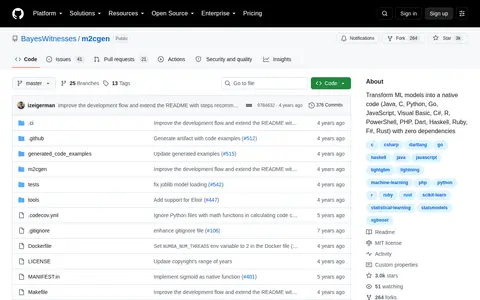
m2cgen is a tool that transforms trained machine learning models into native code across a wide range of programming languages including Java, C, Python, Go, JavaScript, C#, R, PHP, Dart, Haskell, Ruby, F#, and Rust, with zero dependencies. Its codebase is hosted in the BayesWitnesses GitHub repository, which includes navigation for installation, development guidance, supported languages, and supported model types.
Open-source project that supports software development with code generation, analysis, debugging, or documentation.
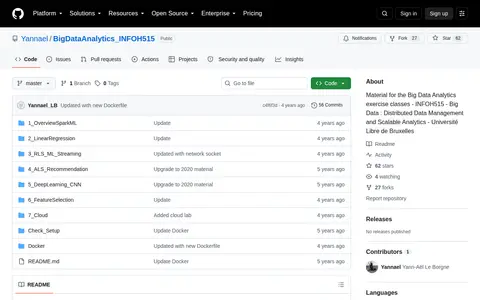
A repository of material for the exercise classes of a Big Data Analytics master course. Hands-on sessions cover Spark and its machine learning library, Map/Reduce implementations of linear regression and alternating least squares, streaming analytics with Recursive Least Squares, and image classification with convolutional neural networks. Material is provided as Jupyter notebooks.
Open-source project that supports software development with code generation, analysis, debugging, or documentation.
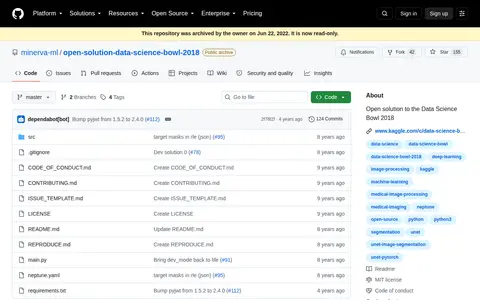
An open solution to the Data Science Bowl 2018, based on the topcoders winning solution from ods.ai. The repository was archived by the owner on Jun 22, 2022 and is now read-only. It uses PyTorch and references neptune.ml, though running it as a plain Python script is possible.
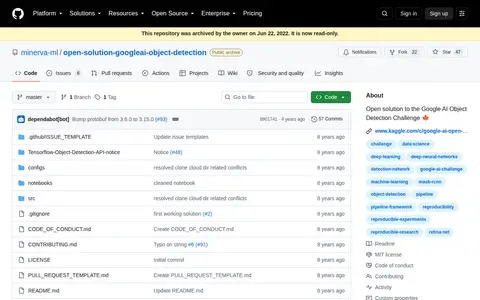
An archived, read-only GitHub repository holding an open solution to the Google AI Open Images Object Detection Track. It offers starter code, configs and notebooks, with RetinaNet training and references to the Neptune experiment platform; Neptune use is optional and the code can run as a plain Python script. The README notes the competition used Open Images Dataset V4.
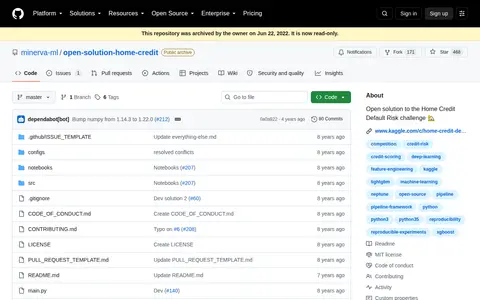
An archived, read-only GitHub repository holding an open solution to the Home Credit Default Risk challenge. It provides code, configs and notebooks plus documented solutions using LightGBM, sklearn and XGBoost with engineered features; the README lists cross-validation and leaderboard scores for each. References to Neptune are optional and the solution can run as a plain Python script.
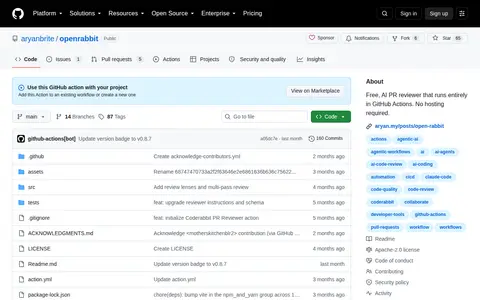
OpenRabbit is a free, open-source, self-hosted GitHub pull request reviewer. It analyzes PR diffs, consults a pluggable LLM provider such as Groq or OpenRouter, and posts a summary with inline comments. It runs entirely in GitHub Actions, so no server or hosting subscription is required, and code stays in the user's runner.
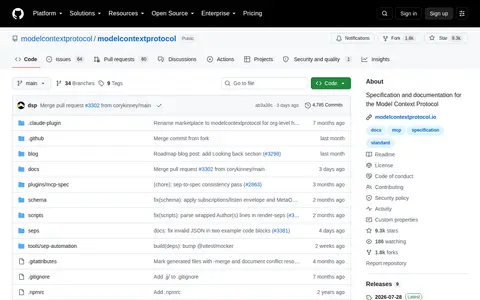
Model Context Protocol - An open standard for connecting AI models to external tools and data sources. MCP Registry.