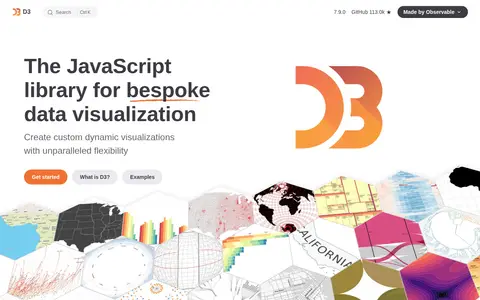

D3.js is a JavaScript library for bespoke data visualization developed by Observable. It enables creation of custom dynamic visualizations with features including selections and transitions, scales and axes, shape rendering, interactive behaviors, layout algorithms, and geographic map projections. The library also powers Observable Plot, a high-level visualization API.
Directory
Search results
Published directory entries matching your search.

Data Science at Home is a podcast about machine learning, artificial intelligence, and algorithms. The site describes it as among the top AI and machine learning podcasts in the world and notes that industry leaders have sponsored its initiative.
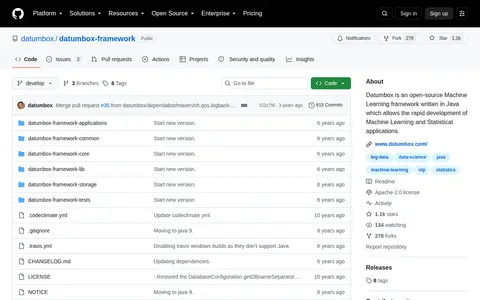
Datumbox is an open-source machine learning framework written in Java for rapid development of machine learning and statistical applications. It focuses on including many machine learning algorithms and statistical methods and on handling large datasets. The code is licensed under the Apache License, Version 2.0, and releases are available on Maven Central, including version 0.8.2.
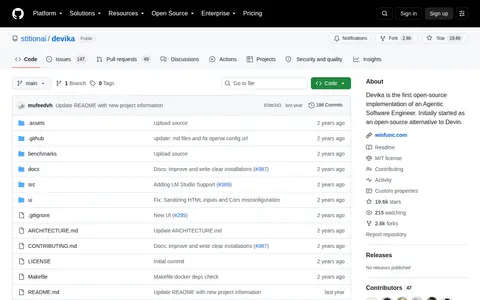
Devika is an open-source implementation of an Agentic Software Engineer, initially started as an alternative to Devin. It uses large language models, planning and reasoning algorithms, and web browsing to develop software from human instructions. The project is in an early experimental stage, and the repository notes that there are unimplemented or broken features.
dCode is a collection of over 900 online tools for solving games, riddles, ciphers, mathematics and puzzles. It offers word game solvers, a cipher identifier recognizing more than 200 ciphers, and tools for codes, alphabets, calculators and algorithms. The site states that it is free.
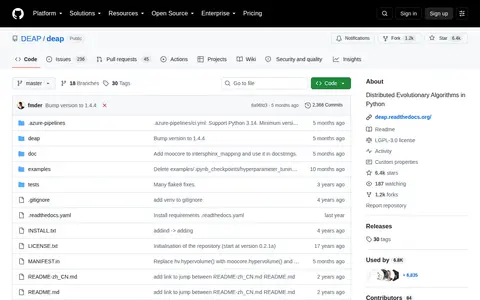
DEAP is an evolutionary computation framework for Python aimed at rapid prototyping and testing of ideas. It provides genetic algorithms over representations such as lists, arrays, sets, dictionaries, trees and Numpy arrays, genetic programming with prefix trees, evolution strategies including CMA-ES, multi-objective optimisation, and co-evolution of multiple populations. It supports parallelisation via multiprocessing and SCOOP and works out of the box with Python 3 since version 0.8.
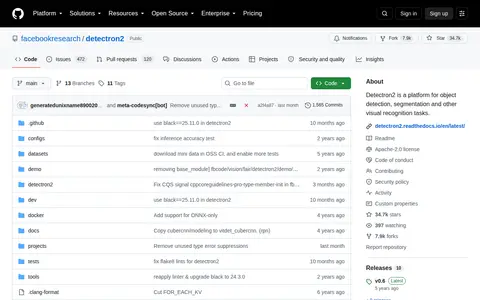
Detectron2 is Facebook AI Research's next generation library providing detection and segmentation algorithms, succeeding Detectron and maskrcnn-benchmark. It supports computer vision research projects and production applications at Facebook and includes capabilities such as panoptic segmentation, Densepose, Cascade R-CNN, rotated bounding boxes, PointRend, DeepLab, ViTDet and MViTv2. Models can be exported to TorchScript or Caffe2 format for deployment.
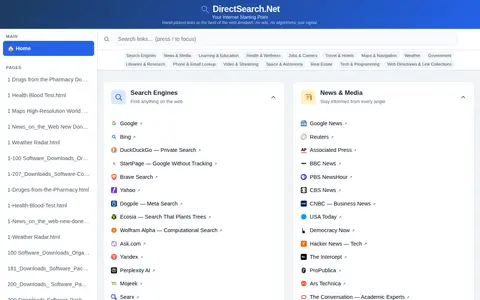
DirectSearch.Net is a hand-curated web directory that provides links to high-quality web content across categories including search engines, news, learning resources, health information, job listings, travel content, maps and additional topics. The service does not display advertisements and does not use algorithms to sort or select its listed links.
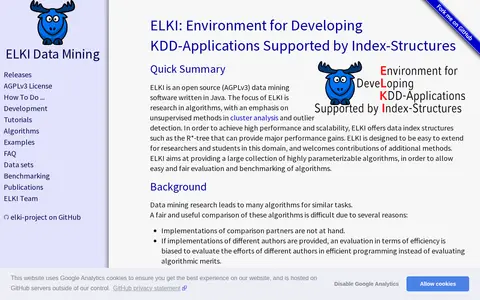
ELKI is an open source data mining software written in Java. It focuses on research in algorithms, emphasizing unsupervised methods in cluster analysis and outlier detection, and offers data index structures for performance and scalability. It is designed for researchers and students to extend.
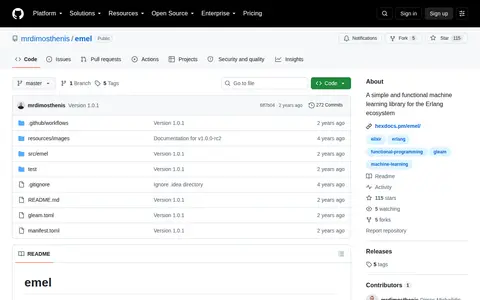
emel is a simple and functional machine learning library built for the Erlang ecosystem and implemented in Gleam. It turns data into functions and supports installing through rebar.config, mix.exs or gleam add. Implemented algorithms include linear regression, k nearest neighbors, decision tree, naive Bayes, k means, perceptron, logistic regression and neural network, along with mathematics, algebra, geometry and statistics.
Fediverse.Party is a guide to decentralized, autonomous networks running free open software on servers worldwide. It presents federated platforms including Friendica, Lemmy, Mastodon, PeerTube, Pleroma, Funkwhale, Hubzilla, Misskey, Pixelfed and diaspora. The site states there are no ads and no algorithms.
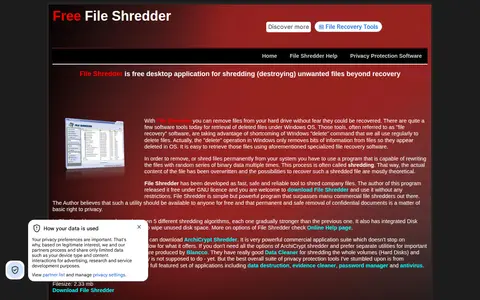
File Shredder is a free desktop application for shredding unwanted files beyond recovery. It offers five shredding algorithms and an integrated Disk Wiper that uses a shredding algorithm to wipe unused disk space. It runs on Windows NT through Windows 10 and is released under the GNU/GPL license for personal and commercial use.
The Front End Interview Handbook provides free interview preparation resources for busy engineers, including quiz questions, JavaScript coding questions, algorithms questions and front end system design questions. The content is updated for 2026 and is community-vetted. The site states it is completely free to read.
Efficient pure-Matlab implementations of graph algorithms to complement MatlabBGL's mex functions.
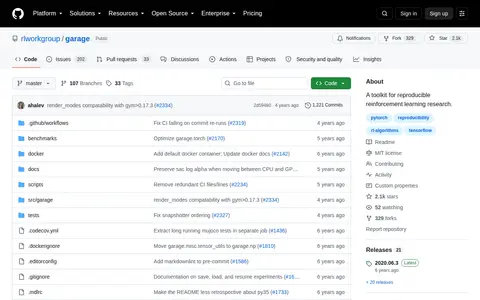
Garage is a toolkit for developing and evaluating reinforcement learning algorithms, with an accompanying library of implementations built using it. The toolkit offers modular tools including composable neural network models, replay buffers, high-performance samplers, an experiment definition interface, reproducibility tools, logging including TensorBoard, checkpointing and resuming, and environment interfaces.
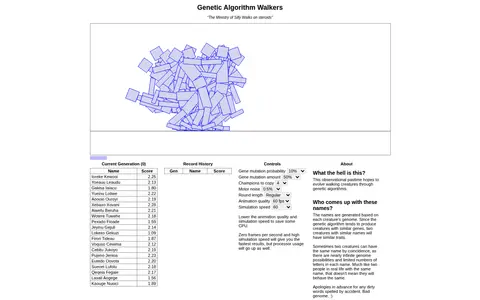
HTML5 interactive web tool that evolves biped walker creatures using genetic algorithms. Users can adjust parameters including mutation probability, animation quality, and simulation speed to observe how creatures develop walking traits across generations. Creature names are generated from their genomes, and scoring rewards upright walking and forward progress.
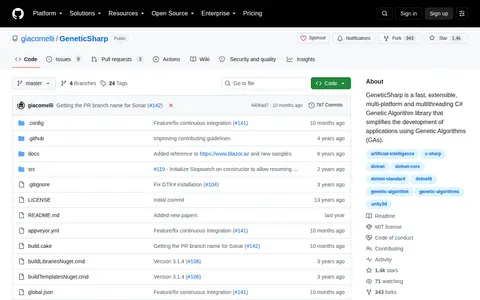
GeneticSharp is a C# genetic algorithm library described as fast, extensible, multi-platform and multithreading, intended to simplify development of applications using genetic algorithms. The source states it can be used in .NET 6, .NET Standard and .NET Framework apps, including ASP.NET MVC, ASP.NET Core, Blazor, Web Forms, UWP, Windows Forms, GTK#, Xamarin, MAUI and Unity3D games.
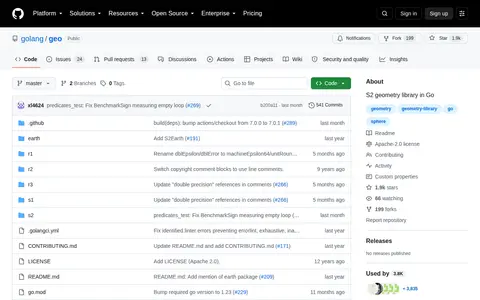
S2 is a Go library for spherical geometry. It provides representations of angles, intervals, latitude-longitude points and unit vectors, geometric shapes over the unit sphere such as caps, rectangles, polylines and polygons, a hierarchical cell decomposition, constructive operations and predicates, in-memory indexing, distance algorithms and snapping and simplification. Planar geometry and conversions to common GIS formats are outside its scope.
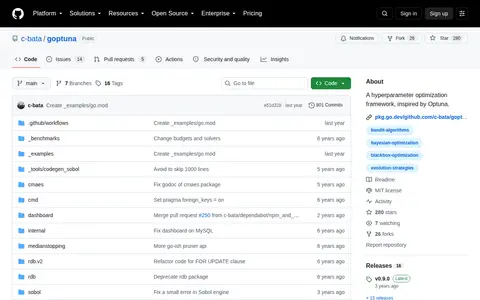
Goptuna is a hyperparameter optimization framework inspired by Optuna, written in pure Go. It provides Bayesian optimization, evolution strategies and multi-armed bandit algorithms, including random search, TPE, CMA-ES variants, ASHA and Sobol sampling. It supports a Define-by-Run style API for dynamically constructing search spaces and offers RDB storage for continuing optimizations and scaling studies across workers.
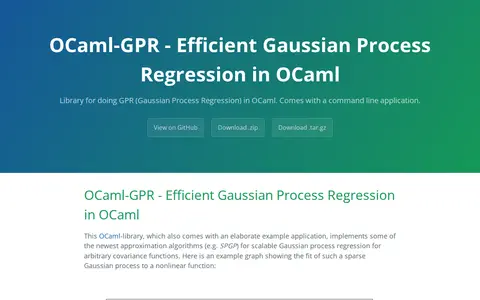
OCaml-GPR is an OCaml library for Gaussian process regression that includes a command line application and an example application. It implements approximation algorithms for scalable regression with arbitrary covariance functions.
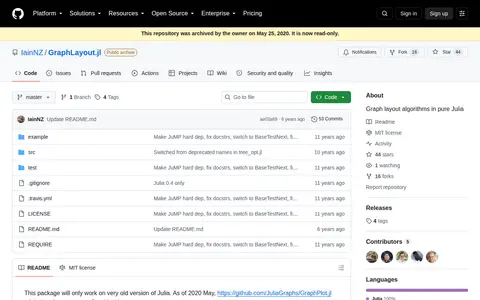
Graph layout algorithms in pure Julia.
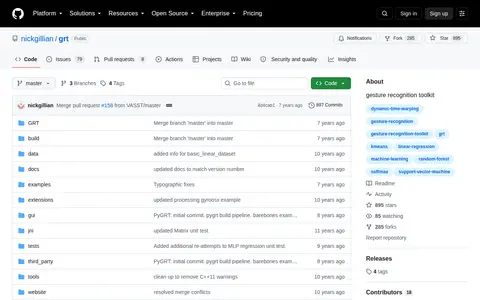
GRT (Gesture Recognition Toolkit) is an open-source project hosted on GitHub. It provides core algorithms, extensions, and related utilities for gesture recognition, with documented architecture and core resources available in the repository.
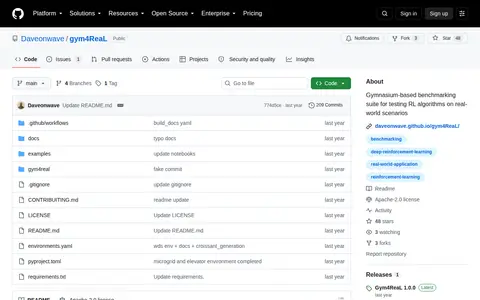
Gym4ReaL is an open-source GitHub repository maintained by Daveonwave. It is a Gymnasium-based benchmarking suite for testing reinforcement learning algorithms on real-world scenarios. The repository includes documentation on supported characteristics, reinforcement learning paradigms, folder structure, contribution guidelines, and licensing terms.
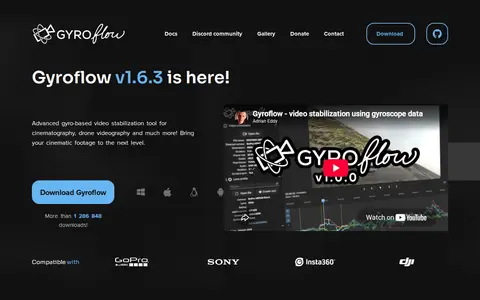
Gyroflow is a gyro-based video stabilization tool for cinematography and drone footage. It corrects lens distortion and includes customizable smoothing algorithms with horizon leveling, supports gyro data from several camera and drone sources, and offers realtime preview, GPU processing and plugins for DaVinci Resolve and Adobe.