
github.com
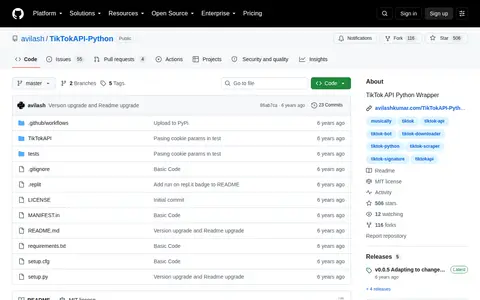
TikTok API Python Wrapper
Directory
Published directory entries matching your search.
TikTok API Python Wrapper

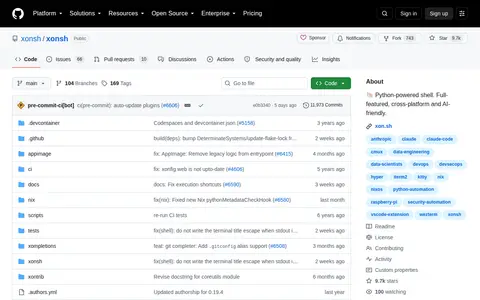
Xonsh is a full-featured, cross-platform Python-based shell whose language is a superset of Python 3 with shell functionality and commands. It runs on Linux, macOS, Windows, BSD, Jupyter, Android, Raspberry Pi and Nix, and has an extension system called xontribs.

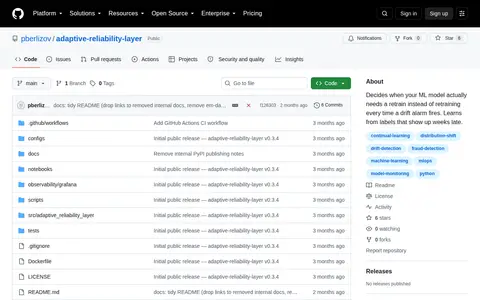
Adaptive Reliability Layer is a Python project that sits between an inference pipeline and a monitoring layer. It detects distribution shift, decides whether adaptation is warranted, and learns from delayed revealed labels. It does not replace the model.

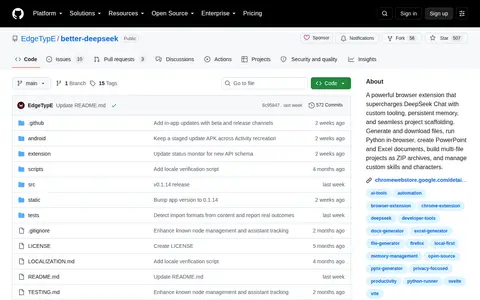
Better DeepSeek is an open-source browser extension that adds tools to the DeepSeek chat interface, including a customizable system prompt, persistent memory, and tag-based output. It can generate downloadable files, PowerPoint and Excel documents, and multi-file ZIP projects, and run Python in the browser. The project is described as unofficial and independent.

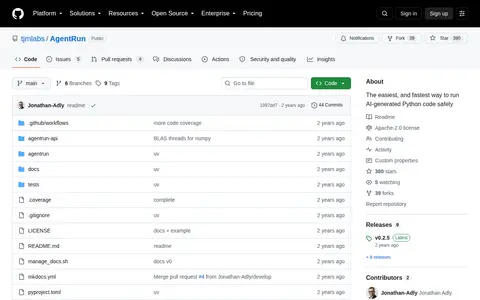
The easiest, and fastest way to run AI-generated Python code safely.

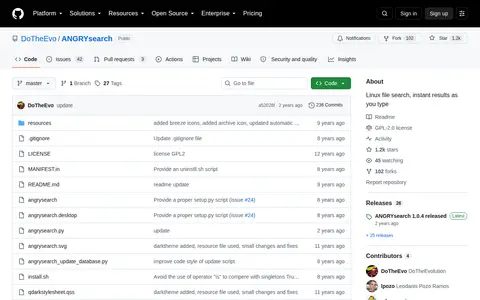
ANGRYsearch is a Linux file search tool that returns instant results as you type, written in Python 3 with a PyQt5 GUI. It offers lite and full modes, and fast, slow and regex search modes. The database and config files are stored locally; indexing about one million files can take roughly two minutes.

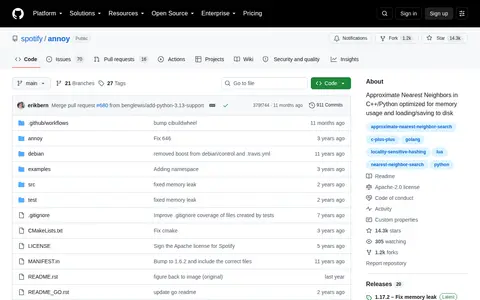
Annoy is a C++ library with Python bindings for approximate nearest neighbor search. It creates large read-only file-based indexes that are mmapped into memory so many processes can share the same data. Supported distances include Euclidean, Manhattan, cosine, Hamming and dot product.

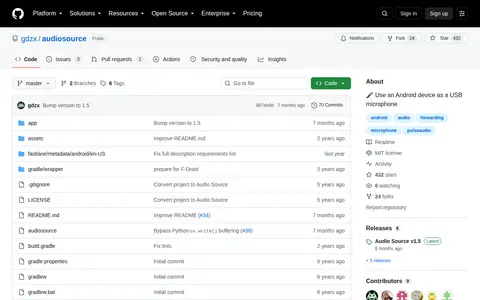
Audio Source is a tool that forwards Android microphone audio input to the PulseAudio daemon through ADB, allowing an Android device to be used as a USB microphone. It consists of an Android app and a client script for a GNU/Linux machine with Android SDK Platform Tools, PulseAudio or PipeWire with PulseAudio support, and Python 3.

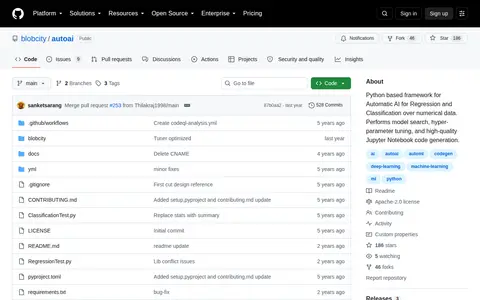
autoai is an open-source Python framework for automatic artificial intelligence focused on regression and classification tasks over numerical data. It automates model search, hyper-parameter tuning, and generates high-quality Jupyter Notebook code for resulting models.

AutoKeras is an AutoML library for deep learning built on Keras, developed by DATA Lab at Texas A&M University. The project describes its goal as making machine learning accessible to everyone. It can be installed with pip, and the documentation states it is currently only compatible with Python 3.7 or later and TensorFlow 2.8.0 or later.

AutoKey is a desktop automation utility for Linux and X11, formerly hosted on Google and updated to run on Python 3. It is an X11 application and will not function correctly when Wayland is used instead of Xorg. The project offers scripting, phrases, and mouse and keyboard control features documented in its wiki.

AutoViz is a Python library that automatically visualizes any dataset, any size, with a single line of code. It also offers the FixDQ() function for a quick assessment of dataset quality and fixing data quality issues. The project aims to provide an automated approach to exploratory data analysis through quick and easy data visualization plus data quality, abstracting away the complexities of various plotting libraries and techniques.

A GitHub repository listing packages, services and manuals related to web scraping. It covers libraries for Python, PHP, Ruby, JavaScript and Go, command line tools, and web-scraping manuals. It also lists headless browsers, DNS over HTTPS providers, pastebin sites, tunneling software and captcha solving services.

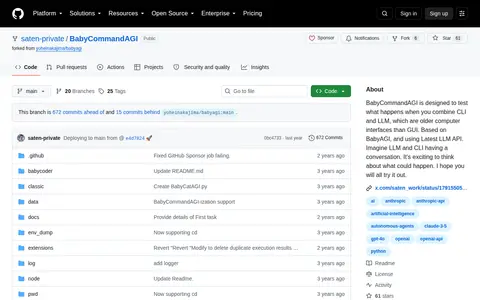
BabyCommandAGI is a Python script system based on BabyAGI that is designed to test combining CLI and LLM interfaces, with the thinking part of BabyAGI greatly simplified to execute commands efficiently. The README warns that it may unintentionally destroy the environment, recommends running it in a virtual environment such as Docker, and recommends Claude 3.7 Sonnet or higher.

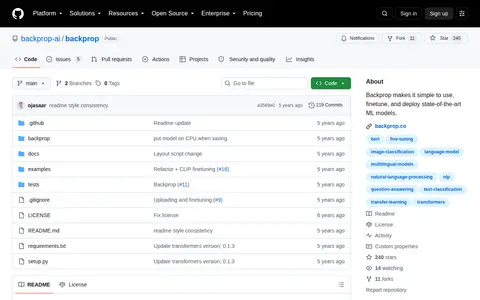
Backprop is a Python library, installable via PyPi, that enables use, finetuning and deployment of machine learning models. It provides task interfaces for conversational question answering, text classification in over 100 languages, image classification, summarisation, emotion detection and text generation, and models can be finetuned with a single line of code.

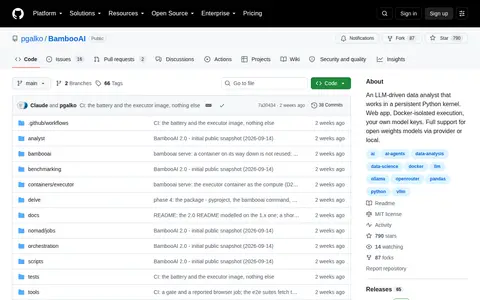
BambooAI is an LLM-driven data analyst tool that operates in a persistent Python kernel. It is available as a web app with Docker-isolated execution, supports user-provided model keys, and is compatible with open weights models via provider or local deployment.

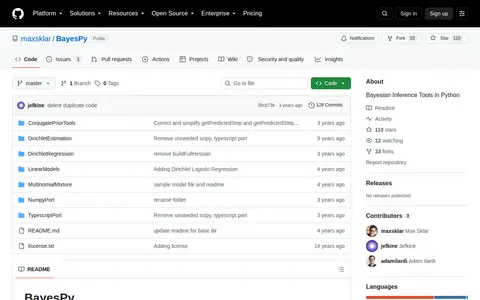
BayesPy is an open-source Python library that provides tools for performing Bayesian inference. It is hosted as a public repository on GitHub where users can access the code and contribute to its development.

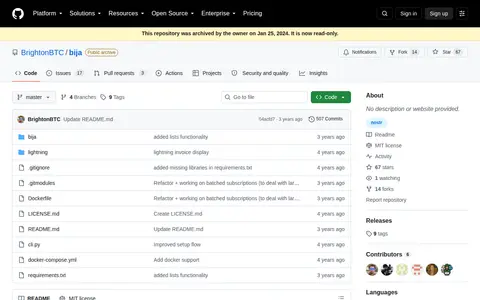
) - A desktop client written in python. Currently Linux only

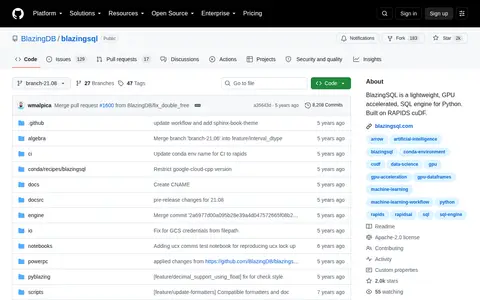
A lightweight, GPU accelerated, SQL engine for Python. Built on RAPIDS cuDF.

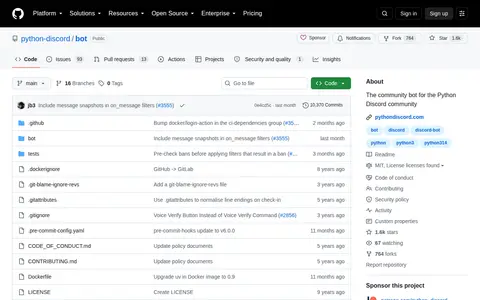
The community bot for the Python Discord community

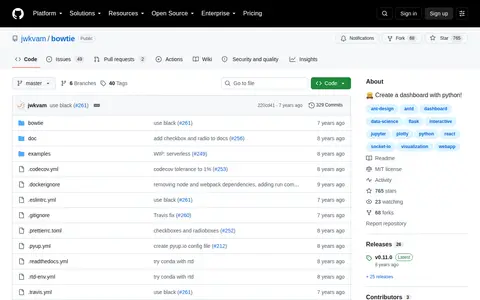
Bowtie is a library for writing dashboards in Python. It wraps the code needed for interactive data exploration and visualization, so users can build functionality without knowing web frameworks or JavaScript. It can be installed with conda or pip, and Docker images are provided.

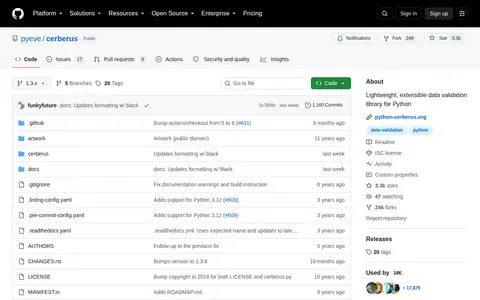
Cerberus is a lightweight and extensible data validation library for Python. It provides type checking and other base functionality out of the box, is designed to be non-blocking and extensible for custom validation, and has no dependencies. It is available on PyPI and maintained according to semantic versioning since version 1.2.

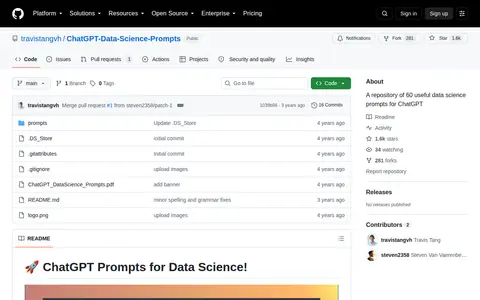
ChatGPT Prompts for Data Science is a GitHub repository containing 60 useful prompts for data science tasks. It includes prompts for writing Python code, automatic machine learning, and other data science workflows.

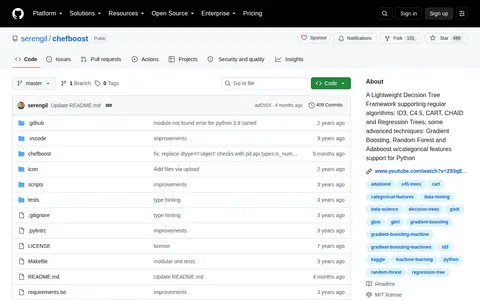
ChefBoost is a lightweight decision tree framework for Python. It supports standard algorithms including ID3, C4.5, CART, CHAID and regression trees, as well as advanced techniques such as gradient boosting, random forest and Adaboost, with support for categorical features.