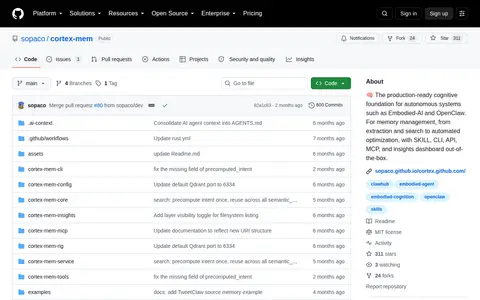

Cortex Memory is a production-ready cognitive foundation for autonomous systems such as Embodied-AI and OpenClaw. It provides memory management functionality including extraction, search, and automated optimization, and includes SKILL, CLI, API, MCP, and an insights dashboard out-of-the-box.
Directory
Search results
Published directory entries matching your search.

Find and access early modern history research data, with indexed datasets.
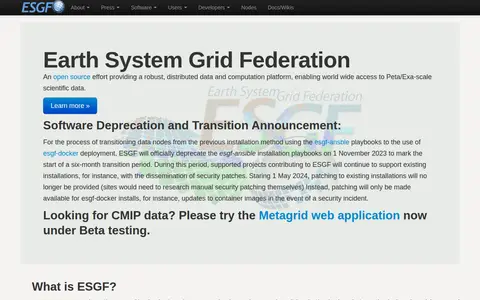
The Earth System Grid Federation is an open source collaboration that develops, deploys and maintains software infrastructure for managing, disseminating and analysing model output and observational data. Its peer-to-peer system serves climate data from multiple locations, including model simulations, satellite observations and reanalysis products. The project also states that the esgf-ansible installation playbooks were deprecated on 1 November 2023.
Browse research datasets and datasets related to early modern history.
The Health Atlas is the Local Data Hub/Leipzig, a registered repository listing scientific projects, publications, models and data files. It gathers algorithm-based predictions, simulation models, geo data and phenotype definitions for research purposes, and holds datasets from different areas of medicine. The site states it is now a product of NFDI4Health.
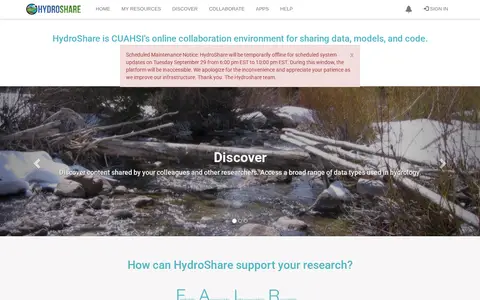
HydroShare is CUAHSI's online collaboration environment for sharing hydrologic data, models, and code. Users upload files through a web interface, describe them with metadata, choose who can access them, and can obtain Digital Object Identifiers for citation. The platform also offers a REST web service API and Python client, and web apps for visualizing, analyzing, and running models.
Research data portal for exploring early modern history records, including dataset.
Userscript that adds external media-site shortcuts and search links to IMDb title pages.
JamStart is a music theory and ear-training tool that works with Spotify playlists. It provides key, mode, BPM, chord charts, scale charts and circle-of-fifths information for songs, and allows filtering songs by key or mode. Users can search a database and view or edit playlists.
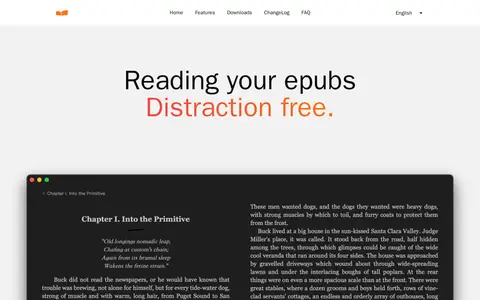
Jane Reader is an epub reader for macOS and Windows with a library for managing ebooks. It offers automatic light/dark mode, six color themes, one- or two-column layouts, built-in fonts, customizable margins, line height and font size, saved reading locations and window sizes, chapter and page numbers, and a vertical mode for Chinese and Japanese. The software is in beta.
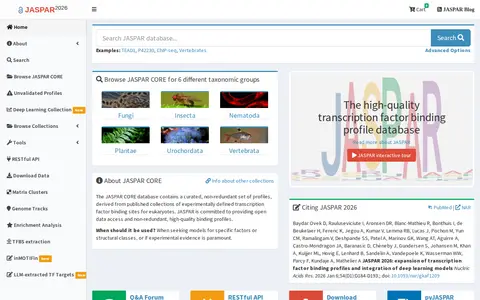
JASPAR is an open-access database of curated, non-redundant transcription factor binding profiles from six taxonomic groups. It stores manually curated binding preferences as position frequency matrices that can be converted into models for scanning DNA sequences and predicting transcription factor binding sites. From 2026 it also stores deep learning models and discovered position frequency matrices linked to its PFM collections.
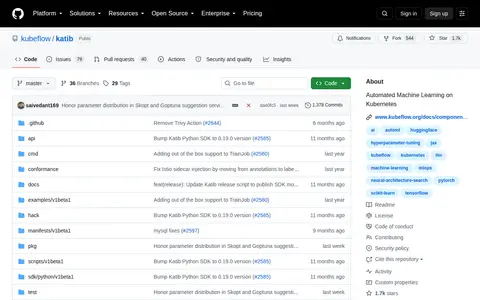
Kubeflow Katib is a Kubernetes-native project for automated machine learning (AutoML). It supports hyperparameter tuning, early stopping and neural architecture search, and is agnostic to machine learning frameworks, natively supporting frameworks such as TensorFlow, PyTorch and XGBoost. Training jobs can use any Kubernetes Custom Resources, with out-of-box support for Kubeflow Training Operator, Argo Workflows and Tekton Pipelines. A Python SDK simplifies creating tuning jobs.
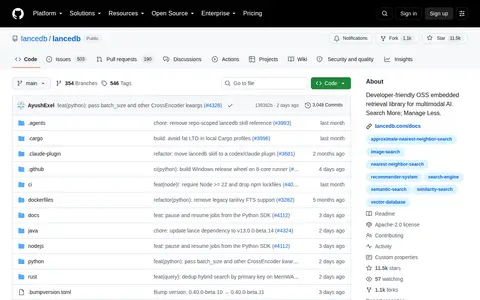
LanceDB is a developer-friendly open-source embedded retrieval library for multimodal AI. It emphasizes searching more and managing less. The project tagline is 'Search More; Manage Less.' It is available on GitHub.
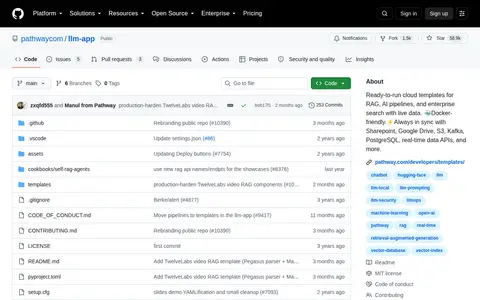
LLM App is an open-source project providing ready-to-run cloud templates for retrieval-augmented generation (RAG), AI pipelines and enterprise search with live data. It is Docker-friendly and designed to stay synchronized with data sources including Sharepoint, Google Drive, S3, Kafka, PostgreSQL and real-time data APIs, hosted by pathwaycom on GitHub.
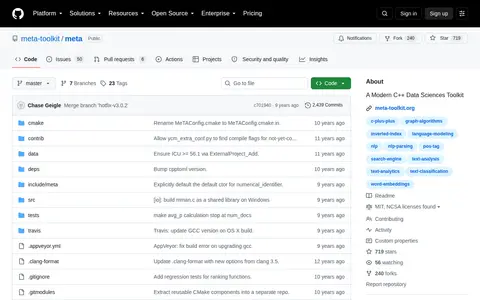
MeTA is a modern C++ data sciences toolkit. It provides text tokenization including deep semantic features like parse trees, inverted and forward indexes with compression and caching strategies, ranking functions for searching indexes, topic models, classification algorithms, graph algorithms, language models, a CRF implementation for POS-tagging and shallow parsing, and wrappers for liblinear and libsvm.
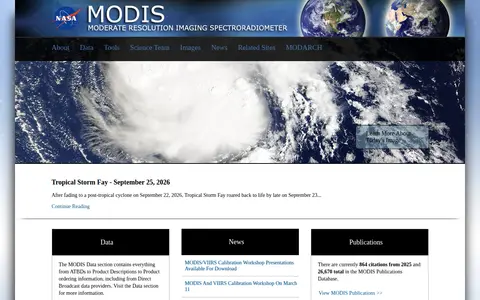
MODIS Web is NASA's portal for the Moderate Resolution Imaging Spectroradiometer. It lists data products for atmosphere, land, cryosphere and ocean, along with tools, publications, images and news, and links to product descriptions and ordering information.
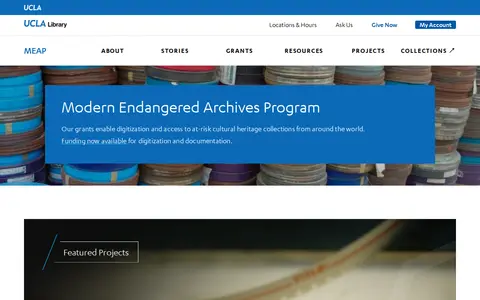
The Modern Endangered Archives Program provides grants for digitization and access to at-risk cultural heritage collections worldwide. It offers Planning, Project, and Regional Grants, with a ninth round of funding open; preliminary applications are due November 16, 2026. Grants aim to keep collections available for community needs, research, and instruction.
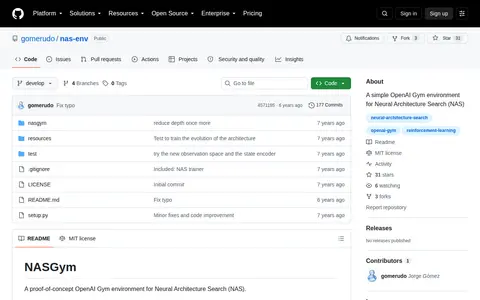
NASGym is a proof-of-concept OpenAI Gym environment for Neural Architecture Search. It implements reinforcement learning steps for NAS and encodes networks using the Neural Structure Code from BlockQNN. A network is modeled as a list of NSCs, an action adds a layer, and the reward is accuracy after early-stop training. CIFAR-10 is the default dataset. The code and documentation may contain minor bugs.
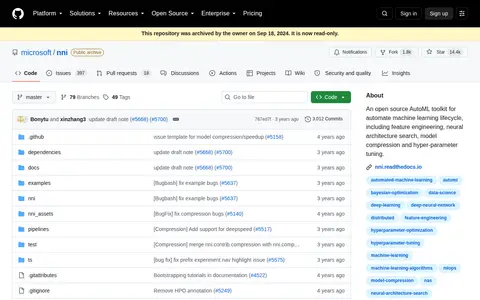
NNI is an open source AutoML toolkit developed by Microsoft. It automates tasks across the machine learning lifecycle, including feature engineering, neural architecture search, model compression and hyper-parameter tuning for machine learning workflows.
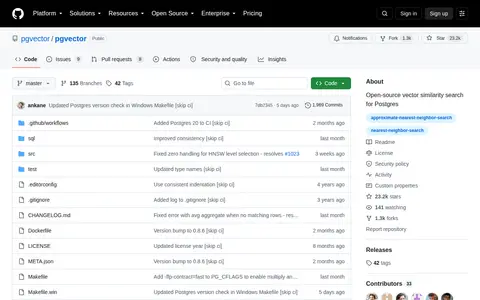
Open-source vector similarity search for Postgres.
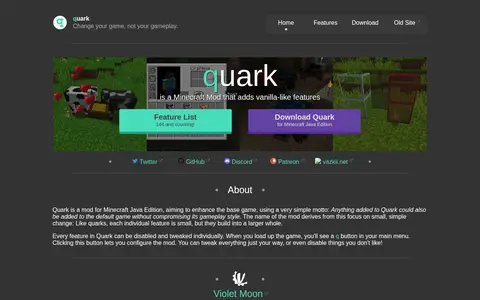
Quark is a mod for Minecraft Java Edition that adds vanilla-style features. Each feature can be disabled and tweaked individually, and the mod is configured through a q button in the main menu. The project lists features such as inventory sorting, hotbar swapping, auto-walk, chest searching and crafting helper.
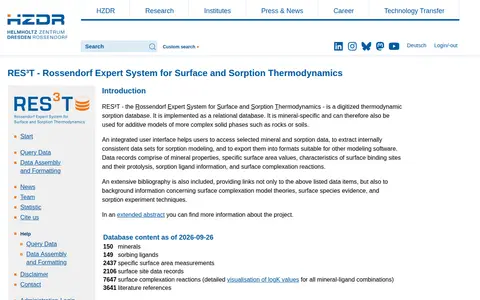
RES³T is a digitized thermodynamic sorption database implemented as a relational database. It is mineral-specific, allowing use with additive models of more complex solid phases such as rocks or soils. An integrated user interface lets users access selected mineral and sorption data, extract internally consistent data sets for sorption modeling, and export them in formats for other modeling software.
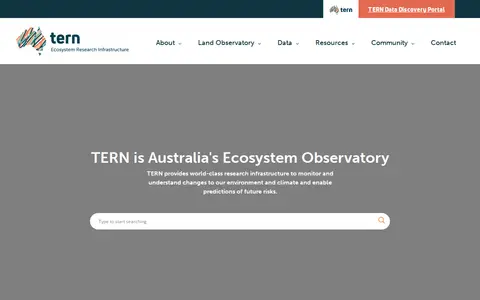
TERN is Australia's Terrestrial Ecosystem Research Network. It provides model-ready terrestrial ecosystem data for research and describes itself as Australia's Ecosystem Observatory. Its Data Discovery Portal supports discovery, access and reuse of datasets from TERN observatory measurements, including site surveys, remote sensing, model-derived and in-situ sensor data. Data infrastructure includes a cloud-based virtual desktop and tools for data submission and landscape-scale dataset analysis.
An illustrated explainer article on VQGAN, describing how the model generates images from text at a conceptual level and how VQGAN and CLIP work in tandem. It covers a theory of perception, using transformers to model interactions, expressing images through a codebook, and training the GAN and transformer.