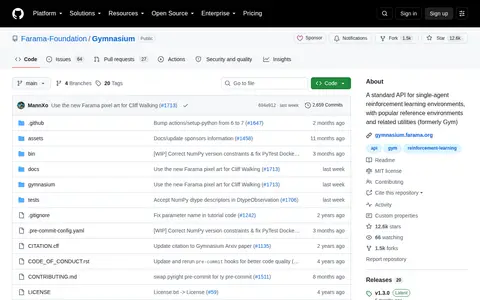

Gymnasium is an open source Python library for developing and comparing reinforcement learning algorithms. It provides a standard API between learning algorithms and environments, plus reference environments including Classic Control, Box2D, Toy Text, MuJoCo and Atari. It is a fork of OpenAI's Gym library maintained by its maintainers.
Directory
Search results
Published directory entries matching your search.
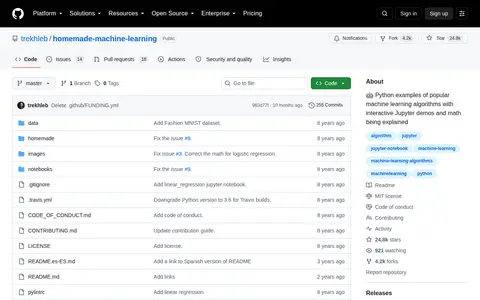
Python examples of popular machine learning algorithms with interactive Jupyter demos and math being explained.
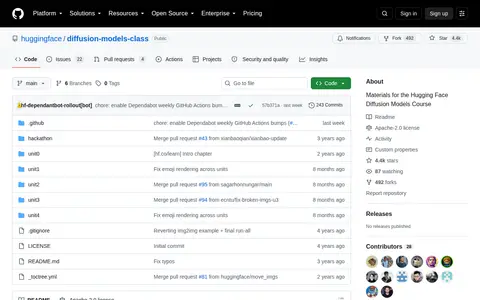
Materials for the Hugging Face Diffusion Models Course, a free course on diffusion models. It covers theory, generating images and audio with Diffusers, training and fine-tuning models, and conditional generation. Prerequisites include Python skills and basics in deep learning and PyTorch.
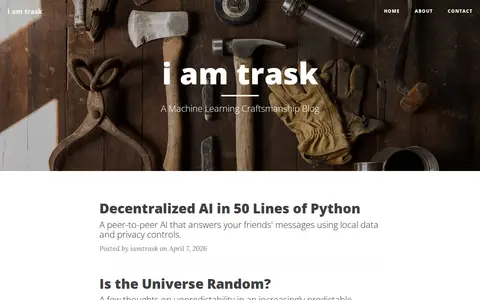
I am trask is a machine learning craftsmanship blog. Posts listed include Decentralized AI in 50 Lines of Python, Is the Universe Random?, Safe Crime Detection, Deep Learning without Backpropagation and Building Safe A.I.
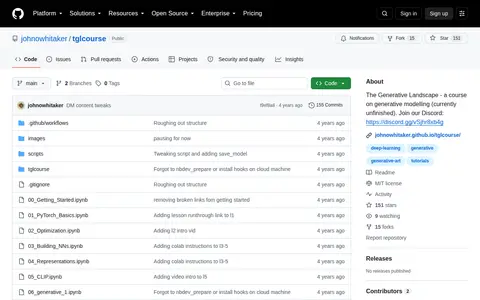
A course on generative modelling, currently unfinished, with the first approximately five lessons mostly done. It covers topics such as PyTorch basics, representations, CLIP, GANs, sequence modelling and transformers. No prior deep learning knowledge is assumed, though comfort with some Python and Jupyter Notebooks is expected.
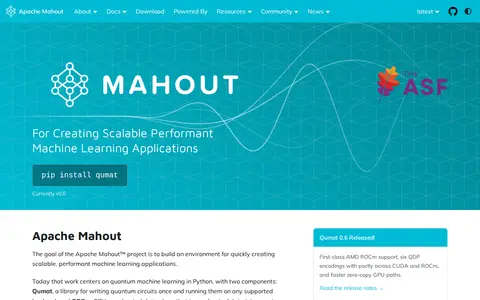
Apache Mahout builds an environment for quickly creating scalable, performant machine learning applications. Its current work centers on quantum machine learning in Python, with Qumat, a high-level library for writing quantum circuits once and running them on supported backends, and QDP, a GPU-accelerated engine that turns classical data into quantum states. The earlier Mahout Classic codebase is in maintenance mode.
mlpack is a header-only C++ machine learning library with bindings to Python, Julia, R, Go, and the command line. It is built on Armadillo, ensmallen, and cereal and provides implementations of machine learning algorithms. The documentation lists classification, regression, clustering, and preprocessing facilities. It is open source under the 3-clause BSD license.
modAL is a modular active learning framework designed for use with the Python programming language. The project includes introductory documentation, overviews of active learning concepts, usage examples, and quickstart guides. It is hosted as an open source repository on GitHub.
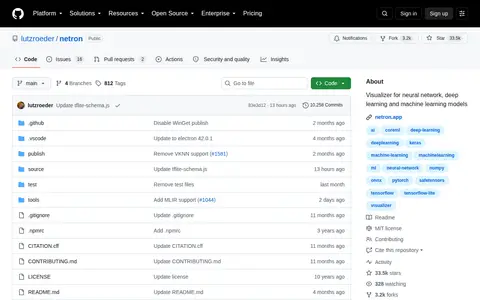
Netron is a viewer for neural network, deep learning and machine learning models. It supports formats including ONNX, TensorFlow Lite, PyTorch, TensorFlow, Core ML, OpenVINO, Keras, Caffe, Darknet, Safetensors and NumPy. It is available as a browser version and installers for macOS, Linux and Windows, plus a Python package. Experimental support exists for MLIR, JAX, GGUF and other formats.
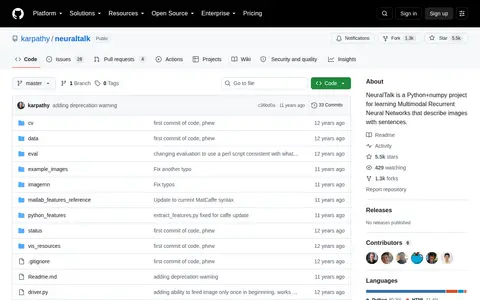
NeuralTalk is a Python+numpy project for learning Multimodal Recurrent Neural Networks that describe images with sentences.
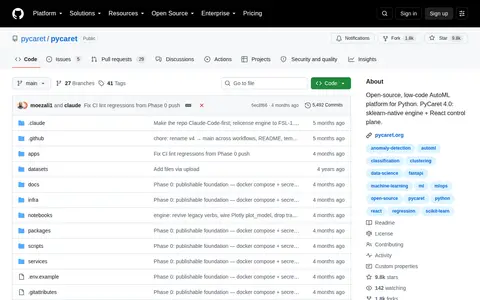
Open-source, low-code machine learning library in Python that automates machine learning workflows.
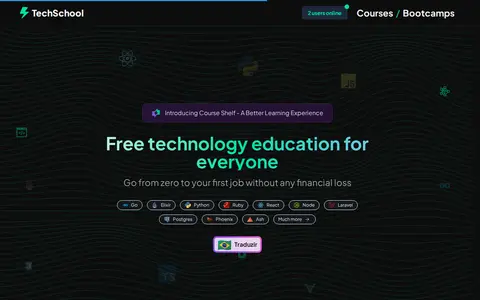
TechSchool is a free and open-source platform for learning programming, covering topics such as Elixir, Python, Ruby, React, Node and Postgres. It states a mission of making technology education accessible for free and links a Discord community, GitHub and sponsorship options.
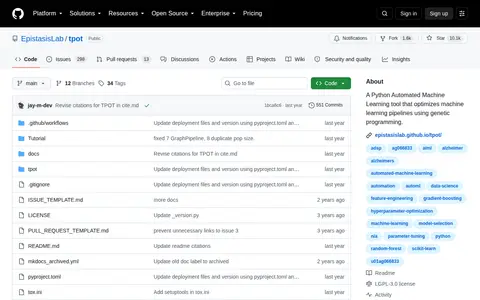
TPOT (Tree-based Pipeline Optimization Tool) is a Python automated machine learning tool that optimizes machine learning pipelines using genetic programming. The project underwent a major refactoring, merging what was once called TPOT2 into the main package, with new features including genetic feature selection, multi-objective optimization and an expanded method of defining search spaces.
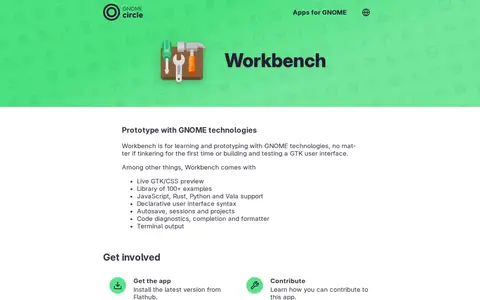
A GNOME application for learning and prototyping with GNOME technologies, from first tinkering to building and testing a GTK user interface. It includes live GTK/CSS preview, a library of over 100 examples, support for JavaScript, Rust, Python and Vala, declarative UI syntax, autosave, sessions and projects, code diagnostics and terminal output.
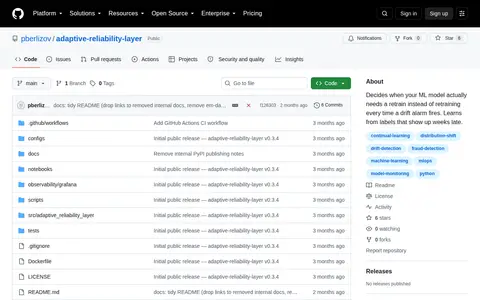
Adaptive Reliability Layer is a Python project that sits between an inference pipeline and a monitoring layer. It detects distribution shift, decides whether adaptation is warranted, and learns from delayed revealed labels. It does not replace the model.
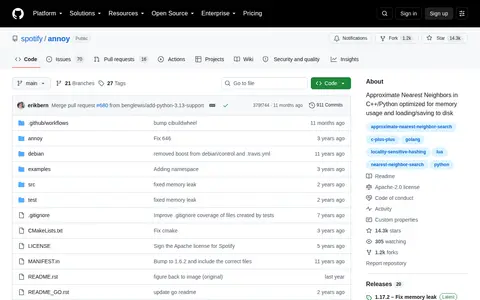
Annoy is a C++ library with Python bindings for approximate nearest neighbor search. It creates large read-only file-based indexes that are mmapped into memory so many processes can share the same data. Supported distances include Euclidean, Manhattan, cosine, Hamming and dot product.
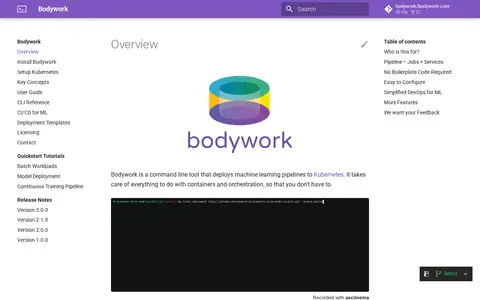
Bodywork is a command line tool that deploys machine learning pipelines to Kubernetes, handling containers and orchestration. Any pipeline stage runs either a batch job or a long-running process. It is presented as a lightweight alternative to Kubeflow or building a platform around workflow tools such as Apache Airflow, Argo Workflows or Dagster. Stages are defined as Python modules or Jupyter notebooks and configured in a single bodywork.yaml file.
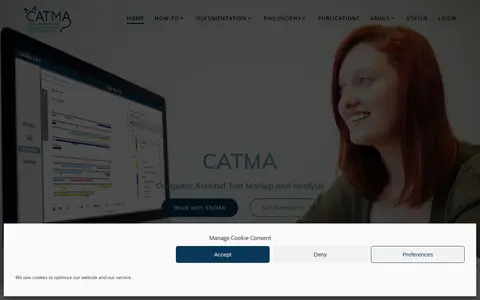
CATMA (Computer Assisted Text Markup and Analysis) is a free, browser-based tool for annotating, analyzing, interpreting and visualizing text. It supports collaborative project work, custom tagset creation, and offers TEI-XML export, Git access, a GitMA Python package, and a JSON API for data access. Users can generate interactive visualizations including word clouds and distribution graphs.
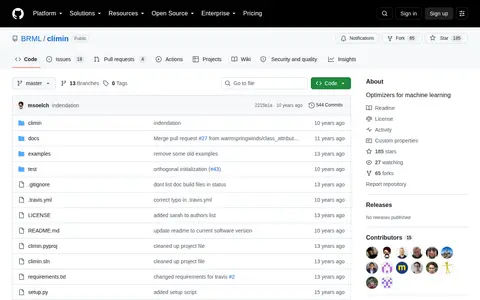
climin is a Python package for optimization that is heavily biased toward machine learning scenarios, distributed under the BSD 3-clause license. It works on top of numpy and partially gnumpy, and was started in winter 2011 by Christian Osendorfer and Justin Bayer.
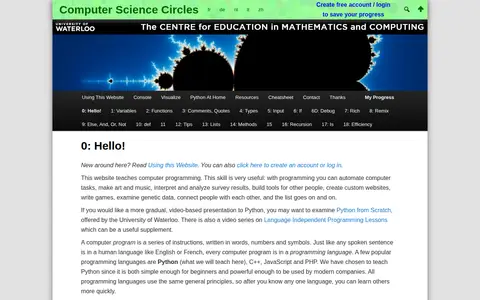
Computer Science Circles is a website that teaches computer programming using Python. It presents lessons and exercises in which users write programs and run them to check the results. The site states that programming can be used to automate computer tasks, make art and music, and create websites and games. Accounts can be created to log in.
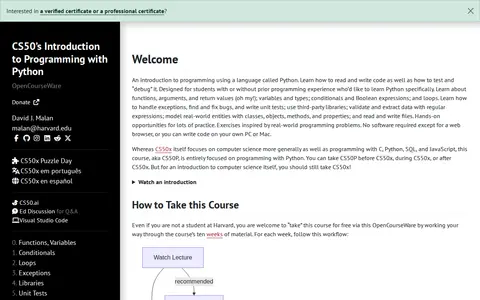
An introductory course on programming with Python. It covers reading and writing code, testing and debugging, functions, variables, conditionals, loops, exceptions, unit tests, third-party libraries, regular expressions, classes and file handling. It is designed for students with or without prior programming experience. The course's ten weeks of material are available free via OpenCourseWare.
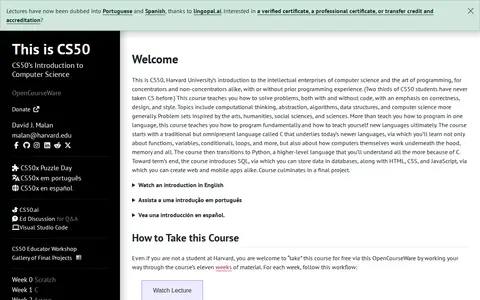
CS50 is Harvard University's introduction to computer science and programming, intended for students with or without prior experience. It covers computational thinking, abstraction, algorithms and data structures, and programming in C, then Python, and later SQL, HTML, CSS and JavaScript, ending with a final project. The material is available free online through OpenCourseWare over eleven weeks.
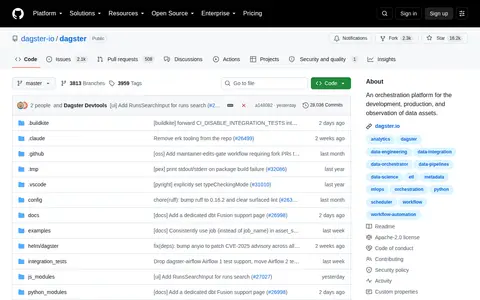
Dagster is an open source, cloud-native data pipeline orchestrator for the data development lifecycle, with integrated lineage and observability. Users declare data assets as Python functions, and Dagster runs them and keeps assets up to date. It is designed for developing and maintaining data assets such as tables, data sets, machine learning models, and reports.
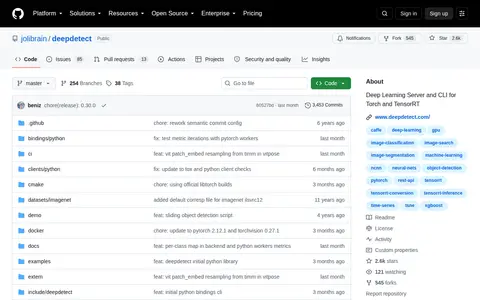
DeepDetect is a deep learning runtime, command-line tool and REST server for training and inference. It provides Python wheel variants for CPU and GPU environments and a command-line interface with profiles such as object detection and semantic segmentation. YAML configuration files make runs repeatable. It handles images, text, tabular data, time series, object-detection boxes and segmentation masks through a single API surface.